
#FactCheck: AI-Generated Video Falsely Shared as French Police’s ‘Pig Squad’ to Tackle Protesters
Executive Summary
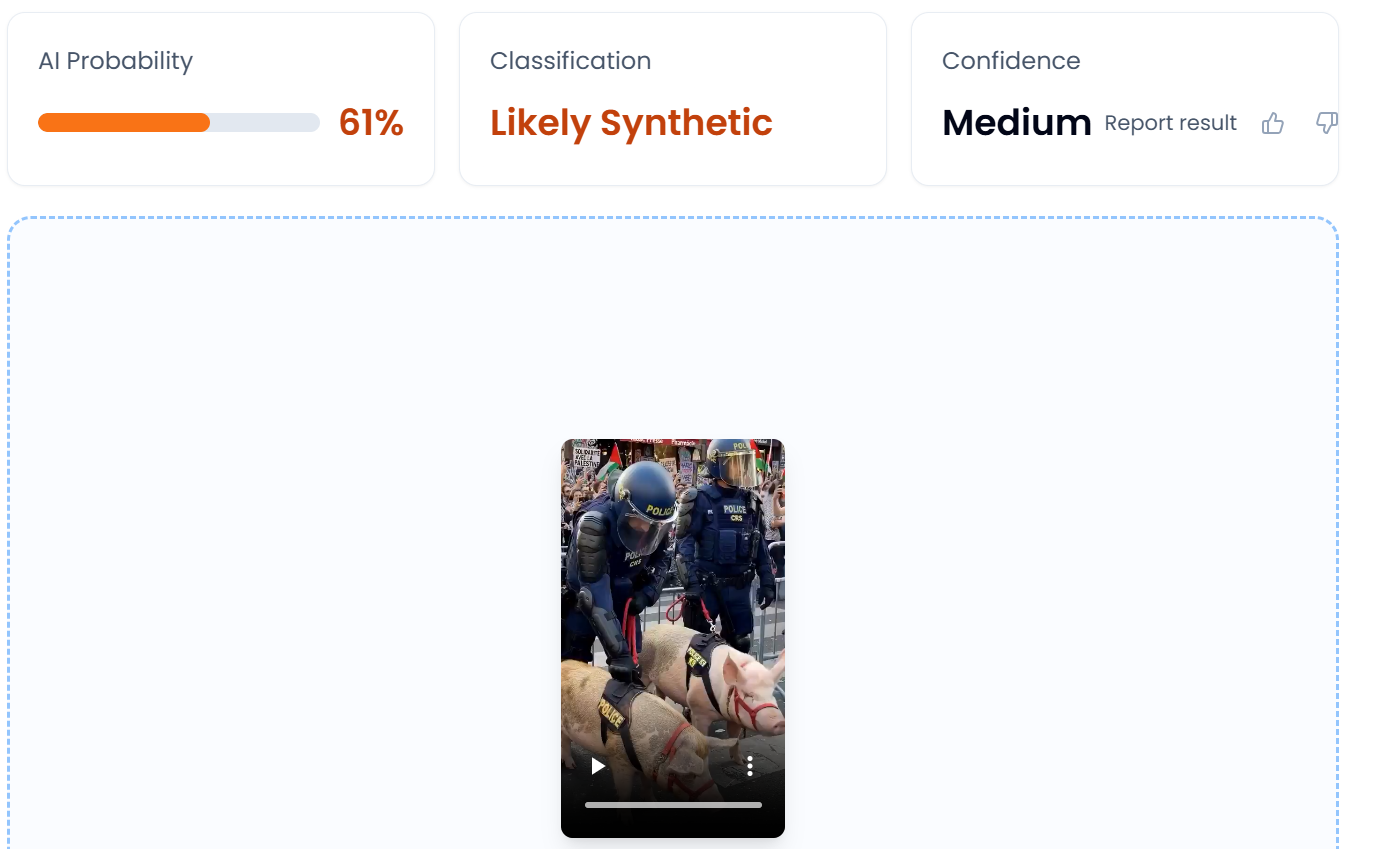
A video is being shared on social media with the claim that French police have formed a “Pig Squad” to deal with protesters. In the video, police personnel can be seen holding several pigs in their hands, with straps bearing the word “Police” visible on them. Social media users are sharing the video claiming that the French police have adopted a new method to deal with protesters. CyberPeace Research found that the viral video is not authentic but AI-generated and is being shared with a misleading claim.
Claim
A user shared the video with the caption: “French police are ready for the ‘protest’ in ‘Paris’ tomorrow! We have heard of a dog squad, but this is the first time I’m seeing a ‘pig squad’!”
https://x.com/Kumar1975Rajesh/status/2113566258247651403

Fact Check
Upon closely examining the video, we noticed several inconsistencies. For instance, the word “Police” written on the officers’ helmets keeps changing as the video plays. In addition, some posters can be seen in the background behind the police personnel, but the text on them keeps changing and is often unclear. Such inconsistencies are commonly seen in AI-generated content.
As part of our research, we scanned the video using the AI detection tool Undetectable AI. According to the results, the viral video is AI-generated.

As part of our research, we scanned the viral video using an AI detection tool. According to the results, the viral video is 61 per cent likely to be AI-generated.
Conclusion
Our research found that the viral video is not authentic but AI-generated and is being shared with a misleading claim.

Related Blogs

The Digital Covenant: Aligning Communication with SDG Goals
“Rethinking Communication, Cyber Responsibility, and Sustainability in a Connected World”
Introduction
It is rightly said by Antonio Guterres, United Nations Secretary General, “Everyone should be able to express themselves freely without fear of attack. Everyone should be able to access a range of views and information sources.” In 2024, when the Global Alliance for PR and Communication Management asserted that it aligns with the era of digital transformation, where technology is moving at terminal velocity and bringing various risks and threats, it called on the global leaders and stakeholders to proclaim ‘Responsible Communication’ as the 18th Sustainable Development Goal (SDG). On May 17th, as we celebrate World Telecommunication and Information Society Day (WTISD) 2025, we must align our personal, professional, and virtual spaces with a safe and sustainable information age.
In terms of digital growth, it is indubitable that India is growing at a brisk pace consistently in alignment with its South Asian and Western counterparts and has incorporated international covenants on digital personal data and cyber crimes within its domestic regime.
UN Global Principles for Information Integrity
The United Nations has displayed its constant commitment to the achievement of the seventeen SDGs that were adopted at the United Nations Conference in 2012 in Rio de Janeiro. It recognises that you cannot isolate the digital transformation, technology, and digitisation from other areas that are included within the SDGs, such as health, education, and poverty. The UN released Policy Brief 8 in June 2023 by the UN Secretary-General that seeks to empirically derive data on the threats posed to information integrity and then come up with norms that help guide the member states, the digital platforms, and other stakeholders. The norms must be in conformity with the right to freedom of opinion and expression and the right to information access.
In line with its agenda, it has formulated Global Principles of Information Integrity, which include “Societal Trust and Resilience”, “Healthy Incentives”, “Public Empowerment”, “Independent, Free and Pluralistic Media” and “Transparency and Research”. The principles recognise the harm caused by hatred, misinformation, and disinformation propagated by the misuse of advances in Artificial Intelligence Technology (AI).
Breaking the Binary: Bridging the Gender Digital Divide
The reflection of how far we have come and how far we have to go can be deciphered with a single sentence, i.e., using digital technologies to promote gender equality. This can be seen both as a paradox and a pressing call to action. As we celebrate WTISD 2025, the day highlights the fundamental role of Information and Communication Technologies (ICTs) in accelerating progress and bringing those not included in this digital transformation to become a part of this change, especially the female population that remains isolated from mainstream growth. As per the data given by ITU, “Out of the world population, 70 per cent of men are using the internet, compared with 65 per cent of women.”
This exclusion is not merely a technical gap but a societal and economic chasm, reinforcing existing inequalities. By including such an important goal in the theme of this day, it marks a critical moment towards the formation of gender-sensitive digital policies, promoting digital literacy among women and girls, and ensuring safe, affordable, and meaningful connectivity. We can explore the future potential where technology is the true instrument for gender parity, not a mirror of old hierarchies.
India and its courts have time and again proven their commitment to cultivating digital transformation as an inherent strength to bridge this digital divide, and the recent judgement where the court declared the right to digital access an intrinsic part of the right to life and liberty is a single instance among many.
CyberPeace Resolution on World Telecommunication and Information Society Day
CyberPeace is actively bridging the gap between digital safety and sustainable development through its initiatives, aligning with the principles of the Sustainable Development Goals (SDGs). The ‘CyberPeace Corps’ empowers communities by fostering cyber hygiene awareness and building digital resilience. The ‘CyberPeace Initiative’, a project with Google.org, tackles digital misinformation, promoting informed online engagement. Additionally, Digital Shakti, now in its fifth phase, empowers women by enhancing their digital literacy and safety. These are just a few of the many impactful initiatives by CyberPeace, aimed at creating a safer and more inclusive digital future. Together, we are spreading awareness and strengthening the foundation for a safer and more inclusive digital future and promoting responsible tech use. Let us be resolute on this World Telecommunication and Information Society Day for “Clean Data. Safe Clicks. Stronger Future. Pledge to Cyber Hygiene Today!”
References

Introduction
Uttar Pradesh's state government has taken significant step to promote e-sports, organised games played on video or digital formats, under its new sports policy. The plan includes setting up an e-sports centre in the state, providing basic infrastructure to athletes in every district, and including them under various beneficiary schemes. Schools and colleges will also be asked to promote e-sports. The government sees e-sports as a crucial tool for connecting with young people and a significant market for businesses, game developers, and sports organisations. An awareness program will be held at high school and college levels to educate children about the benefits of e-sports. A talent search and skill development model will be created by studying the national and international e-sports ecosystem.
Recognition to E-Sports
The Uttar Pradesh cabinet, chaired by Chief Minister Yogi Adityanath, has approved the New Sports Policy 2023 to promote and foster a sports culture in the state. The policy focuses on various aspects, including physical fitness and training, and supports the development of new institutions and connecting schools, colleges, and private academies with sports. The state government has also incorporated provisions from other states to help athletes chase their goals.
The state's first-ever sports policy, establishing a primary fund of 10 crore for the Uttar Pradesh Sports Development Fund (UPSDF). The policy also inducted e-sports, becoming the first state in India to have e-sports in its official policy. E-sports refers to competitive and organized video game events, and the Centre has officially recognised it.
Key highlights of the Uttar Pradesh Sports Policy 2023
The government's sports department, with the help of the industrial directorate, will plan to promote sports goods manufacturing in the state, with Meerut being one of the main clusters.
The policy also promises to increase the participation of women in sports. Para-athletes will be accommodated in all schemes of the sports department, and special coaches will be appointed for para-sports.
Athletes who have represented the state at national and international levels will be part of the state pension scheme, receiving monthly pensions and preference for university admission and jobs under the sports quota. Cash prizes will be awarded based on international performance and will be increased for those who help these athletes win medals at the top level.
Way forward
The policy promises financial assistance to sports associations and academies, allowing them to expand their infrastructure and training facilities. The state will also establish 14 centres of excellence, each centred around a particular sport, through Public-Private Partnership (PPP) models. The state sports authority will be established, on the lines of the Sports Authority of India (SAI). A State Sports Development Fund will be put in place to provide assistance to weak players, associations, or academies. Five high-performance centres will be built in the state, providing training facilities for high-performance athletes.
The policy also includes provisions for financial assistance to budding athletes, providing health insurance coverage of up to Rs 5 lakh for registered players and funds from the Eklavya Sports Fund for injury treatment. Players will receive training based on their skill power, with three categories: grassroots players, elite-class players, and elite-class players. Other notable aspects of the policy include establishing sports centres in each district, promoting local and indigenous sports, encouraging the sports industry, promoting e-sports, providing better facilities in hostels, forming committees for international players, encouraging schools to start sports nurseries or academies, and forming a committee for the Khelo India University Games which is a largest ever competition held at university level in India.
Conclusion
Uttar Pradesh's New Sports Policy 2023 is a significant step towards sports development, integrating e-sports into its sports promotion strategies. Under Chief Minister Yogi Adityanath, the state government is committed to sports infrastructure development, talent identification, and athlete support systems. The policy emphasises inclusivity, accommodating para-athletes, and providing financial assistance, training, and health insurance coverage for athletes. Initiatives include establishing sports centres, promoting indigenous sports, encouraging private investments, and fostering collaboration between educational institutions and sports academies. The policy also encourages for organising and hosting national and international level e-sports competitions in the state. This forward-looking approach aims to harness the full spectrum of sporting opportunities, empowering citizens and elevating its standing in national and international sporting arenas.
References:

Executive Summary:
False information spread on social media that Flight Lieutenant Shivangi Singh, India’s first female Rafale pilot, had been captured by Pakistan during “Operation Sindoor”. The allegations are untrue and baseless as no credible or official confirmation supports the claim, and Singh is confirmed to be safe and actively serving. The rumor, likely originating from unverified sources, sparked public concern and underscored the serious threat fake news poses to national security.
Claim:
An X user posted stating that “ Initial image released of a female Indian Shivani singh Rafale pilot shot down in Pakistan”. It was falsely claimed that Flight Lieutenant Shivangi Singh had been captured, and that the Rafale aircraft was shot down by Pakistan.


Fact Check:
After doing reverse image search, we found an instagram post stating the two Indian Air Force pilots—Wing Commander Tejpal (50) and trainee Bhoomika (28)—who had ejected from a Kiran Jet Trainer during a routine training sortie from Bengaluru before it crashed near Bhogapuram village in Karnataka. The aircraft exploded upon impact, but both pilots were later found alive, though injured and exhausted.

Also we found a youtube channel which is showing the video from the past and not what it was claimed to be.

Conclusion:
The false claims about Flight Lieutenant Shivangi Singh being captured by Pakistan and her Rafale jet being shot down have been debunked. The image used was unrelated and showed IAF pilots from a separate training incident. Several media also confirmed that its video made no mention of Ms. Singh’s arrest. This highlights the dangers of misinformation, especially concerning national security. Verifying facts through credible sources and avoiding the spread of unverified content is essential to maintain public trust and protect the reputation of those serving in the armed forces.
- Claim: False claims about Flight Lieutenant Shivangi Singh being captured by Pakistan and her Rafale jet being shot down
- Claimed On: Social Media
- Fact Check: False and Misleading
