
#FactCheck: Edited Broadcast Misused to Spread False Assam Political Rift Claim
Executive Summary:
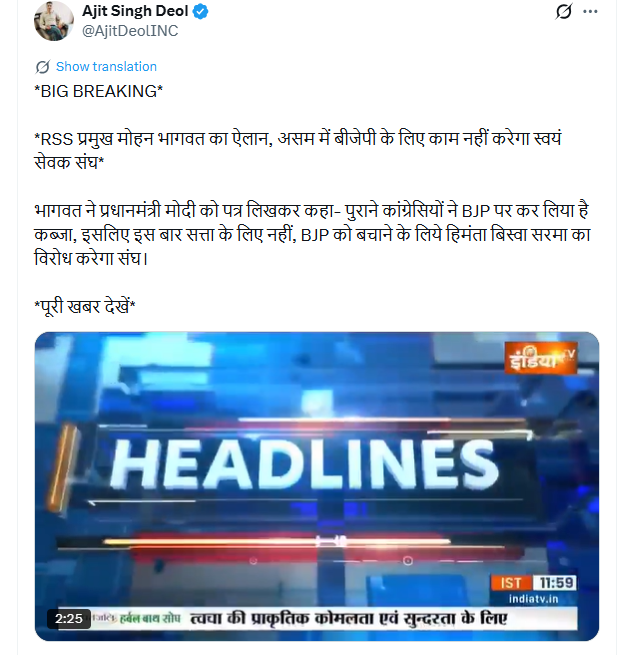
A video from an India TV news show related to the Assam elections is going viral on social media. In the clip, anchor Meenakshi Joshi is allegedly seen claiming that there is a rift between the BJP and the RSS in Assam. The video further suggests that RSS chief Mohan Bhagwat wrote a letter to Prime Minister Narendra Modi stating that former Congress members have taken over the BJP, and that RSS volunteers would not work for the party in Assam. However, a research by the CyberPeace found that the viral video is edited and misleading. The original video contains no such claims.
Claim:
A social media user Ajit Singh shared the video on X with the caption:“The core idea of today’s BJP is to capture power by any means. We have been saying this for long, and now even RSS has accepted that BJP in Assam has been taken over by Congress mindset.”
Fact Check:
To verify the claim, we searched relevant keywords about the alleged letter by RSS chief Mohan Bhagwat to Prime Minister Narendra Modi. However, we found no credible media reports supporting this claim. We then checked the YouTube channel of India TV but could not find the viral clip there. During the search, we did find a similar video from Meenakshi Joshi’s show. In the beginning of that video, the portion seen in the viral clip appears.
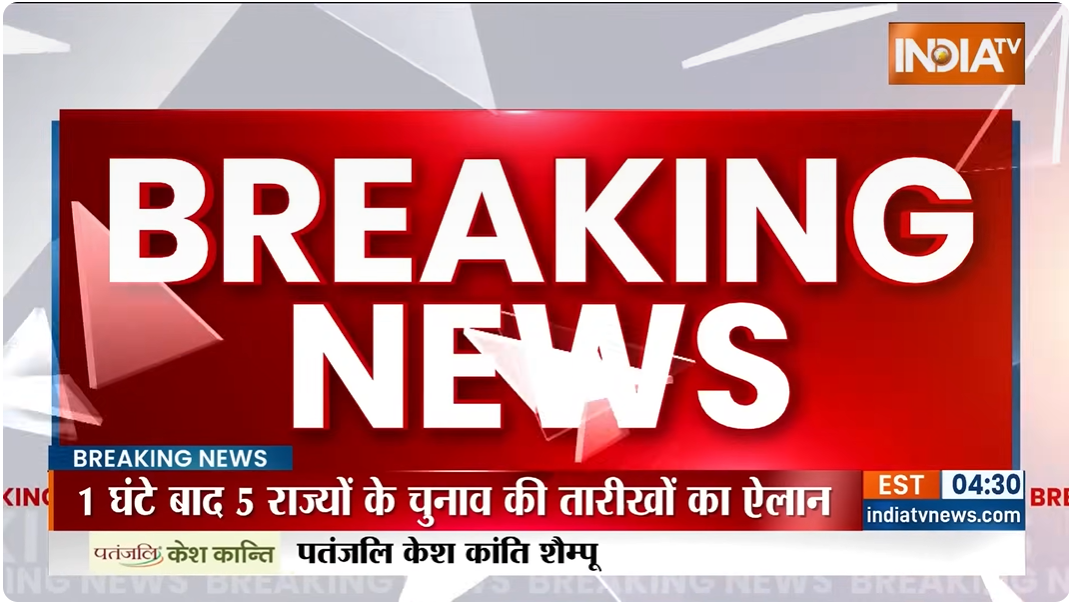
In the original video, the anchor is discussing the announcement of election dates in five states. There is no mention of any rift between the BJP and RSS in Assam.
Conclusion:
The viral India TV video claiming a rift between the BJP and RSS in Assam is edited and misleading. The original broadcast was about election dates in five states and did not include any such claims.

Related Blogs

Executive Summary:
Amid escalating tensions between Afghanistan and Pakistan, a video is being widely shared on social media claiming that Afghanistan has shot down a Pakistani fighter jet. The posts further allege that the incident marks the formal beginning of a war between the two countries. However, research conducted by the CyberPeace found the viral claim to be false and the research revealed that the circulating video is not authentic but AI-generated.
Claim
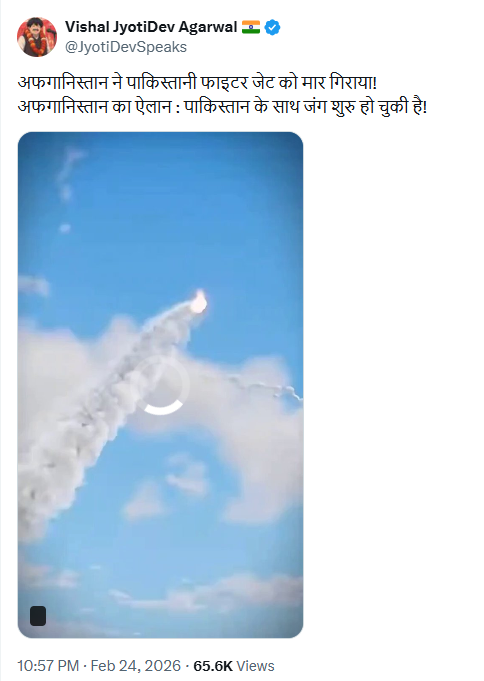
On February 24, 2026, a user on X (formerly Twitter) shared the viral video with the caption: “Afghanistan has shot down a Pakistani fighter jet! Afghanistan announces that war with Pakistan has begun.”
- Original post link: https://x.com/JyotiDevSpeaks/status/2026348257186545914
- Archived link: https://ghostarchive.org/archive/7l00Y
Fact Check:
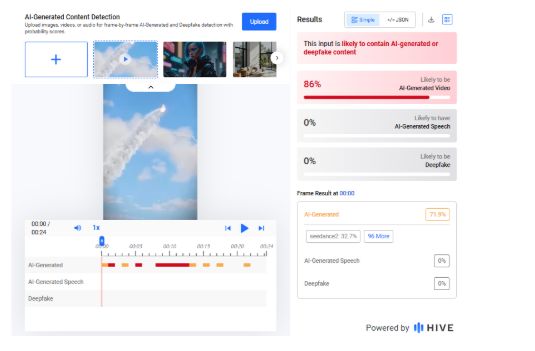
A careful review of the viral video revealed unusual visual patterns and artificial-looking effects, raising suspicions that it may have been created using artificial intelligence.We analyzed the video using the AI detection tool Hive Moderation, which indicated an 86 percent probability that the video was AI-generated.
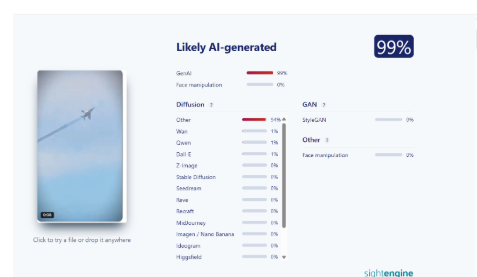
To further verify the findings, we scanned the footage using another AI detection platform, Sightengine. The results showed a 99 percent likelihood that the video was AI-generated.
To understand the broader context of the ongoing tensions, we conducted a keyword search and found a report published on February 22, 2026, by BBC Hindi. According to the report, Pakistan claimed it had targeted “seven terrorist hideouts and camps” along the Pakistan–Afghanistan border based on intelligence inputs. Meanwhile, a spokesperson for the Taliban government in Afghanistan stated that Pakistani airstrikes in Nangarhar and Paktika provinces resulted in the deaths of dozens of people, including women and children.
- https://www.bbc.com/hindi/articles/clyz8141397o
Conclusion
Our research confirms that the viral video claiming Afghanistan shot down a Pakistani fighter jet and formally declared war on Pakistan is fake. The footage is AI-generated and is being circulated with a false and misleading narrative.

India’s online gaming industry has grown at lightning speed, drawing millions of users across age groups. From casual games and e-sports to fantasy leagues and online poker, digital entertainment has become both a social and economic phenomenon. But with this growth came rising concerns of addiction, financial loss, misleading ads, and even criminal misuse of gaming platforms for illegal betting. To address these concerns, the Government of India introduced the Promotion and Regulation of Online Gaming Act and draft Rules in October 2025. While the Act represents a crucial step toward accountability and user protection, it also raises difficult questions about freedom, innovation, and investor confidence.
The Current Legal Framework
The 2025 Act, along with corresponding changes in the Information Technology and GST laws, aims to create a safer and more transparent gaming environment.
1. Ban on real-money games:
Any online game where money is involved, whether it’s entry fees, bets, or prizes, is now banned, regardless of whether it is based on skill or chance. As a result, previously permitted formats such as fantasy sports, rummy, and poker once defended as “games of skill” now fall within the category of banned activities.
2. Promotion of e-sports and social gaming
Not all gaming is banned. Casual games, e-sports, and social games that don’t involve money are fully allowed. The government is encouraging these as part of India’s growing digital economy.
3. Advertising and financial restrictions: Banks, payment gateways, and advertisers cannot facilitate or promote real-money games. Any platform offering deposits or prize pools can be blocked.
4. Central regulatory authority: The law establishes a national body to classify games, monitor compliance, and address complaints. It has the power to order the locking of violative content and websites.
Why Regulation Was Needed
The push for regulation came after a surge in online betting scams, debt-related suicides, and disputes about whether certain apps were skill-based or chance-based. State governments had taken conflicting positions, some banning, others licensing such games. Meanwhile, offshore gaming apps operated freely in India’s grey market.
The 2025 Act thus attempts to impose uniformity, protect minors, and bring moral and fiscal discipline to a rapidly expanding digital frontier. Its underlying philosophy resembles that of the Digital Personal Data Protection Act, encouraging responsible use of technology rather than an unregulated free-for-all.
Key Challenges and Gaps
(a) Clarity of Definitions
The Act bans all real-money games, ignoring the difference between skill-based games and chance-based games. This could lead to legal challenges under Article 19(1)(g), which protects the right to do business. Games like rummy or fantasy cricket, which need real skill, arguably shouldn’t be banned outright
(b) Weak Consumer and Child Protection
Although age verification and KYC are mandated, compliance at the user-end remains uncertain. India needs a Responsible Gaming Code covering:
- Spending limits and cooling-off periods;
- Self-exclusion options;
- Transparent disclosure of odds; and
- Algorithmic fairness audits.
These measures can help mitigate addiction and prevent exploitation of minors.
(c) Federal Conflicts
“Betting and gambling” fall within the State List under India’s Constitution, yet the 2025 Act seeks national uniformity. States like Tamil Nadu and Karnataka already have independent bans. Without harmonisation, legal disputes between state and central authorities could multiply. A cooperative federal framework allowing states to adopt central norms voluntarily could offer flexibility without fragmentation.
(d) Regulatory Transparency
The gaming regulator has a lot of power, like deciding which games are allowed and blocking websites. But it’s not clear who chooses its members or how people can challenge its decisions. Including court oversight, public input, and regular reporting would make the regulator fairer and more reliable.
What’s Next for India’s Online Gaming
India’s online gaming scene is at a turning point. Banning all money-based games might reduce risks, but it also slows innovation and limits opportunities. A better approach could be to license skill-based or low-risk games with proper KYC and audits, set up a Responsible Gaming Charter with input from government, industry, and civil society, and create rules for offshore platforms targeting Indian players. Player data should be protected under the Digital Personal Data Protection Act, 2023, and the law should be reviewed every few years to keep up with new tech like the metaverse, NFTs, and AI-powered games.
Conclusion
CyberPeace has already provided its detailed feedback to MEITy as on 30th October, 2025 hopes the finalised rules are released soon with the acknowledgment of the challenges discussed. The Promotion and Regulation of Online Gaming Act, 2025, marks an important turning point since this is India’s first serious attempt to bring order to a chaotic digital arena. The goal is to keep players safe, stop crime, and hold platforms accountable. But the tricky part is moving away from blanket bans. We need rules that let new ideas grow, respect people’s rights, and keep players safe. With a few smart changes and fair enforcement, India could have a gaming industry that’s safe, responsible, and ready to compete globally.
References
- https://ssrana.in/articles/indias-online-gaming-bill-2025-regulation-prohibition-and-the-future-of-digital-play/
- https://www.google.com/amp/s/m.economictimes.com/news/economy/policy/new-online-gaming-law-takes-effect-money-games-banned-from-today/amp_articleshow/124255401.cms
- https://www.google.com/amp/s/timesofindia.indiatimes.com/technology/tech-news/government-proposes-to-make-violation-of-online-money-game-rules-non-bailable-draft-rules-ban-/amp_articleshow/124277740.cms
- https://www.egf.org.in/
- https://www.pib.gov.in/PressNoteDetails.aspx?NoteId=155075&ModuleId=3

Introduction
“an intermediary, on whose computer resource the information is stored, hosted or published, upon receiving actual knowledge in the form of an order by a court of competent jurisdiction or on being notified by the Appropriate Government or its agency under clause (b) of sub-section (3) of section 79 of the Act, shall not , which is prohibited under any law for the time being in force in relation to the interest of the sovereignty and integrity of India; security of the State; friendly relations with foreign States; public order; decency or morality; in relation to contempt of court; defamation; incitement to an offence relating to the above, or any information which is prohibited under any law for the time being in force”
Law grows by confronting its absences, it heals itself through its own gaps. The most recent notification from MeitY, G.S.R. 775(E) dated October 22, 2025, is an illustration of that self-correction. On November 15, 2025, the Information Technology (Intermediary Guidelines and Digital Media Ethics Code) Amendment Rules, 2025, will come into effect. They accomplish two crucial things: they restrict who can use "actual knowledge” to initiate takedown and require senior-level scrutiny of those directives. By doing this, they maintain genuine security requirements while guiding India’s content governance system towards more transparent due process.
When Regulation Learns Restraint
To better understand the jurisprudence of revision, one must need to understand that Regulation, in its truest form, must know when to pause. The 2025 amendment marks that rare moment when the government chooses precision over power, when regulation learns restraint. The amendment revises Rule 3(1)(d) of the 2021 Rules. Social media sites, hosting companies, and other digital intermediaries are still required to take action within 36 hours of receiving “actual knowledge” that a piece of content is illegal (e.g. poses a threat to public order, sovereignty, decency, or morality). However, “actual knowledge” now only occurs in the following situations:
(i) a court order from a court of competent jurisdiction, or
(ii) a reasoned written intimation from a duly authorised government officer not below Joint Secretary rank (or equivalent)
The authorised authority in matters involving the police “must not be below the rank of Deputy Inspector General of Police (DIG)”. This creates a well defined, senior-accountable channel in place of a diffuse trigger.
There are two more new structural guardrails. The Rules first establish a monthly assessment of all takedown notifications by a Secretary-level officer of the relevant government to test necessity, proportionality, and compliance with India’s safe harbour provision under Section 79(3) of the IT Act. Second, in order for platforms to act precisely rather than in an expansive manner, takedown requests must be accompanied by legal justification, a description of the illegal act, and precise URLs or identifiers. The cumulative result of these guardrails is that each removal has a proportionality check and a paper trail.
Due Process as the Law’s Conscience
Indian jurisprudence has been debating what constitutes “actual knowledge” for over a decade. The Supreme Court in Shreya Singhal (2015) connected an intermediary’s removal obligation to notifications from official channels or court orders rather than vague notice. But over time, that line became hazy due to enforcement practices and some court rulings, raising concerns about over-removal and safe-harbour loss under Section 79(3). Even while more recent decisions questioned the “reasonable efforts” of intermediaries, the 2025 amendment institutionally pays homage to Shreya Singhal’s ethos by refocusing “actual knowledge” on formal reviewable communications from senior state actors or judges.
The amendment also introduces an internal constitutionalism to executive orders by mandating monthly audits at the Secretary level. The state is required to re-justify its own orders on a rolling basis, evaluating them against proportionality and necessity, which are criteria that Indian courts are increasingly requesting for speech restrictions. Clearer triggers, better logs, and less vague “please remove” communications that previously left compliance teams in legal limbo are the results for intermediaries.
The Court’s Echo in the Amendment
The essence of this amendment is echoed in Karnataka High Court’s Ruling on Sahyog Portal, a government portal used to coordinate takedown orders under Section 79(3)(b), was constitutional. The HC rejected X’s (formerly Twitter’s) appeal contesting the legitimacy of the portal in September. The business had claimed that by giving nodal officers the authority to issue takedown orders without court review, the portal permitted arbitrary content removals. The court disagreed, holding that the officers’ acts were in accordance with Section 79 (3)(b) and that they were “not dropping from the air but emanating from statutes.” The amendment turns compliance into conscience by conforming to the Sahyog Portal verdict, reiterating that due process is the moral grammar of governance rather than just a formality.
Conclusion: The Necessary Restlessness of Law
Law cannot afford stillness; it survives through self doubt and reinvention. The 2025 amendment, too, is not a destination, it’s a pause before the next question, a reminder that justice breathes through revision. As befits a constitutional democracy, India’s path to content governance has been combative and iterative. The next rule making cycle has been sharpened by the stays split judgments, and strikes down that have resulted from strategic litigation centred on the IT Rules, safe harbour, government fact-checking, and blocking orders. Lessons learnt are reflected in the 2025 amendment: review triumphs over opacity; specificity triumphs over vagueness; and due process triumphs over discretion. A digital republic balances freedom and force in this way.
Sources
- https://pressnews.in/law-and-justice/government-notifies-amendments-to-it-rules-2025-strengthening-intermediary-obligations/
- https://www.meity.gov.in/static/uploads/2025/10/90dedea70a3fdfe6d58efb55b95b4109.pdf
- https://www.pib.gov.in/PressReleasePage.aspx?PRID=2181719
- https://www.scobserver.in/journal/x-relies-on-shreya-singhal-in-arbitrary-content-blocking-case-in-karnataka-hc/
- https://www.medianama.com/2025/10/223-content-takedown-rules-online-platforms-36-hr-deadline-officer-rank/#:~:text=It%20specifies%20that%20government%20officers,Deputy%20Inspector%20General%20of%20Police%E2%80%9D.
