
#FactCheck: Digitally Altered Video Falsely Shows Rajnath Singh Claiming Pakistan Could Have Shot Down MiG-21 Squadron Without Rafale Jets
Executive Summary
Social media users are sharing a claim attributed to Defence Minister Rajnath Singh, alleging that he admitted that Pakistan could have shot down an entire squadron of Indian MiG-21 Bison aircraft during Operation Sindoor if the Indian Air Force had not been equipped with Rafale fighter jets. Several users are sharing the claim as genuine. CyberPeace Research found that the viral video has been digitally manipulated. Defence Minister Rajnath Singh made no such statement in the original video.
Claim:
India's Defence Minister Rajnath Singh admitted that Pakistan could have shot down an entire squadron of Indian MiG-21 Bison aircraft during Operation Sindoor in the absence of Rafale fighter jets.
https://x.com/i/birdwatch/t/2125615769031675941?source=6
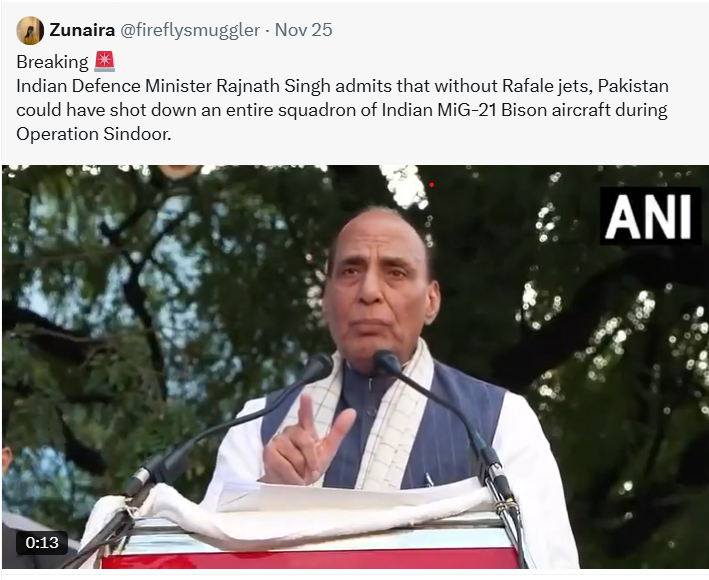
Fact Check
To verify the authenticity of the viral claim, we conducted a Google search using relevant keywords. However, we did not find any credible media reports corroborating the claim.
In the next part of our research, we conducted a reverse image search of the keyframes extracted from the viral video. During this process, we found the original video on Defence Minister Rajnath Singh's official YouTube channel. In the video, Rajnath Singh can be heard addressing a gathering in Kalaburagi, Karnataka, and saying, "Tomorrow is November 26. Constitution Day will be celebrated across the country tomorrow. It pains me deeply to say that Congress, in its obsession with gaining power and the chair, is continuously trying to weaken the foundation of this democratic system."
https://www.youtube.com/live/rojSIp4hhes
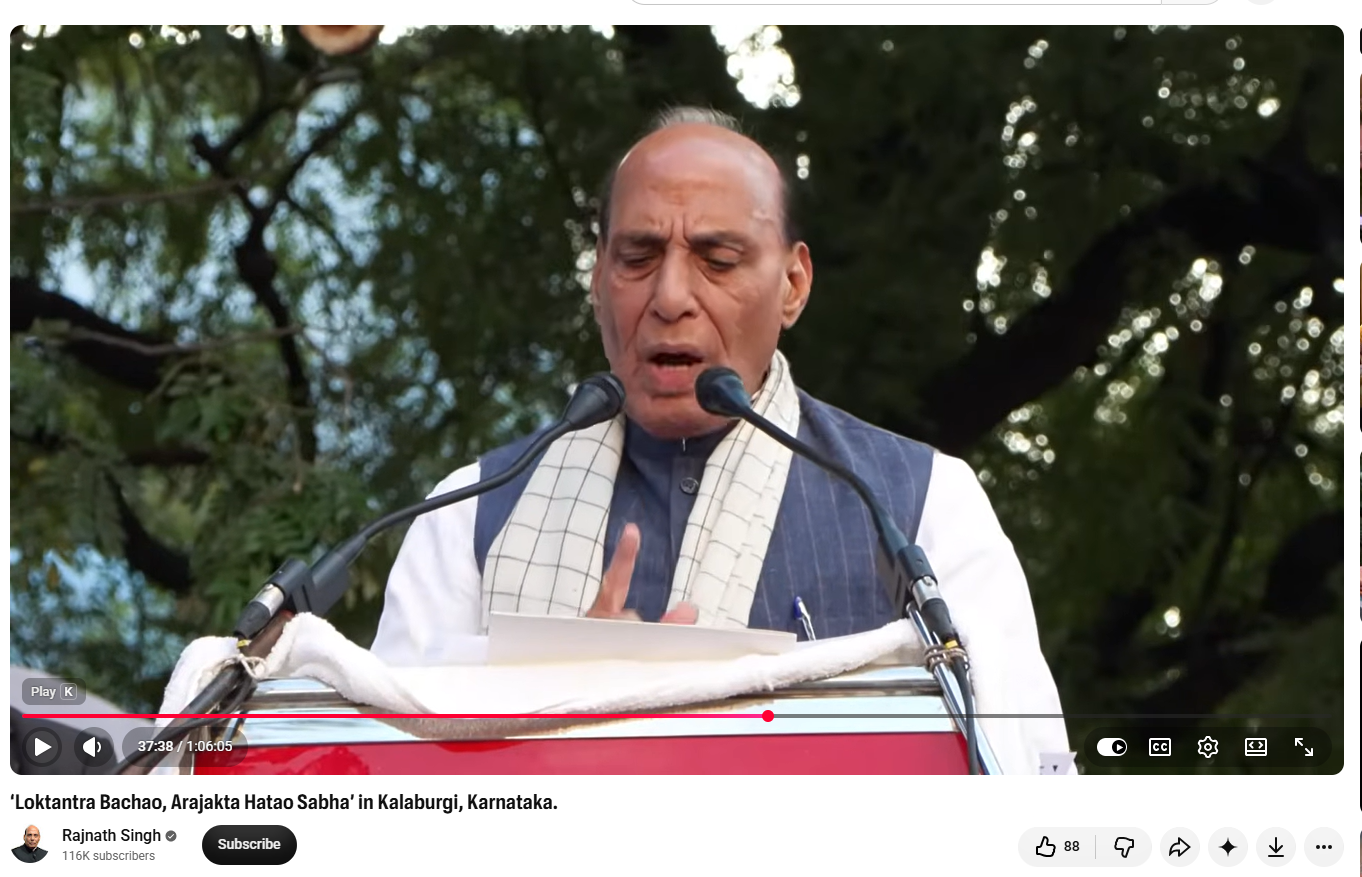
However, the statement heard in the viral video does not appear anywhere in the original footage.
At the end of our research, we also found the original video of Rajnath Singh's address on IANS' official platform. This video was also related to his speech in Kalaburagi, Karnataka. However, the statement heard in the viral video was absent from this footage as well.
https://x.com/ians_india/status/2125620439993217298
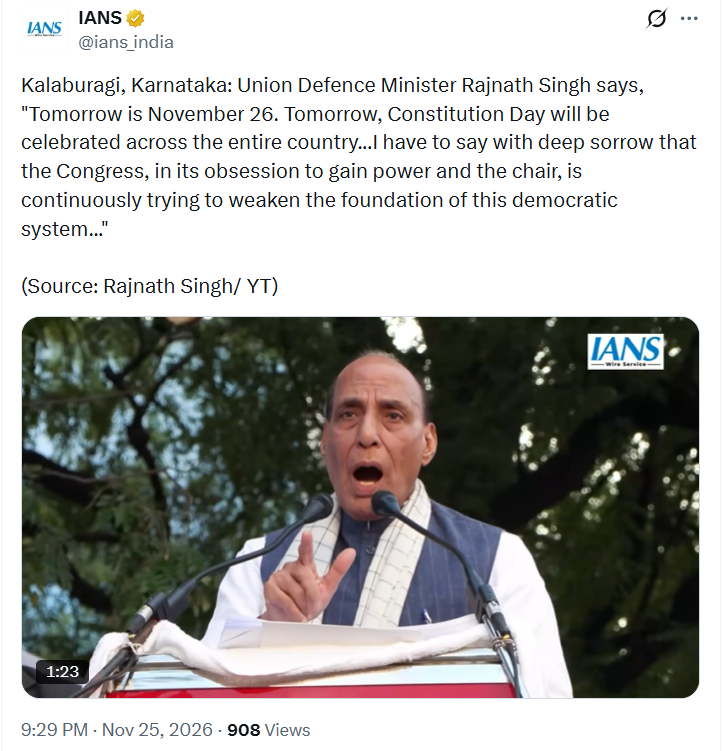
Conclusion
Our research found that the viral video has been digitally manipulated and is being circulated with a false claim. The original video, available on Rajnath Singh's official YouTube channel and IANS' official platform, shows him addressing a gathering in Kalaburagi, Karnataka, where he spoke about Constitution Day and alleged attempts by the Congress to weaken the foundations of the democratic system. However, he did not make any statement suggesting that Pakistan could have shot down an entire squadron of Indian MiG-21 Bison aircraft in the absence of Rafale fighter jets during Operation Sindoor. Therefore, the viral video is digitally altered and the claim is false.

Related Blogs

On March 02, 2023, the Biden-Harris Administration unveiled the National Cybersecurity Plan to ensure that all Americans can enjoy the advantages of a secure digital environment. In this pivotal decade, the United States will reimagine cyberspace as a tool to achieve our goals in a way that is consistent with our values. These values include a commitment to economic security and prosperity, respect for human rights and fundamental freedoms, faith in our democracy and its institutions, and a commitment to creating a fair and diverse society. This goal cannot be achieved without a dramatic reorganisation of the United States’ cyberspace responsibilities, roles, and resources.
VISION- AIM
A more planned, organised, and well-resourced strategy to cyber protection is necessary for today’s rapidly developing world. State and non-state actors alike are launching creative new initiatives to challenge the United States. New avenues for innovation are opening up as next-generation technologies attain maturity and digital interdependencies are expanding. Thus, this Plan lays forth a plan to counter these dangers and protect the digital future. Putting it into effect can safeguard spending on things like infrastructure, clean energy, and the re-shoring of American industry.
The USA will create its digital environment by:
- Defensible if the cyber defence is comparatively easier, more effective, cheaper
- Resilient, where the impacts of cyberattacks and operator mistakes are lasting and little widespread.
- Values-aligned, where our most cherished values shape—and are in turn reinforced by— our digital world.
Already, the National Security Strategy, Executive Order 14028 (Improving the Nation’s Cybersecurity), National Security Memorandum 5 (Improving Cybersecurity for Critical Infrastructure Control Systems), M-22-09 (Moving the U.S. Government Toward Zero-Trust Cybersecurity Principles), and National Security Memorandum 10 (Improving Cybersecurity for Federal Information Systems) have all been issued to help secure cyberspace and our digital ecosystem (Promoting United States Leadership in Quantum Computing While Mitigating Risks to Vulnerable Cryptographic Systems). The Strategy builds upon previous efforts by acknowledging that the Internet serves not as an end in itself but as a means to a goal—the achievement of our highest ideals.
There are five key points that constitute the National Cybersecurity Strategy:
1. Defend Critical Infrastructure –
Defend critical infrastructure by, among other things: i) enacting cybersecurity regulations to secure essential infrastructure; (ii) boosting public-private sector collaboration; (iii) integrating federal cybersecurity centres; (iv) updating federal incident response plans and processes; and (v) modernising federal systems in accordance with zero trust principles.
2. Disrupt and Dismantle Threat Actors
Disrupt and dismantle threat actors, including by i) integrating military, diplomatic, information, financial, intelligence, and law enforcement competence, (ii) strengthening public-private sector collaborations, (iii) increasing the speed and scale of intelligence sharing and victim information, (iv) preventing the abuse of U.S.-based infrastructure, and (v) increasing disruption campaigns and other endeavours against ransomware operators;
3. Shape Market Forces to Drive Security and Resilience
The federal government can help shape market forces that drive security and resilience by doing the following: i) supporting legislative efforts to limit organisations’ ability to collect, use, transfer, and maintain personal information and providing strong protections for sensitive data (such as geolocation and health data), (ii) boosting IoT device security via federal research, development, sourcing, risk management efforts, and IoT security labelling programs, and (iii) instituting legislation establishing standards for the security of IoT devices. (iv) strengthening cybersecurity contract standards with government suppliers, (v) studying a federal cyber insurance framework, and (vi) using federal grants and other incentives to invest in efforts to secure critical infrastructure.
4. Invest in a Resilient Future
Invest in a resilient future by doing things like i) securing the Internet’s underlying infrastructure, (ii) funding federal cybersecurity R&D in areas like artificial intelligence, cloud computing, telecommunications, and data analytics used in critical infrastructure, (iii) migrating vulnerable public networks and systems to quantum-resistant cryptography-based environments, and (iv) investing hardware and software systems that strengthen the resiliency, safety, and security of these areas, (v) enhancing and expanding the nation’s cyber workforce; and (vi) investing in verifiable, strong digital identity solutions that promote security, interoperability, and accessibility.
5. Forge International Partnerships to Pursue Shared Goals
The United States should work with other countries to advance common interests, such as i) forming international coalitions to counter threats to the digital ecosystem; (ii) increasing the scope of U.S. assistance to allies and partners in strengthening cybersecurity; (iii) forming international coalitions to reinforce global norms of responsible state behaviour; and (v) securing global supply chains for information, communications, and operational technologies.
Conclusion:
The Strategy results from months of work by the Office of the National Cyber Director (“ONCD”), the primary cybersecurity policy and strategy advisor to President Biden and coordinates cybersecurity engagement with business and international partners. The National Security Council will oversee the Strategy’s implementation through ONCD and the Office of Management and Budget.
In conclusion, we can say that the National Cybersecurity Plan of the Biden administration lays out an ambitious goal for American cybersecurity that is to be accomplished by the end of the decade. The administration aims to shift tasks and responsibilities to those organisations in the best position to safeguard systems and software and to encourage incentives for long-term investment in cybersecurity to build a more cyber-secure future.
It is impossible to assess the cyber strategy in a vacuum. It’s critical to consider the previous efforts and acknowledge the ones that still need to be made. The implementation specifics for several aspects of the approach are left up to a yet-to-be-written plan.
Given these difficulties, it would be simple to voice some pessimism at this stage regarding the next effort that will be required. Yet, the Biden administration has established a vision for cybersecurity oriented towards the future, with novel projects that could fundamentally alter how the United States handles and maintains cybersecurity. The Biden administration raised the bar for cybersecurity by outlining this robust plan, which will be challenging for succeeding administrations to let go. Also, it has alerted Congress to areas where it will need to act.
References:
- https://www.whitehouse.gov/briefing-room/statements-releases/2023/03/02/fact-sheet-biden-harris-administration-announces-national-cybersecurity-strategy/
- https://www.huntonprivacyblog.com/2023/03/02/white-house-releases-national-cybersecurity-strategy/
- https://www.lawfareblog.com/biden-harris-administration-releases-new-national-cybersecurity-strategy

Introduction
In July 2025, the Digital Defence Report prepared by Microsoft raised an alarm that India is part of the top target countries in AI-powered nation-state cyberattacks with malicious agents automating phishing, creating convincing deepfakes, and influencing opinion with the help of generative AI (Microsoft Digital Defence Report, 2025). Most of the attention in the world has continued to be on the United States and Europe, but Asia-Pacific and especially India have become a major target in terms of AI-based cyber activities. This blog discusses the role of AI in espionage, redefining the threat environment of India, the reaction of the government, and what India can learn by looking at the example of cyber giants worldwide.
Understanding AI-Powered Cyber Espionage
Conventional cyber-espionage intends to hack systems, steal information or bring down networks. With the emergence of generative AI, these strategies have changed completely. It is now possible to automate reconnaissance, create fake voices and videos of authorities and create highly advanced phishing campaigns which can pass off as genuine even to a trained expert. According to the report made by Microsoft, AI is being used by state-sponsored groups to expand their activities and increase accuracy in victims (Microsoft Digital Defence Report, 2025). Based on SQ Magazine, almost 42 percent of state-based cyber campaigns in 2025 had AIs like adaptive malware or intelligent vulnerability scanners (SQ Magazine, 2025).
AI is altering the power dynamic of cyberspace. The tools previously needing significant technical expertise or substantial investments have become ubiquitous, and smaller countries can conduct sophisticated cyber operations as well as non-state actors. The outcome is the speeding up of the arms race with AI serving as the weapon and the armour.
India’s Exposure and Response
The weakness of the threat landscape lies in the growing online infrastructure and geopolitical location. The attack surface has expanded the magnitude of hundreds of millions of citizens with the integration of platforms like DigiLocker and CoWIN. Financial institutions, government portals and defence networks are increasingly becoming targets of cyber attacks that are more sophisticated. Faking videos of prominent figures, phishing letters with the official templates, and manipulation of the social media are currently all being a part of disinformation campaigns (Microsoft Digital Defence Report, 2025).
According to the Data Security Council of India (DSCI), the India Cyber Threat Report 2025 reported that attacks using AI are growing exponentially, particularly in the shape of malicious behaviour and social engineering (DSCI, 2025). The nodal cyber-response agency of India, CERT-In, has made several warnings regarding scams related to AI and AI-generated fake content that is aimed at stealing personal information or deceiving the population. Meanwhile, enforcement and red-teaming actions have been intensified, but the communication between central agencies and state police and the private platforms is not even. There is also an acute shortage of cybersecurity talents in India, as less than 20 percent of cyber defence jobs are occupied by qualified specialists (DSCI, 2025).
Government and Policy Evolution
The government response to AI-enabled threats is taking three forms, namely regulation, institutional enhancing, and capacity building. The Digital Personal Data Protection Act 2023 saw a major move in defining digital responsibility (Government of India, 2023). Nonetheless, threats that involve AI-specific issues like data poisoning, model manipulation, or automated disinformation remain grey areas. The following National Cybersecurity Strategy will attempt to remedy them by establishing AI-government guidelines and responsibility standards to major sectors.
At the institutional level, the efforts of such organisations as the National Critical Information Infrastructure Protection Centre (NCIIPC) and the Defence Cyber Agency are also being incorporated into their processes with the help of AI-based monitoring. There is also an emerging public-private initiative. As an example, the CyberPeace Foundation and national universities have signed a memorandum of understanding that currently facilitates the specialised training in AI-driven threat analysis and digital forensics (Times of India, August 2025). Even after these positive indications, India does not have any cohesive system of reporting cases of AI. The publication on arXiv in September 2025 underlines the importance of the fact that legal approaches to AI-failure reporting need to be developed by countries to approach AI-initiated failures in such fields as national security with accountability (arXiv, 2025).
Global Implications and Lessons for India
Major economies all over the world are increasing rapidly to integrate AI innovation with cybersecurity preparedness. The United States and United Kingdom are spending big on AI-enhanced military systems, performing machine learning in security operations hubs and organising AI-based “red team” exercises (Microsoft Digital Defence Report, 2025). Japan is testing cross-ministry threat-sharing platforms that utilise AI analytics and real-time decision-making (Microsoft Digital Defence Report, 2025).
Four lessons can be distinguished as far as India is concerned.
- To begin with, the cyber defence should shift to proactive intelligence in place of reactive investigation. It is not only possible to detect the adversary behaviour after the attacks, but to simulate them in advance using AI.
- Second, teamwork is essential. The issue of cybersecurity cannot be entrusted to government enforcement. The private sector that maintains the majority of the digital infrastructure in India must be actively involved in providing information and knowledge.
- Third, there is the issue of AI sovereignty. Building or hosting its own defensive AI tools in India will diminish dependence on foreign vendors, and minimise the possible vulnerabilities of the supply-chain.
- Lastly, the initial defence is digital literacy. The citizens should be trained on how to detect deepfakes, phishing, and other manipulated information. The importance of creating human awareness cannot be underestimated as much as technical defences (SQ Magazine, 2025).
Conclusion
AI has altered the reasoning behind cyber warfare. There are quicker attacks, more difficult to trace and scalable as never before. In the case of India, it is no longer about developing better firewalls but rather the ability to develop anticipatory intelligence to counter AI-powered threats. This requires a national policy that incorporates technology, policy and education.
India can transform its vulnerability to strength with the sustained investment, ethical AI governance, and healthy cooperation between the government and the business sector. The following step in cybersecurity does not concern who possesses more firewalls than the other but aims to learn and adjust more quickly and successfully in a world where machines already belong to the battlefield (Microsoft Digital Defence Report, 2025).
References:
- Microsoft Digital Defense Report 2025
- India Cyber Threat Report 2025, DSCI
- Lucknow based organisations to help strengthen cybercrime research training policy ecosystem
- AI Cyber Attacks Statistics 2025: How Attacks, Deepfakes & Ransomware Have Escalated, SQ Magazine
- Incorporating AI Incident Reporting into Telecommunications Law and Policy: Insights from India.
- The Digital Personal Data Protection Act, 2023

Introduction
Since February 2020 the government has been taking keen steps to safeguard the Indian markets and the consumer, this could be seen in the forms of policies and exemptions for the market players and the consumers, however, due to the COVID-19 pandemic, the markets places became vulnerable to loss and various forms of new crimes and frauds. The Government recently tabled the Jan Vishwas bill which is an aftermath of the Vivad se Vishwas Bill, 2020 which was tabled in February 2020 for creating a safe and dynamic market, this bill is a clear example of how AtmaNirbhar Bharat plays a crucial role in nations development.
What is Jan Vishwas Bill, 2022
The Jan Vishwas (Amendment of Provisions) Bill, 2022 is a 108-page bill introduced in the Lok Sabha by the Union Minister of Commerce and Industry, Piyush Goyal. The statement of objects and reasons of the Bill states, “To amend certain enactments for decriminalizing and rationalizing minor offenses to further enhance trust-based governance for ease of living and doing business.” The bill aims to promote ease of doing business in India by decriminalizing minor offences and amending 183 provisions in 42 Acts administered by 19 ministries. The bill proposes to replace minor offences with monetary penalties and rationalize existing monetary penalties based on the gravity of the offences. The Acts to be amended by the bill include-
- Drugs and Cosmetics Act, 1940
- Public Debt Act, 1944
- Pharmacy Act, 1948
- Cinematograph Act, 1952
- Copyright Act, 1957
- Patents Act, 1970
- Environment (Protection) Act, 1986
- Motor Vehicles Act, 1988
- Trade Marks Act, 1999l Railways Act, 1989
- Information Technology Act, 2000
- Prevention of Money-laundering Act, 2002
- Food Safety and Standards Act, 2006
- Legal Metrology Act, 2009
- Factoring Regulation Act, 2011
The bill aims to decriminalize a large number of minor offences and replace them with monetary penalties. This step by the government is a clear indication of how important the market regulations are, in recent times Google was imposed with a penalty of 1300 crores and 900 crores for violating competitive market practices, these penalties, and criminalised actions will ensure proper compliance to laws of the land thus creating a blanket of safeguards for the Indian consumer and netizen.
What will the Ease of Business be?
The Government has been critical in pinpointing various parameters and factors to improve the ease of business in the country, this bill comes at the right time when we can see numerous start-ups and entrepreneurs emerging in our country. The parameters are as follows-
- Starting a Business of all
- Dealing with Construction Permits
- Getting Electricity
- Registering Property
- Getting Credit
- Protecting
- Minority Investors
- Paying Taxes
- Trading across Borders
- Enforcing Contracts and Resolving Insolvency
These parameters have been created with a sight on the future of the markets and how external factors like the Russia-Ukraine war can influence the markets. According to Minister Piyush Goyal, the fear of imprisonment for minor offences is a major factor hindering the growth of the business ecosystem and individual confidence in India. The Jan Vishwas Bill, 2022 aims to address this issue by replacing minor offences with monetary penalties. The bill also proposes an increase of 10% in the minimum amount of fine and penalty levied after every three years, once the bill becomes a law.
Conclusion
The bill will create a level playing field for the market players and the consumers with the backing of strong legislation and precedents thus maintaining transparency and accountability in the system. The amended provisions will allow various already existing legislation to come in tune with the current times and emerging technologies. The nation is at a critical juncture to fabricate policies and laws to address the issues and threats of the future and hence such a bill will be the strengthening pillar of the Indian markets and cyber-ecosystem. The Jan Vishwas Bill, 2022 has been referred to a 31-member joint parliamentary committee for scrutiny. The committee includes members from the Lok Sabha and the Rajya Sabha and will submit its report to parliament by the second part of the Budget session in 2023, The members from the Lok Sabha include PP Chaudhary, Sanjay Jaiswal, Queen Ojha, Rajendra Agrawal, Gaurav Gogoi, A Raja, Rajendra Agarwal, Poonam Pramod Mahajan, and Sougata Ray.
