
AI-Powered Espionage: How India’s Cybersecurity Strategy Must Evolve
Introduction
In July 2025, the Digital Defence Report prepared by Microsoft raised an alarm that India is part of the top target countries in AI-powered nation-state cyberattacks with malicious agents automating phishing, creating convincing deepfakes, and influencing opinion with the help of generative AI (Microsoft Digital Defence Report, 2025). Most of the attention in the world has continued to be on the United States and Europe, but Asia-Pacific and especially India have become a major target in terms of AI-based cyber activities. This blog discusses the role of AI in espionage, redefining the threat environment of India, the reaction of the government, and what India can learn by looking at the example of cyber giants worldwide.
Understanding AI-Powered Cyber Espionage
Conventional cyber-espionage intends to hack systems, steal information or bring down networks. With the emergence of generative AI, these strategies have changed completely. It is now possible to automate reconnaissance, create fake voices and videos of authorities and create highly advanced phishing campaigns which can pass off as genuine even to a trained expert. According to the report made by Microsoft, AI is being used by state-sponsored groups to expand their activities and increase accuracy in victims (Microsoft Digital Defence Report, 2025). Based on SQ Magazine, almost 42 percent of state-based cyber campaigns in 2025 had AIs like adaptive malware or intelligent vulnerability scanners (SQ Magazine, 2025).
AI is altering the power dynamic of cyberspace. The tools previously needing significant technical expertise or substantial investments have become ubiquitous, and smaller countries can conduct sophisticated cyber operations as well as non-state actors. The outcome is the speeding up of the arms race with AI serving as the weapon and the armour.
India’s Exposure and Response
The weakness of the threat landscape lies in the growing online infrastructure and geopolitical location. The attack surface has expanded the magnitude of hundreds of millions of citizens with the integration of platforms like DigiLocker and CoWIN. Financial institutions, government portals and defence networks are increasingly becoming targets of cyber attacks that are more sophisticated. Faking videos of prominent figures, phishing letters with the official templates, and manipulation of the social media are currently all being a part of disinformation campaigns (Microsoft Digital Defence Report, 2025).
According to the Data Security Council of India (DSCI), the India Cyber Threat Report 2025 reported that attacks using AI are growing exponentially, particularly in the shape of malicious behaviour and social engineering (DSCI, 2025). The nodal cyber-response agency of India, CERT-In, has made several warnings regarding scams related to AI and AI-generated fake content that is aimed at stealing personal information or deceiving the population. Meanwhile, enforcement and red-teaming actions have been intensified, but the communication between central agencies and state police and the private platforms is not even. There is also an acute shortage of cybersecurity talents in India, as less than 20 percent of cyber defence jobs are occupied by qualified specialists (DSCI, 2025).
Government and Policy Evolution
The government response to AI-enabled threats is taking three forms, namely regulation, institutional enhancing, and capacity building. The Digital Personal Data Protection Act 2023 saw a major move in defining digital responsibility (Government of India, 2023). Nonetheless, threats that involve AI-specific issues like data poisoning, model manipulation, or automated disinformation remain grey areas. The following National Cybersecurity Strategy will attempt to remedy them by establishing AI-government guidelines and responsibility standards to major sectors.
At the institutional level, the efforts of such organisations as the National Critical Information Infrastructure Protection Centre (NCIIPC) and the Defence Cyber Agency are also being incorporated into their processes with the help of AI-based monitoring. There is also an emerging public-private initiative. As an example, the CyberPeace Foundation and national universities have signed a memorandum of understanding that currently facilitates the specialised training in AI-driven threat analysis and digital forensics (Times of India, August 2025). Even after these positive indications, India does not have any cohesive system of reporting cases of AI. The publication on arXiv in September 2025 underlines the importance of the fact that legal approaches to AI-failure reporting need to be developed by countries to approach AI-initiated failures in such fields as national security with accountability (arXiv, 2025).
Global Implications and Lessons for India
Major economies all over the world are increasing rapidly to integrate AI innovation with cybersecurity preparedness. The United States and United Kingdom are spending big on AI-enhanced military systems, performing machine learning in security operations hubs and organising AI-based “red team” exercises (Microsoft Digital Defence Report, 2025). Japan is testing cross-ministry threat-sharing platforms that utilise AI analytics and real-time decision-making (Microsoft Digital Defence Report, 2025).
Four lessons can be distinguished as far as India is concerned.
- To begin with, the cyber defence should shift to proactive intelligence in place of reactive investigation. It is not only possible to detect the adversary behaviour after the attacks, but to simulate them in advance using AI.
- Second, teamwork is essential. The issue of cybersecurity cannot be entrusted to government enforcement. The private sector that maintains the majority of the digital infrastructure in India must be actively involved in providing information and knowledge.
- Third, there is the issue of AI sovereignty. Building or hosting its own defensive AI tools in India will diminish dependence on foreign vendors, and minimise the possible vulnerabilities of the supply-chain.
- Lastly, the initial defence is digital literacy. The citizens should be trained on how to detect deepfakes, phishing, and other manipulated information. The importance of creating human awareness cannot be underestimated as much as technical defences (SQ Magazine, 2025).
Conclusion
AI has altered the reasoning behind cyber warfare. There are quicker attacks, more difficult to trace and scalable as never before. In the case of India, it is no longer about developing better firewalls but rather the ability to develop anticipatory intelligence to counter AI-powered threats. This requires a national policy that incorporates technology, policy and education.
India can transform its vulnerability to strength with the sustained investment, ethical AI governance, and healthy cooperation between the government and the business sector. The following step in cybersecurity does not concern who possesses more firewalls than the other but aims to learn and adjust more quickly and successfully in a world where machines already belong to the battlefield (Microsoft Digital Defence Report, 2025).
References:
- Microsoft Digital Defense Report 2025
- India Cyber Threat Report 2025, DSCI
- Lucknow based organisations to help strengthen cybercrime research training policy ecosystem
- AI Cyber Attacks Statistics 2025: How Attacks, Deepfakes & Ransomware Have Escalated, SQ Magazine
- Incorporating AI Incident Reporting into Telecommunications Law and Policy: Insights from India.
- The Digital Personal Data Protection Act, 2023

Related Blogs

Executive Summary
A video circulating on social media claims that a Jaguar fighter jet of the Indian Air Force (IAF) failed to land during a takeoff and landing exercise held on April 22, 2026, at the Purvanchal Expressway in Uttar Pradesh. The claim suggests that the incident disrupted preparations for “Operation Sindoor.” However, an research by the CyberPeace Research Wing has found the claim to be false.
Claim
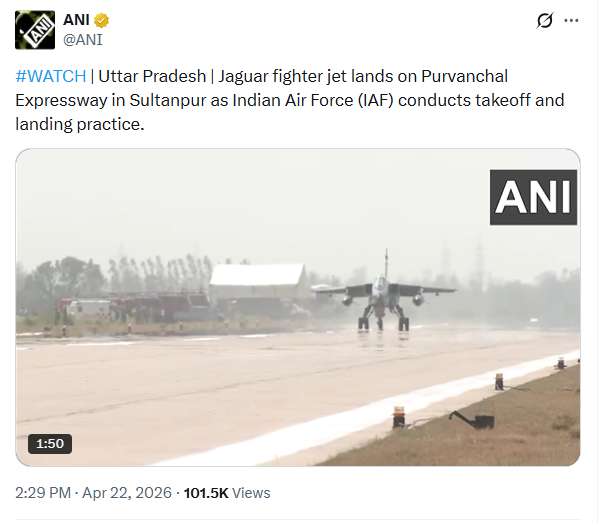
The video was shared by a Facebook user, ‘Meera MJ,’ alleging that the Jaguar aircraft could not land during the exercise conducted near Sultanpur. To verify the authenticity of the video, multiple keyframes were extracted and analyzed using reverse image search tools. This led to the original footage shared by ANI on its official X (formerly Twitter) handle on April 22, 2026. The authentic video of the air show does not show any such incident of a failed landing.

Fact Check
A detailed review of ANI’s social media posts also revealed no evidence supporting the viral claim. This strongly indicates that the circulating clip has been digitally manipulated by altering the original footage.
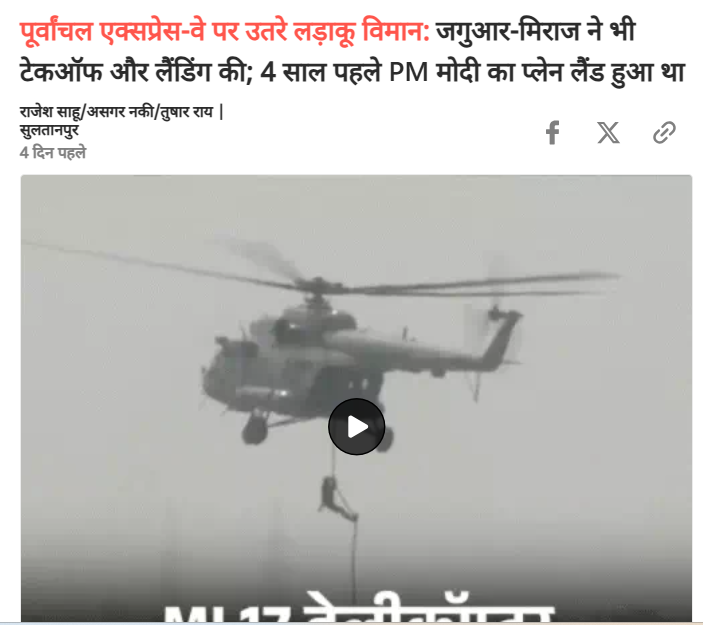
Further corroboration came from a report published by Bhaskar.com, which extensively covered the air show. According to the report, the event featured successful operations by multiple aircraft, including the C-295 transport aircraft landing on the expressway airstrip, followed by Jaguar jets taking off. Sukhoi and Mirage fighter jets also performed takeoff and landing drills, while M17 helicopters carried out commando mock operations. Additionally, the M32 Bhishma aircraft conducted ‘touch and go’
Conclusion:
The viral claim that a Jaguar fighter jet failed to land during the Indian Air Force drill is baseless. The video being circulated is digitally manipulated and does not reflect any real incident.

Executive Summary:
A morphed video of the actor Anup Soni popular on social media promoting IPL betting Telegram channel is found to be fake. The audio in the morphed video is produced through AI voice cloning. AI manipulation was identified by AI detection tools and deepfake analysis tools. In the original footage Mr Soni explains a case of crime, a part of the popular show Crime Patrol which is unrelated to betting. Therefore, it is important to draw the conclusion that Anup Soni is in no way associated with the betting channel.

Claims:
The facebook post claims the IPL betting Telegram channel which belongs to Rohit Khattar is promoted by Actor Anup Soni.

Fact Check:
Upon receiving the post, the CyberPeace Research Team closely analyzed the video and found major discrepancies which are mostly seen in AI-manipulated videos. The lip sync of the video does not match the audio. Taking a cue from this we analyzed using a Deepfake detection tool by True Media. It is found that the voice of the video is 100% AI-generated.


We then extracted the audio and checked in an audio Deepfake detection tool named Hive Moderation. Hive moderation found the audio to be 99.9% AI-Generated.

We then divided the video into keyframes and reverse searched one of the keyframes and found the original video uploaded by the YouTube channel named LIV Crime.
Upon analyzing we found that in the 3:18 time frame the video was edited, and altered with an AI voice.

Hence, the viral video is an AI manipulated video and it’s not real. We have previously debunked such AI voice manipulation with different celebrities and politicians to misrepresent the actual context. Netizens must be careful while believing in such AI manipulation videos.
Conclusion:
In conclusion, the viral video claiming that IPL betting Telegram channel promotion by actor Anup Soni is false. The video has been manipulated using AI voice cloning technology, as confirmed by both the Hive Moderation AI detector and the True Media AI detection tool. Therefore, the claim is baseless and misleading.
- Claim: An IPL betting Telegram channel belonging to Rohit Khattar promoted by Actor Anup Soni.
- Claimed on: Facebook
- Fact Check: Fake & Misleading

Introduction
Ransomware is one of the serious cyber threats as it causes consequences such as financial losses, data loss, and reputation damage. Recently in 2023, a new ransomware called Akira ransomware emerged or surfaced. It has targeted and affected various enterprises or industries, such as BSFI, Construction, Education, Healthcare, Manufacturing, real estate and consulting, primarily based in the United States. Akira ransomware has targeted industries by exploiting the double-extortion technique by exfiltrating and encrypting sensitive data and imposing the threat on victims to leak or sell the data on the dark web if the ransom is not paid. The Akira ransomware gang has extorted a ransom ranging from $200,000 to millions of dollars.
Uncovering the Akira Ransomware operations and their targets
Akira ransomware gang has gained unauthorised access to computer systems by using sophisticated encryption algorithms to encrypt the Data. When such an encryption process is completed, the affected device or network will not be able to access its files or use its data.
The affected files by Akira ransomware showed the extension named “.akira”, and the file’s icon shows blank white pages. The Akira ransomware has developed a data leak site so as to extort victims. And it has also used the ransom note named “akira_readme.txt”.
Akira ransomware steeled the corporate data of various organisations, which the Akira ransomware gang used as leverage while threatening the affected organisation with high ransom demands. Akira Ransomware gang threaten the victims to leak their sensitive data or corporate data in the public domain if the demanded ransom amount is not paid. Akira ransomware gang has leaked the data of four organisations and the size ranges from 5.9GB to 259 GB of data leakage.
Akira Ransomware gang communicating with Victims
The Akira ransomware has provided a unique negotiation password to each victim to initiate communication. Where the ransomware gang deployed a chat system for the purpose of negotiation and demanding ransom from the affected organisations. They have deployed a ransom note as akira_readme.txt so as to provide information as to how they have affected the victim’s files or data along with links to the Akira data leak site and negotiation site.
How Akira Ransomware is different from Pegasus Spyware
Pegasus, developed in the year 2011, belongs to one of the most powerful family of spyware. Once it has infected, it can spear your phone and your text messages or emails. It has the ability to turn your phone into a surveillance device, from copying your messages to harvesting your photos and recording calls. In fact, it has the ability to record you through your phone camera or record your conversation by using your microphone, it also has the ability to track your pinpoint location. In contrast, newly Akira ransomware affects encrypting your files and preventing access to your Data and then asking for ransom n the pretext of leaking your data or for decryption.
How to recover from malware attacks
If affected by such type of malware attack, you can use anti-malware tools such as SpyHunter 5 or Malwarebytes to scan your system. These are the security software which can scan your system and remove suspicious malware files and entries. If you are unable to perform the scan or antivirus in normal mode due to malware in your system, you can use it in Safe Mode. And try to find a relevant decryptor which can help you to recover your files. Do not fall into a ransomware gang’s trap because there is no guarantee that they will help you to recover or will not leak your data after paying the ransom amount.
Best practices to be safe from such ransomware attacks
Conclusion
The Akira ransomware operation poses serious threats to various organisations worldwide. There is a high need to employ robust cybersecurity measures to safeguard networks and sensitive data. Organisations must ensure to keep their software system updated and backed up to a secure network on a regular basis. Paying the ransom is illegal mean instead you should report the incident to law enforcement agencies and can consult with cybersecurity professionals for the recovery method.
