
#FactCheck: Claim That Belgian PM Took a Dig at PM Modi Over ‘Chocolate Diplomacy’ Is Misleading
Executive Summary
Belgian Prime Minister Bart De Wever is on an official visit to India. During the visit, he met Prime Minister Narendra Modi. Meanwhile, a video of his speech is going viral on social media. In his speech, Bart De Wever can be heard saying to PM Modi, “Chocolate is excellent for diplomacy, but not for diplomatic travel.” The video is being shared with the claim that Belgian Prime Minister Bart De Wever took a jibe at Prime Minister Narendra Modi’s diplomacy by referring to “chocolate diplomacy.” A research done by the CyberPeace Research Wing found that Belgian Prime Minister Bart De Wever had brought an unusual and thoughtful gift for Prime Minister Narendra Modi. It was a miniature replica of Delhi’s iconic India Gate, made entirely from Belgian chocolate. However, the chocolate replica melted during the journey to India. Referring to the incident, Bart De Wever made the remark in a humorous manner, saying that the chocolate gift could not withstand the journey. The video is now being shared by users with a misleading claim.
Claim:
X user Jyoti Verma wrote, “Belgium is a small country, smaller than the city of Mumbai, yet its Prime Minister is taking a jibe at Modi by saying that ‘chocolate is a very good thing for diplomacy.’ Modi has brought the level of Indian diplomacy down so much that even the leader of a small country does not hesitate to mock and belittle him. How much more humiliation does Modi want India to face because of his weak leadership? In my view, he has turned Indian citizens into ‘third-class’ citizens in the eyes of the world. There are also reports that discrimination and bias against Indian citizens are increasing in other countries.”
https://x.com/Jotti__Vr/status/2096154750425424086?s=20

Fact Check
During the research of the claim, a search using relevant keywords led us to the full video of the Belgian Prime Minister posted on ANI’s official X handle. In the video, Bart De Wever can be seen mentioning the chocolate replica of India Gate during a joint press conference with Prime Minister Narendra Modi.
https://x.com/ANI/status/2095426762243281060?s=20

As part of the research, we found a report published on the Times of India website on September 4, 2026. According to the report, Belgian Prime Minister Bart De Wever arrived in India carrying a unique and special gift for Prime Minister Narendra Modi. It was a miniature replica of Delhi’s iconic India Gate, made entirely of Belgian chocolate. However, there was one problem—the chocolate replica melted during the journey to India. During a joint press conference with Prime Minister Modi in New Delhi on September 3, De Wever shared the anecdote in a light-hearted manner. He said he had planned to gift Modi a replica of India Gate made from “the finest Belgian chocolate.” However, unlike the real India Gate, which has stood for nearly a century, the chocolate replica did not survive the journey intact. De Wever jokingly remarked, “Chocolate is great for diplomacy, but not for diplomatic travel.”

Conclusion:
Our research found that the viral claim is misleading. Belgian Prime Minister Bart De Wever did indeed bring a miniature replica of India Gate made entirely of Belgian chocolate as a gift for Prime Minister Narendra Modi. However, the claim that the replica “melted during the journey” needs context. De Wever mentioned the incident humorously during his joint press conference with PM Modi, explaining that the chocolate replica did not survive the journey intact. Therefore, the viral post is based on a genuine incident but may present the context in a misleading manner.

Related Blogs
Introduction
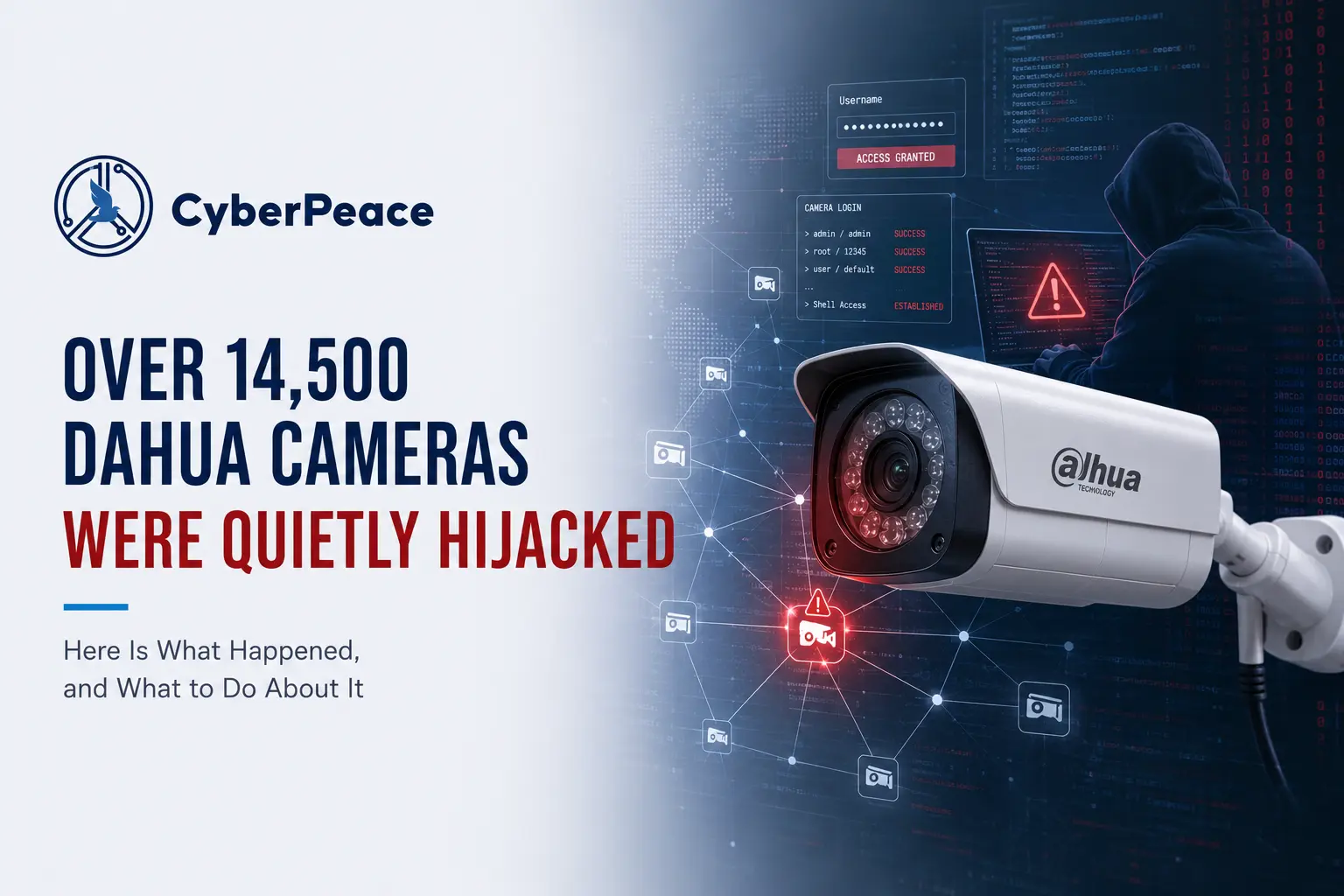
Not every major breach begins with a sophisticated new exploit. Sometimes it begins with a device nobody remembered to update, and this one began exactly that way, at scale. Security researchers have disclosed a campaign that compromised more than 14,530 internet connected cameras made by Dahua Technology, (one of the world's largest surveillance equipment manufacturers), using a mix of stolen credentials, two long known authentication flaws, and a peer to peer relay technique that let attackers reach devices tucked behind home and office routers. The operation, tracked by researchers at Hunt.io, has been named Operation CameraSwarm. It ran between June 17 and July 22, 2026, and was reconstructed almost entirely from an exposed 407 megabyte working directory the attackers themselves left accessible, containing over 2,600 files, campaign logs, shell history, and tooling. Confirmed compromises were concentrated in Ukraine and Russia, and researchers described the operators/attackers as Russian speaking based on language artifacts found in the recovered material, suggesting the campaign was most plausibly built around surveillance or access relevant to the ongoing conflict between the two countries, though no formal attribution to a named threat actor or state entity has been established or claimed. What makes this worth understanding in detail is not just the scale, though 14,500 compromised cameras is a serious number, but how mundane the actual break in methods were. None of this depended on the attackers discovering some brand new, unknown flaw, the kind of vulnerability security researchers call a ‘zero day’. It depended on something far more ordinary: thousands of devices running years-old software that had never been patched, combined with cheap automated tools that could try weak passwords and known exploits at scale.
What is Dahua, and why does this matter
Dahua Technology, founded in Hangzhou in 2001, is a publicly traded, partially state owned Chinese company and the world's second largest video surveillance manufacturer by revenue, trailing only fellow Chinese firm Hikvision. Its cameras, digital video recorders, and network video recorders are sold in roughly 180 countries through more than 2,100 partners, and the company has shipped tens of millions of devices into homes, retail stores, offices, and public infrastructure worldwide. That scale is precisely what makes any systemic vulnerability in Dahua's product line consequential well beyond a single country or sector.
How the attackers actually got in
Hunt.io attributed the compromises to three distinct attack paths. The largest, by far, was straightforward credential attacks, essentially automated login guessing using weak, default, or previously leaked passwords, which researchers traced to 12,324 unique IP addresses across more than 13,000 recorded campaign attempts. The second path exploited two authentication bypass flaws, catalogued as CVE-2021-33044 and CVE-2021-33045, both rated a severe 9.8 out of 10 on the current CVSS severity scale used by the US National Vulnerability Database. These are not new vulnerabilities. They were publicly disclosed back in 2021, and Dahua issued fixed firmware for them years ago, yet both remain listed today on the US Cybersecurity and Infrastructure Security Agency's Known Exploited Vulnerabilities catalog, a designation reserved specifically for flaws still being actively exploited in the wild despite available patches. The third and most technically interesting path involved a peer to peer, or P2P, relay mechanism built into Dahua's own Easy4IP cloud infrastructure, a system designed to let users remotely access their camera without manually configuring network settings. Security firm ITRES Labs, which documented this exposure separately in 2025, found that on firmware released before mid-2024, simply knowing a device's serial number was enough to establish a connection route through Dahua's relay servers before the camera's own login check ever kicked in, a design gap that let attackers reach devices even when they sat behind network address translation, the technical barrier that normally shields home devices from direct internet exposure. Hunt.io's recovered operator logs claimed an extraordinary 89.4 percent of live serial numbers tested returned an open channel without any authentication at all, though it is worth noting that figure comes solely from the attackers' own recovered data and has not been independently verified by Dahua, ITRES Labs, or any public incident response body as of this writing. Beyond the initial break in, the campaign also planted 1,923 cameras with a persistent account, essentially a backdoor login the operators could return to later, and researchers found evidence suggesting parts of the toolkit may have been built specifically to hand off access to a third party, though no confirmed link to a named threat actor or state sponsor has been established.
Why cameras remain such a persistent target
Internet connected cameras occupy an unusual position in the broader device ecosystem. Unlike a laptop or phone, they are rarely patched by an end user paying regular attention, they are often installed once and forgotten, and many owners never change the default credentials shipped from the factory. A compromised camera also offers an attacker something more than a foothold, live or recorded video feeds of homes, businesses, and sometimes sensitive facilities, which carries value well beyond the kind of access a compromised laptop typically provides.
CyberPeace Advisory | What device owners should do now
For anyone running Dahua surveillance equipment, or any internet connected camera system, several concrete steps meaningfully reduce exposure.
For Dahua device owners specifically:
Two steps address the exact mechanisms this campaign exploited.
- First, check the device's firmware version against Dahua's official download portal and apply the latest available update immediately, since the fixes for both 2021 authentication bypass vulnerabilities have existed for years and simply have not been applied on thousands of devices.
- Second, disable the P2P or Easy4IP remote access feature entirely unless it is actively required, since this is the exact mechanism the third attack path, the serial number based relay, relied on to reach cameras without any login check at all.
For any internet connected camera system, including in India:
The remaining precautions apply regardless of manufacturer, and are worth following on any brand of camera, DVR, or NVR connected to the internet.
- Replace default or weak passwords with strong, unique credentials on every camera and recorder, and remove any unused or unrecognised accounts, since the persistent account technique this campaign used depends entirely on unnoticed access surviving unchecked.
- Place surveillance devices on a segmented network separate from computers and phones, so that a compromised camera cannot become a stepping stone into more sensitive systems.
- Periodically audit which devices on a home or office network are internet facing at all, since many cameras end up exposed simply because remote access was left switched on by default and nobody thought to check.
- And where a device offers the option, disable any built in peer to peer or cloud relay convenience feature unless genuinely needed, since the underlying design pattern this campaign exploited, a remote access shortcut that runs before proper authentication.Is not unique to Dahua and has shown up across other camera brands in the past.
The view from India
This disclosure lands at a particularly relevant moment for India, which enforced sweeping new restrictions on Chinese origin CCTV equipment earlier this year. Since April 1, 2026, internet connected surveillance cameras sold in India have been required to carry Standardisation Testing and Quality Certification under Essential Requirements norms first introduced by the Ministry of Electronics and Information Technology in April 2024, It's a country-of-origin requirement under the Essential Requirements norms (introduced by India's Ministry of Electronics and Information Technology in April 2024), manufacturers must disclose the origin of key components like the System-on-Chip (SoC), and devices using Chinese-origin chipsets are reportedly not being granted approval by certifying authorities. Since Dahua's cameras, like Hikvision's and TP-Link's, generally rely on Chinese-made chipsets, the practical effect is that their products haven't received STQC certification, which functions as a blanket exclusion without the government needing to name any single company in the rule text itself. The stated rationale for that policy, concerns over hidden backdoor access, transmission of data to foreign servers, and deployment near sensitive locations, reads almost like a preview of exactly the kind of exposure Operation CameraSwarm has now documented in the wild. It is worth being precise here: the restriction applies to new sales, not existing installations, and CameraSwarm's confirmed victims were concentrated in Ukraine and Russia rather than India. But the underlying lesson travels well beyond any one country's borders. A camera manufactured with a convenience feature that bypasses its own login check, sitting unpatched for years despite a fix being publicly available, is a vulnerability that does not respect national boundaries, and India's decision to tighten certification requirements before an incident of this scale surfaced looks, in hindsight, considerably more prudent than reactive.
References
- The Hacker News, "Hackers Compromised 14,500+ Dahua Devices Using Credential Attacks, Auth Bypasses, and P2P." August 19, 2026. https://thehackernews.com/2026/08/hackers-compromised-14500-dahua-devices.html
- Hunt.io, "Operation CameraSwarm: Dahua Cameras Compromised." https://hunt.io/blog/operation-cameraswarm-dahua-cameras-compromised
- ITRES Labs, "Dahua Beyond CVE-2025-31702: P2P Relay Exposure." October 29, 2025. https://labs.itresit.es/2025/10/29/dahua-beyond-cve-2025-31702-p2p-relay-exposure?
- Dahua Security, "DHCC-SA-202106-001: Security Advisory - Identity Authentication Bypass Vulnerability Found in Some Dahua Products." https://www.dahuasecurity.com/about-dahua/trust-center/dahua-psirt/dhcc-sa-202106-001%3Asecurity-advisory---identity-authentication-bypass-vulnerability-found-in-some-dahua-products
- National Vulnerability Database, "CVE-2021-33044 Detail." https://nvd.nist.gov/vuln/detail/CVE-2021-33044
- CISA, "Known Exploited Vulnerabilities Catalog." https://www.cisa.gov/known-exploited-vulnerabilities-catalog
- Business Standard, "India to ban Chinese CCTV from Apr 1 as security concerns reshape market." https://www.business-standard.com/industry/news/india-ban-chinese-cctv-government-security-concerns-hikvision-dahua-market-126033000316_1.html
- PTC News, "India CCTV ban 2026: Hikvision, Dahua face STQC block as new security rules begin." https://www.ptcnews.tv/amp/nation/india-cctv-ban-hikvision-dahua-stqc-rules-2026-4422961
- Uyghur Human Rights Project, "Surveillance Tech Series: Dahua's Links to Human Rights Abuses in East Turkistan." https://uhrp.org/report/dahuas-links-to-human-rights-abuses-in-east-turkistan/

The UN established its first permanent Global Mechanism for cybersecurity which will begin operations in March 2026. The policy framework for Western countries exists because their current strategies are being developed. The situation in India presents greater complexity and higher levels of interest than any other country.
The Fence That Became a Vantage Point
The United Nations cybersecurity talks have seen India actively participate since their start. India brought its proposal for an open and inclusive multilateral framework which was supported by Western states who wanted to establish universal norms and responsible state behaviour but India did not accept their geopolitical viewpoint.
India did not support the Russia-led bloc which wanted a permanent open-ended working group that would focus only on plenary meetings and the country also rejected the European Union's Program of Action. India maintained its previous stance by supporting multilateralism as a general principle while showing hesitation about backing specific power structures.
The fence now provides an advantage because it no longer serves as a point of vulnerability. India's non-alignment provides him with operational power because the body operates through decision-making which requires all members to agree.
Sovereignty First, Norms Second
The digital sovereignty framework which defines India's long-standing cybersecurity diplomatic activities serves as the country's fundamental cybersecurity diplomatic framework. New Delhi has been reluctant to endorse frameworks that could constrain how it manages its own cyberspace, whether through content regulation, surveillance architecture, or incident response. The Indian government establishes its control over internet governance through its implementation of VPN regulations and CERT-In reporting requirements and data localization discussions.
The new Global Mechanism creates a situation which India must handle because it creates an uncommon diplomatic situation. The framework's five pillars, threats, norms, international law, confidence-building measures, and capacity-building, each carry embedded assumptions that don't sit neatly with India's domestic policy posture. India supports the norm which prohibits countries from attacking each other's critical infrastructure while developing offensive cyber abilities and keeping its cyber response strategies secret.
The Capacity-Building Opening
The Indian government has a definite interest in dedicated thematic group 2 which focuses on building cybersecurity capacity. India exists in two opposing states because it operates as a developing nation which lacks basic national cybersecurity systems while also maintaining advanced cyber defense capabilities. The donor table exists as a platform which gives India both funding rights and complete rights to speak for developing nations. India should serve as a connecting force for DTG 2 by sharing its experience with CERT-In development and its sectoral frameworks for finance and telecom and its National Cyber Coordination Centre programs which train cybersecurity professionals while requesting capacity-building programs that follow demand-based needs assessment and local context understanding and which do not include the typical restrictions that accompany Western technical assistance.
India has done this before in other multilateral settings. The organization maintains its independence through its role as a credible Global South representative which it uses to speak for the Global South without aligning with any particular alliance.
The DTG 1 Question: Critical Infrastructure and Strategic Ambiguity
The DTG 1 study about ICT security challenges shows how resilience and cooperation and stability work together as different themes but creates complex challenges for India.
The 2020 Mumbai power grid incident which some researchers attribute to Chinese state-linked actors has become one of three major attacks against India's critical infrastructure together with AIIMS Delhi incidents in 2022 and ongoing cyber intrusions into defence and government networks. The international standards which govern critical infrastructure protection require actual implementation from India because the country possesses vital national assets.
India has not yet established formal processes for cyberattack attribution while its officials avoid the norm-enforcement diplomacy which Western countries practice through their coordinated attribution and sanction procedures.
India must either develop deeper transparency about its operations or create specialized operational plans which can keep its needed information undercover if it wants to participate in DTG 1 about cross-border interdependencies and incident response collaboration. India will likely engage selectively, supporting the idea of critical infrastructure norms while resisting mechanisms that operationalise accountability.
Geopolitical Triangulation
The new Global Mechanism needs countries to implement their national policies because states must stop merely restating their positions. Multilateral cybersecurity forums operate as Geopolitical triangulation platforms for India. India's security system must protect its interests against its two main cyber adversaries which include China and Pakistan-based groups.
The US and EU strategic partnership between India and these Western governments requires India to show closer ties with democratic nations through its participation in international forums. The new Global Mechanism will require India to pursue its current position by participating in capacity-building activities while developing common norms through its work on general norms language.
India will maintain its current position between Western liberal order enforcement and Russia-China sovereignty-maximalist counter-narrative through its capacity-building activities and general norms language work.
What India Should Actually Do
The document establishes core argument which states early DTG development needs to be established for proper assessment of future results which applies to Indian territory and European territory. India has the credibility and technical foundation and diplomatic ties which enable it to establish itself as an agenda-setter who takes proactive actions instead of following others. India should take the following actions to achieve its goals: lead or co-lead DTG 2 discussions which focus on the capacity requirements of the Global South while advancing DG 1 areas that protect developing nations from actual threats and establish South-South cybersecurity agreements through this system which will help them bypass Western capacity development restrictions. The Global Mechanism offers an essential multilateral platform which provides advantages to countries that take initial actions. India has the ability to make an impact because it possesses strategic advantages which will be activated through its choice between active participation and total disengagement.
References
- http://interface-eu.org/publications/the-new-united-nations-mechanism-on-cybersecurity#a-european-strategy-for-the-dtgs
- https://disarmament.unoda.org/en/our-work/emerging-challenges/developments-field-information-and-telecommunications-context
- https://www.recordedfuture.com/research/redecho-targeting-indian-power-sector
- https://www.saikrishnaassociates.com/cert-in-issues-directions-for-information-security-practices-procedure-prevention-response-and-reporting-of-cyber-incidents/
Introduction
The Digital Personal Data Protection (DPDP) Act 2023 of India is a significant transition for privacy legislation in this age of digital data. A key element of this new law is a requirement for organisations to have appropriate, user-friendly consent mechanisms in place for their customers so that collection, use or removal of an individual's personal data occurs in a clear and compliant manner. As a means of putting this requirement into practice, the Ministry of Electronics and Information Technology (MeitY) issued a comprehensive Business Requirements Document (BRD) in June 2025 to guide organizations, as well as Consent Managers, on how to create a Consent Management System (CMS). This document establishes the technical and functional framework by which organizations and individuals (Data Principals) will exercise control over the way their data is gathered, used and removed.
Understanding the BRD and Its Purpose
BRD represents an optional guide created as part of the "Code for Consent" programme run by MeitY in India. The purpose of the BRD is to provide guidance to startups, digital platforms and other enterprises on how to create a technology system that supports management of user consent per the requirements of the DPDP Act. Although the contents of the BRD do not carry any legal weight, it lays out a clear path for organisations to create their own consent mechanisms using best practices that align with the principles of transparency, accountability and purpose limitation in the DPDP Act.
The goal is threefold:
- Enable complete consent lifecycle management from collection to withdrawal.
- Empower individuals to manage their consents actively and transparently.
- Support data fiduciaries and processors with an interoperable system that ensures compliance.
Key Components of the Consent Management System
The BRD proposes the development of a modular Consent Management System (CMS) that provides users with secure APIs and user-friendly interfaces. This system will allow for a variety of features and modules, including:
- Consent Lifecycle Management – consent should be specific, informed and tied to an explicit purpose. The CMS will manage the collection, validation, renewal, updates and withdrawal of consent. Each transaction of consent will create a tamper-proof “consent artifact,” which will include the timestamp of creation as well as an ID identifying the purpose for which it was given.
- User Dashboard – A user will be able to view and modify the status of their active, expired or withdrawn consent and revoke access at any time via the multilingual user-friendly interface. This would make the system accessible to people from different regions and cultures.
- Notification Engine – The CMS will automatically notify users, fiduciaries and processors of any action taken with respect to consent, in order to ensure real-time updates and accountability.
- Grievance Redress Mechanism – The CMS will include a complaints mechanism that allows users to submit complaints related to the misuse of consent or the denial of their rights. This will enable tracking of the complaint resolution status, and will allow for escalation if necessary.
- Audit and Logging – As part of the CMS's internal controls for compliance and regulatory purposes, the CMS must maintain an immutable record of every instance of consent for auditing and regulatory review. The records must be encrypted, time-stamped, and linked permanently to a user and purpose ID.
- Cookie Consent Management – A separate module will enable users to manage cookie consent for websites separately from any other consents.
Roles and Responsibilities
The BRD identifies the various stakeholders involved and their associated responsibilities.
- Data Principals (Users): The user has full authority to give, withhold, amend, or revoke their consent for the use of their personal data, at any time.
- Data Fiduciaries (Companies): Companies (the fiduciaries) must collect the data principals' consents for each particular reason and must only begin processing a data subject's personal data after validating that consent through the CMS. Companies must also provide the data principals with any information or notifications needed, as well as how to resolve their complaints.
- Data Processors: Data Processors must strictly adhere to the consent stated in the CMS, and Data Processors may only process personal data on behalf of the Data Fiduciary.
- Consent Managers: The Consent Managers are independent entities that are registered with the Data Protection Board. They are responsible for administering the CMS, allowing users to manage their consent across different platforms.
This layered structure ensures transparency and shared responsibility for the consent ecosystem.
Technical Specifications and Security
The following principles of the DPDP Act must be followed to remain compliant with the DPDP Act.
- End-to-End Encryption: All exchanges of data with users must be encrypted using a minimum of TSL 1.3 and also encrypting within that standard.
- API-First Approach: API’s will be utilized to validate, withdraw and update consent in a secured manner using external sources.
- Interoperability/Accessibility: The CMS needs to allow for users to utilize several different languages (e.g. Hindi, Tamil, etc.) and be appropriate for use with various types of mobile devices and different abilities.
- Data Retention Policy: The CMS should also include automatic deletion of consent data (when the consent has expired or has been withdrawn) in order to maintain compliance with data retention limits.
Legal Relevance and Timelines
While the BRD itself is not enforceable, it is directly aligned with the upcoming enforcement of the DPDP Act, 2023. The Act was passed in August 2023 but is expected to come into effect in stages, once officially notified by the central government. Draft implementation rules, including those defining the role of Consent Managers, were released for public consultation in early 2025.
For businesses, the BRD serves as an early compliance tool—offering both a conceptual roadmap and technical framework to prepare before the law is enforced. Legal experts have described it as a critical resource for aligning data governance systems with emerging regulatory expectations.
Implications for Businesses
Organizations that collect and process user data will be required to overhaul their consent workflows:
- No blanket consents: Every data processing activity must have explicit, separate consent.
- Granular audit logs: Companies must maintain tamper-proof logs for every consent action.
- Integration readiness: Enterprises need to integrate their platforms with third-party or in-house CMS platforms via the specified APIs.
- Grievance redress and user support: Systems must be in place to handle complaints and withdrawal requests in a timely, verifiable manner.
Failing to comply once the DPDP Act is in force may expose companies to penalties, reputational damage, and potential regulatory action.
Conclusion
The BRD on Consent Management of India is a forward-looking initiative laying a technological framework that is an essential component of the DPDP Act concerning user consent; Although not yet a legal document, it provides an extent of going into all the necessary discipline for companies to prepare. As data protection grows in importance, developing consent mechanisms based on security, transparency, and the needs of the user is no longer just a regulatory requirement, but rather a requirement for the development of trust. This is the time for businesses to establish or implement CMS solutions that support this objective to be better equipped for the future of data governance in India.
References
- https://d38ibwa0xdgwxx.cloudfront.net/whatsnew-docs/8d5409f5-d26c-4697-b10e-5f6fb2d583ef.pdf
- https://ssrana.in/articles/ministry-releases-business-requirement-document-for-consent-management-under-the-dpdp-act-2023/
- https://dpo-india.com/Blogs/consent-dpdpa/
- https://corporate.cyrilamarchandblogs.com/2025/06/the-ghost-in-the-machine-the-recent-business-requirement-document-on-consent/
- https://www.mondaq.com/india/privacy-protection/1660964/analysis-of-the-business-requirement-document-for-consent-management-system
