
#FactCheck-Claim that a Chinese helicopter reached the site of a glacier collapse in Nepal is false; video is from Alaska
Executive Summary
A video purportedly showing a glacier breaking apart while being filmed from a helicopter is being shared on social media with the claim that a Chinese helicopter has reached the site where a glacier broke apart, triggering floods in Nepal. A research by the Research Wing of the CyberPeace found that the video is actually from Alaska, USA. It was uploaded on Instagram and YouTube by an American pilot, Leigh Kotes, before the recent floods in Nepal, and is unrelated to the incident.
Claim
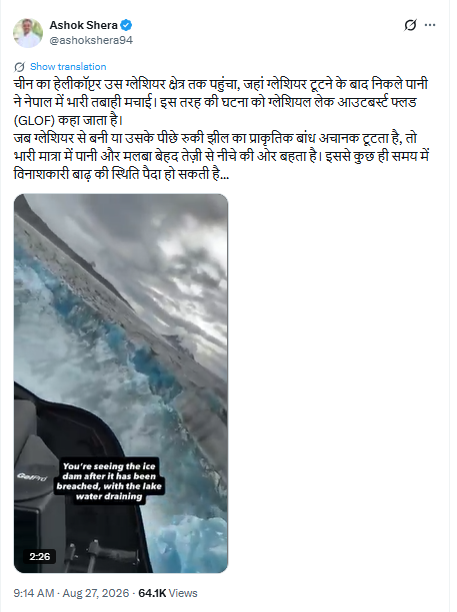
The video is being shared on X with a caption claiming: “A Chinese helicopter reached the glacier region where water released after the glacier broke apart caused massive destruction in Nepal. Such an event is known as a Glacial Lake Outburst Flood (GLOF).”
https://x.com/ashokshera94/status/2092820484811538681
Fact Check
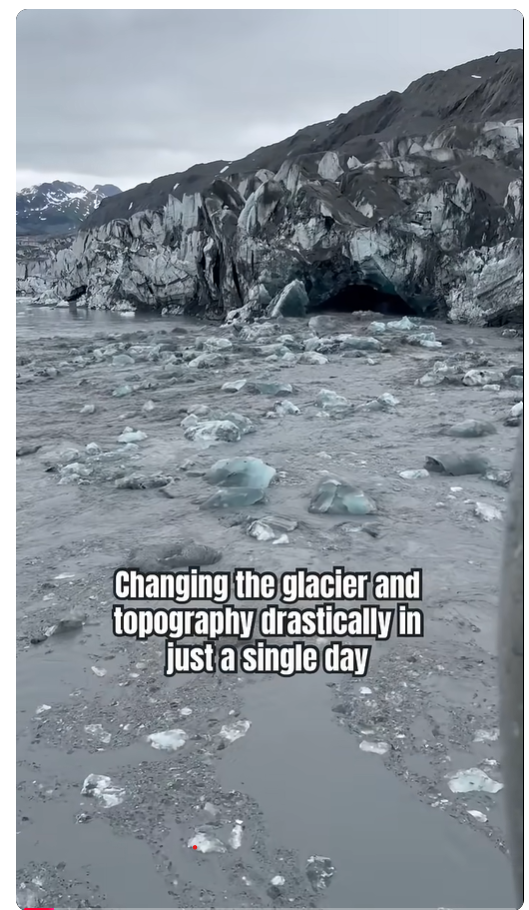
To verify the viral video claiming that a Chinese helicopter reached the site of the glacier break after the floods in Nepal, we conducted a reverse image search using keyframes from the clip. During the search, we found a video featuring the same visuals uploaded on a YouTube account named “Heli Pilot Leigh” on January 16, 2025. The location mentioned with the video identified it as Alaska, USA.
https://www.youtube.com/shorts/floh1LkZT7o
We also found several videos featuring scenes similar to those in the viral video on Ligh Kotes’ YouTube account. Among them, a nearly two-minute-long video uploaded on January 16, 2025, also contains visuals similar to those seen in the viral clip. Recorded from a helicopter, the video shows Ligh extending her mobile phone outside the helicopter to capture footage of water rushing out at high speed following the breaking of a glacier. https://www.youtube.com/watch?v=5vQP5HlyMMY
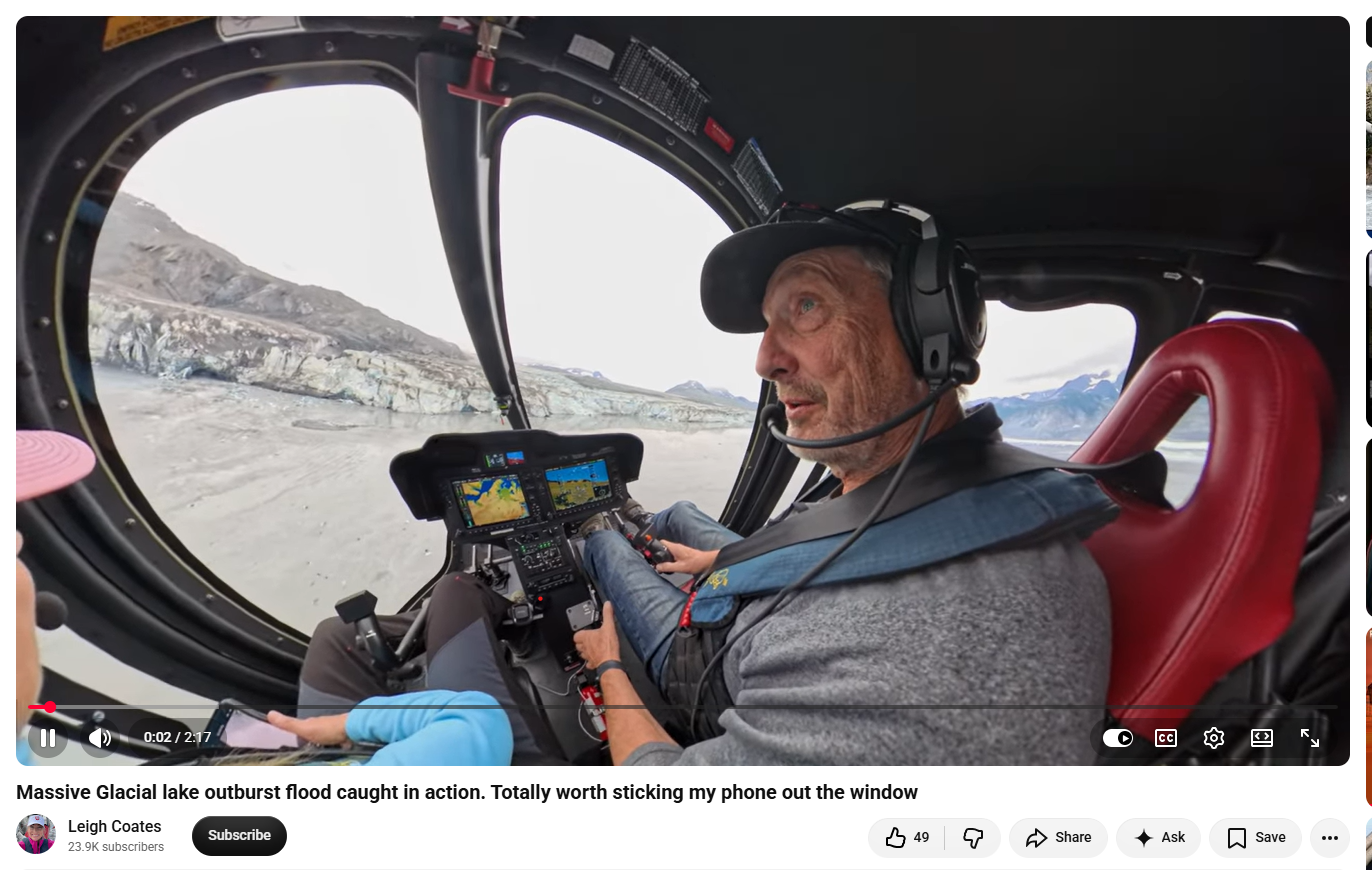
Additionally, our research found that the Columbia Glacier featured in Ligh’s video is located near Valdez, Alaska.
https://www.alaska.org/detail/columbia-glacier

Conclusion
The evidence gathered during our research makes it clear that the viral video, which is being shared with the claim that a Chinese helicopter reached the site of a glacier collapse following floods in Nepal, is actually from the Columbia Glacier in Alaska, USA. The video was recorded by an American pilot, Ligh Kotes.

Related Blogs

Introduction
In June 2026, Eros Innovation launched Eros Music Worlds, describing itself as the world's first "large cultural music platform". Its first two acts, Jordan and Tanu, are not singers in any conventional sense; they are AI-native personas built from Eros's own film characters, powered by models trained on a licensed corpus of roughly 1.5 trillion cultural tokens drawn from 11,000 films. Alongside them sits a strategic partnership with the family of Mohammed Rafi, the late playback legend, to produce new recordings, a live concert franchise, and a music academy in his name. It's a tidy preview of where AI in music is actually headed: not a novelty generator bolted onto the old industry, but a new kind of media company built around owned IP, licensed data, and characters designed to outlive any single song.
Beyond the demo
The last eighteen months have produced a stream of "firsts". Xania Monet, an AI-voiced R&B act built by Mississippi poet Telisha Jones using Suno, became the first AI artist to chart on a Billboard airplay ranking and was signed by Hallwood Media after a bidding war that reportedly reached $3 million. Breaking Rust, Enlly Blue and Juno Skye followed onto country, rock and Christian charts within weeks. None of this happened in a vacuum: Suno and Udio, the two dominant AI music generators, went from being sued by every major label in mid-2024 to signing licensing settlements with Universal and Warner by late 2025. Voice cloning has run a parallel track from the viral 2023 track "Heart on My Sleeve", which mimicked Drake and The Weeknd without consent, to a wave of Indian cases where AI tools recreated a specific singer's timbre for commercial use. Composition and production tools are now routine studio infrastructure rather than curiosities; the interesting frontier has shifted to multilingual adaptation and catalogue reanimation. Eros has promised 34-language localisation for its AI artists, a scale no dubbing studio could match manually. A related, if less music-specific, signal came from Collective Artists Network's AI-powered Mahabharat: Ek Dharmayudh, produced with Prasar Bharati. AI tools handled pre-visualisation, multi-language dubbing sync and sound design, while composers and voice directors retained control of tone and emotion, a template other Indian studios are likely to copy for scoring and localising large-scale cultural content cheaply.
Where the money actually is?
The commercial case for labels isn't "AI makes music at scale", because scale alone isn't value. Deezer, the only major platform publishing detection data, reported in July 2026 that AI-generated tracks had crossed 50% of daily uploads, around 90,000 tracks a day, up from 10,000 in January 2025. Yet those tracks account for only 1–3% of actual streams, and Deezer flags 85% of that listening as fraudulent bot activity. Generating music has become nearly free; getting anyone to listen hasn't. The real opportunity for rights holders lies elsewhere: licensing catalogues into controlled ecosystems (Universal's 2026 platform with Udio, Warner's deals with both Udio and Suno), reviving legacy artists for new audiences (Eros-Rafi), and using AI for the unglamorous, high-volume work of localisation, sync placement and short-form content that never justified full production budgets before. AI-native performers also travel well into gaming, virtual concerts and brand collaboration formats built for characters rather than people, where a synthetic act never ages, never cancels a tour and can be licensed into a dozen campaigns simultaneously. That is a genuinely new revenue line, but it's a narrow one; it monetises IP ownership, not music generation itself. IFPI's Global Music Report 2026 shows the underlying business is healthy: revenues reached $31.7 billion, up 6.4% — but that growth is still driven overwhelmingly by human catalogues and paid subscriptions, not AI-generated volumes.
The legal fault lines
This is where India's position is genuinely instructive and unresolved. The Copyright Act, 1957, defines the author of a "computer-generated" work as the person who causes it to be created (language added in 1994 for a world of human-directed software, not autonomous generative models), and Indian courts haven't yet settled how far it stretches. What's clearer is the industry's stance on training data: The Indian music industry body, alongside T-Series, Saregama and Sony Music, has sought to join the ANI Media suit against OpenAI in the Delhi High Court, arguing that scraping sound recordings to train models without a licence breaches copyright, a case they say is "crucial for the entire music industry in India, and even worldwide".
Personality rights have moved faster than legislation. In the absence of a dedicated statute, Indian courts have built protection case by case: the Delhi High Court's 2023 order shielding Anil Kapoor's voice and likeness from AI misuse and the Bombay High Court's 2024 ruling in Arijit Singh v Codible Ventures, India's first AI voice-cloning judgement, which granted an injunction spanning every medium, explicitly including the metaverse and generative-AI tools, and rejected fair-use and parody defences outright. Similar orders have since followed for Amitabh Bachchan, Aishwarya Rai Bachchan and others. The pattern mirrors, but predates, statutory responses abroad: Tennessee's 2024 ELVIS Act was the first US law to protect voice explicitly as property, and the federal NO FAKES Act remains pending. The US Copyright Office's January 2025 report reaffirmed that human authorship is the bedrock of copyrightability, denying protection to fully AI-generated output while leaving substantially human-directed hybrid works to case-by-case review. Two regimes are converging on the same instinct that consent and human contribution must anchor ownership through different legal tools: India via judge-made personality rights and the US via statute and Copyright Office guidance.
Who bears the risk?
The disruption isn't evenly spread. Session singers, jingle artists, dubbing performers and early-career composers, the layer of the industry that supplies craft rather than fame, are most exposed since their work is precisely what generative tools now approximate cheaply. A PRS for Music survey of over 2,600 creators found 79% worried about AI competing directly with their output and 76% expecting it to hurt their livelihoods. CISAC has projected AI could erode musicians' incomes by nearly a quarter by 2028. Separately, roughly a fifth of professional voice actors surveyed say they've already lost work to a synthetic voice. For streaming platforms, the risk is structural: as AI supply floods catalogues, royalty pools shared across all streams get diluted, discoverability worsens, and fraud bot streams on AI tracks are designed purely to harvest royalties, which becomes a live threat to the economics everyone else depends on.
Recommendations
None of this points to AI simply replacing musicians, nor to it staying a background production tool. A third category is emerging AI-native "characters" with continuity, backstory and owned IP, closer to franchise properties than bands, which is exactly the model Eros and Hallwood Media are betting on. The deeper shift underneath it is economic: once the marginal cost of producing a new track approaches zero, the constraint on the industry stops being supplied and becomes attention. Whether AI-native artists become a durable category depends on questions still unresolved, training data legality chief among them, and on whether audiences keep listening once the novelty fades. Deezer's own research found 97% of listeners can't reliably distinguish AI from human music, yet 52% still believe fully AI-generated songs shouldn't sit on the same charts as human ones. Provenance matters even when perception can't detect it.
Conclusion
Scarcity in the age of AI will not be creative output but genuine human connection. As AI makes music production abundant and inexpensive, the qualities it cannot replicate authenticity, lived experience, artistic identity, and trust – become increasingly valuable. Audiences will continue to seek creators with compelling stories and meaningful live experiences. In an era of infinite synthetic content, originality is no longer the premium; credibility, human presence, and emotional connection are.
Sources
- https://www.livemint.com/industry/media/ai-music-ai-native-artists-eros-music-worlds-eros-innovation-copyright-intellectual-property-music-industry-11785053693997.html
- https://www.facebook.com/KJSIMofficial/posts/the-mint-featured-insights-from-dr-alka-agarwal-assistant-professor-general-mana/1375301184595168/
- https://www.linkedin.com/posts/livemint_how-ai-brought-the-mahabharat-to-life-collective-activity-7389643662193999873-6BKG
- https://musically.com/2026/07/02/ai-powered-platform-eros-music-worlds-is-turning-film-characters-into-virtual-singers/
- https://www.business-standard.com/companies/news/bollywood-t-series-saregama-sony-music-copyright-lawsuit-openai-delhi-hc-125021400876_1.html

Introduction
A photo circulating on social media depicting modified tractors is being misrepresented as part of the 'Delhi Chalo' farmers' protest narrative. In the recent swirl of misinformation surrounding the 'Delhi Chalo' farmers' protest. A photo, ostensibly showing a phalanx of modified tractors, has been making the rounds on social media platforms, falsely tethered to the ongoing protests. This image, accompanied by a headline suggesting a mechanical metamorphosis to resist police barricades, was allegedly published by a news agency. However, beneath the surface of this viral phenomenon lies a more complex and fabricated reality.
The Movement
The 'Delhi Chalo' movement, a clarion call that resonated with thousands of farmers from the fertile plains of Punjab, the verdant fields of Haryana, and the sprawling expanses of Uttar Pradesh, has been a testament to the agrarian community's demand for assured crop prices and legal guarantees for the Minimum Support Price (MSP). The protest, which has seen the fortification of borders and the chaos at the Punjab-Haryana border on February 13, 2024, has become a crucible for the farmers' unyielding spirit.
Yet, amidst this backdrop of civil demonstration and discourse, a nefarious narrative of misinformation has taken root. The viral image, which has been shared with the fervour of wildfire, was accompanied by a screenshot of an article allegedly published by the news agency. This article, dated February 11, 2024, quoted an anonymous official who claimed that intelligence agencies had alerted the police to the protesters' plans to outfit tractors with hydraulic tools. The implication was clear: these machines had been transformed into battering rams against the bulwark of law enforcement.
The Pursuit of Truth
However, the India TV Fact Check team, in their relentless pursuit of truth, unearthed that the viral photo of these so-called modified tractors is nothing but a chimerical creation, a figment of artificial intelligence. Visual discrepancies betrayed its AI-generated nature.
This is not the first time that the misinformation has loomed over the farmers' protest. Previous instances, including a viral video of a modified tractor, have been debunked by the same fact-checking team. These efforts are a bulwark against the tide of false narratives that seek to muddy the waters of public understanding.
The claim that the photo depicted modified tractors intended for use in the ‘Delhi Chalo’ farmers' protest rally in Delhi on February 13, 2024, was a mirage.
The Fact Check
OpIndia, in their article, clarified that the photo used was a representative image created by AI and not a real photograph. To further scrutinize this viral photo, the HIVE AI detector tool was employed, indicating a 99.4% likelihood of the image being AI-generated. Thus, the claim made in the post was misleading.
The viral photo claiming that farmers had modified their tractors to avoid tear gas shells and remove barricades put up by the police during the rally was a digital illusion. The internet has become a fertile ground for the rapid spread of misinformation, reaching millions in an instant. Social media, with its complex algorithms, amplifies this spread, as any interaction, even those intended to debunk false information, inadvertently increases its reach. This phenomenon is exacerbated by 'echo chambers,' where users are exposed to a homogenous stream of content that reinforces their pre-existing beliefs, making it difficult to encounter and consider alternative perspectives.
Conclusion
The viral image depicting modified tractors for the ‘Delhi Chalo’ farmers' protest rally was a digital fabrication, a testament to the power of AI in creating convincing yet false narratives. As we navigate the labyrinth of information in the digital era, it is imperative to remain vigilant, to question the veracity of what we see and hear, and to rely on the diligent work of fact-checkers in discerning the truth. The mirage of modified machines serves as a stark reminder of the potency of misinformation and the importance of critical thinking in the age of artificial intelligence.
References
- https://www.indiatvnews.com/fact-check/fact-check-ai-generated-tractor-photo-misrepresented-delhi-chalo-farmers-protest-narrative-msp-police-barricades-punjab-haryana-uttar-pradesh-2024-02-15-917010
- https://factly.in/this-viral-image-depicting-modified-tractors-for-the-delhi-chalo-farmers-protest-rally-is-created-using-ai/

Executive Summary
A video is being widely circulated on social media by Pakistani propaganda-linked users, showing a group of people protesting on a road. It is being claimed that protesters in Jammu & Kashmir stopped Indian Army personnel from entering Nagrota, indicating growing public opposition against the forces. Research by CyberPeace Research Wing found that the claim is misleading. The viral video is unrelated to any protest against the Indian Army.
Claim
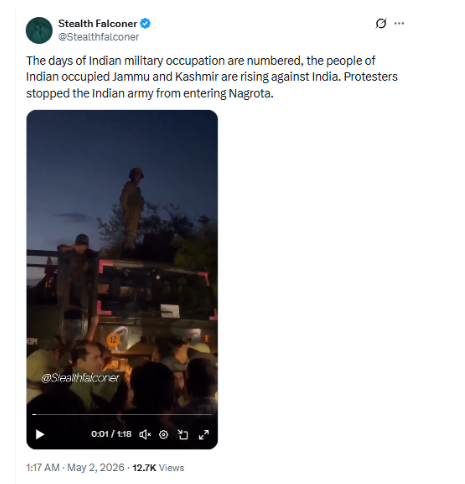
A user posted the video on X, claiming: “The days of Indian military occupation are numbered; people of Jammu & Kashmir have risen against India. Protesters stopped the Indian Army from entering Nagrota.”
- https://x.com/Stealthfalconer/status/2050301106623045758?s=20
Fact Check
During the research, the CyberPeace Research Wing team found no evidence of any such incident where civilians blocked or opposed the Indian Army in Nagrota. Further probe led to a post by an X user “Defence News Of INDIA,” which contained the full version of the viral video. The accompanying information clarified that the protest took place in Dansal’s Badsu Panchayat area of Nagrota and was led by BJP MLA Devayani Rana.
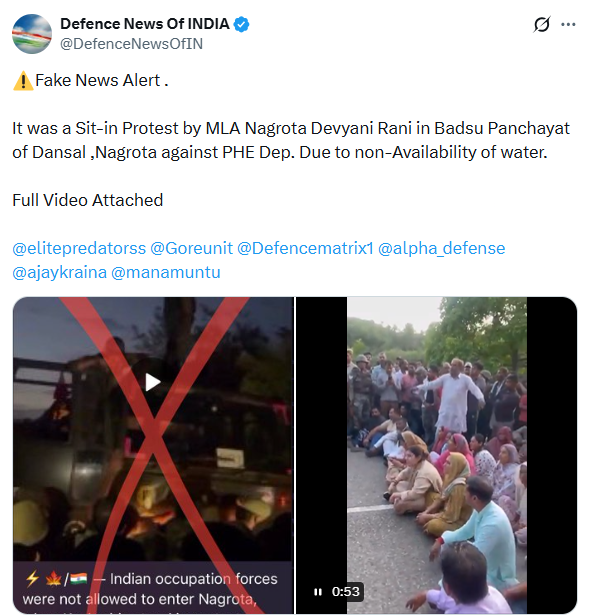
The protest was organized against the Public Health Engineering (PHE) Department over severe water shortage issues in the region. Locals, along with the MLA, staged a sit-in to highlight the lack of water supply.
We also found multiple media reports, including from KBC News – Kashmir and Jammu Links News, confirming that Devayani Rana led a road blockade protest in her constituency over water scarcity and accused the Jal Shakti Department of negligence and administrative failure. Additionally, videos of the same protest were available on social media platforms, including live streams shared from Devayani Rana’s official pages.

Conclusion
Our research confirms that the viral claim is false and misleading. The video does not show any protest against the Indian Army. It is actually from a demonstration led by Devayani Rana and local residents over water shortage issues in Nagrota.
