
#FactCheck- Old US Troops Homecoming Video Falsely Linked to Iran Ceasefire
Executive Summary
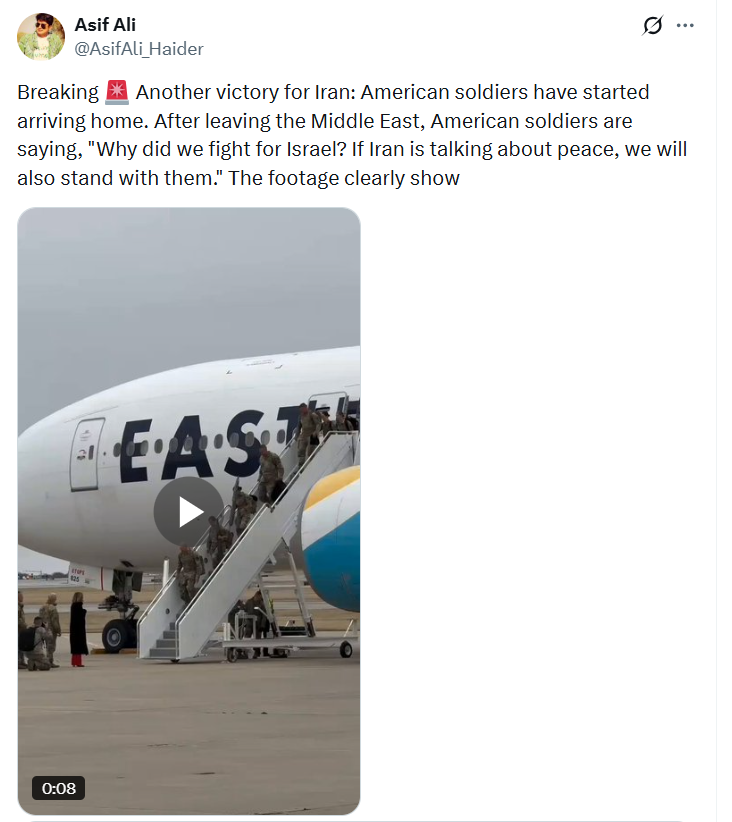
Talks between the United States and Iran over a ceasefire reportedly held in Islamabad on Saturday ended without a resolution. Meanwhile, a video circulating on social media claims to show US troops returning home following a ceasefire in the Middle East conflict.
However, a research by the CyberPeace found the claim to be false. The viral video is not linked to any recent ceasefire. It actually dates back to March and shows the return of Iowa National Guard troops after months of deployment in the Middle East.
Claim
An X (formerly Twitter) user posted the video on April 7, 2026, claiming,“Another victory for Iran: American soldiers have started arriving home. After leaving the Middle East, American soldiers are saying, ‘Why did we fight for Israel? If Iran is talking about peace, we will also stand with them.’”
Fact Check
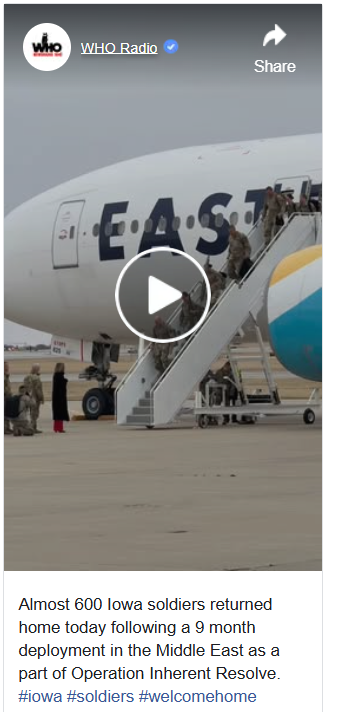
To verify the claim, we extracted keyframes from the viral video and conducted a reverse image search using Google Lens. This led us to posts by Newsradio 1040 WHO, which had shared the same footage on March 12 across Facebook and Instagram.
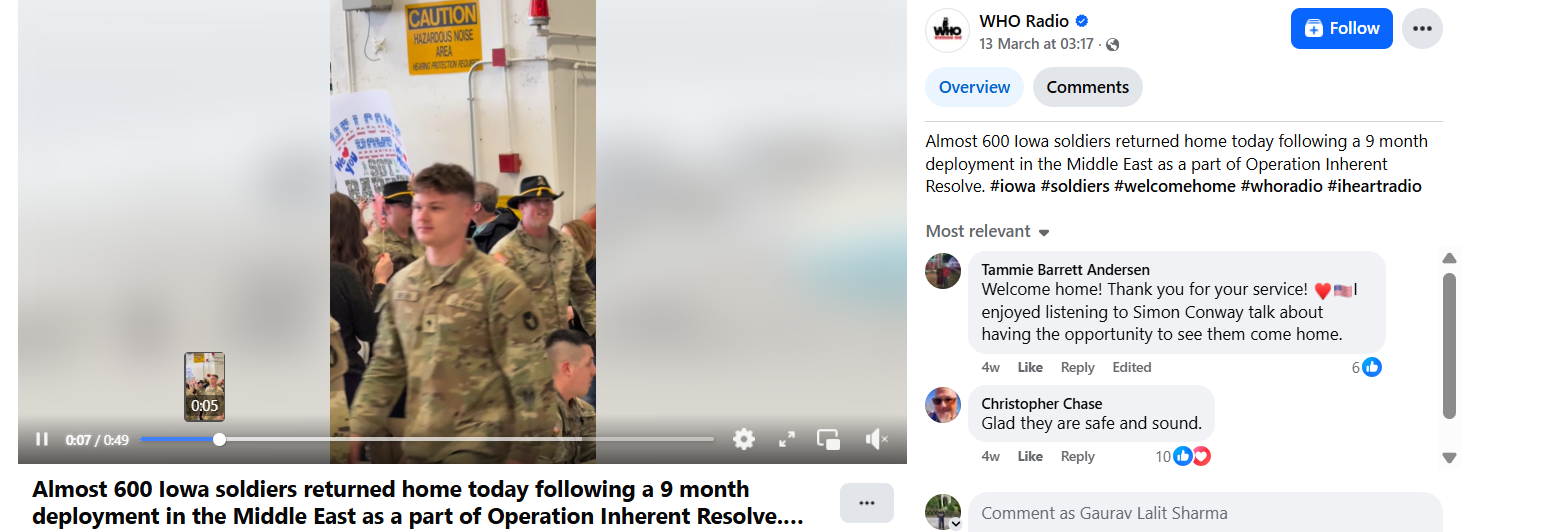
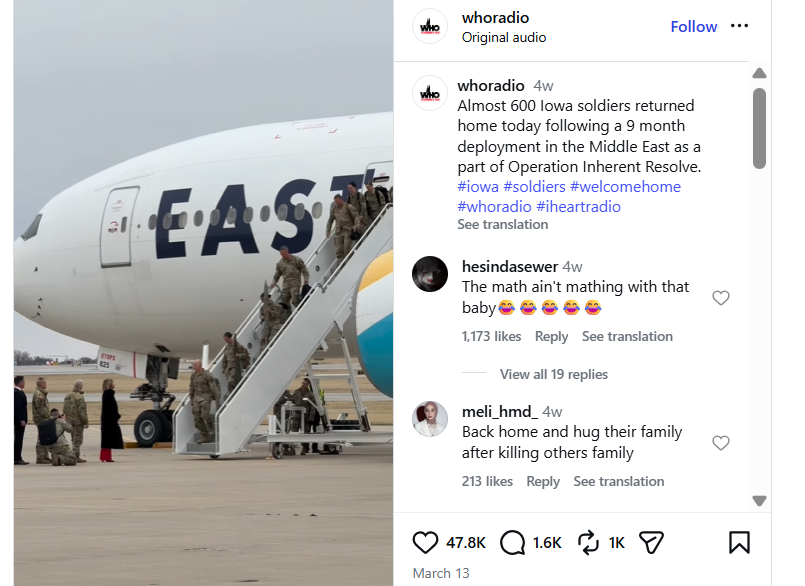
In its caption, the radio station stated that nearly 600 Iowa soldiers had returned home after a nine-month deployment in the Middle East as part of Operation Inherent Resolve. The segment, narrated by journalist Claire Burnett, explained that the soldiers belonged to the 2nd Brigade Combat Team, 34th Infantry Division, and had been deployed to Iraq and Syria. The footage was recorded at the 132nd Wing base of the Iowa Air National Guard in Des Moines.
For further confirmation, a March 12 report by KCCI 8 News also showed the same aircraft and troops, verifying the authenticity and timeline of the footage
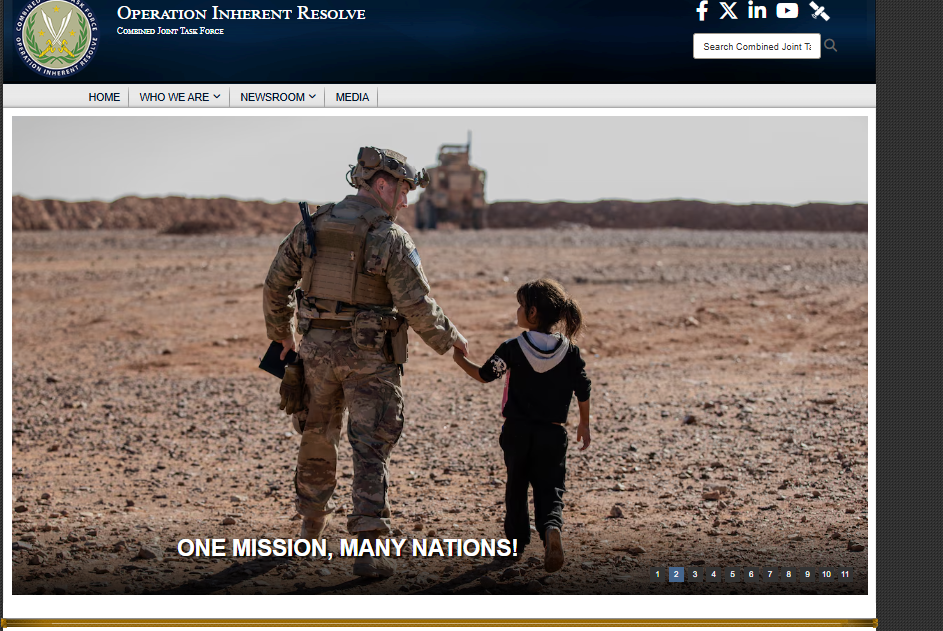
Operation Inherent Resolve, launched in 2014, is a US-led campaign aimed at supporting local forces in the fight against the Islamic State (ISIS) and ensuring its lasting defeat.
https://www.kcci.com/article/iowans-welcome-national-guard-unit-home-from-deployment-in-middle-east/70729105

Conclusion
The viral claim is false and misleading. The video does not show US troops returning due to any recent ceasefire between the United States and Iran. Instead, it captures the routine homecoming of Iowa National Guard soldiers in March after completing a scheduled deployment in the Middle East.There is no evidence linking the footage to current geopolitical developments or any ceasefire agreement. The claim has been taken out of context and shared with a misleading narrative to create confusion around ongoing international events.

Related Blogs

Executive Summary:
A video circulating online claims to show a man being assaulted by BSF personnel in India for selling Bangladesh flags at a football stadium. The footage has stirred strong reactions and cross border concerns. However, our research confirms that the video is neither recent nor related to the incident that occurred in India. The content has been wrongly framed and shared with misleading claims, misrepresenting the actual incident.
Claim:
It is being claimed through a viral post on social media that a Border Security Force (BSF) soldier physically attacked a man in India for allegedly selling the national flag of Bangladesh in West Bengal. The viral video further implies that the incident reflects political hostility towards Bangladesh within Indian territory.

Fact Check:
After conducting thorough research, including visual verification, reverse image searching, and confirming elements in the video background, we determined that the video was filmed outside of Bangabandhu National Stadium in Dhaka, Bangladesh, during the crowd buildup prior to the AFC Asian Cup. A match featuring Bangladesh against Singapore.

Second layer research confirmed that the man seen being assaulted is a local flag-seller named Hannan. There are eyewitness accounts and local news sources indicating that Bangladeshi Army officials were present to manage the crowd on the day under review. During the crowd control effort a soldier assaulted the vendor with excessive force. The incident created outrage to which the Army responded by identifying the officer responsible and taking disciplinary measures. The victim was reported to have been offered reparations for the misconduct.

Conclusion:
Our research confirms that the viral video does not depict any incident in India. The claim that a BSF officer assaulted a man for selling Bangladesh flags is completely false and misleading. The real incident occurred in Bangladesh, and involved a local army official during a football event crowd-control situation. This case highlights the importance of verifying viral content before sharing, as misinformation can lead to unnecessary panic, tension, and international misunderstanding.
- Claim: Viral video claims BSF personnel thrashing a person selling Bangladesh National Flag in West Bengal
- Claimed On: Social Media
- Fact Check: False and Misleading

Introduction
The 2023-24 annual report of the Union Home Ministry states that WhatsApp is among the primary platforms being targeted for cyber fraud in India, followed by Telegram and Instagram. Cybercriminals have been conducting frauds like lending and investment scams, digital arrests, romance scams, job scams, online phishing etc., through these platforms, creating trauma for victims and overburdening law enforcement, which is not always the best equipped to recover their money. WhatsApp’s scale, end-to-end encryption, and ease of mass messaging make it both a powerful medium of communication and a vulnerable target for bad actors. It has over 500 million users in India, which makes it a primary subject for scammers running illegal lending apps, phishing schemes, and identity fraud.
Action Taken by Whatsapp
As a response to this worrying trend and in keeping with Rule 4(1)(d) of the Information Technology (Intermediary Guidelines and Digital Media Ethics Code) Rules, 2021, [updated as of 6.4.2023], WhatsApp has been banning millions of Indian accounts through automated tools, AI-based detection systems, and behaviour analysis, which can detect suspicious activity and misuse. In July 2021, it banned over 2 million accounts. By February 2025, this number had shot up to over 9.7 million, with 1.4 million accounts removed proactively, that is, before any user reported them. While this may mean that the number of attacks has increased, or WhatsApp’s detection systems have improved, or both, what it surely signals is the acknowledgement of a deeper, systemic challenge to India’s digital ecosystem and the growing scale and sophistication of cyber fraud, especially on encrypted platforms.
CyberPeace Insights
- Under Rule 4(1)(d) of the IT Rules, 2021, significant social media intermediaries (SSMIs) are required to implement automated tools to detect harmful content. But enforcement has been uneven. WhatsApp’s enforcement action demonstrates what effective compliance with proactive moderation can look like because of the scale and transparency of its actions.
- Platforms must treat fraud not just as a content violation but as a systemic abuse of the platform’s infrastructure.
- India is not alone in facing this challenge. The EU’s Digital Services Act (DSA), for instance, mandates large platforms to conduct regular risk assessments, maintain algorithmic transparency, and allow independent audits of their safety mechanisms. These steps go beyond just removing bad content by addressing the design of the platform itself. India can draw from this by codifying a baseline standard for fraud detection, requiring platforms to publish detailed transparency reports, and clarifying the legal expectations around proactive monitoring. Importantly, regulators must ensure this is done without compromising encryption or user privacy.
- WhatsApp’s efforts are part of a broader, emerging ecosystem of threat detection. The Indian Cyber Crime Coordination Centre (I4C) is now sharing threat intelligence with platforms like Google and Meta to help take down scam domains, malicious apps, and sponsored Facebook ads promoting illegal digital lending. This model of public-private intelligence collaboration should be institutionalized and scaled across sectors.
Conclusion: Turning Enforcement into Policy
WhatsApp’s mass account ban is not just about enforcement but an example of how platforms must evolve. As India becomes increasingly digital, it needs a forward-looking policy framework that supports proactive monitoring, ethical AI use, cross-platform coordination, and user safety. The digital safety of users in India and those around the world must be built into the architecture of the internet.
References
- https://scontent.xx.fbcdn.net/v/t39.8562-6/486805827_1197340372070566_282096906288453586_n.pdf?_nc_cat=104&ccb=1-7&_nc_sid=b8d81d&_nc_ohc=BRGwyxF87MgQ7kNvwHyyW8u&_nc_oc=AdnNG2wXIN5F-Pefw_FTt2T4K6POllUyKpO7nxwzCWxNgQEkVLllHmh81AHT2742dH8&_nc_zt=14&_nc_ht=scontent.xx&_nc_gid=iaQzNQ8nBZzxuIS4rXLOkQ&oh=00_AfEnbac47YDXvymJ5vTVB-gXteibjpbTjY5uhP_sMN9ouw&oe=67F95BF0
- https://scontent.xx.fbcdn.net/v/t39.8562-6/217535270_342765227288666_5007519467044742276_n.pdf?_nc_cat=110&ccb=1-7&_nc_sid=b8d81d&_nc_ohc=aj6og9xy5WQQ7kNvwG9Vzkd&_nc_oc=AdnDtVbrQuo4lm3isKg5O4cw5PHkp1MoMGATVpuAdOUUz-xyJQgWztGV1PBovGACQ9c&_nc_zt=14&_nc_ht=scontent.xx&_nc_gid=gabMfhEICh_gJFiN7vwzcA&oh=00_AfE7lXd9JJlEZCpD4pxW4OOc03BYcp1e3KqHKN9-kaPGMQ&oe=67FD6FD3
- https://www.hindustantimes.com/india-news/whatsapp-is-most-used-platform-for-cyber-crimes-home-ministry-report-101735719475701.html
- https://www.indiatoday.in/technology/news/story/whatsapp-bans-over-97-lakhs-indian-accounts-to-protect-users-from-scam-2702781-2025-04-02
Executive Summary
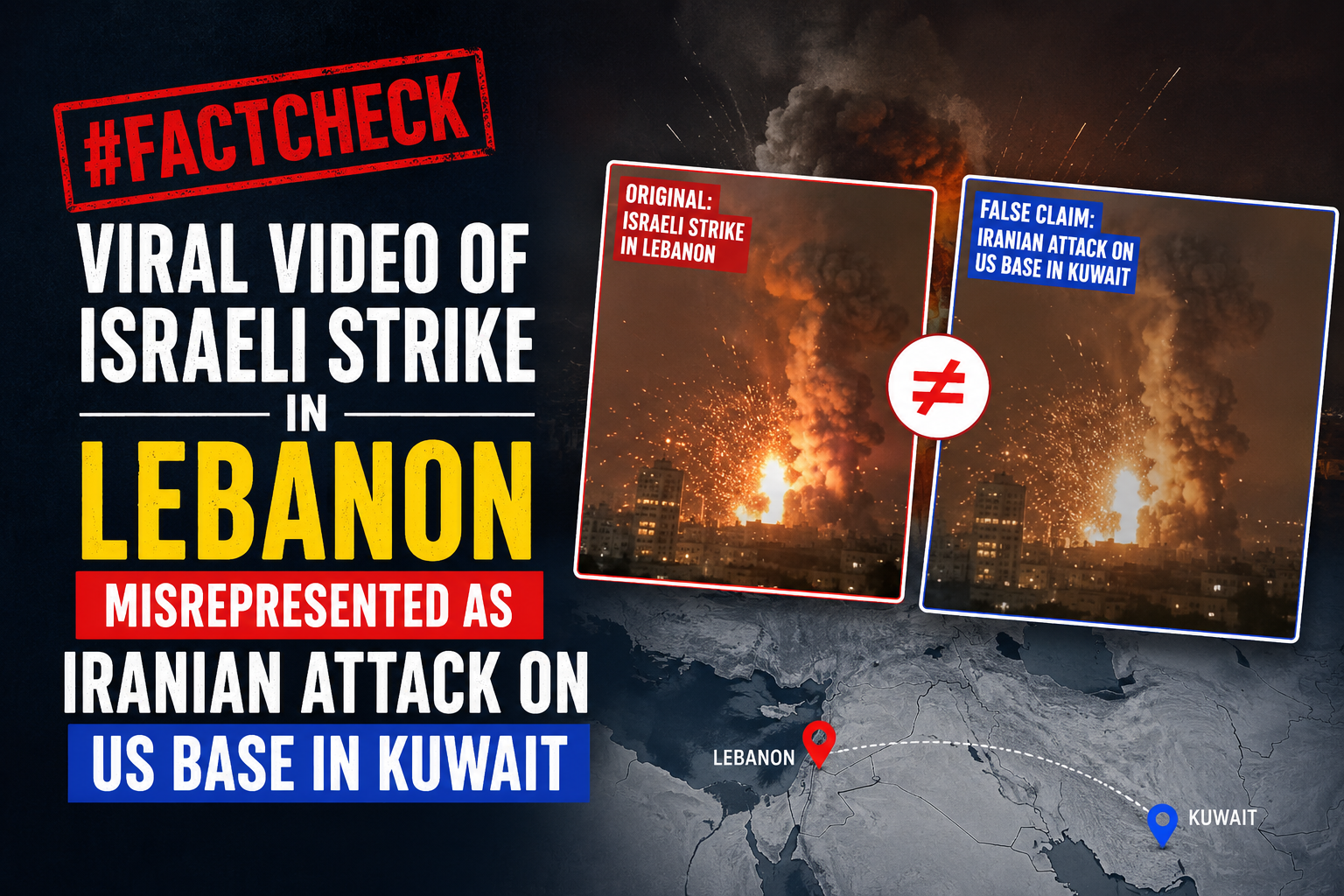
Amid heightened tensions in West Asia following the conflict involving the United States, Israel and Iran, a video showing a large explosion behind a building is being widely shared on social media.
Users claim that the footage shows an Iranian missile strike on a US military base in Kuwait. However, CyberPeace Research Wing research found the claim to be misleading. The viral video is actually from an Israeli airstrike in southern Lebanon. While Kuwait said its air defence systems intercepted missiles and drones during regional hostilities, the viral footage has no connection to any alleged attack on a US base in Kuwait.
Claim
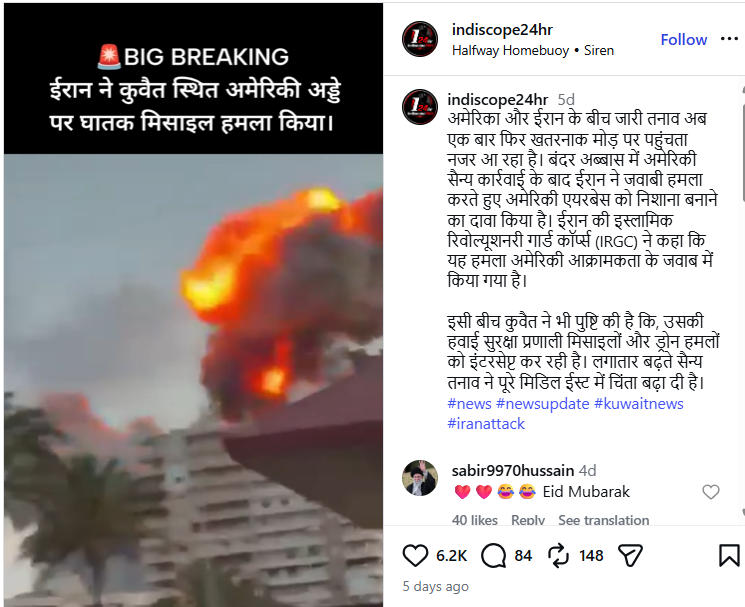
An Instagram user, “indiscope24hr,” shared the video on May 28, 2026, with text overlaid on the clip stating:“Iran launches a deadly missile attack on a US base in Kuwait.”The caption claimed that Iran targeted a US airbase in retaliation for American military action and that Kuwait’s air defence systems were intercepting incoming missiles and drones.
Fact Check
To verify the claim, we extracted key frames from the viral video and conducted a reverse image search using Google Lens. This led us to a post shared on May 28, 2026, by the Instagram account “iltv_israel,” which identified the footage as an Israeli Air Force strike on a Hezbollah target in the southern Lebanese city of Tyre.

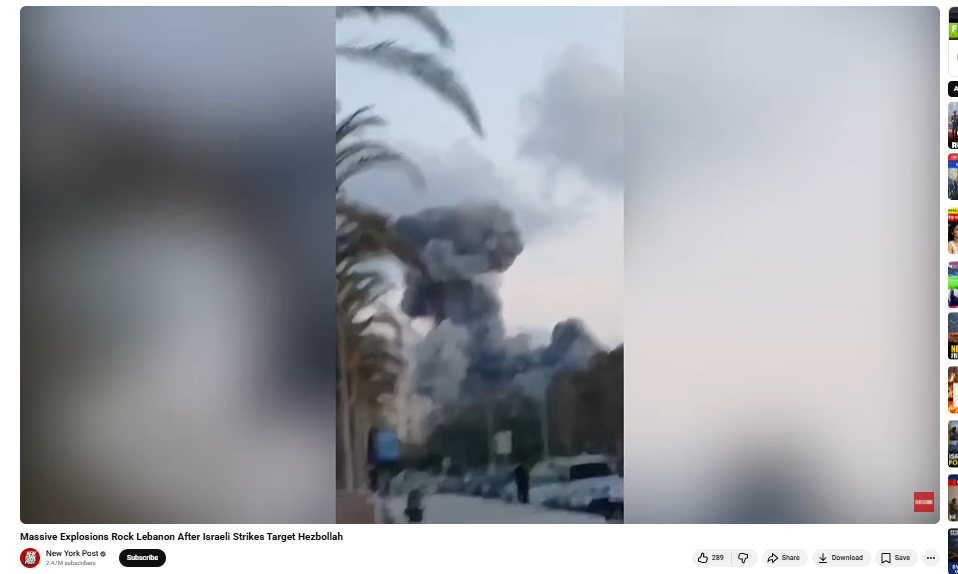
Further research found the same footage in a video report uploaded by the New York Post’s YouTube channel on May 28, 2026. According to the report, Israel carried out strikes targeting Hezbollah positions in Tyre, southern Lebanon.
We also found the clip in a video report published by NBC News. The report stated that Israel intensified strikes in southern Lebanon despite an existing ceasefire agreement.
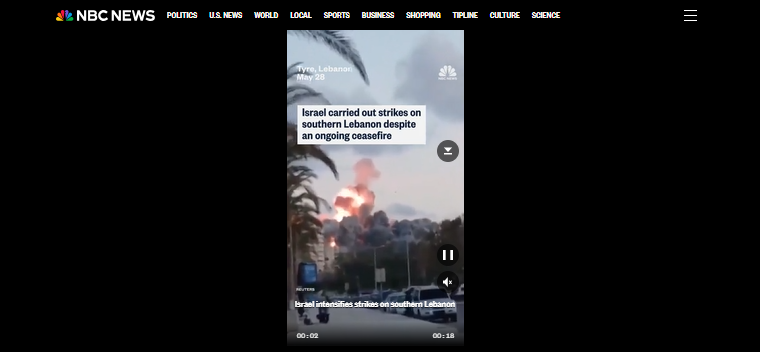
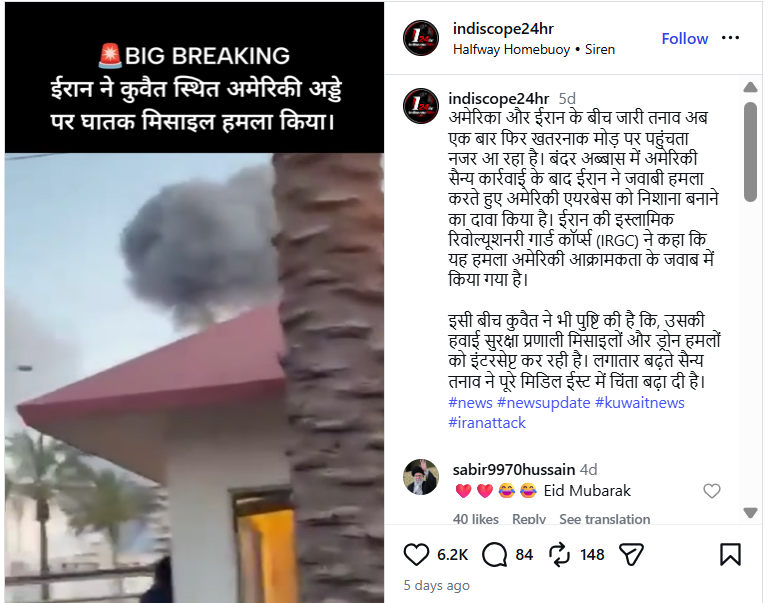
The matching visuals across these reports confirm that the viral footage originated from Lebanon and not from Kuwait.
Conclusion
The viral claim is misleading. The video does not show an Iranian missile strike on a US military base in Kuwait. It actually depicts an Israeli airstrike carried out in the Lebanese city of Tyre on May 28, 2026, and is being shared with a false context on social media.
