
#FactCheck-Claim Linking UP School Hostel Video of Injured Children to Delhi CJP Protest is False
Executive Summary
A video showing several children in an injured condition is being widely shared on social media with the claim that the footage is from the ‘Sansad March’ protest organised by the Cockroach Janata Party (CJP) on July 20, 2026. The video is being circulated with the allegation that Delhi Police lathi-charged children during the protest in Delhi. CyberPeace Research Wing’s research found the claim to be false. The viral video is not related to the CJP protest in Delhi. The footage is from an old incident at a private school hostel in Farrukhabad, Uttar Pradesh, where a warden was accused of assaulting students. The old video has been falsely linked to the recent protest with a misleading claim.
Claim:
A Facebook user named ‘The sociopolitics’ shared the video on July 23, 2026, claiming that children were beaten by Delhi Police during the protest.The post stated, “What had the children done wrong? Were they beaten with their eyes covered, or was the anger of their bosses taken out on the public?” The viral post was shared widely on social media by users who believed the claim to be true. The archived version of the post can be accessed here:
https://www.instagram.com/reels/DbKiqy8lOu5/

Fact Check:
To verify the authenticity of the viral video, the Desk first analysed the footage carefully and examined its audio. The conversation of the children in the video made it clear that the visuals were not connected to the student protest at Delhi’s Jantar Mantar or any police lathi-charge. In the video, the children can be heard mentioning the name of their school and speaking about the warden who allegedly assaulted them. The video also displayed the Instagram username ‘parulpatel4618’, which provided a lead for further research.
https://www.instagram.com/p/DbFcdAjxvG5

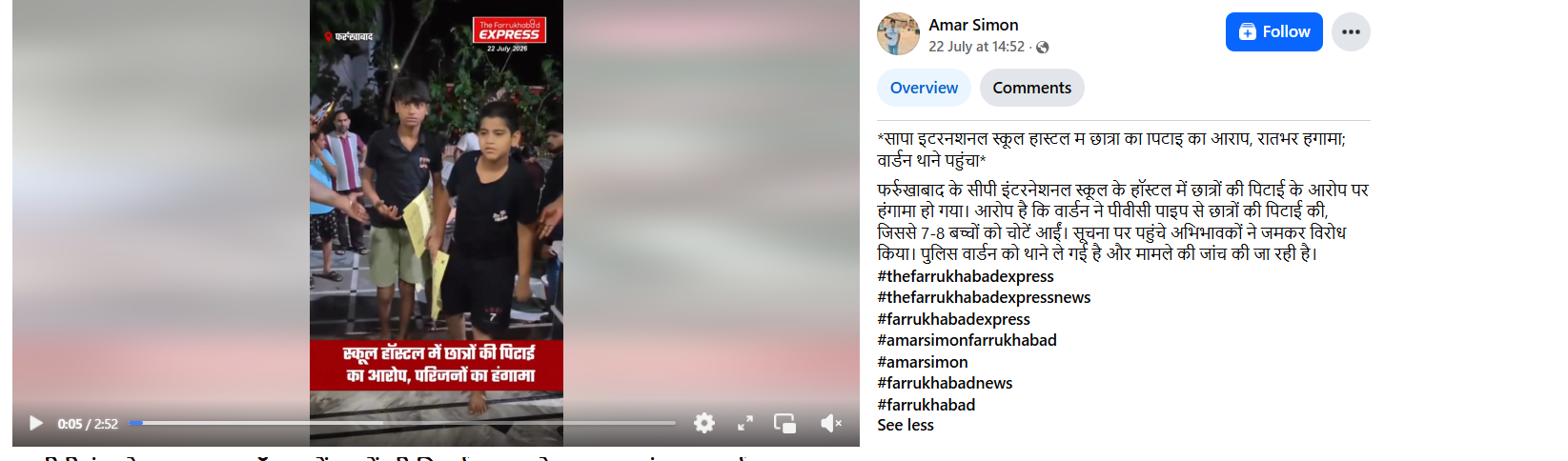
In the next stage of the research, the Desk found a Facebook post dated July 22, 2026, related to the incident. According to the post, students at CP International School hostel in Farrukhabad, Uttar Pradesh, were allegedly beaten, following which a protest was reported. The post stated that the hostel warden was accused of assaulting students with a PVC pipe, leaving several children injured. After receiving information about the incident, parents reached the spot and protested. Police took the warden to the police station and initiated an research.
https://www.facebook.com/watch/?v=992060370500487
Conclusion:
The research established that the viral video is not from the CJP ‘Sansad March’ protest in Delhi. The footage is from an old incident at a private school hostel in Farrukhabad, Uttar Pradesh, where a warden was accused of assaulting students. The video is being circulated with a false claim by linking it to a recent protest.

Related Blogs

Executive Summary
A picture of late actor Sushant Singh Rajput is being shared on social media. In the picture, a woman can be seen holding him, while another person is standing beside him. The social media post claims that the picture is from the last days of Sushant Singh Rajput’s life.CyberPeace Research found the viral claim to be false. Our research found that the viral picture is not authentic, but was created using Artificial Intelligence (AI). The AI-generated image is being shared on social media with a misleading claim.
Claim:
On September 18, 2026, a Facebook user shared the viral picture with the caption, “How was Sushant Singh murdered? The photo is going viral.” The post link, archived link and screenshot are provided below.
https://www.facebook.com/reel/1591592259073828

Fact Check
To verify the authenticity of the viral image, we conducted a Google search using relevant keywords. However, we did not find any credible media report related to the viral image. In the next step of our research, we examined the viral image closely and noticed several inconsistencies that raised suspicion that it had been AI-generated. We then scanned the image using AI or Not. According to the results, the viral image was identified as AI-generated.

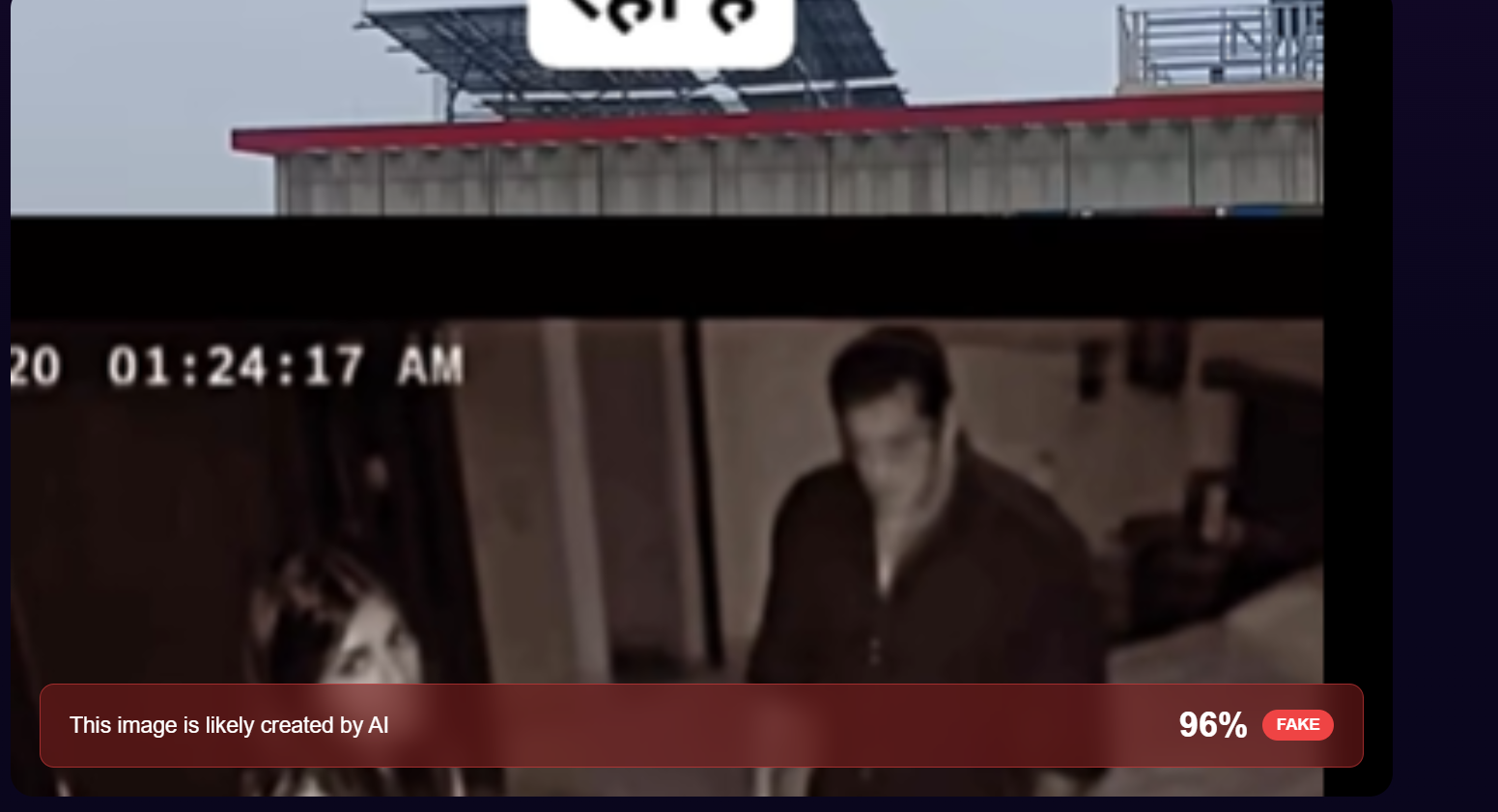
We also scanned the viral image using another AI detection tool, DeepAI. According to the results, the image was found to have a 96 percent likelihood of being AI-generated.
Conclusion
Our research found that the viral image is not authentic, but was created using Artificial Intelligence (AI). The AI-generated image is being shared on social media with a misleading claim.

Introduction
India’s data centre sector is rapidly emerging as strategic national infrastructure at the centre of the country’s AI ambitions, fuelled by a combination of technological advancements and the global political economy. Estimates suggest that national data centre capacity is expected to rise from 1.2 GW in 2025 to almost 8 GW by 2030. With a funding of ₹10,372 crore, the IndiaAI Mission aims to establish domestic compute power and expand GPU infrastructure throughout the nation. Simultaneously, the Digital Personal Data Protection (DPDP) Act, 2023 has introduced a form of “soft localisation,” empowering the government to mandate domestic storage for sensitive categories of data.
Together, this push for infrastructure aims to transform India from a passive data market into an active shaper of global data flows. Yet India’s current policy model differs significantly from the approaches being adopted in other major digital economies. A comparison with Singapore and the European Union reveals that while India is focused on aggressive data centre expansion, other jurisdictions are increasingly prioritising sustainability, efficiency, and digital sovereignty.
This raises a critical policy question: can India scale its AI infrastructure ambitions while accounting for the governance and resource challenges that other markets are now attempting to correct?
India’s Incentive-Led AI Infrastructure Push
India’s current approach to data centre expansion is fundamentally facilitative. The state is acting as an enabler of rapid private investment through fiscal incentives and infrastructure prioritisation.
The Union Budget 2022 had classified data centres as “infrastructure,” which enables developers to access cheaper institutional financing and long-term capital. The Union Budget 2026 further introduced tax holidays for foreign cloud providers using Indian facilities for global operations. At the state level, governments such as Maharashtra and Uttar Pradesh are aggressively competing to attract hyperscale investments through electricity duty exemptions, expedited approvals, and “essential service” status designed to guarantee uninterrupted operations.
This approach reflects India’s broader strategic positioning. As global demand for AI compute accelerates, India seeks to establish itself not only as a major digital market, but as a sovereign compute hub for the Global South.
The IndiaAI Mission demonstrates this ambition clearly. By seeking to scale domestic GPU capacity to 100,000 units, the government is recognising that compute infrastructure is increasingly becoming geopolitically strategic. AI leadership will now depend on the ability to control and secure the physical infrastructure powering advanced AI systems.
However, while India’s policy framework strongly incentivises capacity creation, it remains relatively underdeveloped in areas such as sustainability benchmarks, resource management, and operational accountability.
Singapore and the European Union: Governance After Scale
Singapore and the European Union offer models of digital infrastructure governance as rapid infrastructure growth starts to raise resource and sovereignty issues.
With the limited energy resources and land at its disposal, Singapore has shifted from unrestricted data centre growth to a tightly managed sustainability-first model. Through the Data Centre Call for Application (DC-CFA) framework, only projects meeting strict efficiency and economic value criteria are approved. For instance, new facilities are expected to maintain Power Usage Effectiveness (PUE) levels of 1.3 or lower and submit detailed water efficiency plans to comply with advanced environmental standards. The country has also developed tropical cooling standards that allow facilities to run at higher ambient temperatures, reducing cooling energy consumption significantly. Rather than uninhibited growth, Singapore is now geared towards growth efficiency.
The European Union, on the other hand, is pursuing a sovereignty-oriented governance model in response to geopolitical pressures. However, it is still introducing energy reporting requirements and waste heat recovery rules into digital infrastructure rules through the revised Energy Efficiency Directive and proposed EU Cloud and AI Development Act. Simultaneously, the Digital Markets Act (DMA) is being used to investigate hyperscale cloud providers for potential “gatekeeper” behaviour, reflecting concerns about excessive concentration of digital infrastructure power in the hands of a few non-European firms. This approach shows that sovereignty and energy efficiency can go hand-in-hand.
These models illustrate an important trend: digital infrastructure governance is shifting from the promotion of investment to sustainability, competition regulation and strategic autonomy.
India’s Emerging Governance Challenge
India’s current trajectory and global geopolitical tensions suggest that pressures regarding sustainability and sovereignty are set to intensify over the next decade.
AI infrastructure is resource-intensive by design. For example, a single modern AI server rack can consume up to 250 kilowatts (kW) of power, compared to a traditional enterprise server rack which typically requires only 15 kW. Despite the use of water use effectiveness (WUE) technologies, the sheer volume of heat transfer means that AI data centres can still put immense pressure on local water resources, especially in warmer climates. These figures juxtaposed against hyperscale clusters mean the volumes of electricity, cooling systems, land, water, and high-density compute rise by significant orders of magnitude. Yet most Indian policies remain overwhelmingly focused on fiscal incentives rather than long-term resource governance.
This creates the risk of a reactive policy cycle in which sustainability standards are introduced only after resource pressures become acute. Urban concentration, grid stress, water scarcity, and energy reliability may eventually force abrupt regulatory interventions which can lead to higher compliance costs and uncertainty in operations.
At the same time, India’s push for sovereign AI infrastructure also raises broader questions around digital sovereignty and institutional capacity. Procuring GPUs alone does not create an AI ecosystem. Secure hosting environments, skilled infrastructure personnel, cybersecurity preparedness, and interoperable governance mechanisms are equally essential.
This makes workforce development a strategic human resource development issue rather than simply an industrial challenge. Without sufficient thermal engineers, cybersecurity professionals, and digital infrastructure specialists, India’s infrastructure ambitions may struggle to translate into long-term resilience.
Building Governance into the Expansion Phase
India’s current “pre-regulatory” moment also presents a significant opportunity. Because the sector is still evolving, both policymakers and infrastructure actors have the ability to shape governance standards before constraints become restrictive.
It is vital to establishing national sustainability benchmarks through public-private technical partnerships, possibly under the aegis of of NITI Aayog, the Bureau of Energy Efficiency (BEE) and MeitY, before the next resource pressures dictate reactive regulation. Pilot “sustainability sandboxes” focused on liquid immersion cooling, renewable integration, battery energy storage systems, and water-efficient operations could help create evidence-based policy frameworks tailored to Indian conditions. Similarly, Likewise, collaborations with skilling institutions like NSDC and NIELIT can contribute to the development of dedicated digital infrastructure academies for thermal engineering, cybersecurity, and AI infrastructure management.
This would support India to progress towards a sovereign AI infrastructure stack, bringing together compute capacity, sustainability, capacity building and governance resilience into a seamless ecosystem.
Conclusion
With AI systems become increasingly utilised in finance, healthcare, governance, and public services, the infrastructure ecosystem supporting them will become equally politically and strategically significant. The choices India makes today to operationalise sustainability, skilling, competition, and sovereign compute capacity will shape the foundations of its future AI economy.
The central challenge is no longer whether India can become a major AI infrastructure hub. It is whether the country can transition from an incentive-led expansion model toward a governance framework that balances scale with sustainability, sovereignty, democratic accountability, and long-term resilience.
That transition may ultimately define the success of India’s AI century.
References
https://indiaai.gov.in/news/cabinet-approves-india-ai-mission-at-an-outlay-of-rs-10-372-crore
https://www.midcindia.org/wp-content/uploads/2021/09/IT-ITES_Policy_2015.pdf
https://uplc.up.gov.in/en/page/uttar-pradesh-data-center-policy

Executive Summary
A video is being shared on social media with the claim that a woman in New Delhi slapped an Indian Army soldier who allegedly followed and harassed her on the road. The post claims that the woman confronted the soldier on the spot, linking the incident to harassment of women. CyberPeace Research found the viral claim to be misleading. Our research found that the video is not recent but dates back to an incident in Delhi in September 2017. The video is from a road rage incident that took place in the Vasant Kunj-Rajokari Flyover area of South Delhi in September 2017. According to available reports, the woman allegedly assaulted two Army personnel. The claim that the video shows an incident in which a woman slapped an Army soldier in response to being followed or harassed by him is misleading.
Claim:
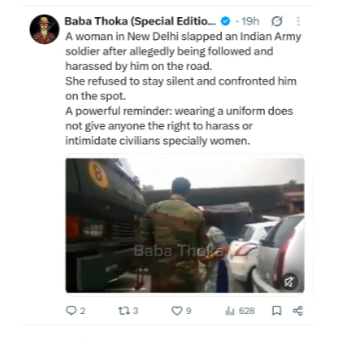
A social media user shared the viral video claiming that a woman in New Delhi slapped an Indian Army soldier who allegedly followed and harassed her on the road. The post claimed that instead of remaining silent, the woman confronted the soldier on the spot. The post further stated that the incident sends a strong message that wearing a uniform does not give anyone the right to harass or intimidate civilians, especially women.
https://x.com/OfficialThoka/status/2101989813071307032
Fact Check
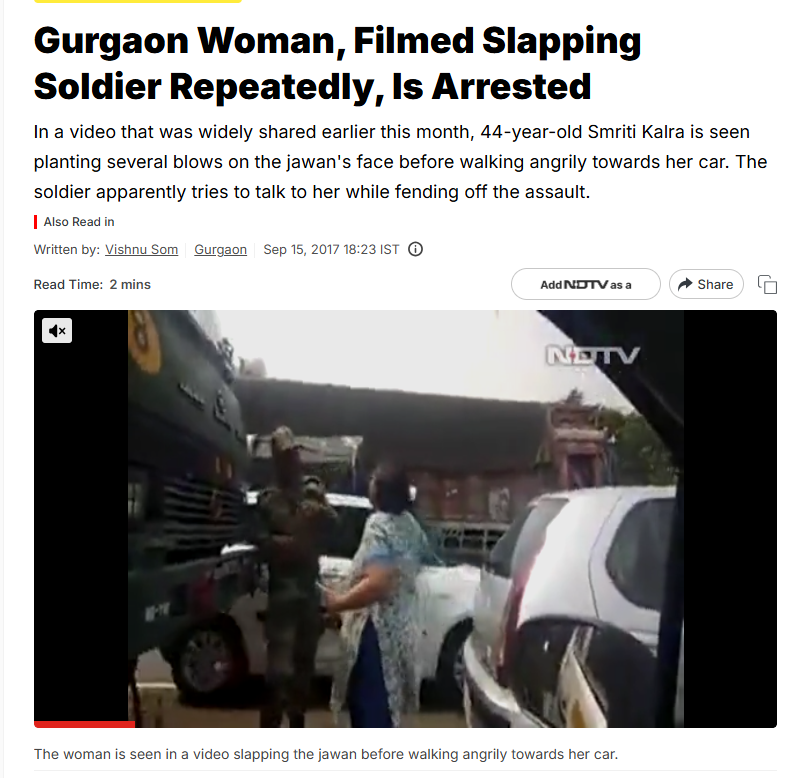
To verify the viral claim, we conducted a Google search using relevant keywords. However, we did not find any credible media reports related to the claim.To further verify the authenticity of the viral claim, we conducted a reverse image search of the keyframes of the video. During the search, we found the same video on the NDTV website, which was published on September 15, 2017. According to the NDTV report, a woman in New Delhi was caught on camera repeatedly slapping an Army personnel. The soldier did not appear to retaliate during the incident. Following a complaint by the Army to the Delhi Police, the woman was arrested. However, she was released within a few hours after a judge granted her bail. The report stated that in a video recorded by a witness on a mobile phone in South Delhi’s Vasant Kunj the previous Saturday, 44-year-old Smriti Kalra was seen repeatedly slapping the soldier on the face before walking angrily towards her car. The soldier appeared to be trying to reason with her while attempting to defend himself against the assault.Smriti Kalra, a resident of Gurgaon, had stopped her Tata Indica car in front of an Army truck carrying soldiers. At first glance, the incident appeared to be a case of road rage, although there was no reported collision or any obvious provocation for the attack.Smriti Kalra, who was divorced, was charged with causing hurt to deter a public servant from performing his duty. She was also accused of obstructing and assaulting a public servant on duty and wrongfully restraining him. Police seized her car.
In the next stage of our research, we found a report on the Aaj Tak website related to the incident, which also featured the viral video. The report included an exclusive interview with the Army personnel involved in the incident. He was identified as Mahavir Singh, who was serving as a Junior Commissioned Officer (JCO) in the Army at the time.
In an exclusive interview with Aaj Tak, Mahavir Singh said that he was deeply saddened by the incident. He questioned how anyone could behave in such a manner with Indian Army personnel, abuse them, or slap them. He said that the Army vehicle was moving slowly when a car suddenly came in front of it and started driving ahead of them. A woman was the only person in the car, and she was allegedly driving in a zigzag manner in front of the Army vehicle.
Conclusion
Our research found that the viral video is being shared with a misleading context. The video is not from a recent incident but from a road rage incident that took place in the Vasant Kunj-Rajokari Flyover area of South Delhi in September 2017. According to available media reports, the woman had allegedly misbehaved with Army personnel and slapped one of the soldiers during the incident. Mahavir Singh, who was serving as a JCO in the Army at the time, also spoke to the media about the incident. Our research found no credible information confirming that the Army personnel had followed or harassed the woman. Therefore, the claim that the video from the 2017 incident shows a woman slapping a soldier in response to being allegedly followed or harassed by him is misleading.
