
#FactCheck-AI-Generated Video Falsely Shows Mishandling of Baggage at Indian Airport
Executive Summary
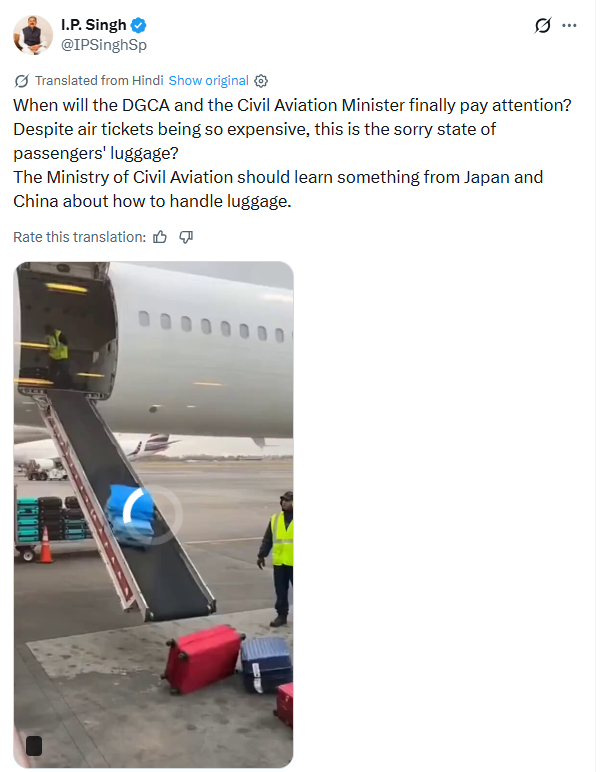
A video is being widely shared on social media claiming to show baggage handlers in India carelessly unloading passenger luggage from an aircraft cargo hold. The clip allegedly shows a handler ignoring standard procedures and throwing bags directly onto the tarmac instead of placing them on a motorized conveyor belt. CyberPeace Research Wing research found the video to be entirely fake. The clip has been generated using artificial intelligence (AI) and is being falsely shared as a real incident from India.
Claim
An X user, I.P. Singh (@IPSinghSp), shared the video on June 25, claiming it shows baggage handlers unloading luggage from an aircraft in India. The post criticized the alleged mishandling of passenger baggage and questioned aviation authorities over poor service standards.
The accompanying post read:
“When will the DGCA and the Civil Aviation Minister finally pay attention? Despite high airfares, this is the state of passengers’ luggage. The Ministry of Civil Aviation should learn from Japan and China how luggage should be handled.” https://x.com/IPSinghSp/status/2070164107551273109?s=20 , https://archive.ph/heiHA
Fact Check
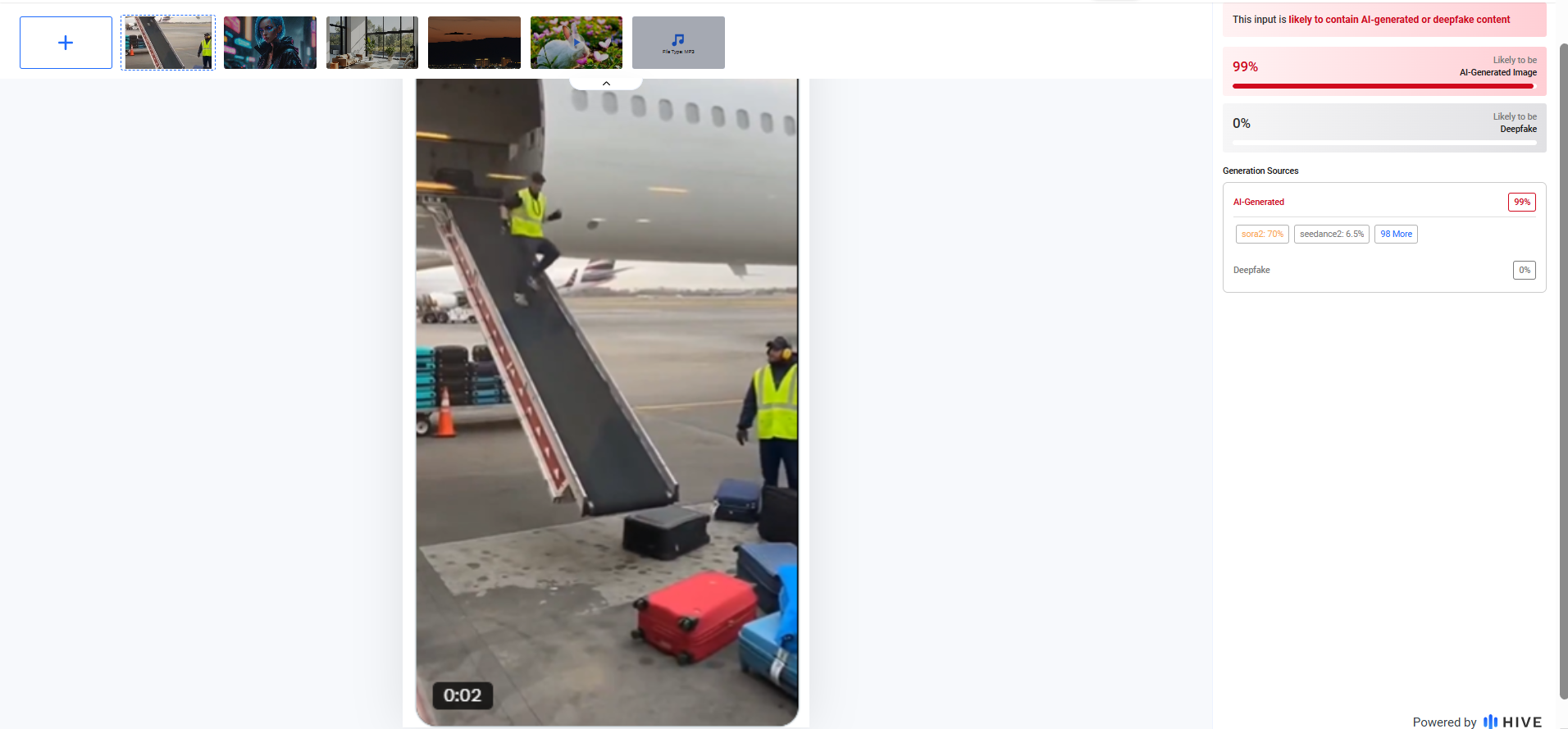
A detailed analysis of the footage revealed multiple visual inconsistencies suggesting AI generation. Notably, even after the baggage handler seen initially tossing the luggage exits via the conveyor belt, bags continue to emerge from the cargo hold and fall onto the tarmac on their own. This physically impossible sequence strongly indicates digital manipulation. To verify these findings, the video was analyzed using the AI detection tool Hive Moderation. The results indicated that a significant portion of the footage was generated using artificial intelligence.
Conclusion
Our research confirms that the viral video is entirely fake. It has been generated using AI and is being misrepresented as a real incident from India involving baggage handling at an airport.

Related Blogs

Introduction
The Telecom Regulatory Authority of India (TRAI) has directed all telcos to set up detection systems based on Artificial Intelligence and Machine Learning (AI/ML) technologies in order to identify and control spam calls and text messages from unregistered telemarketers (UTMs).
The TRAI Directed telcos
The telecom regulator, TRAI, has directed all Access Providers to detect Unsolicited commercial communication (UCC)by systems, which is based on Artificial Intelligence and Machine Learning to detect, identify, and act against senders of Commercial Communication who are not registered in accordance with the provisions of the Telecom Commercial Communication Customer Preference Regulations, 2018 (TCCCPR-2018). Unregistered Telemarketers (UTMs) are entities that do not register with Access Providers and use 10-digit mobile numbers to send commercial communications via SMS or calls.
TRAI steps to curb Unsolicited commercial communication
TRAI has taken several initiatives to reduce Unsolicited Commercial Communication (UCC), which is a major source of annoyance for the public. It has resulted in fewer complaints filed against Registered Telemarketers (RTMs). Despite the TSPs’ efforts, UCC from Unregistered Telemarketers (UTMs) continues. Sometimes, these UTMs use messages with bogus URLs and phone numbers to trick clients into revealing crucial information, leading to financial loss.
To detect, identify, and prosecute all Unregistered Telemarketers (UTMs), the TRAI has mandated that Access Service Providers implement the UCC.
Detect the System with the necessary functionalities within the TRAI’s Telecom Commercial Communication Customer Preference Regulations, 2018 framework.
Access service providers have implemented such detection systems based on their applicability and practicality. However, because UTMs are constantly creating new strategies for sending unwanted communications, the present UCC detection systems provided by Access Service providers cannot detect such UCC.
TRAI also Directs Telecom Providers to Set Up Digital Platform for Customer Consent to Curb Promotional Calls and Messages.
Unregistered Telemarketers (UTMs) sometimes use messages with fake URLs and phone numbers to trick customers into revealing essential information, resulting in financial loss.

TRAI has urged businesses like banks, insurance companies, financial institutions, and others to re-verify their SMS content templates with telcos within two weeks. It also directed telecom companies to stop misusing commercial messaging templates within the next 45 days.
The telecom regulator has also instructed operators to limit the number of variables in a content template to three. However, if any business intends to utilise more than three variables in a content template for communicating with their users, this should be permitted only after examining the example message, as well as adequate justifications and justification.
In order to ensure consistency in UCC Detect System implementations, TRAI has directed all Access Providers to deploy UCC and detect systems based on artificial intelligence and Machine Learning that are capable of constantly evolving to deal with new signatures, patterns, and techniques used by UTMs.
Access Providers have also been directed to use the DLT platform to share intelligence with others. Access Providers have also been asked to ensure that such UCC Detect System detects senders that send unsolicited commercial communications in bulk and do not comply with the requirements. All Access Providers are directed to follow the instructions and provide an update on actions done within thirty days.
The move by TRAI is to curb the menacing calls as due to this, the number of scam cases is increasing, and now a new trend of scams started as recently, a Twitter user reported receiving an automated call from +91 96681 9555 with the message “This call is from Delhi Police.” It then asked her to stay in the queue since some of her documents needed to be picked up. Then he said he works as a sub-inspector at the Kirti Nagar police station in New Delhi. He then inquired whether she had recently misplaced her Aadhaar card, PAN card, or ATM card, to which she replied ‘no’. The scammer then poses as a cop and requests that she authenticate the last four digits of her card because they have found a card with her name on it. And a lot of other people tweeted about it.

Conclusion
TRAI directed the telcos to check the calls and messages from Unregistered numbers. This step of TRAI will curb the pesky calls and messages and catch the Frauds who are not registered with the regulation. Sometimes the unregistered sender sends fraudulent links, and through these fraudulent calls and messages, the sender tries to take the personal information of the customers, which results in financial losses.

Executive Summary
A photograph is being widely circulated on social media with the claim that it shows Chinese soldiers blindfolding and escorting three Indian soldiers after entering 60 kilometres inside Arunachal Pradesh. The image is being shared as evidence of an alleged Chinese military intrusion into Indian territory.
CyberPeace Research Wing’s research found the claim to be false. Our research revealed that the viral image is AI-generated and has no connection to any real incident in Arunachal Pradesh. The Government of India and the Indian Army have also rejected claims of Chinese forces entering Indian territory.
Claim
An Instagram user, 'star8atik', shared the viral image on July 6, 2026, with the caption:"China has occupied 60 km of land in Arunachal Pradesh."
https://www.instagram.com/reel/Dac60uVtH4j

Fact Check
To verify the claim, we first performed a reverse image search using Google Lens. However, we did not find any authentic source or credible report linking the viral image to an actual incident involving Chinese troops in Arunachal Pradesh. We also conducted keyword-based searches on Google using terms related to the alleged Chinese incursion. The search yielded no credible news reports confirming that Chinese soldiers had captured Indian troops or entered 60 kilometres inside Arunachal Pradesh. We then closely examined the image and noticed several visual inconsistencies commonly associated with AI-generated content. The facial features and body proportions of the soldiers in the background appeared distorted and unnatural. Additionally, one of the Indian soldiers was shown with what appeared to be a Chinese flag patch on his arm, but its design and placement were inconsistent and visually flawed. These anomalies raised strong suspicions that the image had been generated using artificial intelligence. To verify this, we analysed the image using the AI detection tool Hive Moderation, which indicated a 98% probability that the image was AI-generated.
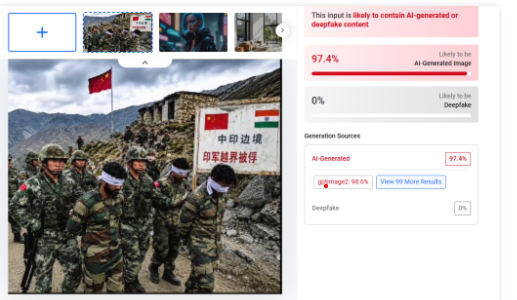
For additional verification, we also scanned the image using Undetectable AI, which found a 97% probability that the image had been digitally generated or manipulated using AI.

Conclusion
Our research found that the viral image claiming to show Chinese soldiers capturing Indian troops after entering Arunachal Pradesh is fake. The image is AI-generated and is being falsely circulated to support misleading claims of a Chinese military incursion. Furthermore, Union Minister Kiren Rijiju and the Indian Army have publicly rejected claims that Chinese forces entered Indian territory, making the viral claim baseless.

Executive Summary
Amid the ongoing tensions between the United States, Israel, and Iran, a video circulating on social media claims that Israeli Prime Minister Benjamin Netanyahu was seen running after Iran launched an attack on Israel. However, research by the CyberPeace found the viral claim to be misleading. Our research revealed that the video has no connection with the current tensions between the United States, Israel, and Iran. In reality, the clip dates back to 2021, when Netanyahu was rushing inside Israel’s parliament to cast his vote after arriving late.
Claim:
On the social media platform X (formerly Twitter), a user shared the video on March 5, 2026, claiming that Netanyahu had fled and gone into hiding due to fear of Iran. The post included inflammatory remarks suggesting that Iran had demonstrated its power and that Netanyahu had abandoned his country out of fear.

Fact Check
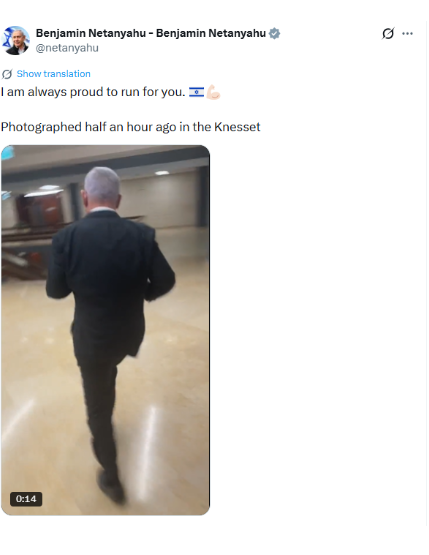
To verify the authenticity of the video, we extracted several keyframes and conducted a reverse image search on Google. During the research, we found the same video on the official X account of Benjamin Netanyahu, posted on December 14, 2021. In the post, Netanyahu wrote in Hebrew, which translates to,“I am always proud to run for you. Photographed half an hour ago in the Knesset.”
Further research also led us to a Hebrew news website where the same video was published.
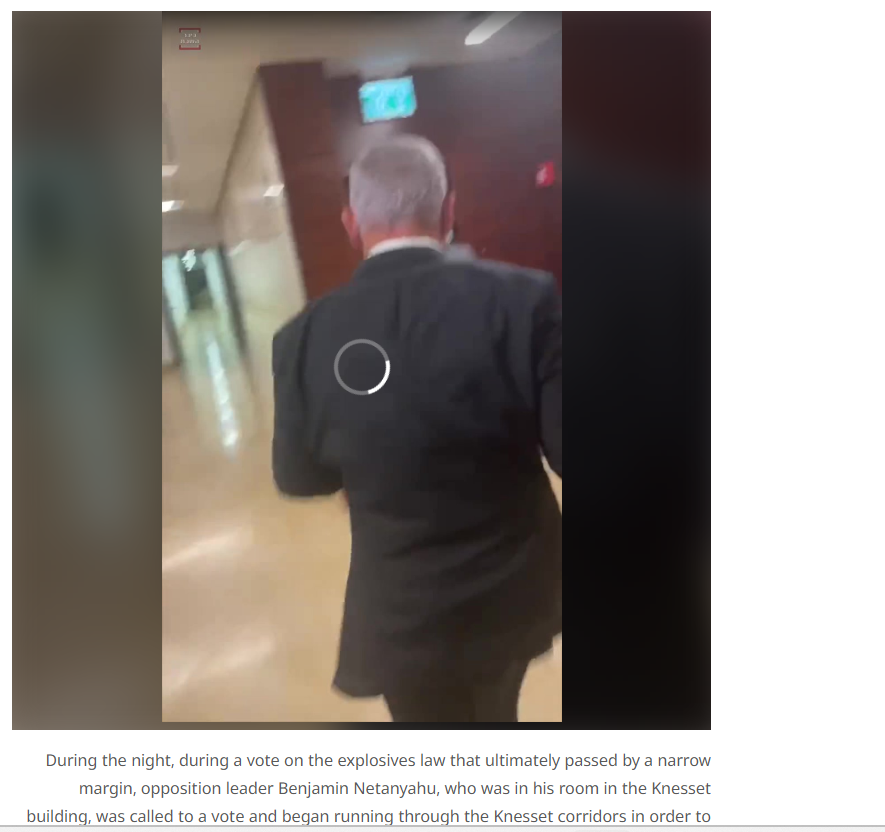
According to the report, voting in the Knesset (Israel’s parliament) continued throughout the night, and an explosives-related bill was passed by a very narrow margin. At the time, opposition leader Benjamin Netanyahu was in his room inside the Knesset building. When he was called for the vote, he hurried through the parliament corridors to reach the chamber in time to cast his vote.
Conclusion:
Our research found that the viral video is unrelated to the ongoing tensions involving the United States, Israel, and Iran. The footage is from 2021 and shows Benjamin Netanyahu rushing inside the Knesset to participate in a parliamentary vote after being called in at the last moment.
