
#FactCheck: AI-Generated Video Falsely Shared as Sunny Deol’s Leaked Hanuman Look from ‘Ramayanam’
Executive Summary
A video of actor Sunny Deol, linked to the film ‘Ramayanam’, which was released around Diwali, is going viral on social media. The video shows Sunny Deol getting ready and undergoing makeup to portray Lord Hanuman. It is being shared with the claim that the video shows Sunny Deol’s look leaked from the sets of ‘Ramayanam’ and that he will appear in the film in this avatar. However, CyberPeace Research found that the viral video was generated using artificial intelligence (AI).
Claim:
An Instagram user, ‘ajitsamachar’, shared the video on November 7, 2026, with the caption: “Sunny Deol as Hanuman, look leaked from the Ramayan film.”
https://www.instagram.com/reels/DfcW6LjhOF5/

Fact Check
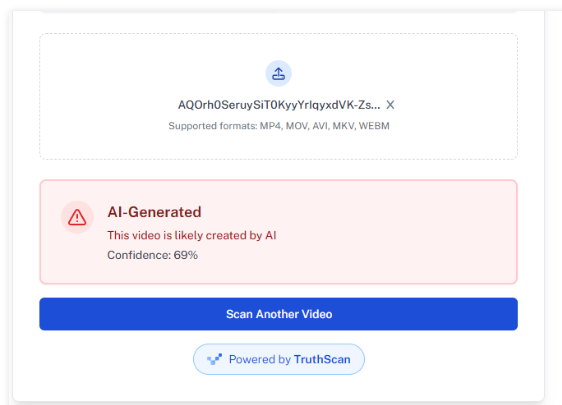
We also used another tool, ‘AI Video Detector’, to analyse the video. The tool indicated that the video was up to 80 per cent likely to be AI-generated.
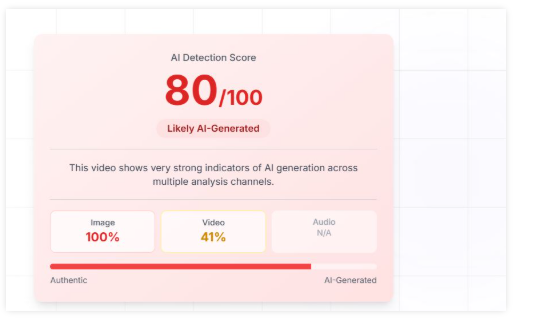
When we analysed the video using another AI detection tool, ‘Undetectable AI’, it indicated a 97 per cent likelihood that the video was AI-generated.
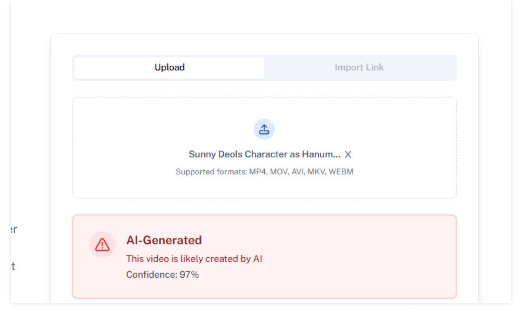
Conclusion
Our research found that the video purportedly showing Sunny Deol getting ready to portray Hanuman in the film ‘Ramayanam’ is not authentic. In fact, the viral video has been generated using artificial intelligence (AI).

Related Blogs

As Generative AI continues to make strides by creating content through user prompts, the increasing sophistication of language models widens the scope of the services they can deliver. However, they have their own limitations. Recently, alerts by Apple Intelligence on the iPhone’s latest version have come under fire for misrepresenting news by news agencies.
The new feature was introduced with the aim of presenting an effective way to group and summarise app notifications in a single alert on a user’s lock screen. This was to enable an easier scan for important details amongst a large number of notifications, doing away with overwhelming updates for the user. This, however, resulted in the misrepresentation of news channels and reporting of fake news such as the arrest of Israeli Prime Minister Benjamin Netanyahu, Luke Litter winning the PDC World Darts Championship even before the competition, tennis Player Rafael Nadal coming out as gay, among other news alerts. Following false alerts, BBC had complained about its journalism being misrepresented. In response, Apple’s proposed solution was to clarify to the user that when the text summary is displayed in the notifications, it is clearly stated to be a product of notification Apple Intelligence and not of the news agency. It also claimed the complexity of having to compress content into short summaries which resulted in fallacious alerts. Further comments revealed that the AI alert feature was in beta and is continuously being worked on depending on the user’s feedback. Owing to the backlash, Apple has suspended this service and announced that an improved version of the feature is set to be released in the near future, however, no dates have been set.
CyberPeace Insights
The rush to release new features often exacerbates the problem, especially when AI-generated alerts are responsible for summarising news reports. This can significantly damage the credibility and trust that brands have worked hard to build. The premature release of features that affect the dissemination, content, and public comprehension of information carries substantial risks, particularly in the current environment where misinformation is widespread. Timely action and software updates, which typically require weeks to implement, are crucial in mitigating these risks. The desire to be ahead in the game and bring out competitive features must not resolve the responsibility of providing services that are secure and reliable. This aforementioned incident highlights the inherent nature of generative AI, which operates by analysing the data it was trained on to deliver the best possible responses based on user prompts. However, these responses are not always accurate or reliable. When faced with prompts beyond its scope, AI systems often produce untrustworthy information, underlining the need for careful oversight and verification. A question to deliberate on is whether we require such services at all, which in practice, do save our time, but do so at the risk of the spread of false tidbits.
References
- https://www.theguardian.com/technology/2025/jan/07/apple-update-ai-inaccurate-news-alerts-bbc-apple-intelligence-iphone
- https://www.firstpost.com/tech/apple-intelligence-hallucinates-falsely-credits-bbc-for-fake-news-broadcaster-lodges-complaint-13845214.html
- https://www.cnbc.com/2025/01/08/apple-ai-fake-news-alerts-highlight-the-techs-misinformation-problem.html
- https://news.sky.com/story/apple-ai-feature-must-be-revoked-over-notifications-misleading-users-say-journalists-13288716
- https://www.hindustantimes.com/world-news/apple-to-pay-95-million-in-user-privacy-violation-lawsuit-on-siri-101735835058198.html
- https://www.hindustantimes.com/business/apple-denies-claims-of-siri-violating-user-privacy-after-95-million-class-action-suit-settlement-101736445941497.html#:~:text=Apple%20denies%20claims%20of%20Siri,action%20suit%20settlement%20%2D%20Hindustan%20Times
- https://www.google.com/search?q=apple+AI+alerts+misinformation&oq=apple+AI+alerts+misinformation+&gs_lcrp=EgZjaHJvbWUyBggAEEUYOTIHCAEQIRigATIHCAIQIRigATIHCAMQIRigATIHCAQQIRigAdIBCTEyMzUxajBqN6gCALACAA&sourceid=chrome&ie=UTF-8
- https://www.fastcompany.com/91261727/apple-intelligence-news-summaries-mistakes
- https://timesofindia.indiatimes.com/technology/tech-news/siris-secret-listening-costs-apple-95m/articleshow/116906209.cms
- https://www.theguardian.com/technology/2025/jan/17/apple-suspends-ai-generated-news-alert-service-after-bbc-complaint

Introduction
Misinformation is a major issue in the AI age, exacerbated by the broad adoption of AI technologies. The misuse of deepfakes, bots, and content-generating algorithms have made it simpler for bad actors to propagate misinformation on a large scale. These technologies are capable of creating manipulative audio/video content, propagate political propaganda, defame individuals, or incite societal unrest. AI-powered bots may flood internet platforms with false information, swaying public opinion in subtle ways. The spread of misinformation endangers democracy, public health, and social order. It has the potential to affect voter sentiments, erode faith in the election process, and even spark violence. Addressing misinformation includes expanding digital literacy, strengthening platform detection capabilities, incorporating regulatory checks, and removing incorrect information.
AI's Role in Misinformation Creation
AI's growth in its capabilities to generate content have grown exponentially in recent years. Legitimate uses or purposes of AI many-a-times take a backseat and result in the exploitation of content that already exists on the internet. One of the main examples of misinformation flooding the internet is when AI-powered bots flood social media platforms with fake news at a scale and speed that makes it impossible for humans to track and figure out whether the same is true or false.
The netizens in India are greatly influenced by viral content on social media. AI-generated misinformation can have particularly negative consequences. Being literate in the traditional sense of the word does not automatically guarantee one the ability to parse through the nuances of social media content authenticity and impact. Literacy, be it social media literacy or internet literacy, is under attack and one of the main contributors to this is the rampant rise of AI-generated misinformation. Some of the most common examples of misinformation that can be found are related to elections, public health, and communal issues. These issues have one common factor that connects them, which is that they evoke strong emotions in people and as such can go viral very quickly and influence social behaviour, to the extent that they may lead to social unrest, political instability and even violence. Such developments lead to public mistrust in the authorities and institutions, which is dangerous in any economy, but even more so in a country like India which is home to a very large population comprising a diverse range of identity groups.
Misinformation and Gen AI
Generative AI (GAI) is a powerful tool that allows individuals to create massive amounts of realistic-seeming content, including imitating real people's voices and creating photos and videos that are indistinguishable from reality. Advanced deepfake technology blurs the line between authentic and fake. However, when used smartly, GAI is also capable of providing a greater number of content consumers with trustworthy information, counteracting misinformation.
Generative AI (GAI) is a technology that has entered the realm of autonomous content production and language creation, which is linked to the issue of misinformation. It is often difficult to determine if content originates from humans or machines and if we can trust what we read, see, or hear. This has led to media users becoming more confused about their relationship with media platforms and content and highlighted the need for a change in traditional journalistic principles.
We have seen a number of different examples of GAI in action in recent times, from fully AI-generated fake news websites to fake Joe Biden robocalls telling the Democrats in the U.S. not to vote. The consequences of such content and the impact it could have on life as we know it are almost too vast to even comprehend at present. If our ability to identify reality is quickly fading, how will we make critical decisions or navigate the digital landscape safely? As such, the safe and ethical use and applications of this technology needs to be a top global priority.
Challenges for Policymakers
AI's ability to generate anonymous content makes it difficult to hold perpetrators accountable due to the massive amount of data generated. The decentralised nature of the internet further complicates regulation efforts, as misinformation can spread across multiple platforms and jurisdictions. Balancing the need to protect the freedom of speech and expression with the need to combat misinformation is a challenge. Over-regulation could stifle legitimate discourse, while under-regulation could allow misinformation to propagate unchecked. India's multilingual population adds more layers to already-complex issue, as AI-generated misinformation is tailored to different languages and cultural contexts, making it harder to detect and counter. Therefore, developing strategies catering to the multilingual population is necessary.
Potential Solutions
To effectively combat AI-generated misinformation in India, an approach that is multi-faceted and multi-dimensional is essential. Some potential solutions are as follows:
- Developing a framework that is specific in its application to address AI-generated content. It should include stricter penalties for the originator and spreader and dissemination of fake content in proportionality to its consequences. The framework should establish clear and concise guidelines for social media platforms to ensure that proactive measures are taken to detect and remove AI-generated misinformation.
- Investing in tools that are driven by AI for customised detection and flagging of misinformation in real time. This can help in identifying deepfakes, manipulated images, and other forms of AI-generated content.
- The primary aim should be to encourage different collaborations between tech companies, cyber security orgnisations, academic institutions and government agencies to develop solutions for combating misinformation.
- Digital literacy programs will empower individuals by training them to evaluate online content. Educational programs in schools and communities teach critical thinking and media literacy skills, enabling individuals to better discern between real and fake content.
Conclusion
AI-generated misinformation presents a significant threat to India, and it is safe to say that the risks posed are at scale with the rapid rate at which the nation is developing technologically. As the country moves towards greater digital literacy and unprecedented mobile technology adoption, one must be cognizant of the fact that even a single piece of misinformation can quickly and deeply reach and influence a large portion of the population. Indian policymakers need to rise to the challenge of AI-generated misinformation and counteract it by developing comprehensive strategies that not only focus on regulation and technological innovation but also encourage public education. AI technologies are misused by bad actors to create hyper-realistic fake content including deepfakes and fabricated news stories, which can be extremely hard to distinguish from the truth. The battle against misinformation is complex and ongoing, but by developing and deploying the right policies, tools, digital defense frameworks and other mechanisms, we can navigate these challenges and safeguard the online information landscape.
References:
- https://economictimes.indiatimes.com/news/how-to/how-ai-powered-tools-deepfakes-pose-a-misinformation-challenge-for-internet-users/articleshow/98770592.cms?from=mdr
- https://www.dw.com/en/india-ai-driven-political-messaging-raises-ethical-dilemma/a-69172400
- https://pure.rug.nl/ws/portalfiles/portal/975865684/proceedings.pdf#page=62
Executive Summary
A video linked to the FIFA World Cup 2026 is being widely shared on social media. The clip appears to show a match between Brazil and Argentina, with Neymar and Lionel Messi facing each other on the field. In the video, Messi is seen trying to stop Neymar from scoring, but Neymar dribbles past him and scores a goal. The footage is being circulated as a real moment from the ongoing FIFA World Cup. CyberPeace Research Wing research found the claim to be false. The video does not depict any real football match and was created using artificial intelligence (AI).
Claim
A Facebook user named “India Guru” shared the viral video on June 25, 2026, with the caption: "Neymar’s storm in the FIFA World Cup. Lionel Messi could only watch. Wow! What a moment… Brilliant." https://www.facebook.com/reel/993162133465919 , https://perma.cc/V8SA-Y3SE

Fact Check
To verify the claim, we searched relevant keywords on Google. However, we found no credible news reports related to the viral video or the claims being made alongside it. We also found no evidence that Brazil and Argentina had played a match against each other during the FIFA World Cup 2026. A closer examination of the footage revealed unusual movements in the legs and body positions of both players, which appeared unnatural and inconsistent with real match footage. These visual anomalies raised suspicions that the video had been generated using artificial intelligence. The video was then analyzed using the AI detection tool Hive Moderation, which indicated a nearly 99 percent probability that the content was AI-generated.
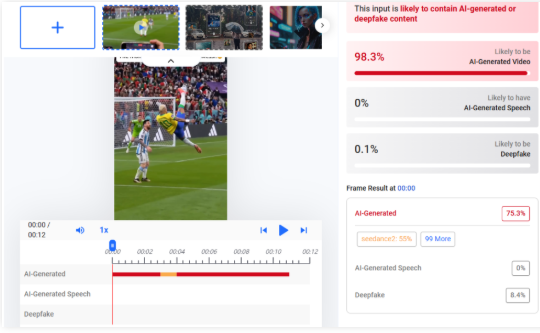
For additional verification, we also examined the clip using Undetectable AI, which similarly indicated a high likelihood that the video had been created using artificial intelligence.
Conclusion
Our research found that the viral claim linking the video to a FIFA World Cup 2026 match between Neymar and Lionel Messi is false. The footage is AI-generated and does not show a real football match.
