
#FactCheck-AI-Generated Video Falsely Shared as Drone Show Honouring Cristiano Ronaldo Introduction
Executive Summary
A video is being widely circulated on social media showing thousands of drones forming an image of Cristiano Ronaldo wearing his iconic Portugal jersey over what appears to be a water body. Moments later, the drones are seen creating his famous “SIUUU” celebration pose. The video is being shared with the claim that this spectacular aerial drone show was organised as a tribute to Ronaldo.
CyberPeace Research Wing’s research found the viral claim to be false. The research revealed that the video is not a real drone display but was created using Artificial Intelligence (AI) and is being circulated with a misleading claim.
Claim
The viral video is being shared on social media with the claim that the drone show was organised in honour of Cristiano Ronaldo.
https://www.instagram.com/reel/DamaeegILpU/?igsh=NmtjOTN4cWJzenJ1

Fact Check
To verify the claim, we extracted multiple keyframes from the viral video and conducted a reverse image search using Google Lens. During the research, we did not find any credible video, news report, or reliable source confirming that such a drone show was organised for Cristiano Ronaldo.
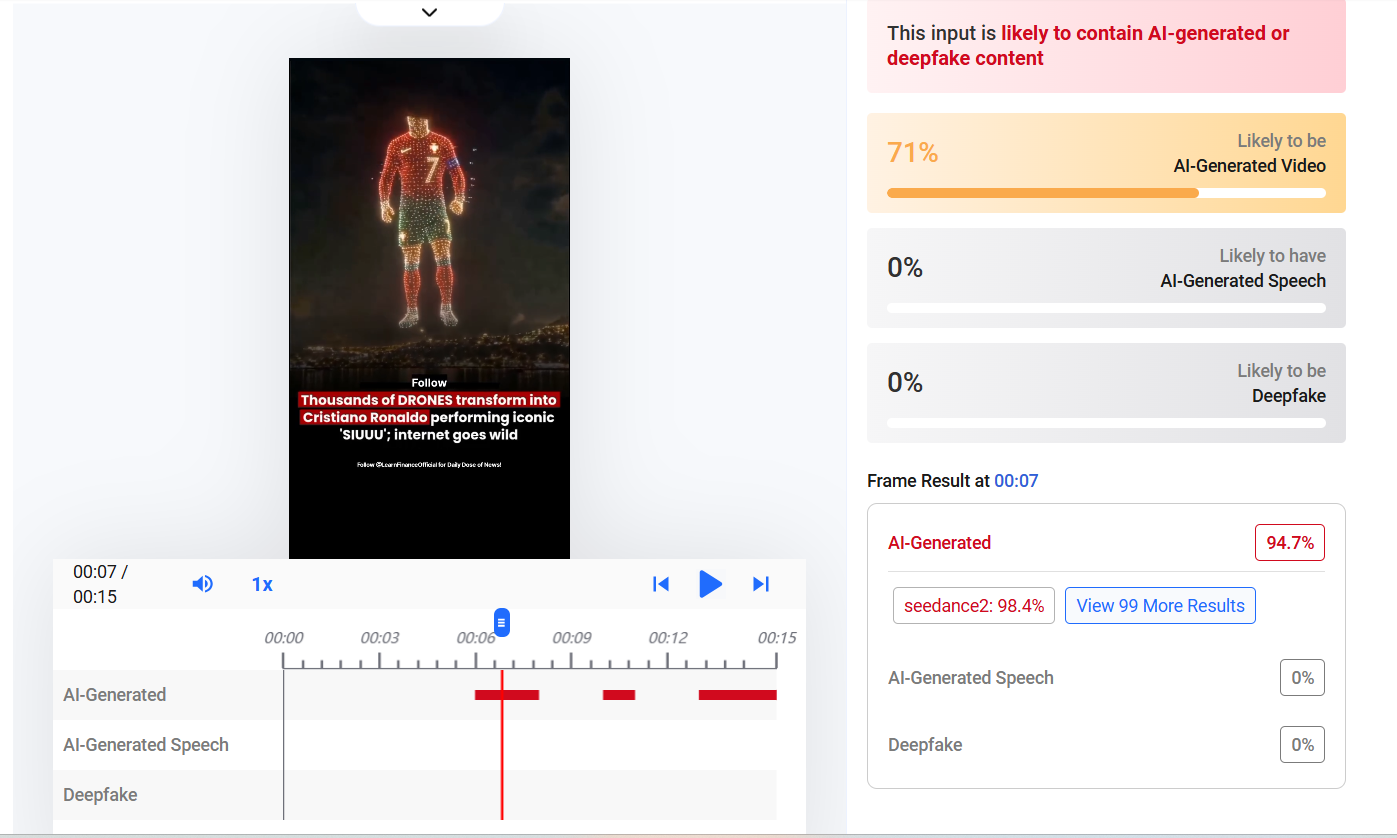
In the next stage of the research, we analysed the video using the AI detection tool Hive Moderation. The tool’s results indicated that the viral video had a 71% probability of being AI-generated.
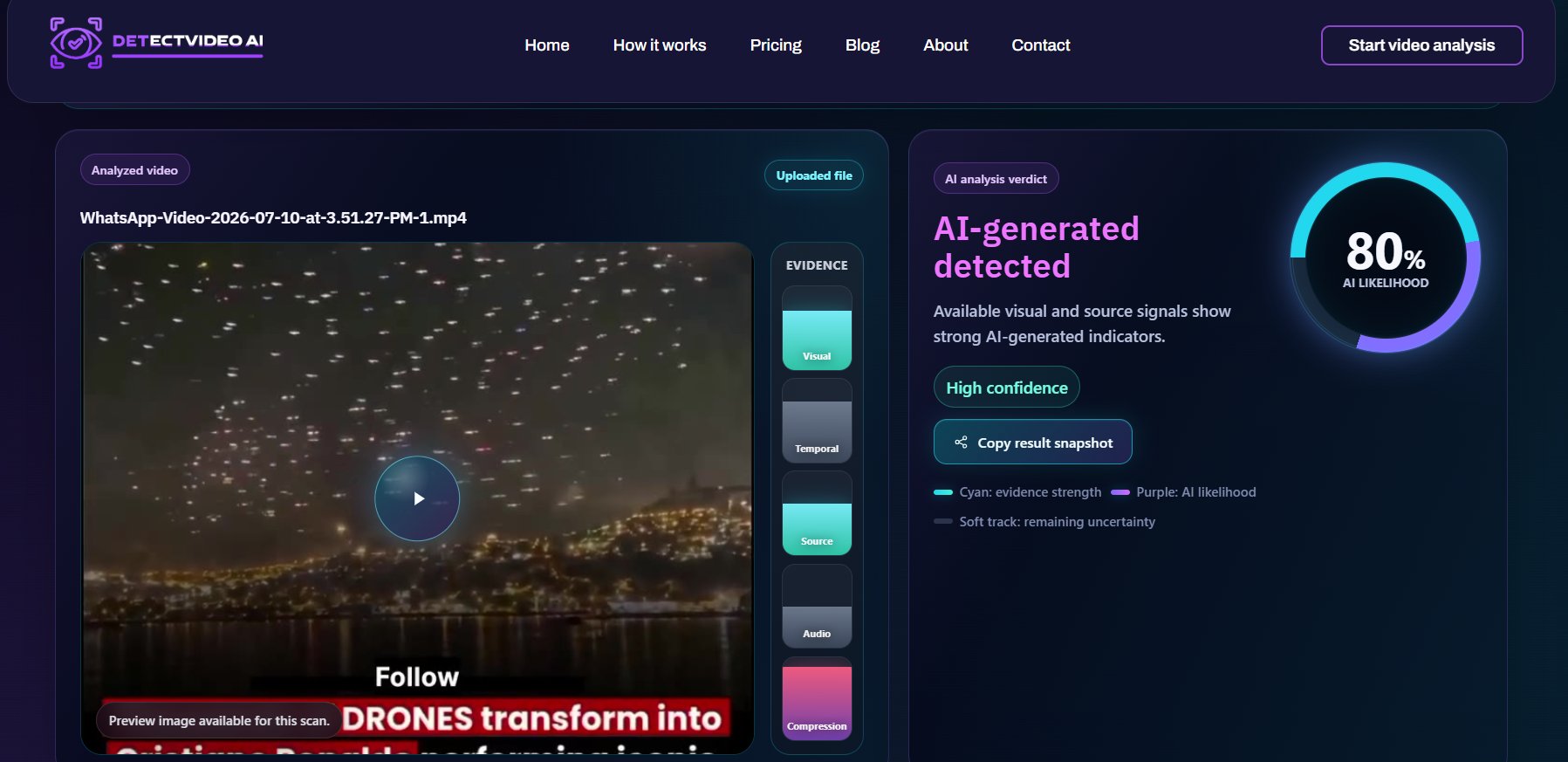
For further verification, we checked the video using another AI detection tool, DetectVideo AI. The analysis showed that the video had an 80% probability of being AI-generated.
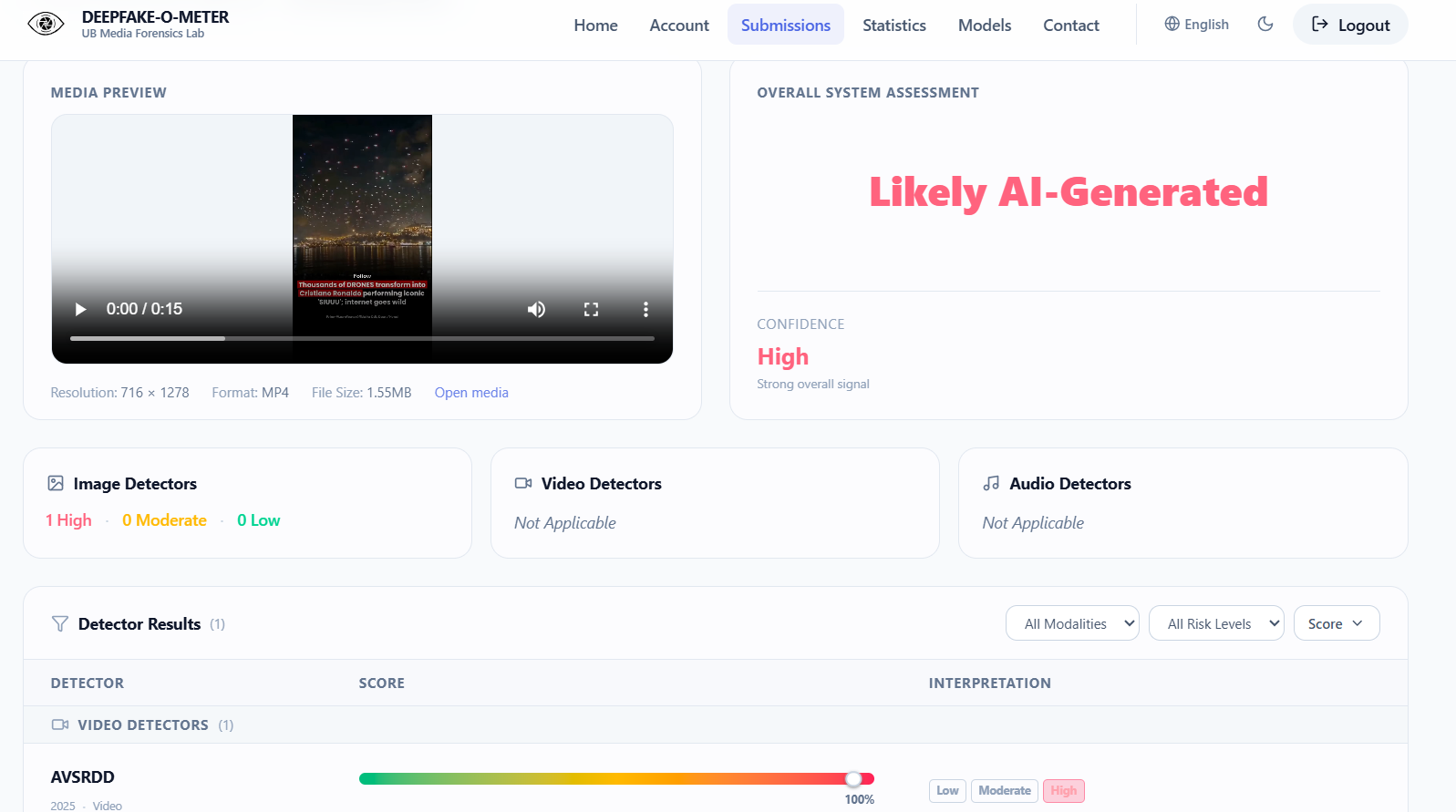
At the final stage of the research, the video was also analysed using Deepfake-O-Meter. The tool indicated an almost 100% probability that the video was AI-generated.
Conclusion
Our research found that the viral claim is false. The video does not show a real drone show organised in honour of Cristiano Ronaldo. The footage was found to be AI-generated and is being circulated on social media with a false narrative.

Related Blogs
Executive Summary
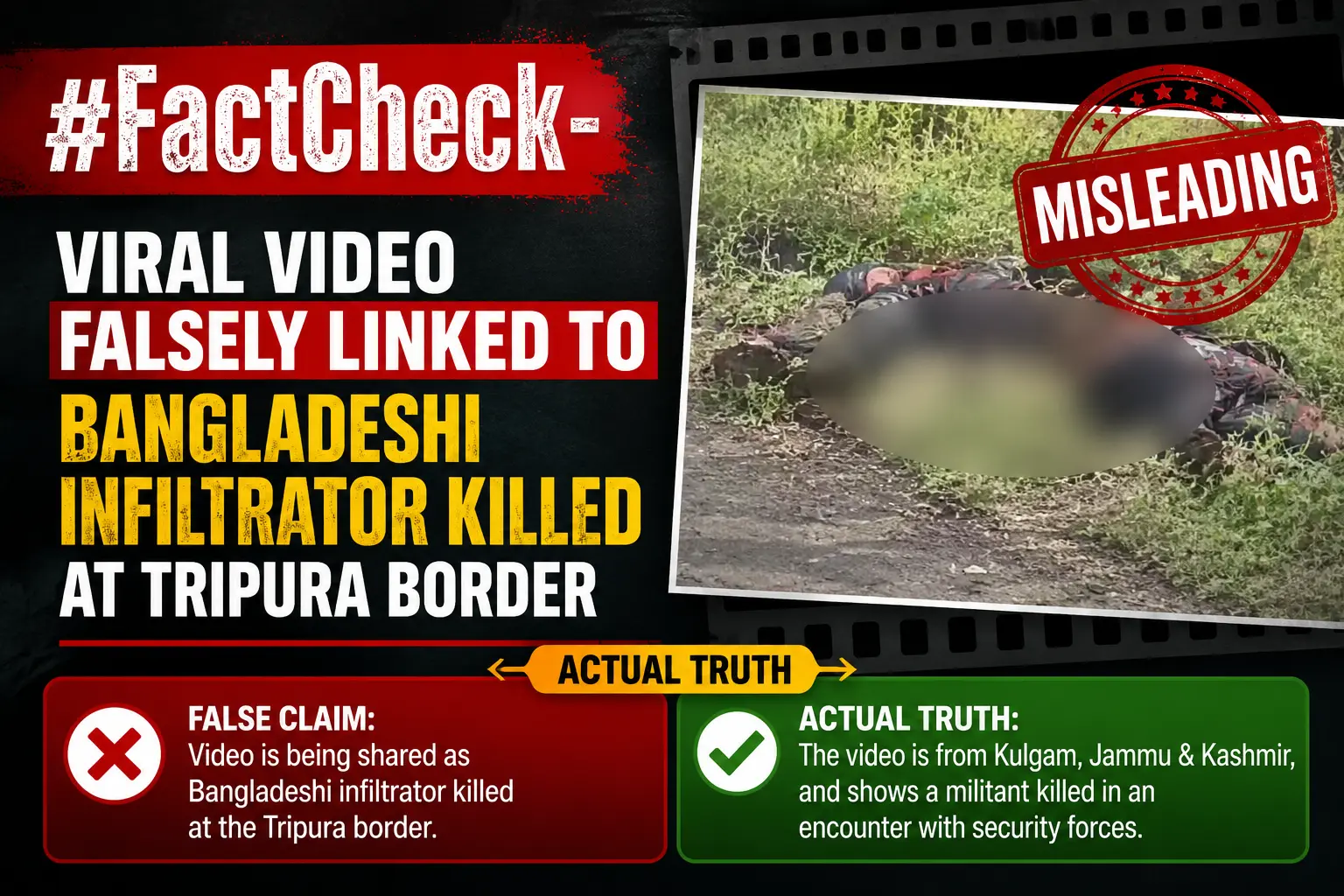
A video circulating on social media is being shared with the claim that the Border Security Force (BSF) shot dead a Bangladeshi national who was attempting to infiltrate India through the Tripura border. CyberPeace Research Wing research found the claim to be misleading. The viral video is not related to any recent incident on the Tripura border. It actually shows Haris Nazir Dar, a militant who was killed during an encounter in Jammu and Kashmir’s Kulgam district last year.
Claim:
The viral clip, which is around eight seconds long, shows a body lying on the ground. It is being shared on X with captions suggesting that the deceased was a Bangladeshi infiltrator who was killed while attempting to cross the India-Bangladesh border in Tripura.
https://x.com/ocjain4/status/2066210317265457298

Fact Check:
To verify the claim, we extracted keyframes from the viral video and conducted a reverse image search. During the research, we found matching visuals in a report published by Dainik Bhaskar on August 2, 2025. The report was related to an encounter between security forces and militants in the Akhal forest area of Kulgam district in Jammu and Kashmir. Visuals in the report matched those seen in the viral video.

We also found a report published by India Today on August 2, 2025, which carried photographs of slain militant Haris Nazir Dar taken from a different angle. The report stated that security forces had killed three militants during the operation in the Akhal forest area of Kulgam. https://www.indiatoday.in/india/story/gunfight-underway-with-3-lashkar-terrorists-in-jks-kulgam-2764971-2025-08-01

Conclusion:
The evidence gathered during our research makes it clear that the viral video does not show a Bangladeshi infiltrator killed at the Tripura border. The footage is actually from a security operation in Jammu and Kashmir and shows Haris Nazir Dar, a militant who was killed in an encounter in Kulgam last year.

Introduction:
With the rapid advancement in technologies, vehicles are also being transformed into moving data centre. There is an introduction of connectivity, driver assistance systems, advanced software systems, automated systems and other modern technologies are being deployed to make the experience of users more advanced and joyful. Software plays an important role in the overall functionality and convenience of the vehicle. For example, Advanced technologies like keyless entry and voice assistance, censor cameras and communication technologies are being incorporated into modern vehicles. Addressing the cyber security concerns in the vehicles the Ministry of Road Transport and Highways (MoRTH) has proposed standard Cyber Security and Management Systems (CSMS) rules for specific categories of four-wheelers, including both passenger and commercial vehicles. The goal is to protect these vehicles and their functions against cyber-attacks or vulnerabilities. This move will aim to ensure standardized cybersecurity measures in the automotive industry. These proposed standards will put forth certain responsibilities on the vehicle manufacturers to implement suitable and proportional measures to secure dedicated environments and to take steps to ensure cyber security.
The New Mandate
The new set of standards requires automobile manufacturers to install a new cybersecurity management system, which will be inclusive of protection against several cyberattacks on the vehicle’s autonomous driving functions, electronic control unit, connected functions, and infotainment systems. The proposed automotive industry standards aim to fortify vehicles against cyberattacks. These standards, expected to be notified by early next month, will apply to all M and N category vehicles. This includes passenger vehicles, goods carriers, and even tractors if they possess even a single electronic control unit. The need for enhanced cybersecurity in the automotive sector is palpable. Modern vehicles, equipped with advanced technologies, are highly prone to cyberattacks. The Ministry of Road Transport and Highways has thus taken a precautionary measure to safeguard all new-age commercial and private vehicles against cyber threats and vulnerabilities.
Cyber Security and Management Systems (CSMS)
The proposed standards by the Ministry of Road Transport and Highways (MoRTH) clarify that CSMS refers to a systematic risk-based strategy that defines organisational procedures, roles, and governance to manage and mitigate risks connected with cyber threats to vehicles, eventually safeguarding them from cyberattacks. According to the draft regulations, all manufacturers will be required to install a cyber security management system in their vehicles and provide the government with a certificate of compliance at the time of vehicle type certification.
Electrical vehicle charging system
Electric vehicle charging stations could also be susceptible and prone to cyber threats and vulnerabilities, which significantly requires to have in place standards to prevent them. It is highlighted that the Indian Computer Emergency Response Team (CERT-In), a designated authority to track and monitor cybersecurity incidents in India, had received reports of vulnerabilities in products and applications related to electric vehicle charging stations. Electric cars or vehicles becoming increasingly popular as the world shifts to green technology. EV owners may charge their cars at charging points in convenient spots. When you charge an EV at a charging station, data transfers between the car, the charging station, and the company that owns the device. This trail of data sharing and EV charging stations in many ways can be exploited by the bad actors. Some of the threats may include Malware, remote manipulation, and disturbing charging stations, social engineering attacks, compromised aftermarket devices etc.
Conclusion
Cyber security is necessary in view of the increased connectivity and use of software systems and other modern technologies in vehicles. As the automotive industry continues to adopt advanced technologies, it will become increasingly important that organizations take a proactive approach to ensure cybersecurity in the vehicles. A balanced approach between technology innovation and security measures will be instrumental in ensuring the cybersecurity aspect in the automotive industry. The recent proposed policy standard by the Ministry of Road Transport and Highways (MoRTH) can be seen as a commendable step to make the automotive industry cyber-resilient and safe for everyone.
References:
- https://economictimes.indiatimes.com/news/india/road-transport-ministry-proposes-uniform-cyber-security-system-for-four-wheelers/articleshow/105187952.cms
- https://www.financialexpress.com/business/express-mobility-cybersecurity-in-the-autonomous-vehicle-the-next-frontier-in-mobility-3234055/
- https://www.gktoday.in/morth-proposes-uniform-cyber-security-standards-for-four-wheelers/
- https://cybersecurity.att.com/blogs/security-essentials/the-top-8-cybersecurity-threats-facing-the-automotive-industry-heading-into-2023
CyberPeace | Automotive Cybersecurity & Digital Forensics
Introduction
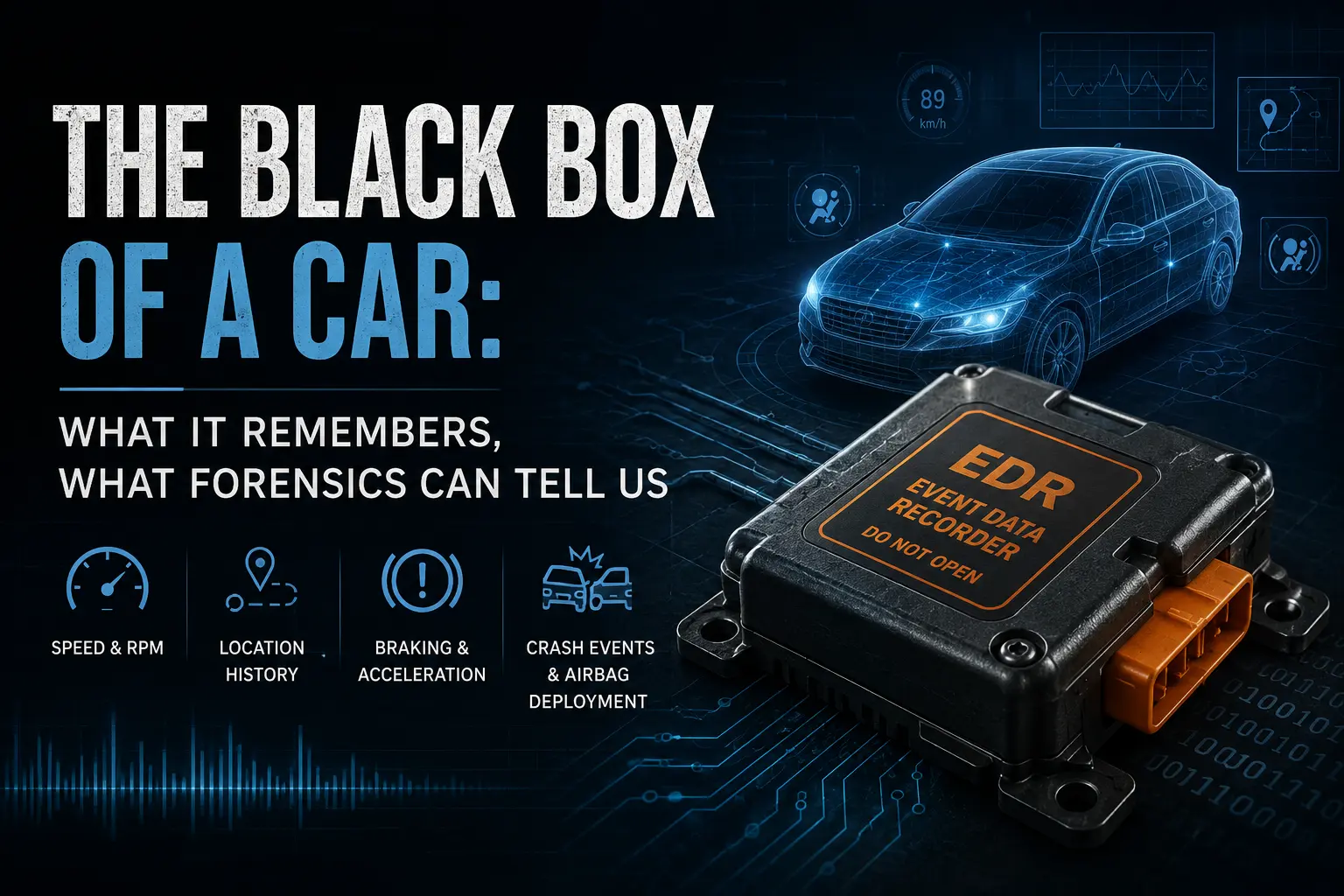
After a crash, the story usually comes from the driver, a witness or a police report. But a modern vehicle can leave another version behind - a digital one. An Event Data Recorder (EDR), commonly called a car's black box, can preserve selected information from the seconds around a crash. NHTSA describes EDRs as recording vehicle dynamics, driver inputs, crash characteristics, restraint status and some post-crash information.[1] The exact fields depend on the vehicle. A black box is not a magical device that records everything; it is one evidence source inside a much larger vehicle.
A modern vehicle can also contain safety controllers, diagnostic interfaces, ADAS, telematics and software-update systems. For an investigator, the question is what evidence can be linked to the EDR and what that combined record can actually support.
What Is Actually in the Black Box?
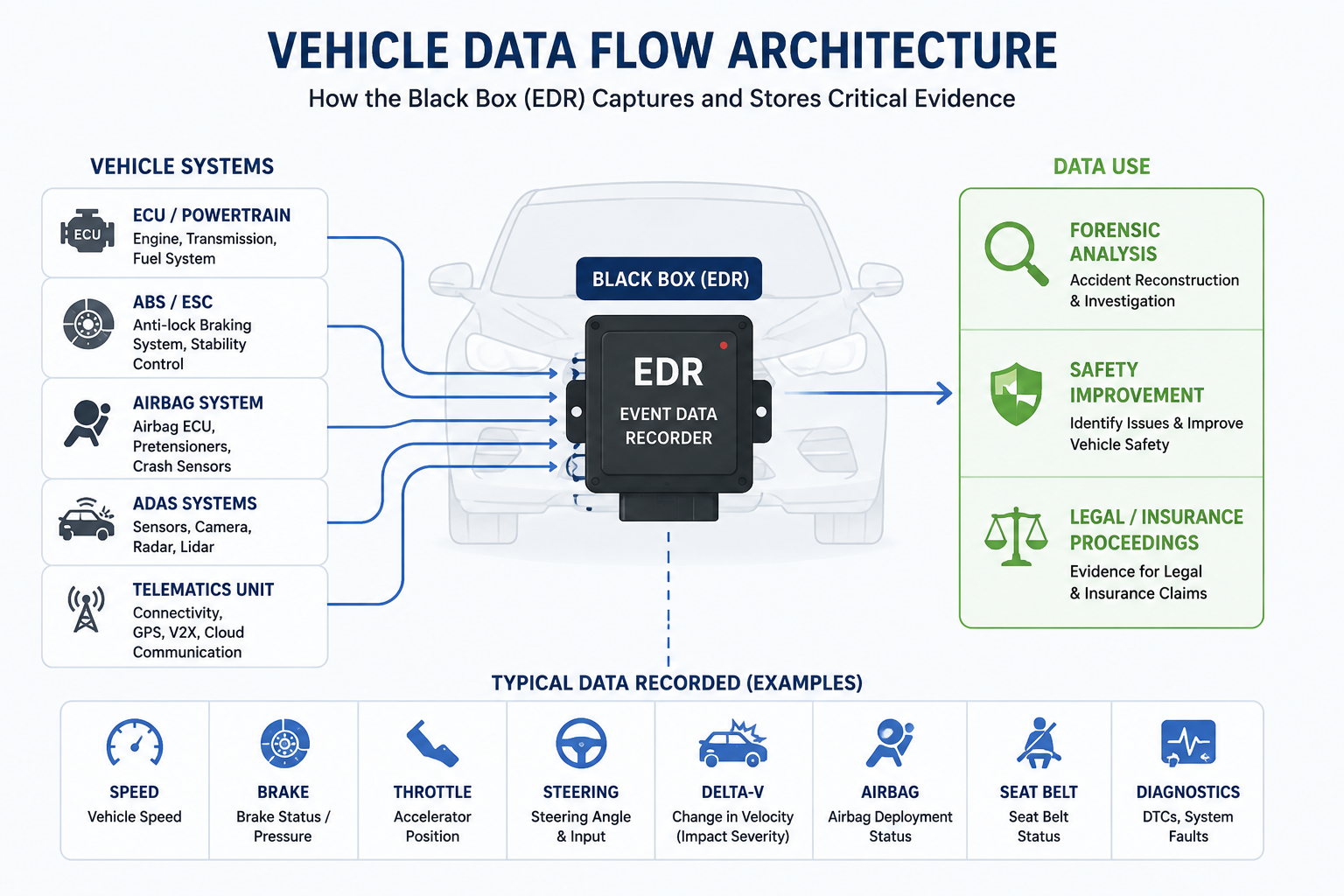
An EDR is best understood as a short event record, not a continuous driving diary. Depending on the vehicle and its configuration, forensic extraction may reveal items such as speed, acceleration, delta-V, engine RPM, throttle position, brake status, steering input, ABS or stability-control activity, seat-belt status and airbag or restraint events. NHTSA's published EDR material shows that data elements can include longitudinal and lateral acceleration, delta-V, vehicle speed, engine speed, throttle, service-brake status, roll/pitch/yaw information and steering input.[2] Do not overread the data: A field that exists in one model should not automatically be assumed to exist in another. A forensic report must identify exactly which module and fields were available and actually recovered.
What Can a Forensic Examination Recover?
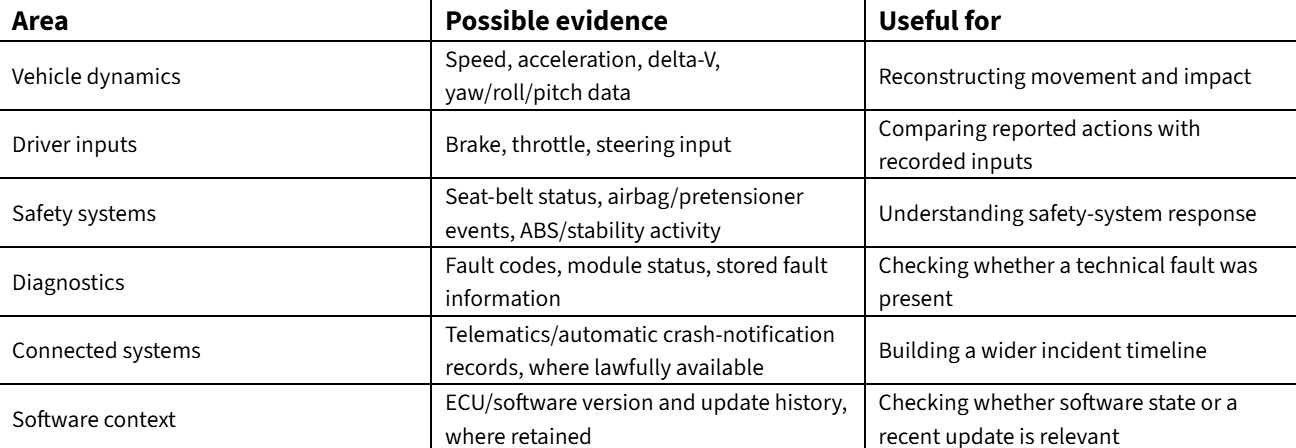
A Brake Failure Example
Consider a driver who reports: “I pressed the brake, but nothing happened.” The statement should be preserved, but a forensic investigation should test it. Was brake status captured? What was the speed before the event? Did ABS activate? What were the acceleration and delta-V patterns? Were there relevant fault codes? Was the vehicle recently repaired or updated? Suppose the recovered records show a brake input, ABS activity and a change in vehicle speed before impact. That does not prove the brakes were mechanically perfect. It does, however, make the sentence “nothing happened” too simple. Conversely, a relevant fault appearing just before the event may give investigators a stronger lead. The important part is the comparison: human account, vehicle record, physical evidence and technical history should be examined together.
Smart Vehicles, Digital Evidence and Cybersecurity Investigation
A connected vehicle can communicate through cellular networks, Bluetooth, Wi-Fi, mobile applications, workshop tools and cloud services. If unusual activity appears around a safety-critical incident, investigators may need to look beyond the EDR. Useful questions include:
• Was there unusual diagnostic or service activity before the incident?
• Was a software update or configuration change recently applied?
• Do timestamps from different modules line up, or is there clock drift?
• Can the extracted record be tied back to the original vehicle and module?
• Is there a non-cyber explanation - such as a hardware fault or software defect - that fits the evidence better?
The mindset matters: A cyberattack should be a conclusion supported by evidence, not the default explanation for strange vehicle behaviour.
The Forensic View: From Data to Evidence
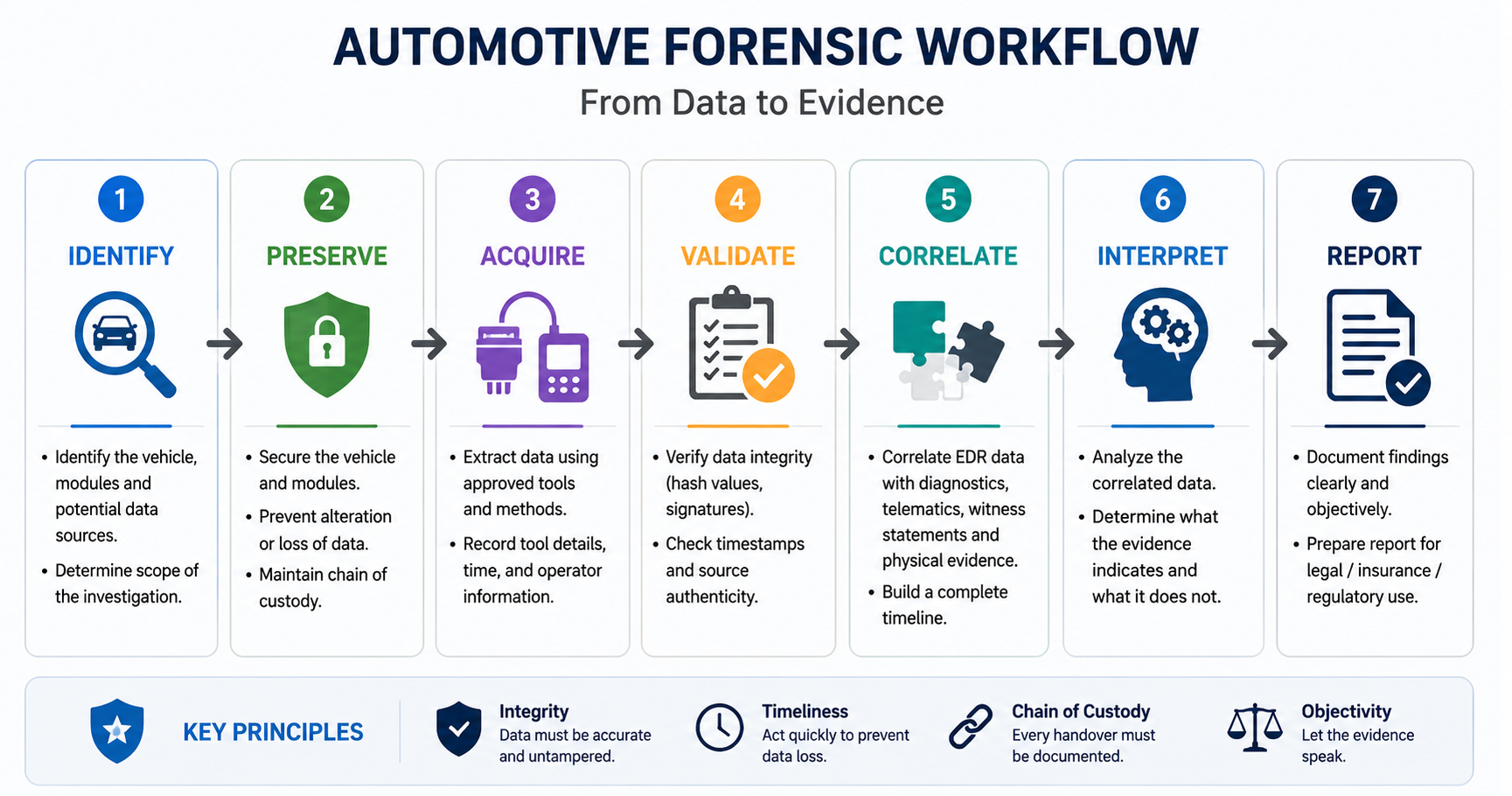
Automotive forensics is not simply plugging in a tool and exporting a report. The investigator should document the vehicle identity, module involved, extraction method, tool version, acquisition time and evidence-preservation steps. The goal is to make the work repeatable and defensible.
• Identify the relevant modules and evidence sources.
• Preserve the vehicle and extracted data against unnecessary alteration.
• Acquire data using a documented and appropriate method.
• Validate provenance, integrity, timestamps and completeness.
• Correlate EDR, diagnostics, software history, connected records and physical evidence.
• Report both findings and uncertainty.
A useful forensic rule: “Recorded” does not mean “proven.” Evidence becomes persuasive when its source, integrity and context are clear.
What the Law and Standards Are Changing
India is moving toward a more formal automotive cybersecurity lifecycle. IS-189 focuses on vehicle cybersecurity and the Cyber Security Management System (CSMS), while AIS-190 deals with software updates and the Software Update Management System (SUMS).[4][5] The wider statutory and type-approval framework is provided by the Motor Vehicles Act, 1988 and the Central Motor Vehicles Rules, 1989. For vehicle prototypes, Rule 126 provides for testing and approval by authorized testing agencies.[6][7]
In June 2026, the Ministry of Road Transport and Highways (MoRTH) came out with draft G.S.R. 503(E). The draft proposes new CMVR Rules 125-T and 125-U covering cybersecurity and software-update requirements. Since G.S.R. 503(E) is still a draft notification, its proposed requirements and the dates from which they may apply should be verified with the latest final notification before treating them as applicable law.[8]
At the international level, UN Regulation No. 155 addresses vehicle cybersecurity, while UN Regulation No. 156 covers software updates and their management.[9][10] This matters to forensics because lifecycle cybersecurity creates an expectation that manufacturers should be able to understand and manage security risks over time. In other words, logs, software-state information, vulnerability records and incident evidence can become part of the security story, not merely post-incident paperwork.
The Real Takeaway
The black box is valuable because it can reduce guesswork. It may tell us how fast the vehicle was moving, whether the driver applied the brake, how the vehicle responded, and what certain safety systems were doing around the event. But it rarely answers the whole case on its own. The strongest investigation is built by joining several pieces: EDR data, diagnostics, software context, connected-system evidence and what was found at the crash scene.
For cybersecurity professionals, the lesson is simple: a secure vehicle should not only resist attacks. It should also leave trustworthy evidence when something goes wrong. Good access controls, reliable timestamps and careful evidence handling help turn “something failed” into a defensible explanation.
Conclusion
The phrase “car black box” sounds simple, but the evidence behind it is not. An EDR can preserve a small but valuable window into a crash. During forensic examination, investigators may also be able to recover diagnostic, safety-system, software and connected-vehicle information, depending on the vehicle and what has been retained. The job is not to collect the largest possible amount of data. It is to collect the right data, preserve it properly and understand what each record can - and cannot - prove.
That is where automotive cybersecurity and digital forensics meet. As vehicles become more connected and software-driven, the ability to reconstruct an incident becomes part of security itself.
References
1. National Highway Traffic Safety Administration (NHTSA), Event Data Recorder (EDR) overview and research resources.
2. NHTSA, Use of Event Data Recorder (EDR) Technology for Highway Crash Data Analysis.
3. NHTSA, Light-Vehicle Event Data Recorder Technologies Update.
4. Automotive Research Association of India (ARAI), AIS-189, Approval of Vehicles with Regards to Cyber Security and Cyber Security Management System, April 2024.
5. Automotive Research Association of India (ARAI), AIS-190, Approval of Vehicles with Regards to Software Update and Software Update Management System, April 2024.
6. Government of India, Motor Vehicles Act, 1988.
7. Government of India, Central Motor Vehicles Rules, 1989, Rule 126.
8. Ministry of Road Transport and Highways, G.S.R. 503(E), 17 June 2026, draft Central Motor Vehicles (Amendment) Rules concerning cybersecurity and software updates.
9. UNECE, UN Regulation No. 155, Cyber Security and Cyber Security Management System.
10. UNECE, UN Regulation No. 156, Software Update and Software Update Management System.
11. NIST, SP 800-86, Guide to Integrating Forensic Techniques into Incident Response.
