
#FactCheck: AI-Generated Video Falsely Shared as CCTV Footage of Bull Saving Young Man
Executive Summary
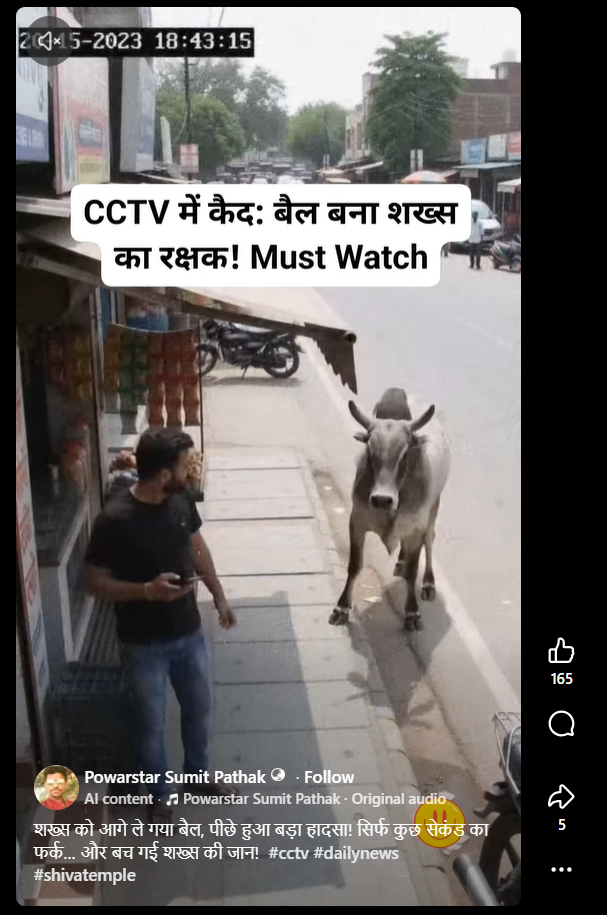
A video circulating on social media shows a bull pushing a young man who appears to be engrossed in looking at his mobile phone. Users sharing the video claim that the CCTV footage captured an incident in which the bull pushed the man and saved him from a mishap. CyberPeace Research found the viral claim to be false. Our research found that the viral video is AI-generated and is being shared with a misleading claim.
Claim
A Facebook user shared the viral video with the caption, “The one whose life is being protected by God Himself.” The post link, archive link and screenshot are provided below.
https://www.facebook.com/reel/2568861153629568

Fact-check
To verify the viral claim, we conducted a Google Lens search using keyframes from the video. During the search, we found the same video on the Facebook page of user ‘Powarstar Sumit Pathak’. The video, uploaded on October 4, 2026, carries an ‘AI content’ label.
https://www.facebook.com/reel/1473526454600527
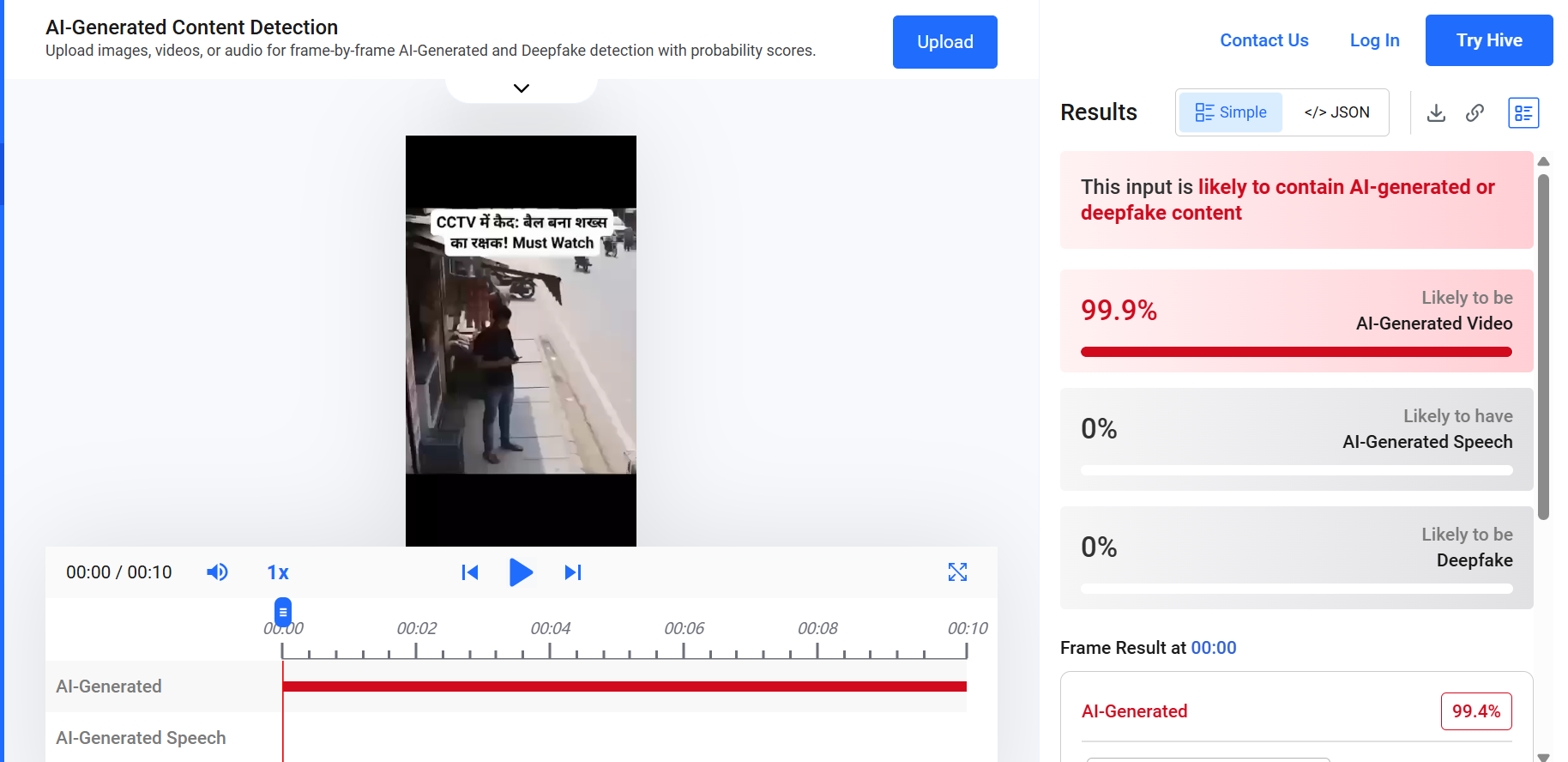
As part of our further research, we scanned the viral video using the AI detection tool Hive Moderation. The results indicated that the video is 99% likely to be AI-generated.
Conclusion
Our research found that the viral video is AI-generated and is being shared with a misleading claim. The video does not show an actual incident involving a bull saving a young man, as claimed in social media posts. The viral claim is therefore false.

Related Blogs
Introduction
Freedom of speech and expression is fundamental to democracy and is constitutionally entrenched in Article 19(1)(a) of the Indian Constitution. The explosion of online spaces, brought about by the digital age, in the form of social media, blogs, and messaging apps, has reinterpreted how information is authored, disseminated, and consumed. This digital revolution has galvanised individuals to engage further inclusively in public debate, but has also fanatically magnified the risks of misinformation, hate speech, and threats to public order. Against this background, the judiciary is increasingly called upon to determine the limits of free speech, primarily where state regulation seeks to infringe upon constitutional protection.
Constitutional and Statutory Framework related to Freedom of Speech
The judiciary plays an integral role in balancing the fundamental right of freedom of speech with the regulation of online content, especially during the fast-paced evolution of the digital world. In India, with Article 19(1)(a) of the Constitution guaranteeing the freedom of speech, the courts bear the critical responsibility of protecting this liberty while recognising the State's legitimate interests in restricting harmful or unlawful content on a digital scale. This adjudicatory dilemma is even trickier because the said right has been held by the Supreme Court not to be an absolute one and is subject to "reasonable restrictions" as in Article 19(2), which recognises restrictions in the interest of sovereignty, security, public order, decency, and morality. Freedom of speech, being the cornerstone of democracy in India, does have an umbrella of reasonable restrictions under which the state can regulate any form of speech that infringes upon other equally compelling societal interests. However, with the coming of the internet and other digital communication arrangements, there was a need to develop new statutory instruments, i.e., Information Technology Act, 2000 (IT Act) and Rules made thereunder, including Information Technology (Intermediary Guidelines) and Digital Media Ethics Code Rules, 2021. These enactments attempt to regulate digital content, confronting issues such as hate speech, misinformation, and content that threatens public order. The judiciary's mandate is to interpret the enactments within the constitutional precincts, thus ensuring that the arbitrariness of State action is not aggravated or that the regulation is not overbroad. Judicial Landmark Decisions Affirming Balance The judiciary has played a front-ranking role in elaborating a jurisprudence protecting free speech in delineating legitimate regulation thereof. The Supreme Court judgment in Shreya Singhal v. Union of India, 2015, is seminal. Section 66A of the IT Act was struck down as it was vague and overly broad, causing a chilling effect on online speech. The Court has emphasised that any limitation on speech must be precise and fall strictly within the parameters laid down in Article 19(2). While the Court recognises that harmful online content needs to be addressed, the remedy must not encroach upon free political debate, satire, and criticism vital for democracy.
Following this, the Anuradha Bhasin case clarified the convergence of free speech and online access. The court held that the right to free speech had a vital medium in the form of the internet and that it would have to be an inevitable, proportionate shutdown, and transparent for challenge before the judiciary for any shutdown of the internet. This reaffirmed that restrictions on online speech must be rigorously tested.
Subsequent cases involve limitations on the 2021 IT Rules, whereby such government bodies can demand that “fake” or “misleading” material be taken off the internet. Courts move with circumspection, recognising the government's interest in fighting bogus information but remaining vigilant against over-regulation that can be code for pre-emptive censorship and threatening healthy discourses.
The virtual world raises particular and deeper questions: the viral nature of online speech multiplies its impact, distributing both democratic ideas and abusive material instantaneously. The courts recognise this twinning. While pressurising the legislature and executive to formulate clearer, more precise rules, courts simultaneously act as constitutional Guardians, avoiding breaches of the right with executive excess or vague laws. There is a strain between judicial activism, which promotes constitutional rights aggressively, and the fear of judicial paternalism, courts overreaching into policy arenas. But there is a need for vigilance by the judiciary due to the rapidly changing nature of digital technologies and threats to the freedoms of democracy. The judiciary continues to give contours to free speech and online regulation. There are enforcement issues, such as ongoing abuse of struck-down provisions, such as Section 66A, that the court counters with reaffirmation of constitutional directives. The evolving jurisprudence balances on thin stilts, upholding the democratic spirit of India by securing speech on online spaces and sanctioning reasonable, transparent moderation of harmful speech.
Conclusion
The Indian judiciary's leadership in balancing online content regulation with the freedom of speech is central and refined. The courts continually emphasise that speech on the digital medium is highly constitutionally protected and that restrictions must be legally valid, specific, essential, and proportionate. By classical decisions and constant review of new regulating actions, courts safeguard democratic participation in the digital public domain from unmeritorious censorship. Concurrently, the courts recognize the responsibility of the state in regulating digital ills such as mis recipe and hate speech, demanding parameters that uphold constitutional freedoms and the due process. The balancing act of the judiciary continues to be fundamental in defining India's digital democracy so that free speech can thrive even as the state upholds public order and human dignity in the digital communication age.

EXECUTIVE SUMMARY:
A viral video is surfacing claiming to capture an aerial view of Mount Kailash that has breathtaking scenery apparently providing a rare real-life shot of Tibet's sacred mountain. Its authenticity was investigated, and authenticity versus digitally manipulative features were analyzed.
CLAIMS:
The viral video claims to reveal the real aerial shot of Mount Kailash, as if exposing us to the natural beauty of such a hallowed mountain. The video was circulated widely in social media, with users crediting it to be the actual footage of Mount Kailash.


FACTS:
The viral video that was circulated through social media was not real footage of Mount Kailash. The reverse image search revealed that it is an AI-generated video created by Sonam and Namgyal, two Tibet based graphic artists on Midjourney. The advanced digital techniques used helped to provide a realistic lifelike scene in the video.
No media or geographical source has reported or published the video as authentic footage of Mount Kailash. Besides, several visual aspects, including lighting and environmental features, indicate that it is computer-generated.
For further verification, we used Hive Moderation, a deep fake detection tool to conclude whether the video is AI-Generated or Real. It was found to be AI generated.

CONCLUSION:
The viral video claiming to show an aerial view of Mount Kailash is an AI-manipulated creation, not authentic footage of the sacred mountain. This incident highlights the growing influence of AI and CGI in creating realistic but misleading content, emphasizing the need for viewers to verify such visuals through trusted sources before sharing.
- Claim: Digitally Morphed Video of Mt. Kailash, Showcasing Stunning White Clouds
- Claimed On: X (Formerly Known As Twitter), Instagram
- Fact Check: AI-Generated (Checked using Hive Moderation).

Introduction
Empowering today’s youth with the right skills is more crucial than ever in a rapidly evolving digital world. Every year on July 15th, the United Nations marks World Youth Skills Day to emphasise the critical role of skills development in preparing young people for meaningful work and resilient futures. As AI transforms industries and societies, equipping young minds with digital and AI skills is key to fostering security, adaptability, and growth in the years ahead.
Why AI Upskilling is Crucial in Modern Cyber Defence
Security in the digital age remains a complex challenge, regardless of the presence of Artificial Intelligence (AI). It is one of the biggest modern ironies, and not only that, it is a paradox wrapped in code, where the cure and the curse are written in the same language. The very hand that protects the world from cyber threats can very well be used for the creation of that threat. This being said, the modern-day implementation of AI has to circumvent the threats posed by it or any other advanced technology. A solid grasp of AI and machine learning mechanisms is no longer optional; it is fundamental for modern cybersecurity. The traditional cybersecurity training programs employ static content, which can often become outdated and inadequate for the vulnerabilities. AI-powered solutions, such as intrusion detection systems and next-generation firewalls, use behavioural analysis instead of just matching signatures. AI models are susceptible, nevertheless, as malevolent actors can introduce hostile inputs or tainted data to trick computers into incorrect classification. Data poisoning is a major threat to AI defences, according to Cisco's evidence.
As threats surpass the current understanding of cybersecurity professionals, a need arises to upskill them in advanced AI technologies so that they can fortify the security of current systems. Two of the most important skills for professionals would be AI/ML Model Auditing and Data Science. Skilled data scientists can sift through vast logs, from pocket captures to user profiles, to detect anomalies, assess vulnerabilities, and anticipate attacks. A news report from Business Insider puts it correctly: ‘It takes a good-guy AI to fight a bad-guy AI.’ The technology of generative AI is quite new. As a result, it poses fresh security issues and faces security risks like data exfiltration and prompt injections.
Another method that can prove effective is Natural Language Processing (NLP), which helps machines process this unstructured data, enabling automated spam detection, sentiment analysis, and threat context extraction. Security teams skilled in NLP can deploy systems that flag suspicious email patterns, detect malicious content in code reviews, and monitor internal networks for insider threats, all at speeds and scales humans cannot match.
The AI skills, as aforementioned, are not only for courtesy’s sake; they have become essential in the current landscape. India is not far behind in this mission; it is committed, along with its western counterparts, to employ the emerging technologies in its larger goal of advancement. With quiet confidence, India takes pride in its remarkable capacity to nurture exceptional talent in science and technology, with Indian minds making significant contributions across global arenas.
AI Upskilling in India
As per a news report of March 2025, Jayant Chaudhary, Minister of State, Ministry of Skill Development & Entrepreneurship, highlighted that various schemes under the Skill India Programme (SIP) guarantee greater integration of emerging technologies, such as artificial intelligence (AI), cybersecurity, blockchain, and cloud computing, to meet industry demands. The SIP’s parliamentary brochure states that more than 6.15 million recipients have received training as of December 2024. Other schemes that facilitate educating and training professionals, such as Data Scientist, Business Intelligence Analyst, and Machine Learning Engineer are,
- Pradhan Mantri Kaushal Vikas Yojana 4.0 (PMKVY 4.0)
- Pradhan Mantri National Apprenticeship Promotion Scheme (PM-NAPS)
- Jan Shikshan Sansthan (JSS)
Another report showcases how Indian companies, or companies with their offices in India such as Ernst & Young (EY), are recognising the potential of the Indian workforce and yet their deficiencies in emerging technologies and leading the way by internal upskilling and establishing an AI Academy, a new program designed to assist businesses in providing their employees with essential AI capabilities, in response to the increasing need for AI expertise. Using more than 200 real-world AI use cases, the program offers interactive, organised learning opportunities that cover everything from basic ideas to sophisticated generative AI capabilities.
In order to better understand the need for these initiatives, a reference is significant to a report backed by Google.org and the Asian Development Bank; India appears to be at a turning point in the global use of AI. As per the research, “AI for All: Building an AI-Ready Workforce in Asia-Pacific,” India urgently needs to provide accessible and efficient AI upskilling despite having the largest workforce in the world. According to the paper, by 2030, AI could boost the Asia-Pacific region’s GDP by up to USD 3 trillion. The key to this potential is India, a country with the youngest and fastest-growing population.
Conclusion and CyberPeace Resolution
As the world stands at the crossroads of innovation and insecurity, India finds itself uniquely poised, with its vast young population and growing technologies. But to truly safeguard its digital future and harness the promise of AI, the country must think beyond flagship schemes. Imagine classrooms where students learn not just to code but to question algorithms, workplaces where AI training is as routine as onboarding.
India’s journey towards digital resilience is not just about mastering technology but about cultivating curiosity, responsibility, and trust. CyberPeace is committed to this future and is resolute in this collective pursuit of an ethically secure digital world. CyberPeace resolves to be an active catalyst in AI upskilling across India. We commit to launching specialised training modules on AI, cybersecurity, and digital ethics tailored for students and professionals. It seeks to close the AI literacy gap and develop a workforce that is both morally aware and technologically proficient by working with educational institutions, skilling initiatives, and industry stakeholders.
References
- https://www.helpnetsecurity.com/2025/03/07/ai-gamified-simulations-cybersecurity/
- https://www.businessinsider.com/artificial-intelligence-cybersecurity-large-language-model-threats-solutions-2025-5?utm
- https://apacnewsnetwork.com/2025/03/ai-5g-skills-boost-skill-india-targets-industry-demands-over-6-15-million-beneficiaries-trained-till-2024/
- https://indianexpress.com/article/technology/artificial-intelligence/india-must-upskill-fast-to-keep-up-with-ai-jobs-says-new-report-10107821/
