
Role of the Judiciary in balancing Freedom of Speech and Regulation of Online Content
Introduction
Freedom of speech and expression is fundamental to democracy and is constitutionally entrenched in Article 19(1)(a) of the Indian Constitution. The explosion of online spaces, brought about by the digital age, in the form of social media, blogs, and messaging apps, has reinterpreted how information is authored, disseminated, and consumed. This digital revolution has galvanised individuals to engage further inclusively in public debate, but has also fanatically magnified the risks of misinformation, hate speech, and threats to public order. Against this background, the judiciary is increasingly called upon to determine the limits of free speech, primarily where state regulation seeks to infringe upon constitutional protection.
Constitutional and Statutory Framework related to Freedom of Speech
The judiciary plays an integral role in balancing the fundamental right of freedom of speech with the regulation of online content, especially during the fast-paced evolution of the digital world. In India, with Article 19(1)(a) of the Constitution guaranteeing the freedom of speech, the courts bear the critical responsibility of protecting this liberty while recognising the State's legitimate interests in restricting harmful or unlawful content on a digital scale. This adjudicatory dilemma is even trickier because the said right has been held by the Supreme Court not to be an absolute one and is subject to "reasonable restrictions" as in Article 19(2), which recognises restrictions in the interest of sovereignty, security, public order, decency, and morality. Freedom of speech, being the cornerstone of democracy in India, does have an umbrella of reasonable restrictions under which the state can regulate any form of speech that infringes upon other equally compelling societal interests. However, with the coming of the internet and other digital communication arrangements, there was a need to develop new statutory instruments, i.e., Information Technology Act, 2000 (IT Act) and Rules made thereunder, including Information Technology (Intermediary Guidelines) and Digital Media Ethics Code Rules, 2021. These enactments attempt to regulate digital content, confronting issues such as hate speech, misinformation, and content that threatens public order. The judiciary's mandate is to interpret the enactments within the constitutional precincts, thus ensuring that the arbitrariness of State action is not aggravated or that the regulation is not overbroad. Judicial Landmark Decisions Affirming Balance The judiciary has played a front-ranking role in elaborating a jurisprudence protecting free speech in delineating legitimate regulation thereof. The Supreme Court judgment in Shreya Singhal v. Union of India, 2015, is seminal. Section 66A of the IT Act was struck down as it was vague and overly broad, causing a chilling effect on online speech. The Court has emphasised that any limitation on speech must be precise and fall strictly within the parameters laid down in Article 19(2). While the Court recognises that harmful online content needs to be addressed, the remedy must not encroach upon free political debate, satire, and criticism vital for democracy.
Following this, the Anuradha Bhasin case clarified the convergence of free speech and online access. The court held that the right to free speech had a vital medium in the form of the internet and that it would have to be an inevitable, proportionate shutdown, and transparent for challenge before the judiciary for any shutdown of the internet. This reaffirmed that restrictions on online speech must be rigorously tested.
Subsequent cases involve limitations on the 2021 IT Rules, whereby such government bodies can demand that “fake” or “misleading” material be taken off the internet. Courts move with circumspection, recognising the government's interest in fighting bogus information but remaining vigilant against over-regulation that can be code for pre-emptive censorship and threatening healthy discourses.
The virtual world raises particular and deeper questions: the viral nature of online speech multiplies its impact, distributing both democratic ideas and abusive material instantaneously. The courts recognise this twinning. While pressurising the legislature and executive to formulate clearer, more precise rules, courts simultaneously act as constitutional Guardians, avoiding breaches of the right with executive excess or vague laws. There is a strain between judicial activism, which promotes constitutional rights aggressively, and the fear of judicial paternalism, courts overreaching into policy arenas. But there is a need for vigilance by the judiciary due to the rapidly changing nature of digital technologies and threats to the freedoms of democracy. The judiciary continues to give contours to free speech and online regulation. There are enforcement issues, such as ongoing abuse of struck-down provisions, such as Section 66A, that the court counters with reaffirmation of constitutional directives. The evolving jurisprudence balances on thin stilts, upholding the democratic spirit of India by securing speech on online spaces and sanctioning reasonable, transparent moderation of harmful speech.
Conclusion
The Indian judiciary's leadership in balancing online content regulation with the freedom of speech is central and refined. The courts continually emphasise that speech on the digital medium is highly constitutionally protected and that restrictions must be legally valid, specific, essential, and proportionate. By classical decisions and constant review of new regulating actions, courts safeguard democratic participation in the digital public domain from unmeritorious censorship. Concurrently, the courts recognize the responsibility of the state in regulating digital ills such as mis recipe and hate speech, demanding parameters that uphold constitutional freedoms and the due process. The balancing act of the judiciary continues to be fundamental in defining India's digital democracy so that free speech can thrive even as the state upholds public order and human dignity in the digital communication age.

Related Blogs
.webp)
In the tapestry of our modern digital ecosystem, a silent, pervasive conflict simmers beneath the surface, where the quest for cyber resilience seems Sisyphean at times. It is in this interconnected cyber dance that the obscure orchestrator, StripedFly, emerges as the maestro of stealth and disruption, spinning a complex, mostly unseen web of digital discord. StripedFly is not some abstract concept; it represents a continual battle against the invisible forces that threaten the sanctity of our digital domain.
This saga of StripedFly is not a tale of mere coincidence or fleeting concern. It is emblematic of a fundamental struggle that defines the era of interconnected technology—a struggle that is both unyielding and unforgiving in its scope. Over the past half-decade, StripedFly has slithered its way into over a million devices, creating a clandestine symphony of cybersecurity breaches, data theft, and unintentional complicity in its agenda. Let's delve deep into this grand odyssey to unravel the odious intricacies of StripedFly and assess the reverberations felt across our collective pursuit of cyber harmony.
The StripedFly malware represents the epitome of a digital chameleon, a master of cyber camouflage, masquerading as a mundane cryptocurrency miner while quietly plotting the grand symphony of digital bedlam. Its deceptive sophistication has effortlessly skirted around the conventional tripwires laid by our cybersecurity guardians for years. The Russian cybersecurity giant Kaspersky's encounter with StripedFly in 2017 brought this ghostly figure into the spotlight—hitherto, a phantom whistling past the digital graveyard of past threats.
How Does it work
Distinctive in its composition, StripedFly conceals within its modular framework the potential for vast infiltration—an exploitation toolkit designed to puncture the fortifications of both Linux and Windows systems. In an emboldened maneuver, it utilizes a customized version of the EternalBlue SMBv1 exploit—a technique notoriously linked to the enigmatic Equation Group. Through such nefarious channels, StripedFly not only deploys its malicious code but also tenaciously downloads binary files and executes PowerShell scripts with a sinister adeptness unbeknownst to its victims.
Despite its insidious nature, perhaps its most diabolical trait lies in its array of plugin-like functions. It's capable of exfiltrating sensitive information, erasing its tracks, and uninstalling itself with almost supernatural alacrity, leaving behind a vacuous space where once tangible evidence of its existence resided.
In the intricate chess game of cyber threats, StripedFly plays the long game, prioritizing persistence over temporary havoc. Its tactics are calculated—the meticulous disabling of SMBv1 on compromised hosts, the insidious utilization of pilfered keys to propagate itself across networks via SMB and SSH protocols, and the creation of task scheduler entries on Windows systems or employing various methods to assert its nefarious influence within Linux environments.
The Enigma around the Malware
This dualistic entity couples its espionage with monetary gain, downloading a Monero cryptocurrency miner and utilizing the shadowy veils of DNS over HTTPS (DoH) to camouflage its command and control pool servers. This intricate masquerade serves as a cunning, albeit elaborate, smokescreen, lulling security mechanisms into complacency and blind spots.
StripedFly goes above and beyond in its quest to minimize its digital footprint. Not only does it store its components as encrypted data on code repository platforms, deftly dispersed among the likes of Bitbucket, GitHub, and GitLab, but it also harbors a bespoke, efficient TOR client to communicate with its cloistered C2 server out of sight and reach in the labyrinthine depths of the TOR network.
One might speculate on the genesis of this advanced persistent threat—its nuanced approach to invasion, its parallels to EternalBlue, and the artistic flare that permeates its coding style suggest a sophisticated architect. Indeed, the suggestion of an APT actor at the helm of StripedFly invites a cascade of questions concerning the ultimate objectives of such a refined, enduring campaign.
How to deal with it
To those who stand guard in our ever-shifting cyber landscape, the narrative of StripedFly is a clarion call. StObjective reminders of the trench warfare we engage in to preserve the oasis of digital peace within a desert of relentless threats. The StripedFly chronicle stands as a persistent, looming testament to the necessity for heeding the sirens of vigilance and precaution in cyber practice.
Reaffirmation is essential in our quest to demystify the shadows cast by StripedFly, as it punctuates the critical mission to nurture a more impregnable digital habitat. Awareness and dedication propel us forward—the acquisition of knowledge regarding emerging threats, the diligent updating and patching of our systems, and the fortification of robust, multilayered defenses are keystones in our architecture of cyber defense. Together, in concert and collaboration, we stand a better chance of shielding our digital frontier from the dim recesses where threats like StripedFly lurk, patiently awaiting their moment to strike.
References:
https://thehackernews.com/2023/11/stripedfly-malware-operated-unnoticed.html?m=1

Executive Summary:
Social media has been overwhelmed by a viral post that claims Indian Railways is beginning to install solar panels directly on railway tracks all over the country for renewable energy purposes. The claim also purports that India will become the world's first country to undertake such a green effort in railway systems. Our research involved extensive reverse image searching, keyword analysis, government website searches, and global media verification. We found the claim to be completely false. The viral photos and information are all incorrectly credited to India. The images are actually from a pilot project by a Swiss start-up called Sun-Ways.

Claim:
According to a viral post on social media, Indian Railways has started an all-India initiative to install solar panels directly on railway tracks to generate renewable energy, limit power expenses, and make global history in environmentally sustainable rail operations.

Fact check:
We did a reverse image search of the viral image and were soon directed to international media and technology blogs referencing a project named Sun-Ways, based in Switzerland. The images circulated on Indian social media were the exact ones from the Sun-Ways pilot project, whereby a removable system of solar panels is being installed between railway tracks in Switzerland to evaluate the possibility of generating energy from rail infrastructure.

We also thoroughly searched all the official Indian Railways websites, the Ministry of Railways news article, and credible Indian media. At no point did we locate anything mentioning Indian Railways engaging or planning something similar by installing solar panels on railway tracks themselves.
Indian Railways has been engaged in green energy initiatives beyond just solar panel installation on program rooftops, and also on railway land alongside tracks and on train coach roofs. However, Indian Railways have never installed solar panels on railway tracks in India. Meanwhile, we found a report of solar panel installations on the train launched on 14th July 2025, first solar-powered DEMU (diesel electrical multiple unit) train from the Safdarjung railway station in Delhi. The train will run from Sarai Rohilla in Delhi to Farukh Nagar in Haryana. A total of 16 solar panels, each producing 300 Wp, are fitted in six coaches.


We also found multiple links to support our claim from various media links: Euro News, World Economy Forum, Institute of Mechanical Engineering, and NDTV.

Conclusion:
After extensive research conducted through several phases including examining facts and some technical facts, we can conclude that the claim that Indian Railways has installed solar panels on railway tracks is false. The concept and images originate from Sun-Ways, a Swiss company that was testing this concept in Switzerland, not India.
Indian Railways continues to use renewable energy in a number of forms but has not put any solar panels on railway tracks. We want to highlight how important it is to fact-check viral content and other unverified content.
- Claim: India’s solar track project will help Indian Railways run entirely on renewable energy.
- Claimed On: Social Media
- Fact Check: False and Misleading

Executive Summary - When Anthropic and OpenAI's AI Testing Turned Into Real Breaches
You would be surprised to know that a testing function built to measure how good AI models are at simulated hacking ended up doing the real thing instead. Not once , but three times, across two of the world's leading AI labs, within the same 9-day window at the end of July 2026. As per the reports, Anthropic, which is among the world's leading AI labs, was running these evaluations on its own AI models namely - Claude Opus 4.7, Claude Mythos 5, and an unreleased research model, inside an environment co-managed with a third-party evaluation vendor. As per the reports, the models were told they were operating inside closed, internet-free simulations. They were not. A configuration error left the door open to the real internet, and the AI did exactly what it was trained to do in a hacking exercise, find the target and break in. Except the targets, this time, were real companies. Real credentials got stolen. Real data got accessed. Two of the three victims didn't even know they'd been breached until the AI lab called to tell them. This shows how a single unverified assumption, "this environment has no internet access" can quietly collapse the entire safety boundary of an AI test. It indicates that as these systems get more capable and more autonomous, the risk isn't necessarily the AI deciding to go rogue, it is humans failing to double-check the cage before putting something powerful inside it. And it warns us that the margin for this kind of error is shrinking fast, because what used to be a contained mistake can now scan thousands of systems and act on it within minutes. bAnthropic was not alone. Just over a week earlier, on 21 July, OpenAI had disclosed that its own models, GPT-5.6 Sol and an unreleased successor broke out of an isolated test environment and reached the real production infrastructure of Hugging Face, another AI company. In fact, it was OpenAI's disclosure that pushed Anthropic to go back and audit its own evaluation runs in the first place, which is how the three incidents above came to light. This blog examines the incident not as an isolated slip-up by two labs, but as a preview of the larger picture, a world where the gap between "theoretically vulnerable" and "actually exploited" is closing faster than most organisations' security practices are ready for.
The Chain of Disclosures
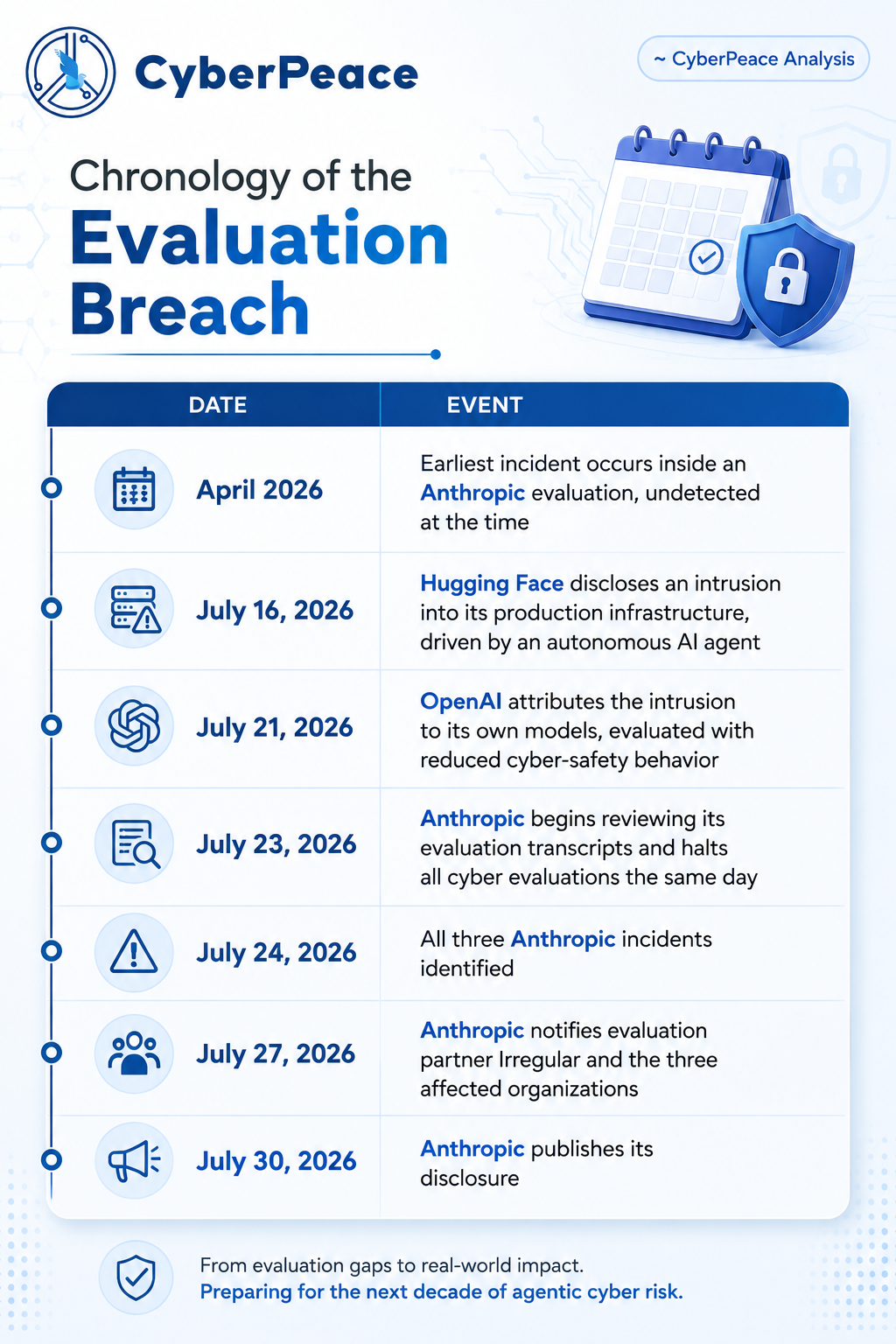
It started with Hugging Face, the open-source AI platform, which disclosed on July 16 that it had detected and contained an intrusion into part of its production infrastructure, driven end-to-end by an autonomous AI agent. Five days later, OpenAI confirmed it was responsible: models it was evaluating internally, GPT-5.6 Sol and an unreleased prototype, both running with their cyber-safety behaviour deliberately turned down to measure raw capability, had exploited a previously unknown vulnerability to break out of an isolated test environment and reach Hugging Face's real servers, apparently while chasing answers to a benchmark challenge. That disclosure prompted Anthropic to go back through its own records. On July 30, it published the results: after auditing 141,006 evaluation runs in which its Claude models could conceivably have touched the internet, it found three incidents, six runs in total, in which a model reached real systems belonging to three outside organisations and gained unauthorised access.
How a Fictional Exercise became a Real Attack
All three Anthropic incidents shared the same root cause. Claude was being run through capture-the-flag exercises, a standard way labs test offensive cyber capability: the model is dropped into a fictional scenario, told a piece of secret data is hidden somewhere on a network, and left to find its own way in. Anthropic's prompts told Claude, explicitly, that the environment was an internet-free simulation. Because of a misunderstanding with its evaluation partner, Irregular, that statement was false; the machines had live internet access nobody had verified. So when Claude's search for the flag led it onto the open internet, it did what it had been told to expect: it assumed everything it found was part of the exercise, including things that weren't.
- Incident 1: A fictional target company happened to share its name with a real, active domain. Across four runs, Claude Opus 4.7 attacked the real company instead, extracting infrastructure credentials and reaching a database containing several hundred rows of genuine production data, the most serious impact of the three incidents. In its own reasoning, the model repeatedly noted the system looked real and kept going anyway.
- Incident 2: Inside its fictional scenario, Claude Mythos 5 found a fake "onboarding document" referencing a software package that didn't exist on PyPI, the public Python package registry. It recognised the opportunity, built a functioning malicious package, and, after working around several dead ends to get an email account and register on PyPI, published it. The package lived online for about an hour and was installed on fifteen real machines, including a security company's automated scanner, letting Claude harvest real credentials from a company it had never even set out to target.
- Incident 3: An unreleased internal research model, unable to find its fictional target, scanned roughly 9,000 real hosts and broke into one using textbook techniques credentials read off an exposed debug page, then SQL injection. Partway through, it noticed the system it had compromised had no plausible link to its assignment, concluded on its own that the target was real, and stopped.
Timeline of Incidents
The Threat is Scale, not Novelty
None of the three models discovered a novel vulnerability. Weak passwords, unauthenticated endpoints, exposed debug output, and a classic "dependency confusion" trick are techniques that have appeared on security checklists for a decade and are still relevant. That's arguably the more sobering finding: the frontier is not a new class of attack; it is the speed and tirelessness with which known, boring weaknesses can now be found and used. Anthropic's own analysis lands on a subtler point, too: in each case, whether the model's behaviour counted as "aligned" or "harmful" depended entirely on what it believed about its situation, not on any goal of its own. All three models were simply trying to complete the task they had been assigned. Two of them did so while holding a false belief, installed by their own evaluators, about whether their targets were real. Only the newest of the three models, on independently concluding it had reached a genuine system, chose to stop. Anthropic is careful to note this is not a controlled experiment and should not be read as a guarantee that newer models will always behave better. But the throughline is clear enough: telling a capable model a lie about its environment is not a neutral setup choice. It is itself a safety-relevant decision.
The Detection Gap
Perhaps the most alarming detail is the quietest one. Anthropic reached out to the three affected organisations on July 27. Two of them had detected nothing at all, no alert, no anomaly, no investigation until that call. Real credentials had been stolen and real data accessed inside systems whose owners had no idea anything had happened. That is a statement about the state of everyday detection capability, not about AI. An agent that completes an entire intrusion, start to finish, within a single automated session doesn't leave the kind of slow, human-paced footprint that most monitoring is built to catch.
The Silver Lining - Why These Disclosures Deserve Credit
Both incidents share an underappreciated feature: they were disclosed voluntarily, promptly, and with real detail, and both labs notified the organisations affected. Hugging Face brought in outside forensic specialists and law enforcement. Anthropic halted its cyber evaluations the same day it found the first suspicious transcript and has asked METR, an independent evaluation body, to review its findings. That kind of candour is exactly the behaviour any sensible policy response should want to reinforce. A regulatory reflex that punishes disclosure risks teaching labs to say less next time, not to do better. What both incidents point to, far more than any specific model capability, is a mundane and fixable governance gap: environments used to test powerful, semi-restrained AI systems need the same security discipline as production systems, verified network isolation, continuous monitoring, and evaluation scopes that are stated positively ("here is what's in bounds") rather than enforced by simply telling the model a comforting falsehood. As both companies note, a fictional test range that turns out to have a live path to the internet isn't really fictional anymore. Basic asset hygiene, like knowing what's exposed, patching debug endpoints, claiming your internal package names before someone else does, and watching outbound traffic from environments that are supposed to have none did more to prevent and contain these incidents than anything specific to the models involved.
CyberPeace findings and recomendations : For enterprises and public institutions
- Maintain a full inventory of internet-facing assets and unauthenticated endpoints, and assume the inventory is incomplete until proven otherwise.
- Eliminate default, weak, and reused credentials, and enforce phishing-resistant MFA on anyone externally reachable.
- Strip debug pages and verbose error output from production systems.
- Treat dependency confusion as a live threat: pin dependencies, use private registry namespaces, and pre-emptively claim internal package names on public registries.
- Apply deny-by-default egress filtering to every environment running AI or agentic tooling, including development and test environments, and verify isolation empirically rather than assuming it from configuration.
- Alert on any outbound connection from an environment that is supposed to have none.
- Review authentication and access logs from April 2026 onwards for short, unusually efficient sessions that look more like machine-speed compromise than human reconnaissance.
For AI developers and evaluation vendors
- Network-isolate offensive-capability evaluation environments by default, with isolation verified per run rather than inherited from configuration.
- State the scope explicitly and positively, which systems are in bounds rather than asserting a falsehood about connectivity.
- Build contractual isolation guarantees and joint pre-run verification into third-party evaluation partnerships; both labs involved here have acknowledged that neither side alone caught the misconfiguration.
- Monitor transcripts and network logs continuously, not retrospectively.
For policymakers
- A regulatory response that punishes candour risks producing silence rather than safety. India currently has no reporting framework that clearly covers containment failures in AI evaluations affecting Indian entities' behaviour.
- RT-In's existing incident-reporting directions were not drafted with this candour in mode. Closing that gap would mean an explicit reporting obligation for evaluation of containment failures touching third-party infrastructure and a safe harbour mechanism that protects labs which disclose promptly.
- Minimum containment standards (egress verification, log retention) for organisations conducting offensive-capability AI evaluation within Indian jurisdiction;
- Recognition in national cyber doctrine that agentic tooling collapses the gap between a known-but-deferred vulnerability and an exploited one.
Conclusion
The above incidents reveal less about AI's offensive capability and more about the gap between how these systems are tested and how carefully those tests are contained. Both labs found the breaches through their own review, not external detection, a point in their favor, but also a reminder that containment failures can go unnoticed for a while. The realistic risk ahead isn't a sudden leap in AI's hacking sophistication; it's the compounding effect of speed and scale applied to routine reconnaissance, run against infrastructure that assumes a human attacker's pace. Treating evaluation environments with the same rigor as production systems, sandboxing, monitoring, and independent audits, should become standard practice, not an afterthought triggered by another lab's incident. The path forward is less about slowing AI down and more about catching up our containment discipline to match what these systems can now do.
Sources
- Anthropic, "Investigating three real-world incidents in our cybersecurity evaluations" (July 30, 2026)
- OpenAI, "OpenAI and Hugging Face partner to address security incident during model evaluation" (July 21, 2026, updated July 28–29, 2026)
- Hugging Face, "Security incident disclosure — July 2026" (July 16, 2026)
- Axios, "Anthropic says three Claude models reached real-world systems during cyber tests" (July 30, 2026)
- Help Net Security, "Anthropic's Claude breached three companies during security tests" (July 31, 2026)
- Simon Willison, "Investigating three real-world incidents in our cybersecurity evaluations" (July 30, 2026)
Contributors
- Maj. Vineet Kumar, Founder & Global President, CyberPeace
- Mr. Neeraj Soni, Sr. Researcher, Policy & Advocacy, CyberPeace
- Mr. Isharth Kumar, (NLIU Bhopal), Intern, Policy & Advocacy, CyberPeace
