
#FactCheck: AI-Generated Photo Shared to Claim Boycott of Hindu Sammelan
Executive Summary:
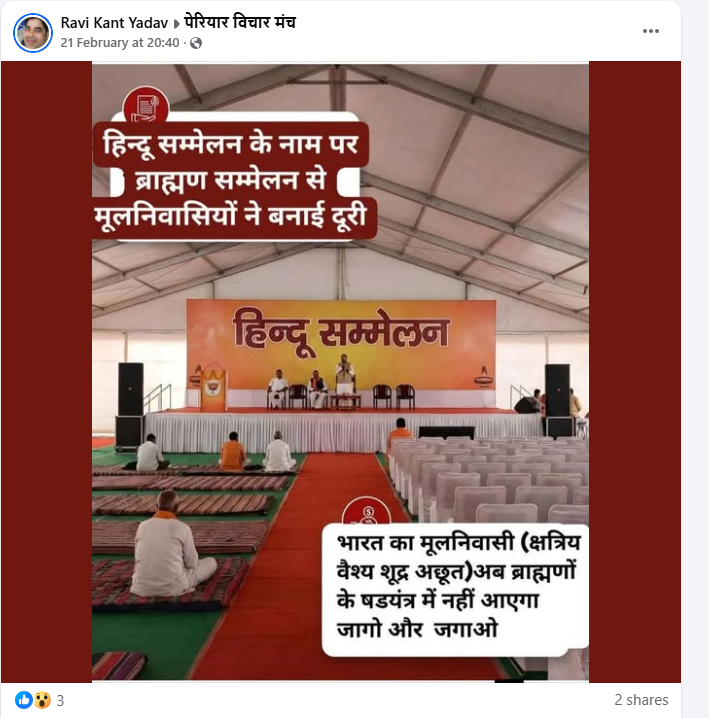
A photo circulating on social media shows a stage with the words “Hindu Sammelan” (Hindu Conference) written in large letters. In front of the stage, rows of chairs appear largely empty, with only a few people seated while most seats remain vacant.
Users sharing the image claim that the event, held under the banner of a “Hindu Sammelan,” was in fact a “Brahmin Sammelan,” and that indigenous communities chose to stay away, resulting in poor attendance.
It is noteworthy that, on the occasion of the centenary year of the Rashtriya Swayamsevak Sangh (RSS), various “Hindu Sammelan” events are being organized across the country. The viral image is being linked to this broader context.
However, research conducted by the CyberPeace found the viral claim to be false. Our research revealed that the image being shared on social media is not authentic but AI-generated and is being circulated with a misleading narrative.
Claim
On February 21, 2026, a Facebook user shared the viral image. The original and archived links are provided below
- https://www.facebook.com/photo?fbid=935049042540479&set=gm.2425972001215469&idorvanity=465387370607285
- https://ghostarchive.org/archive/sxC6d
Fact Check:
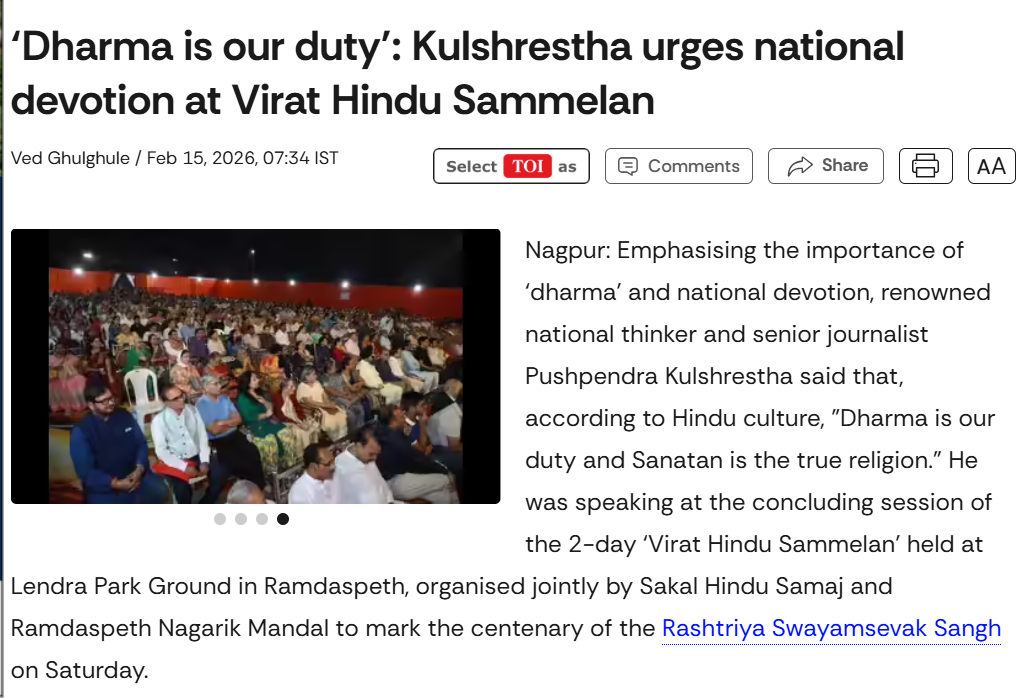
A keyword search on Google confirmed that several “Hindu Sammelan” events have indeed been organized across the country as part of the RSS centenary year. For instance, media reports have covered such events in different cities, including Nagpur.
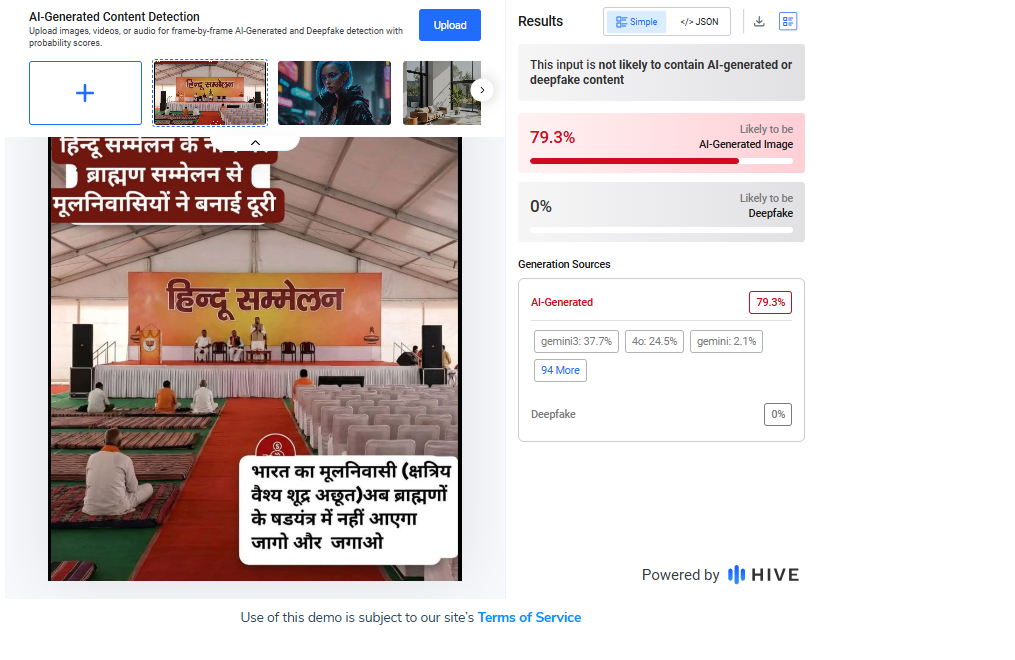
However, upon closely examining the viral image, we observed certain visual inconsistencies and unnatural elements that raised suspicion of AI generation. We first analyzed the image using the AI detection tool Hive Moderation, which indicated a 79.3 percent probability that the image was AI-generated.
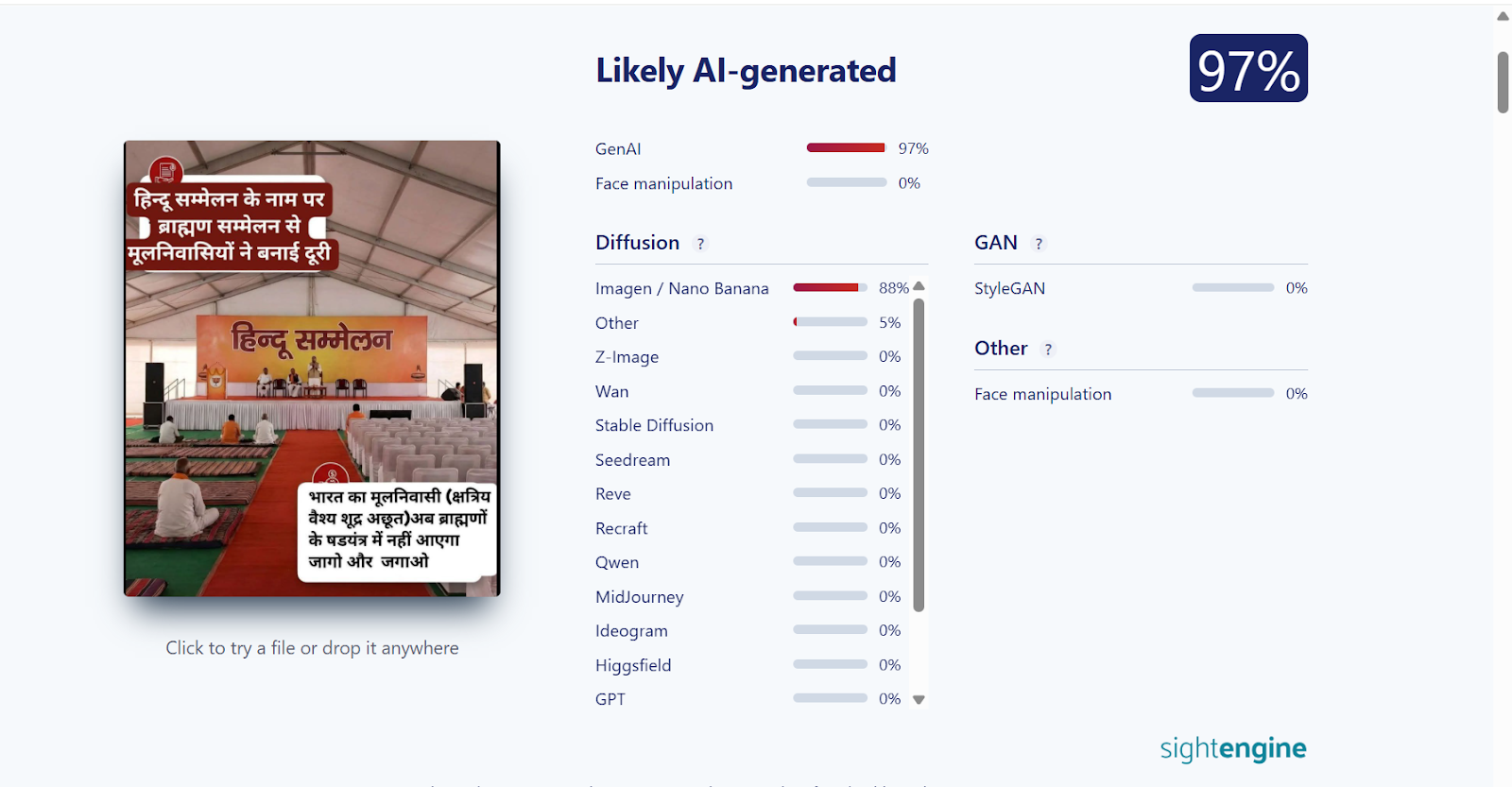
To further verify, we scanned the image using another AI detection platform, Sightengine. The results showed a 97 percent likelihood that the image was AI-generated.
Conclusion
Our research confirms that the image circulating on social media is not genuine. It has been artificially created using AI technology and is being shared with a misleading claim.

Related Blogs
.webp)
Introduction
In an era where organisations are increasingly interdependent through global supply chains, outsourcing and digital ecosystems, third-party risk has become one of the most vital aspects of enterprise risk management. The SolarWinds hack, the MOVEit vulnerabilities and recent software vendor attacks all serve as a reminder of the necessity to enhance Third-Party Risk Management (TPRM). As cyber risks evolve and become more sophisticated and as regulatory oversight sharpens globally, 2025 is a transformative year for the development of TPRM practices. This blog explores the top trends redefining TPRM in 2025, encompassing real-time risk scoring, AI-driven due diligence, harmonisation of regulations, integration of ESG, and a shift towards continuous monitoring. All of these trends signal a larger movement towards resilience, openness and anticipatory defence in an increasingly dependent world.
Real-Time and Continuous Monitoring becomes the Norm
The old TPRM methods entailed point-in-time testing, which typically was an annual or onboarding process. By 2025, organisations are shifting towards continuous, real-time monitoring of their third-party ecosystems. Now, authentic advanced tools are making it possible for companies to take a real-time pulse of the security of their vendors by monitoring threat indicators, patching practices and digital footprint variations. This change has been further spurred by the growth in cyber supply chain attacks, where the attackers target vendors to gain access to bigger organisations. Real-time monitoring software enables the timely detection of malicious activity, equipping organisations with a faster defence response. It also guarantees dynamic risk rating instead of relying on outdated questionnaire-based scoring.
AI and Automation in Risk Assessment and Due Diligence
Manual TPRM processes aren't sustainable anymore. In 2025, AI and machine learning are reshaping the TPRM lifecycle from onboarding and risk classification to contract review and incident handling. AI technology can now analyse massive amounts of vendor documentation and automatically raise red flags on potential issues. Natural language processing (NLP) is becoming more common for automated contract intelligence, which assists in the detection of risky clauses or liability gaps or data protection obligations. In addition, automation is increasing scalability for large organisations that have hundreds or thousands of third-party relationships, eliminating human errors and compliance fatigue. However, all of this must be implemented with a strong focus on security, transparency, and ethical AI use to ensure that sensitive vendor and organisational data remains protected throughout the process.
Risk Quantification and Business Impact Mapping
Risk scoring in isolation is no longer adequate. One of the major trends for 2025 is the merging of third-party risk with business impact analysis (BIA). Organisations are using tools that associate vendors to particular business processes and assets, allowing better knowledge of how a compromise of a vendor would impact operations, customer information or financial position. This movement has resulted in increased use of risk quantification models, such as FAIR (Factor Analysis of Information Risk), which puts dollar values on risks associated with vendors. By using the language of business value, CISOs and risk officers are more effective at prioritising risks and making resource allocations.
Environmental, Social, and Governance (ESG) enters into TPRM
As ESG keeps growing on the corporate agenda, organisations are taking TPRM one step further than cybersecurity and legal risks and expanding it to incorporate ESG-related factors. In 2025, organisations evaluate if their suppliers have ethical labour practices, sustainable supply chains, DEI (Diversity, Equity, Inclusion) metrics and climate impact disclosures. This growth is not only a reputational concern, but also a third-party non-compliance with ESG can now invoke regulatory or shareholder action. ESG risk scoring software and vendor ESG audits are becoming components of onboarding and performance evaluations.
Shared Assessments and Third-Party Exchanges
With the duplication of effort by having multiple vendors respond to the same security questionnaires, the trend is moving toward shared assessments. Systems such as the SIG Questionnaire (Standardised Information Gathering) and the Global Vendor Exchange allow vendors to upload once and share with many clients. This change not only simplifies the due diligence process but also enhances data accuracy, standardisation and vendor experience. In 2025, organisations are relying more and more on industry-wide vendor assurance platforms to minimise duplication, decrease costs and maximise trust.
Incident Response and Resilience Partnerships
Another trend on the rise is bringing vendors into incident response planning. In 2025, proactive organisations address major vendors as more than suppliers but as resilience partners. This encompasses shared tabletop exercises, communication procedures and breach notification SLAs. With the increasing ransomware attacks and cloud reliance, organisations are now calling for vendor-side recovery plans, RTO and RPO metrics. TPRM is transforming into a comprehensive resilience management function where readiness and not mere compliance takes centre stage.
Conclusion
Third-Party Risk Management in 2025 is no longer about checklists and compliance audits; it's a dynamic, intelligence-driven and continuous process. With regulatory alignment, AI automation, real-time monitoring, ESG integration and resilience partnerships leading the way, organisations are transforming their TPRM programs to address contemporary threat landscapes. As digital ecosystems grow increasingly complex and interdependent, managing third-party risk is now essential. Early adopters who invest in tools, talent and governance will be more likely to create secure and resilient businesses for the AI era.
References
- https://finance.ec.europa.eu/publications/digital-operational-resilience-act-dora_en
- https://digital-strategy.ec.europa.eu/en/policies/nis2-directive
- https://www.meity.gov.in/data-protection-framework
- https://securityscorecard.com
- https://sharedassessments.org/sig/
- https://www.fairinstitute.org/fair-model

Executive Summary
In the Philippines, social media users have been sharing a video and an image following complaints over sharp increases in electricity bills. The posts claim that, in exchange for higher electricity charges, low-income households are being provided free electricity and air conditioning units. However, a fact-check by CyberPeace Research Wing found no evidence to support these claims. A closer examination of the visuals revealed several inconsistencies and visual indicators suggesting that the content is likely AI-generated.
Claim
An image was also shared on Instagram on April 29, showing purported beneficiaries holding new air conditioning units allegedly provided “free by the government.”

Fact Check
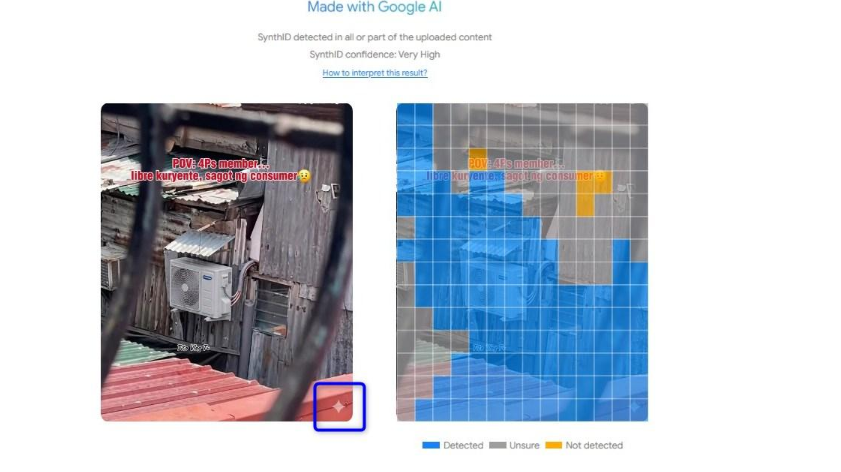
However, the video and image circulating on social media do not actually show beneficiaries receiving any subsidy. A closer analysis of the visuals indicates that the content is AI-generated. In the initial frames of the misrepresented video, a diamond-shaped icon can be seen in the bottom-right corner, which is the watermark associated with Google’s Gemini AI model.
Further analysis using Google’s SynthID Detector, a tool designed to identify AI-generated content, indicated with a “very high” level of confidence that the material was created using the company’s AI technology.
The country’s social welfare agency also issued a statement on Facebook on April 30, rejecting the claim and saying it is “not true” and intended only to “propagate wrong information.” Social welfare agency statement on Facebook
- https://www.facebook.com/photo?fbid=1373756198132587&set=a.665386155636265

Conclusion
However, the video and image circulating on social media do not actually show beneficiaries receiving any subsidy. A closer analysis of the visuals indicates that the content is AI-generated. In the initial frames of the misrepresented video, a diamond-shaped icon can be seen in the bottom-right corner, which is the watermark associated with Google’s Gemini AI model. The viral video and image are misleading. Multiple inconsistencies and visual cues suggest that the content is likely AI-generated, and the claim that low-income households are receiving free electricity and air conditioners is false.
Introduction
Somewhere right now, a model is reading a library. It does not read like you or I, savouring a good line or skipping to the end. It does not copy, clean and convert text into numbers at the scale that a human reader could. The copyright questions these models raise are not new, but they are new in scale, and they implicate a legal order that prizes borders. A book written in Lagos can be replicated on a server in Virginia, used to train a model sold in Berlin. Whose laws apply? The honest answer is: we don't know.
A Treaty Written Before Computers
The Berne Convention is one of the most important international agreements on copyright, with over 180 countries being party to it. According to Article 9(1) of the Berne Convention, authors have the exclusive right to allow or prohibit the reproduction of their works in any form or way. Article 9(2) provides that certain countries may implement exceptions to the rights granted by the convention, as long as they are consistent with the three-step test. More specifically, a national law exception should be confined to a certain category of works, not prejudice the work’s normal use, and not unreasonably prejudice the rights of the author.
This explains how the Berne Convention could apply to copyright protection for AI. Developers of such technology often argue that since the output of a given model rarely resembles anything learned from the examples provided, there is no copying occurring. However, the Agreed Statements of the WIPO Copyright Treaty provide that the reproduction of a protected item in digital format also constitutes a reproduction. Therefore, if a work is used to train a model, this can be considered a reproduction, and the question then emerges whether a national exception applies.
Three Jurisdictions, Three Answers
Countries have responded in different ways to that question. The United States draws on its fair use doctrine, a flexible, four-factor test that was never intended for machine learning but dominates AI-related disputes anyway. Japan’s Article 30-4 permits uses of works for the purpose of data analysis where the use is not for the enjoyment of the work’s expression, which captures a lot of what training entails. And the European Union’s approach falls somewhere in the middle: its text and data mining rules allow mining of lawfully accessible works, but rightsholders can specify in a machine-readable manner that they do not want their works mined, and developers are required to seek permission.
A recent roundtable from the Columbia Undergraduate Law Review argues that the EU model fits the three-step test best because the opt-out keeps a licensing market alive and gives authors control before their work is used rather than after. It argues that broad US fair use and Japan's provision both struggle at the second and third steps, since they can undercut a foreseeable licensing market. That is one scholarly view and not settled law. The EU system also has its own weak spot: an opt-out only protects authors who know it exists and have the technical means to use it.
Bartz v. Anthropic in Brief
Bartz v. Anthropic is the case that puts these debates in front of a judge. Three authors, including Andrea Bartz, Charles Graeber and Kirk Wallace Johnson, filed a lawsuit against the Anthropic company for using part of their works to create the central library used by Claude and to train the models used in its creation. In addition, in June 2025, Judge William Alsup approved the separation of the case, considering each instance of use separately.
On training, he granted summary judgement for Anthropic, holding the use was fair and describing it as exceedingly transformative. He compared it to a reader who studies great writing in order to produce something new. It mattered that the authors did not allege Claude's outputs reproduced their books, so the case turned on inputs alone. He also held that buying print books and scanning them into digital copies was fair use, since it only changed the format of copies Anthropic already owned. But he refused to excuse the more than seven million pirated books Anthropic downloaded to build a permanent library. Building that library from pirated copies, he found, was its own use and not a transformative one, and that part was set for trial.
Two observations are worth making in relation to those thinking across borders. First, the court's assumption that there might be a market for training licences, but its observation that this is not a market which the Copyright Act entitles authors to control, is quite inconsistent with Berne's concern for normal exploitation. Moreover, the order makes no reference to Berne at all, bearing out the observation that the US courts apply the domestic statute and not the treaty.
The story did not end there. Anthropic agreed to a $1.5 billion class settlement covering roughly 482,000 works, and the court granted final approval on 20 July 2026. It resolves claims about past acquisition and copying, so the training ruling remains a trial court's view rather than binding precedent.
Where Borders Break the System
The deeper trouble is that none of this travels well. Berne is not self-executing in the United States, so judges apply the domestic statute, and nobody is required to ask whether a fair use ruling passes the three-step test. Meanwhile, training can happen in one country, on work from dozens of others, for a product used everywhere. The same book might be freely usable in Tokyo, subject to an opt-out in Paris and defended as fair use in San Francisco.
The roundtable suggests one way forward: a new WIPO special agreement, along the lines of the WIPO Copyright Treaty, in response to the internet. It would provide guidance on the application of the three-step test to training, regard licensing markets as an ordinary part of exploitation, and require minimum standards for reservations of rights and compensation. There is one major potential obstacle: many of the most influential AI companies are based in the US, which has a record of opposing international obligations that impinge on fair use. A deal would apply only to the extent that it is not controlled by the US, where most of the training takes place. Market forces, in the form of the so-called Brussels effect, may prove more influential than negotiations at WIPO.
Conclusion
Bartz’s analysis illustrates the importance of characterising a specific use at the level of a particular court. While the former had been viewed as an activity and the latter as an acquisition, the distinction between the use of a work and its acquisition appears more likely to transcend borders than the concept of fair use. Berne was designed to create a common ground for authors. Whether this convention would be able to fulfil its function in the era of generative AI depends on the willingness of nations to adopt a joint understanding of what constitutes its foundations for machines.
