
#FactCheck-AI-Generated Image of Virat Kohli and Anushka Sharma Falsely Shared as a Real Candid Moment
Executive Summary
A picture is rapidly going viral on social media, showing Indian cricketer Virat Kohli and actor Anushka Sharma having breakfast together. Users are sharing this photo, presenting it as a "candid" (real) moment. Research by the CyberPeace Research Wing revealed that the photo of Virat Kohli and Anushka Sharma having breakfast is completely fake. This image does not depict a real moment, but has been created using Artificial Intelligence (AI).
Claim
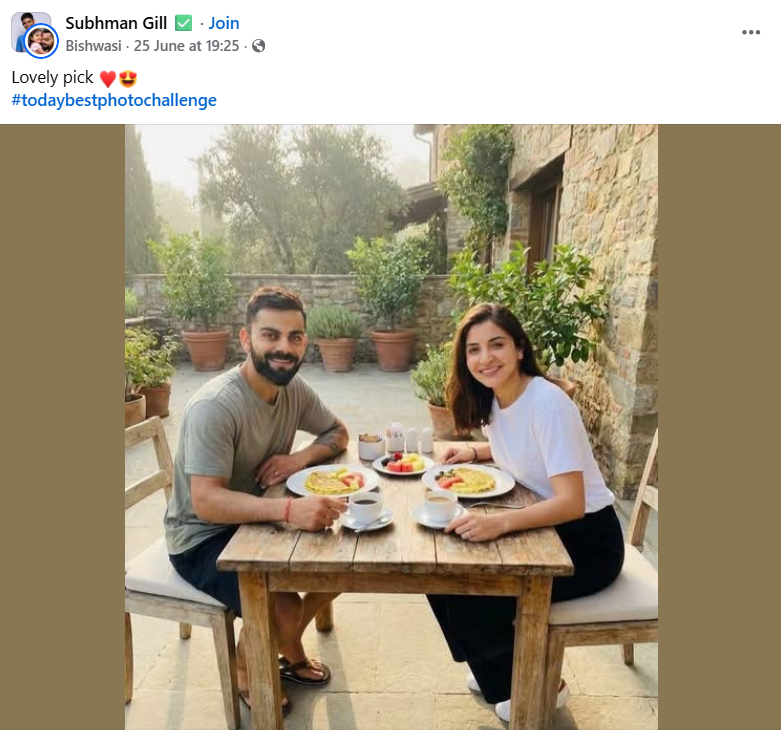
A picture is rapidly going viral on social media, showing Indian cricketer Virat Kohli and actor Anushka Sharma having breakfast together. Users are sharing this photo, presenting it as a "candid" (real) moment.
https://www.facebook.com/groups/1132434027856845/posts/1677540760012833/
Fact Check
In our research, this image was found to be 'AI-generated'. When a reverse image search and keyword scan were conducted to verify this viral photo, no credible media reports, official photographs, or any such posts on the celebrity couple's official social media handles were found.
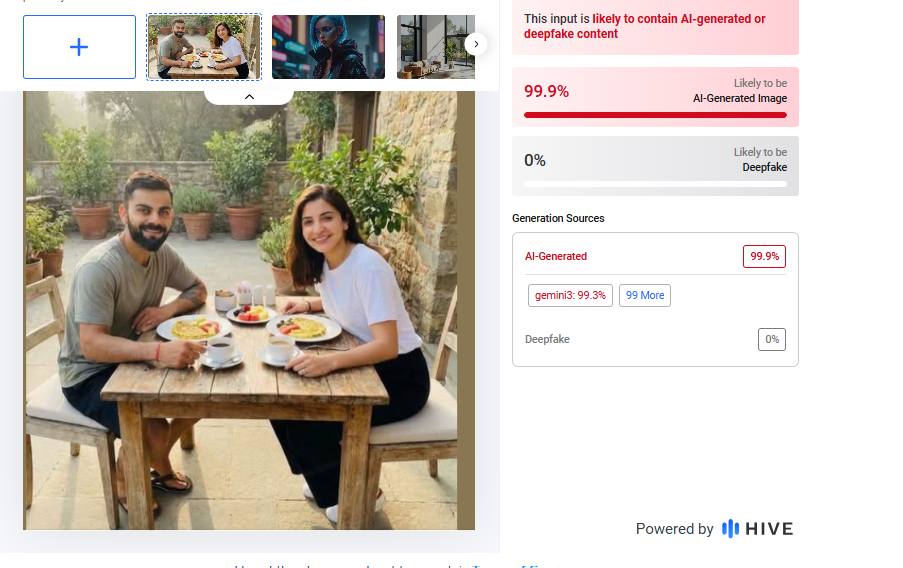
WASIT also confirmed that the image is 'AI-generated'.
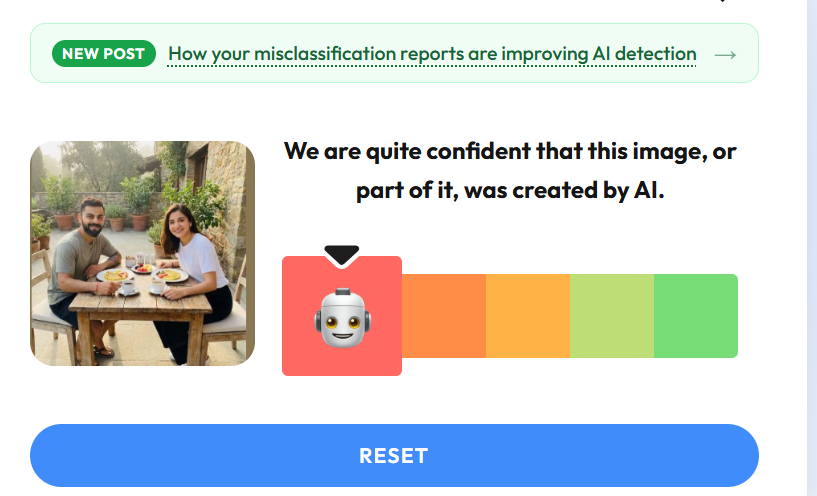
Conclusion
Our research revealed that the photo of Virat Kohli and Anushka Sharma having breakfast is completely fake. This image does not depict a real moment, but has been created using Artificial Intelligence (AI).

Related Blogs
.webp)
Executive Summary
A post is being shared on social media claiming that retired Chief of Defence Staff (CDS) General Anil Chauhan was arrested from his residence in connection with a 51.5-kg drug case. The post states that official confirmation of the case is awaited. Some Army personnel can also be seen in the video, which is being shared as evidence to support the claim. CyberPeace Research found the viral claim to be false. We found that General Anil Chauhan had retired as CDS in May 2026. According to the Ministry of Defence, his tenure ended on May 30, 2026. However, we did not find any credible report confirming General Anil Chauhan’s arrest in connection with a 51.5-kg drug case. Therefore, the claim being shared on social media is misleading and false. Furthermore, according to the available information, the video is related to the December 2021 terrorist attack on a Jammu and Kashmir Police bus in the Pantha Chowk area of Srinagar.
Claim:
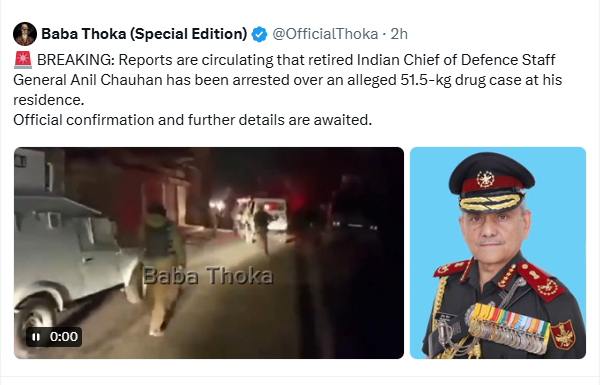
On September 18, 2026, a user on the social media platform X claimed that retired CDS General Anil Chauhan was arrested from his residence in connection with a 51.5-kg drug case.
https://x.com/i/birdwatch/t/2100860615887892915?source=6
Fact Check:
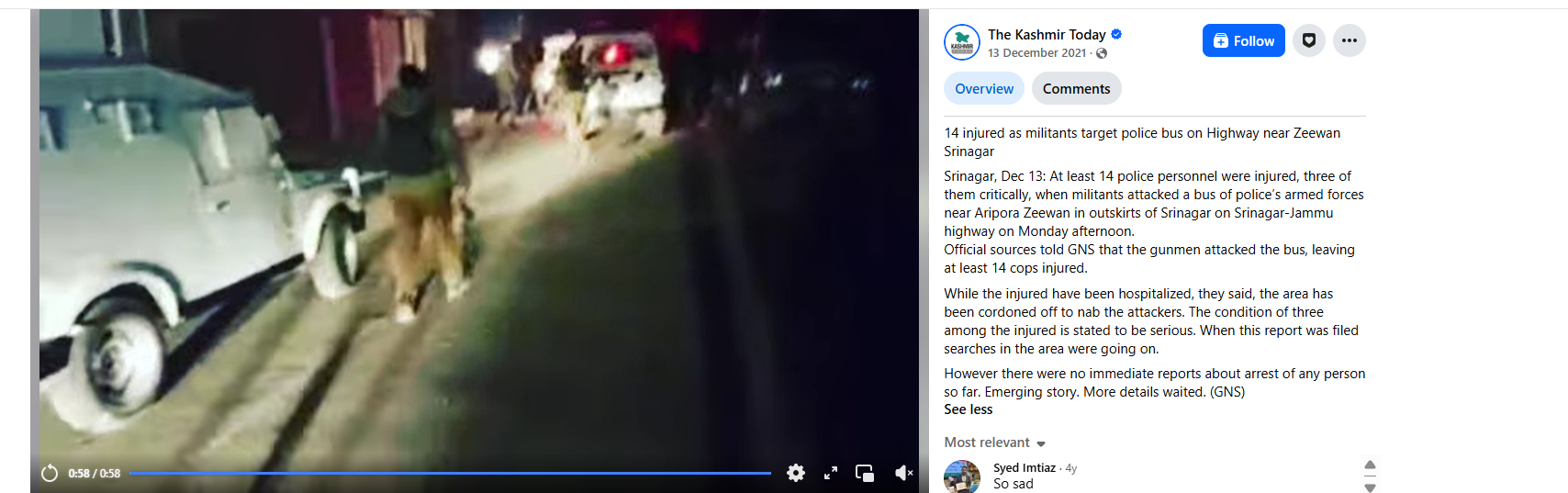
To verify the viral claim, we conducted a Google search using relevant keywords. During the search, we did not find any credible media report supporting the claim. As part of our research, we conducted a reverse image search of keyframes from the video. During the search, we found the same video on the Facebook page of The Kashmir Today, where it was posted on December 13, 2021. The 58-second video also contains the portion seen in the viral video in its final six seconds. According to the information accompanying the video, militants attacked a police bus near Aripora Zewan on the Srinagar-Jammu highway in the outskirts of Srinagar on Monday afternoon. At least 14 police personnel were injured in the attack, three of whom were reported to be in critical condition.
According to official sources cited in the report, the gunmen’s attack injured 14 police personnel, who were subsequently admitted to a hospital. The area was cordoned off and a search operation was underway to apprehend the attackers. At the time, there were no reports of any arrests.
https://www.facebook.com/watch/?v=422219106288318
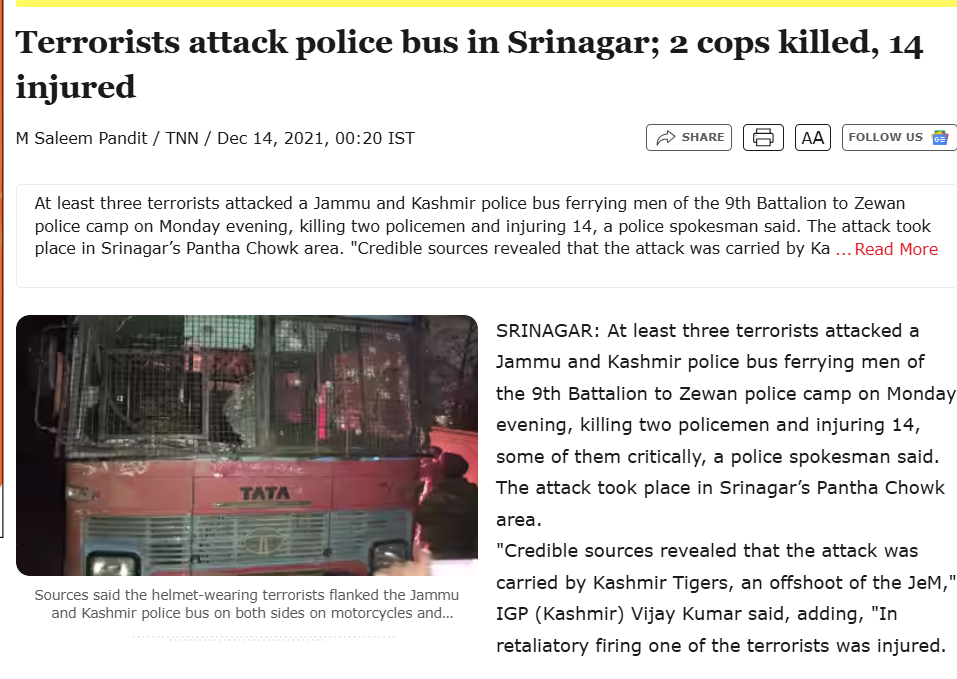
Based on the clue found on Facebook, we conducted a Google search using relevant keywords. During the search, we found a report published on The Times of India website on December 14, 2021, carrying the same claim.
Conclusion
Our research found that the video being shared on social media is not recent but dates back to December 2021. During the reverse image search, we found the same video on The Kashmir Today’s Facebook page, where it was posted on December 13, 2021. The viral portion of the video is also present in the original 58-second clip. According to the available information, the video is related to the December 2021 terrorist attack on a Jammu and Kashmir Police bus in the Pantha Chowk area of Srinagar. The attack resulted in the deaths of two police personnel, while 14 others were injured. Therefore, the old video is being shared with a misleading claim by linking it to a recent incident.
.webp)
The Digital Covenant: Aligning Communication with SDG Goals
“Rethinking Communication, Cyber Responsibility, and Sustainability in a Connected World”
Introduction
It is rightly said by Antonio Guterres, United Nations Secretary General, “Everyone should be able to express themselves freely without fear of attack. Everyone should be able to access a range of views and information sources.” In 2024, when the Global Alliance for PR and Communication Management asserted that it aligns with the era of digital transformation, where technology is moving at terminal velocity and bringing various risks and threats, it called on the global leaders and stakeholders to proclaim ‘Responsible Communication’ as the 18th Sustainable Development Goal (SDG). On May 17th, as we celebrate World Telecommunication and Information Society Day (WTISD) 2025, we must align our personal, professional, and virtual spaces with a safe and sustainable information age.
In terms of digital growth, it is indubitable that India is growing at a brisk pace consistently in alignment with its South Asian and Western counterparts and has incorporated international covenants on digital personal data and cyber crimes within its domestic regime.
UN Global Principles for Information Integrity
The United Nations has displayed its constant commitment to the achievement of the seventeen SDGs that were adopted at the United Nations Conference in 2012 in Rio de Janeiro. It recognises that you cannot isolate the digital transformation, technology, and digitisation from other areas that are included within the SDGs, such as health, education, and poverty. The UN released Policy Brief 8 in June 2023 by the UN Secretary-General that seeks to empirically derive data on the threats posed to information integrity and then come up with norms that help guide the member states, the digital platforms, and other stakeholders. The norms must be in conformity with the right to freedom of opinion and expression and the right to information access.
In line with its agenda, it has formulated Global Principles of Information Integrity, which include “Societal Trust and Resilience”, “Healthy Incentives”, “Public Empowerment”, “Independent, Free and Pluralistic Media” and “Transparency and Research”. The principles recognise the harm caused by hatred, misinformation, and disinformation propagated by the misuse of advances in Artificial Intelligence Technology (AI).
Breaking the Binary: Bridging the Gender Digital Divide
The reflection of how far we have come and how far we have to go can be deciphered with a single sentence, i.e., using digital technologies to promote gender equality. This can be seen both as a paradox and a pressing call to action. As we celebrate WTISD 2025, the day highlights the fundamental role of Information and Communication Technologies (ICTs) in accelerating progress and bringing those not included in this digital transformation to become a part of this change, especially the female population that remains isolated from mainstream growth. As per the data given by ITU, “Out of the world population, 70 per cent of men are using the internet, compared with 65 per cent of women.”
This exclusion is not merely a technical gap but a societal and economic chasm, reinforcing existing inequalities. By including such an important goal in the theme of this day, it marks a critical moment towards the formation of gender-sensitive digital policies, promoting digital literacy among women and girls, and ensuring safe, affordable, and meaningful connectivity. We can explore the future potential where technology is the true instrument for gender parity, not a mirror of old hierarchies.
India and its courts have time and again proven their commitment to cultivating digital transformation as an inherent strength to bridge this digital divide, and the recent judgement where the court declared the right to digital access an intrinsic part of the right to life and liberty is a single instance among many.
CyberPeace Resolution on World Telecommunication and Information Society Day
CyberPeace is actively bridging the gap between digital safety and sustainable development through its initiatives, aligning with the principles of the Sustainable Development Goals (SDGs). The ‘CyberPeace Corps’ empowers communities by fostering cyber hygiene awareness and building digital resilience. The ‘CyberPeace Initiative’, a project with Google.org, tackles digital misinformation, promoting informed online engagement. Additionally, Digital Shakti, now in its fifth phase, empowers women by enhancing their digital literacy and safety. These are just a few of the many impactful initiatives by CyberPeace, aimed at creating a safer and more inclusive digital future. Together, we are spreading awareness and strengthening the foundation for a safer and more inclusive digital future and promoting responsible tech use. Let us be resolute on this World Telecommunication and Information Society Day for “Clean Data. Safe Clicks. Stronger Future. Pledge to Cyber Hygiene Today!”
References

Introduction
Social media is the new platform for free speech and expressing one’s opinions. The latest news breaks out on social media and is often used by political parties to propagate their parties during the elections. Hashtag (#)is the new weapon, a powerful hashtag that goes a long way in making an impact in society that so at a global level. Various hashtags have gained popularity in the last years, such as – #blacklivesmatter, #metoo, #pride, #cybersecurity, and many more, which were influential in spreading awareness among the people regarding various social issues and taboos, which then were removed from multiple cultures. Social media is strengthened by social media influencers who are famous personalities with a massive following as they create regular content that the users consume and share with their friends. Social media is all about the message and its speed, and hence issues like misinformation and disinformation are widespread on nearly all social media platforms, so the influencers play a keen role in making sure the content on social media is in compliance with its community and privacy guidelines.
The Know-How
The Department of Consumer Affairs under the Ministry of Consumer Affairs, Food and Public Distribution released a guide, ‘Endorsements Know-hows!’ for celebrities, influencers, and virtual influencers on social media platforms, The guide aims to ensure that individuals do not mislead their audiences when endorsing products or services and that they are in compliance with the Consumer Protection Act and any associated rules or guidelines. Advertisements are no longer limited to traditional media like print, television, or radio, with the increasing reach of digital platforms and social media, such as Facebook, Twitter, and Instagram, there has been a rise in the influence of virtual influencers, celebrities, and social media influencers. This has led to an increased risk of consumers being misled by advertisements and unfair trade practices by these individuals on social media platforms. Endorsements must be made in simple, clear language, and terms such as “advertisement,” “sponsored,” or “paid promotion” can be used. They should not endorse any product or service and service in which they have done due diligence or that they have not personally used or experienced. The Act established guidelines for protecting consumers from unfair trade practices and misleading advertisements. The Department of Consumer Affairs published Guidelines for prevention of Misleading Advertisements and Endorsements for Misleading Advertisements, 2022, on 9th June 2022. These guidelines outline the criteria for valid advertisements and the responsibilities of manufacturers, service providers, advertisers, and advertising agencies. These guidelines also touched upon celebrities and endorsers. It states that misleading advertisements in any form, format, or medium are prohibited by law.
The guidelines apply to social media influencers as well as virtual avatars promoting products and services online. The disclosures should be easy to notice in post descriptions, where you can usually find hashtags or links. It should also be prominent enough to be noticeable in the content,
Changes Expected
The new guidelines will bring about uniformity in social media content in respect of privacy and the opinions of different people. The primary issue being addressed is misinformation, which was at its peak during the Covid-19 pandemic and impacted millions of people worldwide. The aspect of digital literacy and digital etiquette is a fundamental art of social media ethics, and hence social media influencers and celebrities can go a long way in spreading awareness about the same among common people and regular social media users. The increasing threats of cybercrimes and various exploitations over cyberspace can be eradicated with the help of efficient awareness and education among the youth and the vulnerable population, and the influencers can easily do the same, so its time that the influencers understand their responsibility of leading the masses online and create a healthy secure cyber ecosystem. Failing to follow the guidelines will make social media influencers liable for a fine of up to Rs 10 lakh. In the case of repeated offenders, the penalty can go up to Rs 50 lakh.
Conclusion
The size of the social media influencer market in India in 2022 was $157 million. It could reach as much as $345 million by 2025. Indian advertising industry’s self-regulatory body Advertising Standards Council of India (ASCI), shared that Influencer violations comprise almost 30% of ads taken up by ASCI, hence this legal backing for disclosure requirements is a welcome step. The Ministry of Consumer Affairs had been in touch with ASCI to review the various global guidelines on influencers. The social media guidelines from Clairfirnia and San Fransisco share the same basis, and hence guidelines inspired by different countries will allow the user and the influencer to understand the global perspective and work towards securing the bigger picture. As we know that cyberspace has no geographical boundaries and limitations; hence now is the time to think beyond conventional borders and start contributing towards securing and safeguarding global cyberspace.
