
#FactCheck: AI-Generated Audio Falsely Claims COAS Admitted to Loss of 6 Jets and 250 Soldiers
Executive Summary:
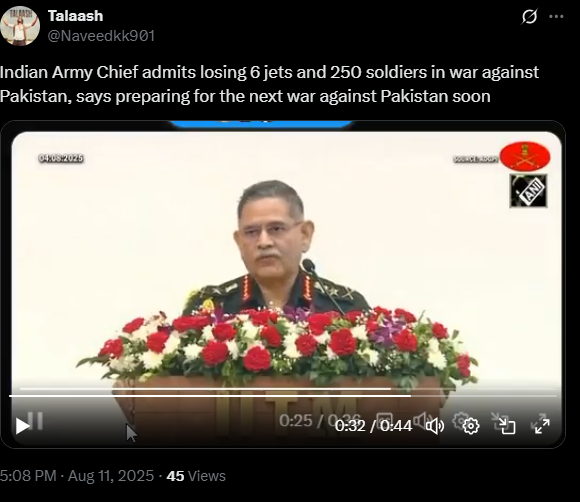
A viral video (archive link) claims General Upendra Dwivedi, Chief of Army Staff (COAS), admitted to losing six Air Force jets and 250 soldiers during clashes with Pakistan. Verification revealed the footage is from an IIT Madras speech, with no such statement made. AI detection confirmed parts of the audio were artificially generated.
Claim:
The claim in question is that General Upendra Dwivedi, Chief of Army Staff (COAS), admitted to losing six Indian Air Force jets and 250 soldiers during recent clashes with Pakistan.
Fact Check:
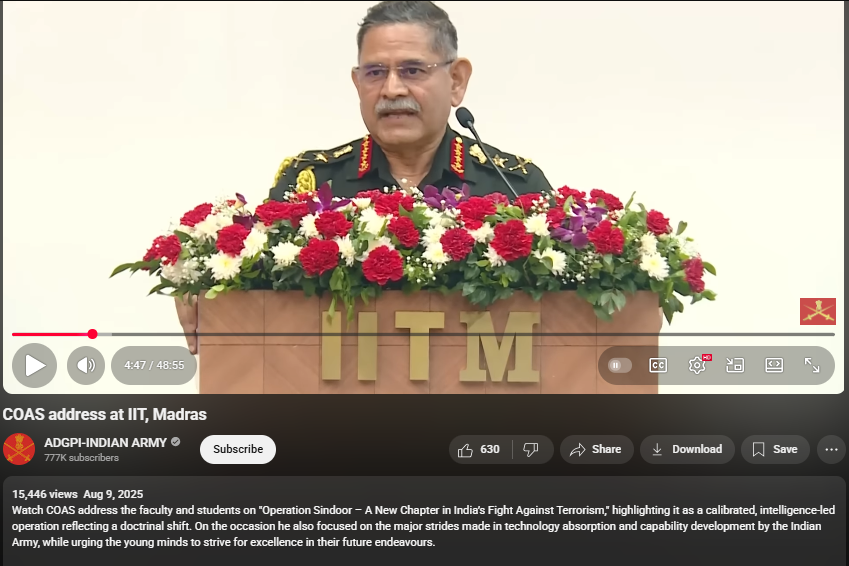
Upon conducting a reverse image search on key frames from the video, it was found that the original footage is from IIT Madras, where the Chief of Army Staff (COAS) was delivering a speech. The video is available on the official YouTube channel of ADGPI – Indian Army, published on 9 August 2025, with the description:
“Watch COAS address the faculty and students on ‘Operation Sindoor – A New Chapter in India’s Fight Against Terrorism,’ highlighting it as a calibrated, intelligence-led operation reflecting a doctrinal shift. On the occasion, he also focused on the major strides made in technology absorption and capability development by the Indian Army, while urging young minds to strive for excellence in their future endeavours.”
A review of the full speech revealed no reference to the destruction of six jets or the loss of 250 Army personnel. This indicates that the circulating claim is not supported by the original source and may contribute to the spread of misinformation.
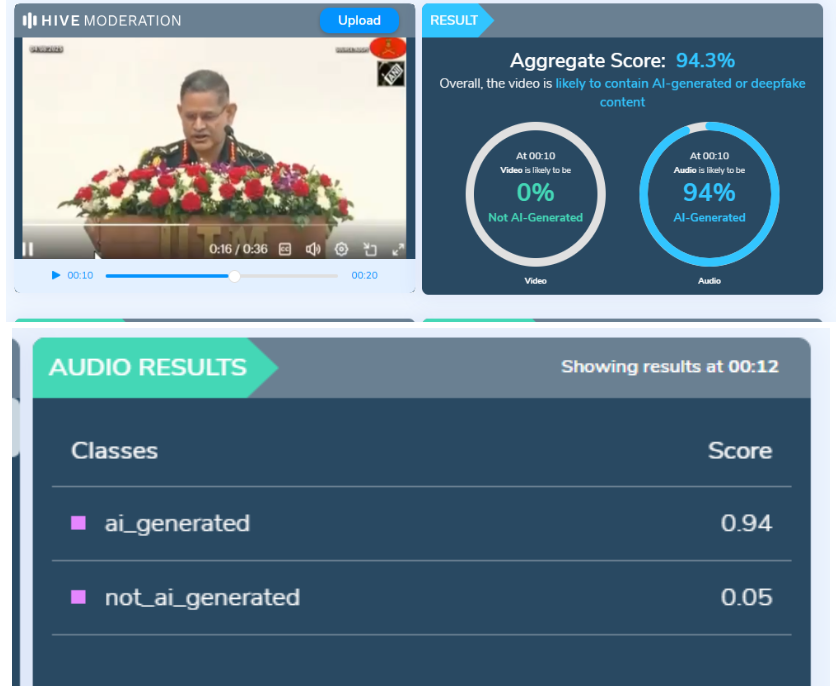
Further using AI Detection tools like Hive Moderation we found that the voice is AI generated in between the lines.
Conclusion:
The claim is baseless. The video is a manipulated creation that combines genuine footage of General Dwivedi’s IIT Madras address with AI-generated audio to fabricate a false narrative. No credible source corroborates the alleged military losses.
- Claim: AI-Generated Audio Falsely Claims COAS Admitted to Loss of 6 Jets and 250 Soldiers
- Claimed On: Social Media
- Fact Check: False and Misleading

Related Blogs
Executive Summary
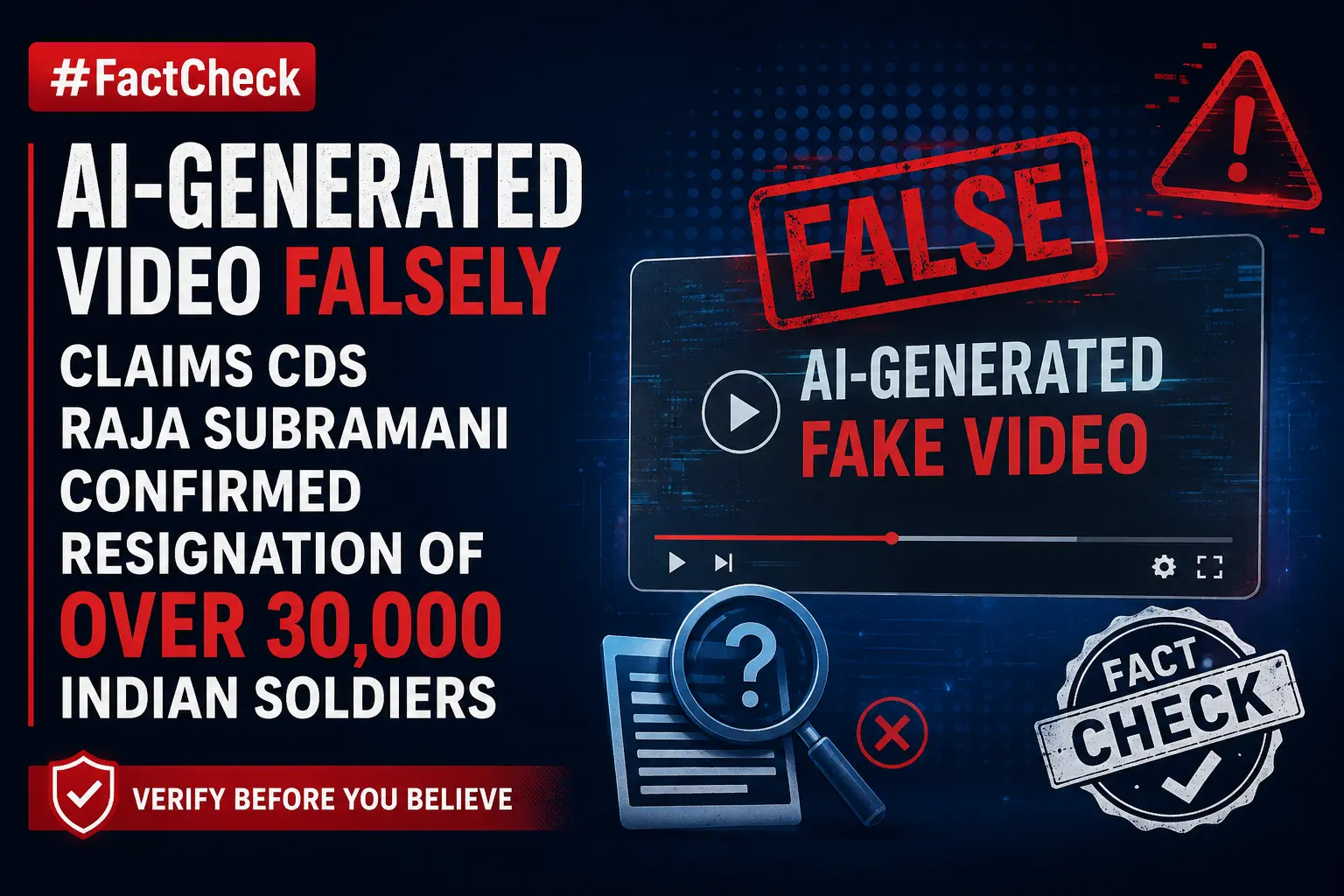
A video is being widely shared on social media, allegedly showing Chief of Defence Staff (CDS) Raja Subramani referring to the resignation of more than 30,000 Indian soldiers. The video is being circulated with the claim that CDS Raja Subramani confirmed that over 30,000 personnel resigned in protest following the demonstration held at Jantar Mantar. CyberPeace Research Wing’s research found that the viral claim is false. The research revealed that the video featuring CDS Raja Subramani has been digitally manipulated and created using Artificial Intelligence (AI). The original video does not contain any statement related to soldiers’ resignations or the Jantar Mantar protest.
Claim
A Facebook user shared the video with a claim stating: “After the protests at Jantar Mantar, India’s Chief of Defence Staff Raja Subramani has issued an emergency alert, saying that more than 30,000 soldiers have resigned in protest because their children were brutally beaten at Jantar Mantar.”
The post link, archive link and screenshot are provided below:

Fact Check
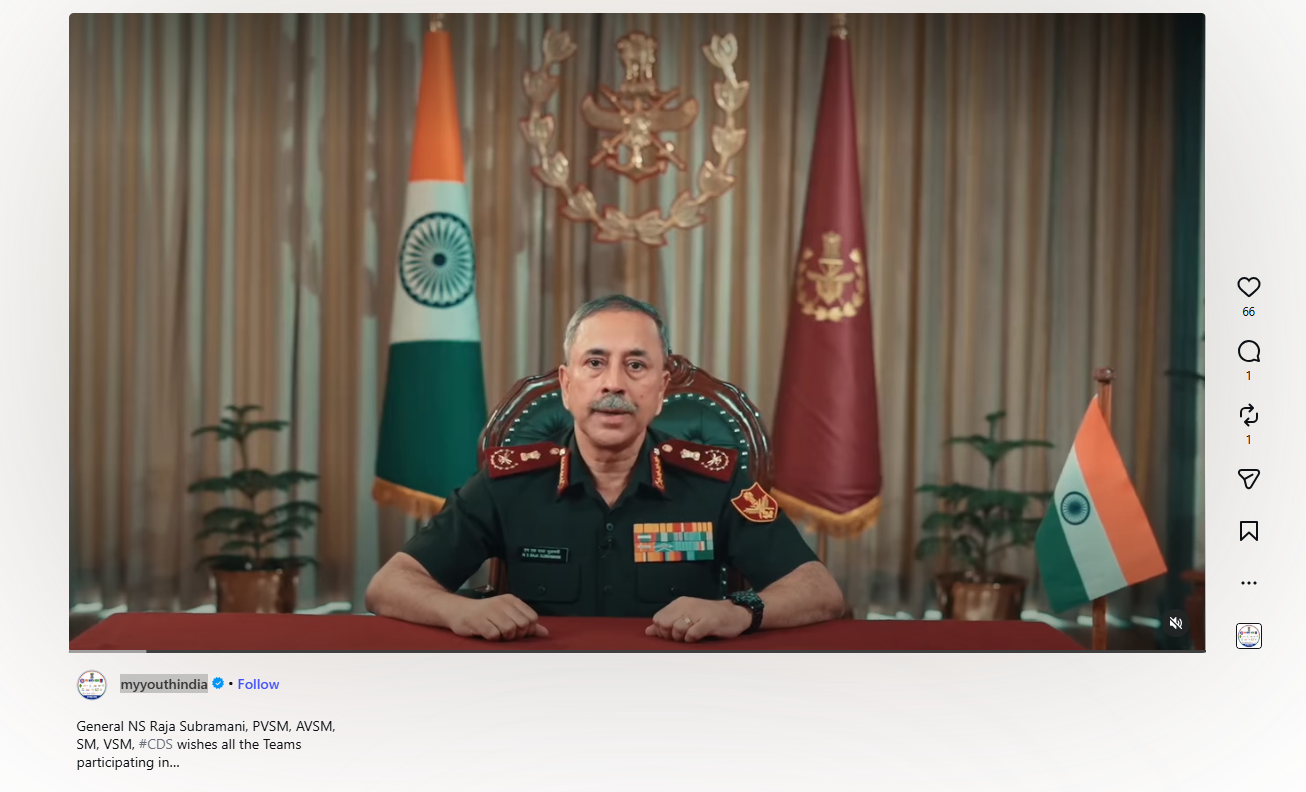
To verify the authenticity of the viral video, we extracted a key frame and conducted a reverse image search using Google Lens. During the search, we found the same video uploaded by the Eastern Command of the Indian Army (@easterncomd) on its official X account on July 21, 2026. The original video shows CDS Raja Subramani extending his best wishes to all participating teams of the 135th Indian Oil Durand Cup Football Tournament. There is no mention of any soldier resignations or the Jantar Mantar protest in the original footage.
https://x.com/easterncomd/status/2079485496988967225
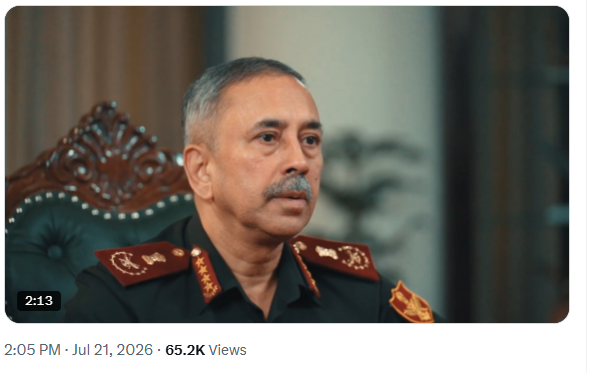
Further research led us to the same video posted by the Instagram account myyouthindia, where CDS Raja Subramani can again be seen wishing teams participating in the 135th Indian Oil Durand Cup Football Tournament.
https://www.instagram.com/reels/DbEGRGBsKv8/
Conclusion
The research established that the viral video of CDS Raja Subramani has been manipulated using AI-generated content. The original video is related to the 135th Indian Oil Durand Cup Football Tournament and does not contain any statement about the resignation of 30,000 Indian soldiers or the Jantar Mantar protest. The digitally altered video is being shared with a false claim.

Introduction
Social media platforms serve as an ideal breeding ground for cybercrime. A new fraud called ‘WhatsApp Pink’ has emerged, promising new features and an improved UI. Several law enforcement and government agencies have already issued severe caution against the program, which is used to hack mobile phones and steal personal information.
What is a pink WhatsApp Scam?
WhatsApp is on a roll with new features, but the messaging app is also experiencing an increase in a new type of scam. The WhatsApp Pink scam, as it is known, is gaining steam. Police and government organisations in several states, including Mumbai, Kerala, and Karnataka, have warned about the scam. A North Region cybercrime wing tweet warned, “WHATSAPP PINK – A Red Alert for Android Users.” The government’s cybersecurity organisations have warned about the rise in pink WhatsApp scams.
Scammers and hackers target WhatsApp users with fake messages via the network in this scam. According to reports, the message contains a link directing users to download WhatsApp Pink, a bogus messaging program. According to sources, scammers are targeting many people with the promise that the next version will have a better interface and additional features.
The application also steals critical financial information such as OTP, bank account information, and contact information. When people open the link, harmful software is installed on their mobile phones, and scammers get access to the phones. The user may even lose access to their phone by downloading the app.
According to the advisory
The news about ‘New Pink Look WhatsApp with extra features’ recently circulating among WhatsApp users is a hoax that can lead to hacking of your mobile through malicious software.” It is uncommon for fraudsters to devise new tricks and methods to entice naive consumers into falling into their trap and committing cyber fraud. It is the users’ responsibility to be Aware, Alert, and Attentive to these types of frauds in order to be safe and secure in the digital world.”
The link that is present in the message, according to a notice from the police, is a phishing effort. By clicking the link, the user runs the risk of having their device compromised, which might allow scammers to steal their device information or use it without their permission.
Users run the possibility of suffering negative outcomes if they click the Pink WhatsApp link, as the Mumbai Police have warned. These dangers include financial loss, identity theft, spam attacks, unauthorised access to contact information and saved images, and even total loss of control over mobile devices.
Guidelines against the Scam
- If a user has installed the fake WhatsApp, the authorities have instructed that they uninstall it immediately by going into the mobile settings, selecting WhatsApp with the pink logo in Apps, and then uninstalling it.
- Users have been advised to exercise caution when clicking links from untrustworthy websites unless they have previously verified their legitimacy. Users are advised to only download and update software from reliable sites such as the official Google Play Store, the iOS App Store, and so on.
- individuals using the site have been told not to send any links or communications to other persons until they have received proper authentication or verification.
- To avoid misuse, users are advised not to disclose any personal or financial information, including passwords, login information, and credit or debit card information, to anybody online. Furthermore, in order to defend themselves against fraud attempts, users are encouraged to stay up to date on the most recent news and changes in order to be informed and careful about cybercriminal activities.
Why do Scammer target WhatsApp
WhatsApp is the world’s most popular messaging service; it can reach out to considerably more prospective victims than it could with another tool. A scammer’s victims are almost certainly using WhatsApp. If all their victims are in one app, the criminal can easily handle their activities.
Conclusion
WhatsApp users may reduce their chances of being victims of the pink WhatsApp scam significantly by following the guidelines issued by the advisory. WhatsApp has become the primary target for scams, as there is a large number of the population using WhatsApp so it will be easy for the Scammer to steal critical personal information and target another victim through WhatsApp. The pink WhatsApp Scam is exactly like it.

Executive Summary:
A viral video claiming to show Israelis pleading with Iran to "stop the war" is not authentic. As per our research the footage is AI-generated, created using tools like Google’s Veo, and not evidence of a real protest. The video features unnatural visuals and errors typical of AI fabrication. It is part of a broader wave of misinformation surrounding the Israel-Iran conflict, where AI-generated content is widely used to manipulate public opinion. This incident underscores the growing challenge of distinguishing real events from digital fabrications in global conflicts and highlights the importance of media literacy and fact-checking.
Claim:
A X verified user with the handle "Iran, stop the war, we are sorry" posted a video featuring people holding placards and the Israeli flag. The caption suggests that Israeli citizens are calling for peace and expressing remorse, stating, "Stop the war with Iran! We apologize! The people of Israel want peace." The user further claims that Israel, having allegedly initiated the conflict by attacking Iran, is now seeking reconciliation.

Fact Check:
The bottom-right corner of the video displays a "VEO" watermark, suggesting it was generated using Google's AI tool, VEO 3. The video exhibits several noticeable inconsistencies such as robotic, unnatural speech, a lack of human gestures, and unclear text on the placards. Additionally, in one frame, a person wearing a blue T-shirt is seen holding nothing, while in the next frame, an Israeli flag suddenly appears in their hand, indicating possible AI-generated glitches.

We further analyzed the video using the AI detection tool HIVE Moderation, which revealed a 99% probability that the video was generated using artificial intelligence technology. To validate this finding, we examined a keyframe from the video separately, which showed an even higher likelihood of 99% probability of being AI generated. These results strongly indicate that the video is not authentic and was most likely created using advanced AI tools.

Conclusion:
The video is highly likely to be AI-generated, as indicated by the VEO watermark, visual inconsistencies, and a 99% probability from HIVE Moderation. This highlights the importance of verifying content before sharing, as misleading AI-generated media can easily spread false narratives.
- Claim: AI generated video of Israelis saying "Stop the War, Iran We are Sorry".
- Claimed On: Social Media
- Fact Check:AI Generated Mislead
