#FactCheck:AI-Generated Audio Added to Real Sheikh Hasina Video to Spread False ‘United Bengal’ Claim
Executive Summary
A video clip carrying the logo of news channel Republic is being shared on social media. In the video, former Bangladesh Prime Minister Sheikh Hasina is allegedly heard saying, "If these radical Muslim terrorists do not back off from imposing terror-based governance over Bangladesh, our goal will be to finish them by any means. I will request Prime Minister Narendra Modi to make Bangla a single province by combining East and West Bengal. We will bring back a secular democracy, which I will lead in the future to restore Bangla to its secular roots." The CyberPeace Research Wing found that the visuals in the viral video are genuine, but the audio has been altered using artificial intelligence (AI) and is being circulated with a false claim.
Claim:
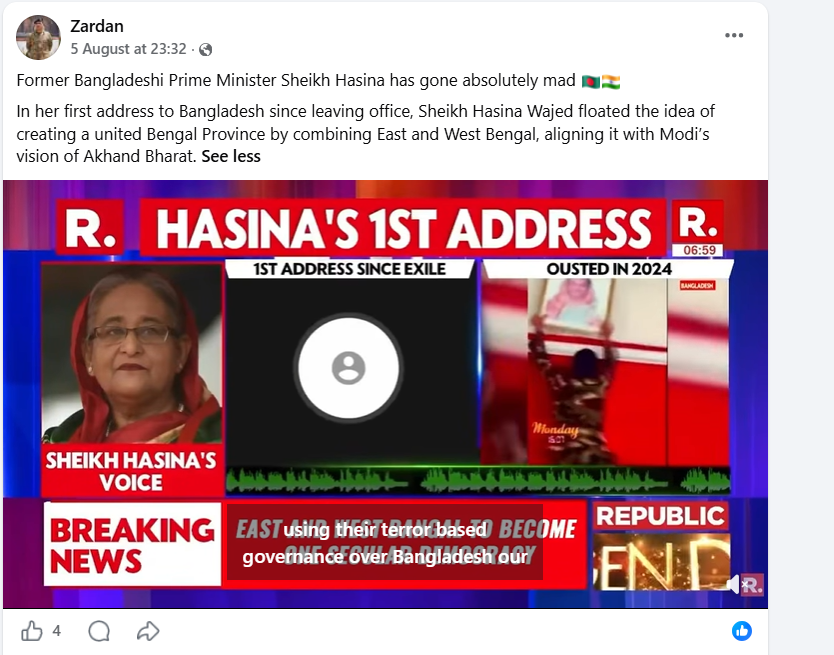
A Facebook user shared the video claiming that Sheikh Hasina proposed merging East and West Bengal to create a single province during her recent address. The link to the post, archive link, and screenshot are provided below.
https://www.facebook.com/reel/1567119714918951
FactCheck
During the research, several key frames from the viral video were extracted and a reverse image search was conducted using Google Lens. The search led us to the original video of Sheikh Hasina’s interaction available on the official social media accounts of Republic News. The link to the post and screenshot are provided below.
https://x.com/republic/status/2084999748755554323?ref_src=twsrc%5Etfw
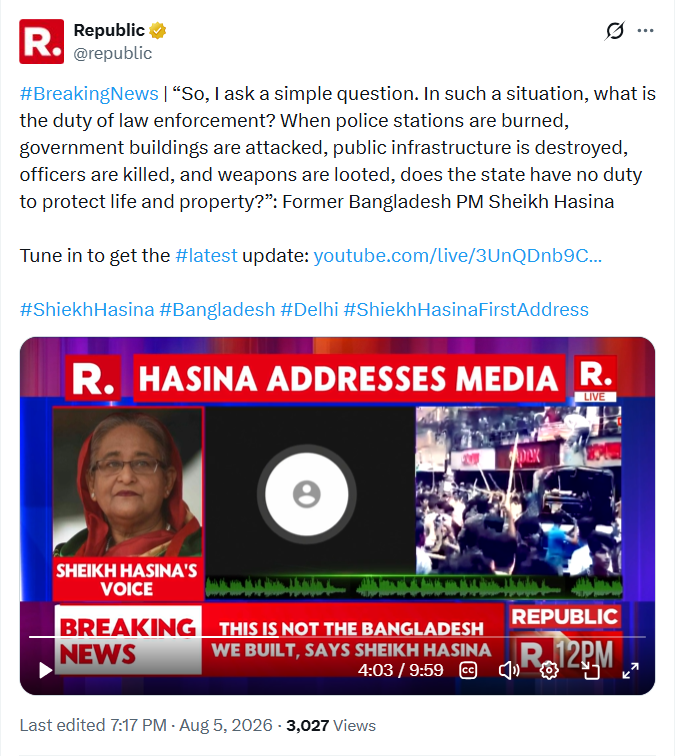
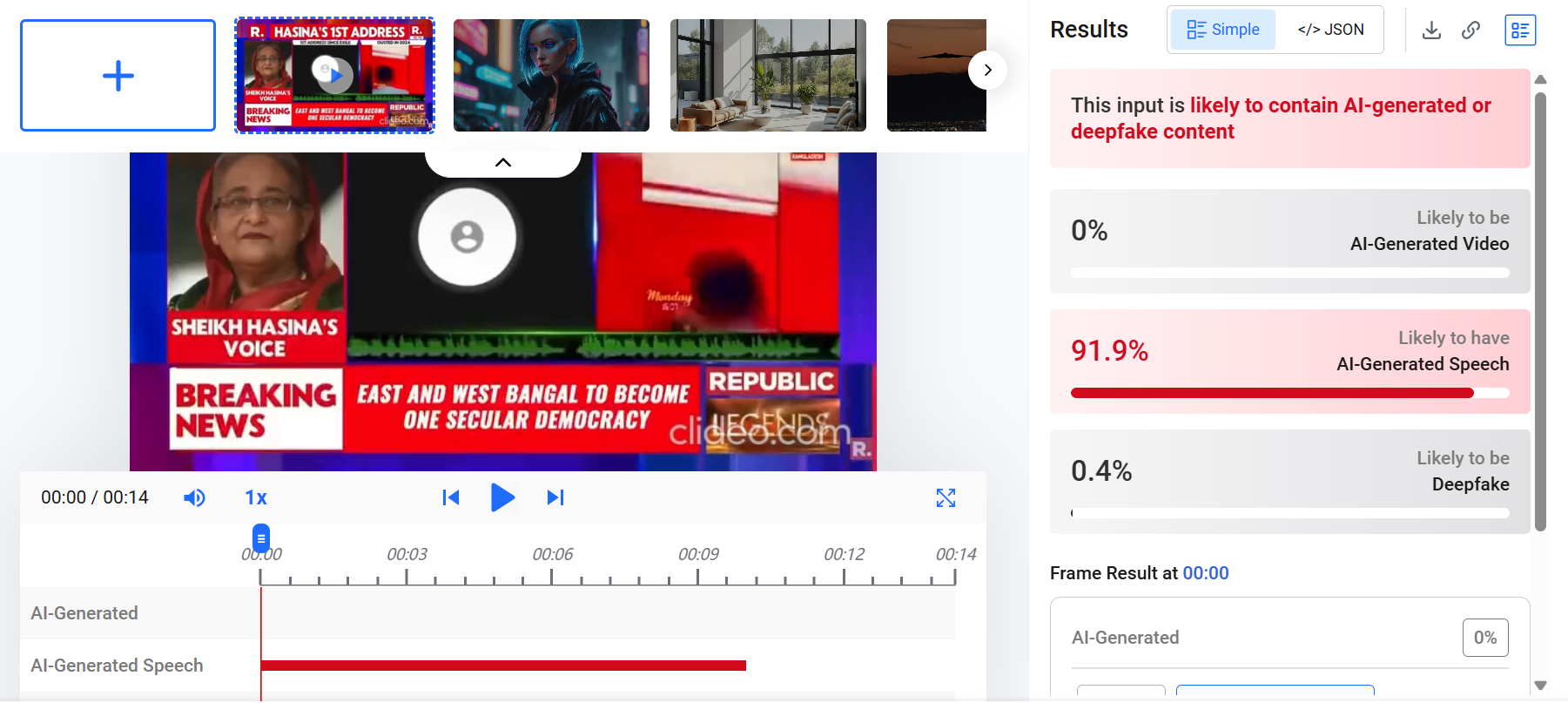
Republic shared the original video on its official X account on August 5, 2026. A comparison between the viral clip and the original footage revealed that the alleged statement about merging East and West Bengal into a single province does not appear anywhere in the authentic video. In the original video, Sheikh Hasina can be heard discussing the responsibilities of law enforcement agencies during periods of unrest. The controversial audio added to the viral clip is not part of the original recording. Further analysis of the viral video’s audio raised suspicion that it was AI-generated. The video was scanned using the AI detection tool Hive Moderation, which indicated a 91 per cent probability that the speech used in the viral video was AI-generated.
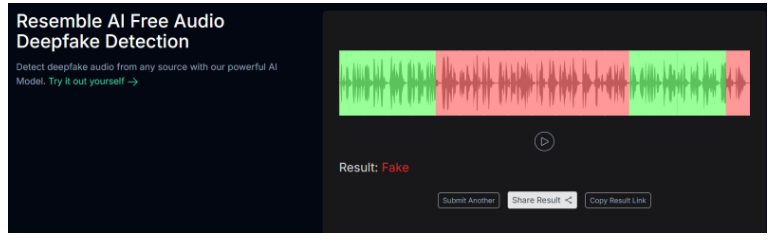
In the next step of the research, the viral audio was analysed using the Resemble AI tool. The results indicated that the audio was likely manipulated, suggesting that it had been altered using artificial intelligence (AI).
Conclusion:
The research found that the visuals used in the viral video are genuine, but the audio has been modified using AI and is being shared with a false claim. The claim that Sheikh Hasina spoke about merging East and West Bengal into a single province is false.
Related Blogs

Introduction
Embark on a groundbreaking exploration of the Darkweb Metaverse, a revolutionary fusion of the enigmatic dark web with the immersive realm of the metaverse. Unveiling a decentralised platform championing freedom of speech, the Darkverse promises unparalleled diversity of expression. However, as we delve into this digital frontier, we must tread cautiously, acknowledging the security risks and societal challenges that accompany the metaverse's emergence.
The Dark Metaverse is a unique combination of the mysterious dark web and the immersive digital world known as the metaverse. Imagine a place where users may participate in decentralised social networking, communicate anonymously, and freely express a range of viewpoints. It aims to provide an alternative to traditional online platforms, emphasizing privacy and freedom of speech. Nevertheless, it also brings new kinds of criminality and security issues, so it's important to approach this digital frontier cautiously.
In the vast expanse of the digital cosmos, there exists a realm that remains shrouded in mystery to the casual netizen—the dark web. It is a place where the surface web, the familiar territory of Google searches and social media feeds, constitutes a mere 5 per cent of the information iceberg floating in an ocean of data. Beneath this surface lies the deep web and the dark web, comprising the remaining 95 per cent, a staggering figure that beckons the brave and curious to explore its abysmal depths.
Imagine, a platform that not only ventures into these depths but intertwines them with the emerging concept of the metaverse—a digital realm that defeats the limitations of the physical world. This is the vision of the Darkweb Metaverse, the world’s premier endeavour to harness the enigmatic depths of the dark web and fuse it into the immersive experience of the metaverse.
As per Internet User Statistics 2024, There are over 5.3 billion Internet users in the world, meaning over 65% of the world’s population has access to the Internet. The Internet is used for various services. News, entertainment, and communication to name a few. The citizens of developed countries depend on the World Wide Web for a multitude of daily tasks such as academic research, online shopping, E-banking, accessing news and even ordering food online hence the Internet has become an integral part of our daily lives.
Surface Web
This layer of the internet is used by the general public on a daily basis. The contents of this layer are accessed by standard web browsers namely Google Chrome, and Mozilla Firefox to name a few. The contents of this layer of the internet are indexed by these search engines.
Deep Web
This is the second layer of the internet; its contents are not indexed by search engines. The content that is unavailable on the surface web is considered to be a part of the deep web. The deep web comprises a collection of various types of confidential information. Several Schools, Universities, Institutes, Government Offices and Departments, Multinational Companies (MNCs), and Private Companies store their database information and website-oriented server information such as online profile and accounts usernames or IDs and passwords or log in credentials and companies' premium subscription data and monetary transactional records in the Intra-net which is part of the deep web.
Dark Web
It is the least explored part of the internet which is considered to be a hub of various bizarre activities. The contents of the dark web are not indexed by search engines and specific software is required to access this layer of the internet namely TOR (The Onion Router) browser which cloaks to identify its users making them anonymous. The websites of the dark web are identified from .onion TLD (Top Level Domain). Due to anonymity provided in this layer, various criminal activities take place over there including Drugs trading, Arms trading, and Illegal PayPal account details to websites offering child pornography.
The Darkverse
The Darkweb Metaverse is not a mere novelty; it is a revolutionary step forward, a decentralised social networking platform that stands in stark contrast to centralised counterparts like YouTube or Twitter. Here, the spectre of censorship is banished, and the freedom of speech reigns supreme.
The architectonic prowess behind the Darkweb Metaverse is formidable. The development team is a coalition of former infrastructure maestros from Theta Network and virtuosos of metaverse design, bolstered by backend engineers from Gensokishi Metaverse. At the helm is a CEO whose tenure at the apex of large Japanese companies has endowed him with a profound understanding of the landscape, setting a solid foundation for the platform's future triumphs.
Financially, the dark web has been a flourishing underworld, with revenues ranging from $1.5 billion to $3.1 billion between 2020 and 2022. Darkverse, with its emphasis on user-friendliness and safety, is poised to capture a significant portion of this user base. The platform serves as a truly decentralised amalgamation of the Dark Web, Metaverse, and Social Networking Services (SNS), with a mission to provide an unassailable bastion for freedom of speech and expression.
The Darkweb Metaverse is not merely a sanctuary for anonymity and privacy; it is a crucible for the diversity of expression. In a world where centralised platforms can muzzle voices, Darkverse stands as a bulwark against such suppression, fostering a community where a kaleidoscope of opinions and information thrives. The ease of use is unparalleled—a one-time portal that obviates the need for third-party software to access the dark web, protecting users from the myriad risks that typically accompany such ventures.
Moreover, the platform's ability to verify the authenticity of information is a game-changer. In an era laced with misinformation, especially surrounding contentious issues like war, Darkverse offers a sign of truth where the source of information can be scrutinised for its accuracy.
Integrating Technologies
The metaverse will be an immersive iteration of the internet, decked with interactive features of emerging technologies such as artificial intelligence, virtual and augmented reality, 3D graphics, 5G, holograms, NFTs, blockchain and haptic sensors. Each building block, while innovative, carries its own set of risks—vulnerabilities and design flaws that could pose a serious threat to the integrated meta world.
The dark web's very nature of interaction through avatars makes it a perfect candidate for a metaverse iteration. Here, in this anonymous world, commercial and personal engagements occur without the desire to unveil real identities. The metaverse's DNA is well-suited to the dark web, presenting a formidable security challenge as it is likely to evolve more rapidly than its real-world counterpart.
While Meta (formerly Facebook) is a prominent entity developing the metaverse, other key players include NVIDIA, Epic Games, Microsoft, Apple, Decentraland, Roblox Corporation, Unity Software, Snapchat, and Amazon. These companies are integral to constructing the vast network of real-time 3D virtual worlds where users maintain their identities and payment histories.
Yet, with innovation comes risk. The metaverse will necessitate police stations, not as a dystopian oversight but as a means to address the inherent challenges of a new digital society. In India, for instance, the integration of law enforcement within the metaverse could revolutionize the public's interaction with the police, potentially increasing the reporting of crimes.
The Perils within the Darkverse
The metaverse will also be a fertile ground for crimes of a new dimension—identity theft, digital asset hijacking, and the influence of metaverse interactions on real-world decisions. With a significant portion of social media profiles potentially being fraudulent, the metaverse amplifies these challenges, necessitating robust identity access management.
The integration of NFTs into the metaverse ecosystem is not without its security concerns, as token breaches and hacks remain a persistent threat. The metaverse's parallel economy will test the developers' ability to engender trust, a Herculean task that will challenge the boundaries of national economies.
Moreover, the metaverse will be a crucible for social engineering-based attacks, where the real-time and immersive nature of interactions could make individuals particularly vulnerable to deception and manipulation. The potential for early-stage fraud, such as the hyping and selling of virtual assets at unrealistic prices, is a stark reality.
The metaverse also presents numerous risks, particularly for children and adolescents who may struggle to distinguish between virtual and real worlds. The implications of such immersive experiences are intense, with the potential to influence behaviour in hazardous ways.
Security risks extend to the technologies supporting the metaverse, such as virtual and augmented reality. The exploitation of biometric data, the bridging of virtual and real worlds, and the tendency for polarisation and societal isolation are all issues requiring immediate attention.
A Way Forward
As we stand on the cusp of this new digital frontier, it is evident that the metaverse, despite its reliance on blockchain, is not immune to the privacy and security breaches that have plagued conventional IT infrastructure. Data security, Identity theft, network security, and ransomware attacks are just a few of the challenges on the way.
In this quest into the unknown, the Darkweb Metaverse radiates with the promise of freedom and the thrill of discovery. Yet, as we navigate these shadowy depths, we must remain vigilant, for the very technologies that empower us also rear the seeds of our grim vulnerabilities. The metaverse is not just a new chapter in the story of the internet—it is a whole narrative, one that we must write with caution and care.
References
- https://spores.medium.com/the-worlds-first-platform-to-deploy-the-dark-web-in-the-metaverse-releap-ido-on-spores-launchpad-a36387b184de
- https://www.makeuseof.com/how-hackers-sell-trade-data-in-metaverse/
- https://www.demandsage.com/internet-user-statistics/#:~:text=There%20are%20over%205.3%20billion,has%20access%20to%20the%20Internet.

Introduction
India & Bangladesh have adopted proactive approaches, focusing on advancing cyber capacity building in the region. Bangladeshi and Indian cybersecurity experts have emphasised the importance of continuous technology training to protect the digital space from growing cyber-attacks and threats. They call for greater collaboration to share knowledge and expertise in cyber resilience, network vulnerability, and cyber risk assessment. The Cyber-Maitree 2023 event held in Dhaka aimed to enrich and build capacity to counter cyber-attacks and threats. The senior director of India's Computer Emergency Response Team acknowledged the growing dependence on cyberspace and the need for increased preparedness as critical infrastructures, energy systems, banks, and utilities are connected to the internet. Recently, Bangladesh Cyber Security Summit 2024, organised by Grameenphone, was held in Dhaka on March 5th, 2024. Such collaborative dialogues between the countries serve as a shining example of cooperation between the governments of Bangladesh and India, serving as a platform for knowledge sharing, capacity building, and international cooperation in cyber security.
Cyber Maitree held in 2023
In 2023, India and Bangladesh held 'Cyber Maitree 2023', an initiative hosted by the ICT Division of the Bangladeshi Government, to address cybersecurity challenges in a rapidly globalising world characterised by digitisation. The event, which translates to "Cyber Friendship," was an interface for cybersecurity experts and aspirants from both nations, creating an avenue for extensive training, practical exercises, and a dynamic exchange of information. We need to emphasise the importance of bolstering digital safety as both nations grapple with the rapid digitisation of the world.
India-Bangladesh joint efforts aim to fortify cyber resilience, pinpoint potential network vulnerabilities, bolster rigorous risk assessments, and illuminate the landscape of cyber threats. It encompasses various sectors, including cybersecurity, artificial intelligence, ICT, and IT-driven human resource expansion. The growing camaraderie between India and Bangladesh has been evident through strategic engagements, such as the India-Bangladesh Startup Bridge and the establishment of 12 High Tech Parks in Bangladesh.
Highlights of the India-Bangladesh MoUs for Cyber Security Cooperation
In 2017, India and Bangladesh signed a Memorandum of Understanding (MoU) focused on cyber security cooperation.
In 2022, Both nations crafted a Memorandum of Understanding (MoU), highlighting collaboration in spheres such as e-governance, e-public service delivery, research, and development. A separate agreement was also inked focusing on mutual information sharing pertaining to cyber-attacks and incidents. The first MoU aims to provide a framework for training Bangladesh Railway employees at Indian Railways' training institutes, including field visits. The Indian Railways will coordinate with officials from the Ministry of Railways, Government of Bangladesh to improve training facilities in Bangladesh. The second MoU focuses on collaboration in IT systems, for the Bangladesh Railway. The Ministry of Railway, Government of India, will offer IT solutions for passenger ticketing, freight operations, train inquiry systems, asset management digitisation, HR and finance infrastructure. The MoUs aim to strengthen the friendship bond between India and Bangladesh and promote friendly cooperation in the railway sector.
Way Ahead
Zunaid Ahmed Palak, State Minister for Posts, Telecom and ICT, Bangladesh, has announced that Bangladesh and India will collaborate to ensure the safety of the cyber world. The two countries are expected to sign a final agreement within the next three to six months. He stressed the importance of attracting investments in the postal, telecommunication, and IT sectors. He also highlighted the strong ties between Bangladesh and India. He also announced that 12 high-tech parks will be constructed in Bangladesh with an Indian Line of Credit, starting operation by 2025. He further referred to the Indian Cyber Emergency Response Team (CERT), and said "We are very much enthusiastic in fighting against the cyber attacks and crimes as the team is now working with us".
Bangladesh Cyber Security Summit 2024
The Bangladesh Cyber Security Summit 2024, organised by Grameenphone, was held in Dhaka on 5th March 2024, focusing on cybersecurity issues and opportunities, fostering collaboration between government, private organisations, industry experts, and sponsors investing in Bangladesh's digital future.
Conclusion
India and Bangladesh share a common vision for a secure digital future, focusing on cybersecurity collaboration to safeguard shared aspirations and empower nations to thrive in the digital age. We must emphasise the need to fortify digital defenses, leveraging expertise, innovation, and collaboration to secure interconnected futures. Collaborative relations in Information and Communication Technology and Cyber Security will strengthen digital defense and establish cyber resilience.
References:
- https://caribbeannewsglobal.com/bangladesh-and-india-call-for-more-cyber-security-training/?amp=1
- https://www.indianewsnetwork.com/en/20231005/bangladesh-and-india-strengthen-ties-through-cyber-maitree-2023
- https://www.bssnews.net/news-flash/150763
- https://digibanglatech.news/english/bangladesh-english/125439/
- https://www.mea.gov.in/Portal/LegalTreatiesDoc/BG17B3024.pdf
- https://digibanglatech.news/english/bangladesh-english/125439/
- https://www.tbsnews.net/tech/ict/bangladesh-india-work-together-cyber-security-palak-712182

Executive Summary
A video of an Indian Army officer leaving a meeting alongside a police official is being widely circulated on social media. Some users are sharing the clip with the claim that the officer walked out of a meeting after the government refused to provide funding for security preparations related to Pakistan and China. CyberPeace Research Wing’s research found the viral claim to be false. Our research revealed that the video is not related to any dispute over defence funding. It actually shows a press conference held in Patiala in March 2025 regarding an attack on an Indian Army Colonel. During the press conference, the Army officer demanded a transparent, time-bound, fair and impartial research, while the police official provided details about the action taken in the case.
Claim
Facebook user ‘Salman Pathan’ shared the video on July 15, 2026, with the claim: “After the government refused funding for security arrangements/preparations related to Pakistan and China, an Indian Army officer left the meeting.” The post further questioned the government over alleged priorities in spending public money.
https://www.facebook.com/reel/3995874277215044
https://perma.cc/JL7A-2A6B?type=standard

Fact Check
To verify the claim, we extracted keyframes from the viral video and conducted a reverse image search using Google Lens. During the research, we found that the same video was uploaded on March 25, 2025, by X user ‘Man Aman Singh Chhina’. The post stated:
“Chief of Staff of Western Command Lieutenant General Mohit Wadhwa left along with senior officers after reading a statement on the Patiala Colonel case without answering any questions. The DGP also read his statement and left, but at least he answered media questions.”
https://x.com/manaman_chhina/status/1904492655720988850?s=20

Further research revealed that the Government of Punjab’s official YouTube channel had uploaded the video of the same press conference on March 25, 2025. At the end of the press conference, when the Army and police officials leave the venue, the same question from journalists that appears in the viral clip can be heard.
https://www.youtube.com/live/7i3Nxc6vTpU

According to a report published by Amar Ujala on July 16, 2025, the Punjab and Haryana High Court, dissatisfied with the research conducted by the Chandigarh Police SIT, transferred the case to the Central Bureau of research (CBI).

Conclusion
Our research found that an old and unrelated video from March 2025 is being falsely circulated with the claim that an Army officer left a meeting after the government refused funding for security preparations related to Pakistan and China. The viral video actually relates to a press conference regarding the attack on Colonel Pushpinder Singh Bath in Patiala and has no connection with any defence funding issue. The viral claim is therefore false and misleading.