
The Enigma of StripedFly Malware
In the tapestry of our modern digital ecosystem, a silent, pervasive conflict simmers beneath the surface, where the quest for cyber resilience seems Sisyphean at times. It is in this interconnected cyber dance that the obscure orchestrator, StripedFly, emerges as the maestro of stealth and disruption, spinning a complex, mostly unseen web of digital discord. StripedFly is not some abstract concept; it represents a continual battle against the invisible forces that threaten the sanctity of our digital domain.
This saga of StripedFly is not a tale of mere coincidence or fleeting concern. It is emblematic of a fundamental struggle that defines the era of interconnected technology—a struggle that is both unyielding and unforgiving in its scope. Over the past half-decade, StripedFly has slithered its way into over a million devices, creating a clandestine symphony of cybersecurity breaches, data theft, and unintentional complicity in its agenda. Let's delve deep into this grand odyssey to unravel the odious intricacies of StripedFly and assess the reverberations felt across our collective pursuit of cyber harmony.
The StripedFly malware represents the epitome of a digital chameleon, a master of cyber camouflage, masquerading as a mundane cryptocurrency miner while quietly plotting the grand symphony of digital bedlam. Its deceptive sophistication has effortlessly skirted around the conventional tripwires laid by our cybersecurity guardians for years. The Russian cybersecurity giant Kaspersky's encounter with StripedFly in 2017 brought this ghostly figure into the spotlight—hitherto, a phantom whistling past the digital graveyard of past threats.
How Does it work
Distinctive in its composition, StripedFly conceals within its modular framework the potential for vast infiltration—an exploitation toolkit designed to puncture the fortifications of both Linux and Windows systems. In an emboldened maneuver, it utilizes a customized version of the EternalBlue SMBv1 exploit—a technique notoriously linked to the enigmatic Equation Group. Through such nefarious channels, StripedFly not only deploys its malicious code but also tenaciously downloads binary files and executes PowerShell scripts with a sinister adeptness unbeknownst to its victims.
Despite its insidious nature, perhaps its most diabolical trait lies in its array of plugin-like functions. It's capable of exfiltrating sensitive information, erasing its tracks, and uninstalling itself with almost supernatural alacrity, leaving behind a vacuous space where once tangible evidence of its existence resided.
In the intricate chess game of cyber threats, StripedFly plays the long game, prioritizing persistence over temporary havoc. Its tactics are calculated—the meticulous disabling of SMBv1 on compromised hosts, the insidious utilization of pilfered keys to propagate itself across networks via SMB and SSH protocols, and the creation of task scheduler entries on Windows systems or employing various methods to assert its nefarious influence within Linux environments.
The Enigma around the Malware
This dualistic entity couples its espionage with monetary gain, downloading a Monero cryptocurrency miner and utilizing the shadowy veils of DNS over HTTPS (DoH) to camouflage its command and control pool servers. This intricate masquerade serves as a cunning, albeit elaborate, smokescreen, lulling security mechanisms into complacency and blind spots.
StripedFly goes above and beyond in its quest to minimize its digital footprint. Not only does it store its components as encrypted data on code repository platforms, deftly dispersed among the likes of Bitbucket, GitHub, and GitLab, but it also harbors a bespoke, efficient TOR client to communicate with its cloistered C2 server out of sight and reach in the labyrinthine depths of the TOR network.
One might speculate on the genesis of this advanced persistent threat—its nuanced approach to invasion, its parallels to EternalBlue, and the artistic flare that permeates its coding style suggest a sophisticated architect. Indeed, the suggestion of an APT actor at the helm of StripedFly invites a cascade of questions concerning the ultimate objectives of such a refined, enduring campaign.
How to deal with it
To those who stand guard in our ever-shifting cyber landscape, the narrative of StripedFly is a clarion call. StObjective reminders of the trench warfare we engage in to preserve the oasis of digital peace within a desert of relentless threats. The StripedFly chronicle stands as a persistent, looming testament to the necessity for heeding the sirens of vigilance and precaution in cyber practice.
Reaffirmation is essential in our quest to demystify the shadows cast by StripedFly, as it punctuates the critical mission to nurture a more impregnable digital habitat. Awareness and dedication propel us forward—the acquisition of knowledge regarding emerging threats, the diligent updating and patching of our systems, and the fortification of robust, multilayered defenses are keystones in our architecture of cyber defense. Together, in concert and collaboration, we stand a better chance of shielding our digital frontier from the dim recesses where threats like StripedFly lurk, patiently awaiting their moment to strike.
References:
https://thehackernews.com/2023/11/stripedfly-malware-operated-unnoticed.html?m=1

Related Blogs
Introduction
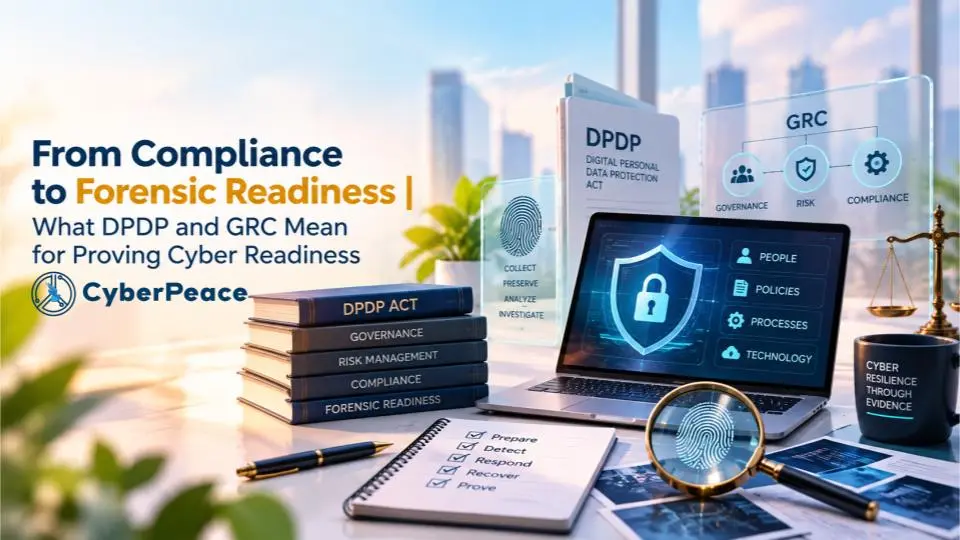
For years, Indian companies could get away with vague privacy promises. That window closed on 13 November 2025, when the government notified the Digital Personal Data Protection Rules, giving teeth to the broad principles Parliament had passed back in 2023 under the DPDP Act. The Rules turned soft commitments into specific, auditable duties, and a lot of organisations are only now realising how much that actually changes.
Start with Section 8(4). It requires every Data Fiduciary to put "appropriate technical and organisational measures" in place. Most readers skim past "organisational" and focus on the technical half, but that's a mistake, because the word is doing real work. It's asking for defined roles, written policies, staff training, and someone actually watching whether any of it holds up over time, not just firewalls and encryption keys. Section 8(5) goes further, demanding reasonable security safeguards against breaches, and Rule 6 spells out exactly what that phrase means in practice: encrypt data at rest and in transit, restrict access on a need to know basis, require multi factor authentication, log and monitor activity, run regular vulnerability checks, bind your data processors contractually to the same standard, and keep relevant logs for at least a year.
Then there's Rule 7, and this is where the clock starts running. Once a Data Fiduciary becomes aware of a breach, the Data Protection Board must be told without delay, and a full report has to follow within 72 hours covering what happened, when, why, what's being done about it, and confirmation that affected individuals were notified. Unlike GDPR, there's no minimum severity threshold here. A breach affecting ten people triggers the same obligation as one affecting ten million. And CERT-In's existing six hour reporting window under its 2022 Directions still applies separately, which means a serious incident can trigger two overlapping regulatory clocks running side by side.
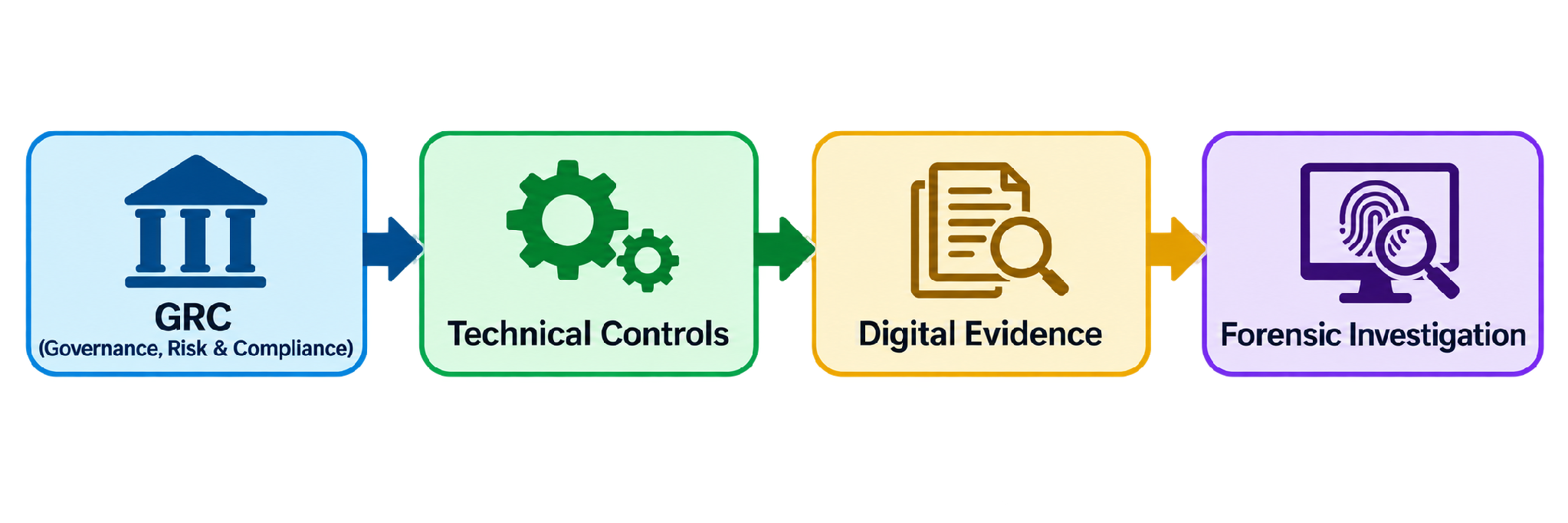
Put all of this together and a pattern emerges. The law assumes an organisation already knows what it's protecting, has actually protected it, kept usable records the whole way through, and can explain clearly what happened the moment something breaks. That coordination job belongs to Governance, Risk and Compliance, or GRC for short. GRC decides who's accountable, which risks actually matter, which controls address them, and how anyone checks whether compliance is real rather than assumed. Skip that structure and security work tends to splinter into a pile of disconnected tasks nobody truly owns.
GRC gives a legal duty somewhere to live. Forensic readiness is what lets an organisation prove, months or years later, that the duty was actually being met.
The Role of Governance, Risk and Compliance
On paper, most cybersecurity programmes look fine. There's an incident response plan somewhere, access control rules exist, logging is "in place," and someone has a title that says they're responsible for security. None of that gets tested until something actually breaks. A phishing compromise, a ransomware infection, a leaked database, a hijacked admin account, whatever the trigger, the questions that follow are always the same, and they're not comfortable ones. What happened, exactly, and when did it start? Which systems, which data, were actually touched? Were the controls the organisation claims to run genuinely functioning at that moment, or just described in a slide deck somewhere? And can anyone produce records solid enough to answer those questions with confidence rather than a shrug?
This is the exact seam where GRC and digital forensics meet. GRC lays out what's expected, who's responsible, and what evidence a control should be generating in the background. Digital forensics is the craft of taking whatever technical traces actually exist and turning them into an account of events that will hold up to scrutiny. Passing an audit was never really the point. Being able to stand in front of a regulator, mid incident, and show that the processes described on paper were real, active, and generating trustworthy evidence, that's the actual bar.
Why Compliance Alone Falls Short
Compliance, in the narrow sense, just means meeting whatever legal, contractual, or internal requirement applies. But a policy sitting in a document repository proves nothing about what actually happens on a Tuesday afternoon when someone requests admin access. A written incident response plan says nothing about whether the team can actually execute it under real pressure, at 2am, with a ransomware note on every screen. A logging policy is close to worthless if the logs it promises were switched off somewhere along the way, or overwritten, or scattered across systems that were never synchronised to the same clock.
NIST's Cybersecurity Framework 2.0 essentially built this concern into its core structure, placing "Govern" alongside Identify, Protect, Detect, Respond, and Recover as one of five equal functions rather than background paperwork sitting off to the side. India's own regulatory posture pushes in the same direction. CERT-In's 2022 Directions require certain incidents to be reported within six hours of discovery, and its guidance for government entities leans heavily on documented incident handling and disciplined evidence practices. The underlying message from both is identical: figure out, before anything goes wrong, whether the evidence you'll eventually need is actually going to exist when someone asks for it.
Where GRC and Forensics Actually Connect
A good GRC programme spells out what's supposed to happen. Forensic readiness is what lets you later prove what actually did.
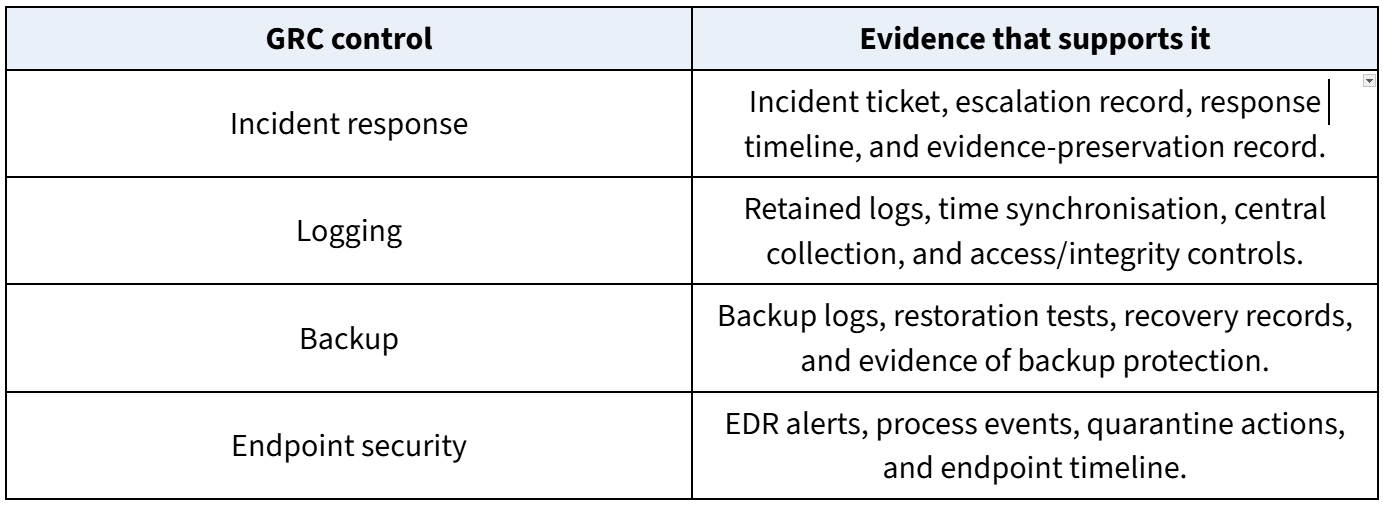
Access control is a useful example here. On the GRC side, an organisation might require least privilege access, multi factor authentication, periodic reviews of who holds privileged accounts, and prompt removal of access once someone leaves or changes roles. On the forensic side, none of that means anything without the underlying records that let investigators actually test it, authentication logs, MFA usage history, privilege change records, and account activity trails. The table below lines up a few common GRC controls against the specific evidence needed to show they were genuinely operating.
A Practical Scenario: After a Ransomware Incident
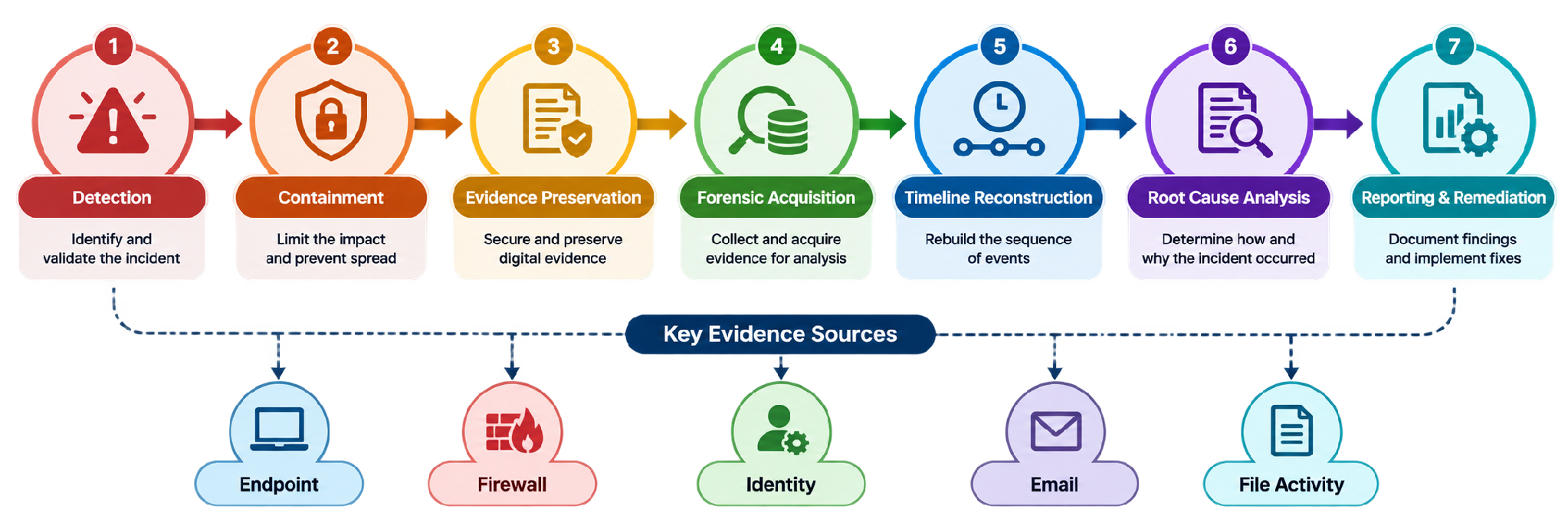
Picture a mid-sized company waking up to find half its file servers encrypted. There's an incident response plan somewhere in the shared drive, technically, but nobody's actually run through it in over a year. The security team isolates the obviously compromised endpoint and starts escalating. Now the forensic side of the house has to reconstruct what happened, working backward through endpoint telemetry, authentication logs, firewall events, email traffic, and file activity, hunting for the original point of entry, how the attacker escalated privileges, how they moved sideways through the network, what data they actually touched, and finally how the ransomware got deployed.
This is where the quality of everything collected beforehand suddenly matters a great deal. If server clocks were never properly synchronised, the timeline investigators build might not line up cleanly enough to trust. If logs only ever lived locally on individual machines rather than being pulled centrally, some of them are probably gone by now. If nobody ever bothered logging administrator actions, there are going to be real, unexplained gaps in the story. And if whatever evidence does exist wasn't collected the right way, its integrity can be challenged later, sometimes fatally, in a legal or regulatory proceeding. CERT-In actually ran a programme on exactly this in July 2026, "Inside the Breach," covering system artefacts, investigative technique, and chain of custody requirements, precisely because this is where real investigations tend to succeed or quietly fall apart.
Building a Forensic Ready GRC Programme
For an organisation starting more or less from scratch, forensic readiness doesn't need to be bolted on as some separate initiative. It can be built straight into the GRC programme that already exists. Start by identifying the systems, applications, cloud services, and privileged accounts that actually matter. Map the real risks and regulatory requirements onto the controls meant to address them. Then get specific about what evidence each control should be generating, and how that evidence gets protected and kept over time. Time synchronisation, centralised logging, tightly controlled access to security records, and clear ownership of preservation, escalation, and investigation all need to exist well before an incident, not be improvised during one. And none of it means much until it's actually been tested, through tabletop exercises and simulated incidents rather than assumed to work because it's written down somewhere. NIST SP 800-61 Revision 3 frames incident response as one continuous loop of preparation, detection, response, recovery, and improvement, rather than a series of separate boxes to check.
There's one question worth asking of every important control an organisation runs: could you actually prove this was working at the moment an incident happened? If the honest answer is no, what you have is a compliance process on paper, and a forensic readiness gap sitting quietly underneath it.
Conclusion
Cyber readiness was never really about how many policies sit in a binder or how many boxes get ticked in an audit. It shows up, or doesn't, in the hours right after something breaks, when an organisation has to move fast, preserve evidence that can actually stand up to scrutiny, explain clearly what happened, and prove that governance and technical controls were genuinely working together rather than just coexisting on paper. GRC sets the direction, the accountability, the risk priorities, and the compliance expectations. Digital forensics does the work of preserving and interpreting the technical evidence once something actually happens. Forensic readiness sits in between the two, making sure they're actually talking to each other long before an incident forces the conversation. The practical task for most organisations comes down to something simple to say, if not always simple to build: design controls that hold up under real incident response, not just an auditor's checklist. The strongest compliance posture was never the one with the thickest binder. It's the one that can back every document up with evidence, on the day it actually matters.
References
- Digital Personal Data Protection Act, 2023, Sections 8(4), 8(5), 8(6). https://www.meity.gov.in/writereaddata/files/Digital%20Personal%20Data%20Protection%20Act%202023.pdf
- Digital Personal Data Protection Rules, 2025, Rules 6 and 7, notified 13 November 2025. https://www.meity.gov.in
- National Institute of Standards and Technology, The NIST Cybersecurity Framework (CSF) 2.0, CSWP 29, 2024. https://csrc.nist.gov/pubs/cswp/29/the-nist-cybersecurity-framework-csf-20/final
- Indian Computer Emergency Response Team (CERT-In), Directions under Section 70B of the Information Technology Act, 2000, dated 28 April 2022. https://www.cert-in.org.in/Directions70B.jsp
- Indian Computer Emergency Response Team (CERT-In), Guidelines on Information Security Practices for Government Entities. https://www.cert-in.org.in/Downloader?fileName=CIPS-2026-0014.pdf&pageid=5&type=2
- National Institute of Standards and Technology, SP 800-86: Guide to Integrating Forensic Techniques into Incident Response, 2006. https://csrc.nist.gov/pubs/sp/800/86/final
- International Organization for Standardization, ISO/IEC 27037:2012, Guidelines for identification, collection, acquisition and preservation of digital evidence. CERT-In, "Inside the Breach: Advanced Cyber Forensics & Incident Investigation," 31 July 2026. https://www.cert-in.org.in/s2cMainServlet?pageid=PRSTNVIEW03&reCode=CIWS-2026-3569
- National Institute of Standards and Technology, SP 800-61 Rev. 3: Incident Response Recommendations and Considerations for Cybersecurity Risk Management, 2025. https://csrc.nist.gov/pubs/sp/800/61/r3/final
- Matters.ai, "DPDP Breach Notification: 72-Hour Rule & ₹200 Cr Penalty." https://www.matters.ai/article/dpdp-breach-notification MediaNama, "Data Breach Reporting Timeline of DPDP Rules 2025 Explained." https://www.medianama.com/2025/11/223-data-breach-reporting-timeline-of-dpdp-rules-2025-explained/

Executive Summary:
Our team has come across a recent social media post highlighting a report on fraudulent activities involving deceptive websites and emails impersonating India’s Oil Marketing Companies (OMCs). These phishing scams falsely promise LPG distributorships and retail outlet dealerships, aiming to extract money and personal information from unsuspecting individuals. We strongly urge the public to exercise caution and verify all information exclusively through official OMC channels to avoid falling victim to such fraudulent schemes.

Claim:
It has been reported that fraudsters are impersonating Indian Oil, Bharat Petroleum, and Hindustan Petroleum through fake websites and emails, promising LPG distributorships and seeking money from victims.

Fact Check:
After our research, we came upon more information about this topic and found out that the Press Information Bureau (PIB) has released an official notice confirming that fraudulent websites and emails are impersonating India's Oil Marketing Companies (OMCs), which include Indian Oil Corporation Ltd., Bharat Petroleum Corporation Ltd., and Hindustan Petroleum Corporation Ltd. The scams falsely promise LPG distributorships and retail outlet dealerships while demanding large sums of money from unsuspecting individuals. On June 19, 2019, this was confirmed. The PIB highlighted that OMCs have not allowed any person or organization to charge a fee for dealership selection. All authentic information on these offers is available at the websites of the OMCs: www.iocl.com, www.bharatpetroleum.com, and www.hindustanpetroleum.com. The general public is cautioned to rely only on these sources and report suspicious approaches to the offices of concerned OMCs. If someone finds such an approach, he should immediately contact the cybercrime branch. HPCL has issued alerts on fake websites and emails that promise LPG distributorships and jobs, mimicking official HPCL sites to deceive people.

On the official website of HPCL list down the malicious URLs. They are mentioned below:
- https://kskdealerchayan.com/
- bajajgas.com/index
- hindustanbiofuel.in
- petrolpumpchayanonline.com
- dealerchayanpetrolpump.in
- petrolpumpdealarchayan.com
- petrolpumpsdealerchayan.co.in
- petrolpumpdealershipchayan.org.in
- petrolpumpdealerchayangov.in
- petrolpumpdealership.info
- petrolpumpsdealershipchayan.in
- allindiagasdealership.com
- hindustanpetroleum.online
- hindustanpetroleumcorp.com
- hpcldelership.com
- ujjwalalpgvitarak.org
- ujjwaladealership.com
- lpgvitrakkendra.com
- kissansevakendra.org
- lpgvitarakchayanltd.org
- petrolpumpdelerchayan.in
- petrolpumpdealerschayan.in
- petrolepumpsdelearchayan.in
- kissansevakendra.org
- petrolpumpdealerchayanpro.com
- petrolpumchayanweb.com
- onlinepetrolpumpdealerchayan.com/
HPCL also shared an advisory for their applicants regarding Beware Of Fraudsters.


Conclusion:
It has been proven that fraud offers for LPG distributorships and retail outlet dealerships are being made through fake websites and emails. To avoid such scams, people are advised to be more vigilant, verify all information through official OMC platforms, and immediately report any suspicious activities to the concerned authorities. Being alert and informed is the key to preventing financial loss and protecting personal data from exploitation.
- Claim: Is this HPCL approval letter for an LPG agency dealership legit?
- Claimed On: Social Media
- Fact Check: False and Misleading

Introduction
In the rapidly evolving landscape of cyber threats, a novel menace has surfaced the concept of Digital Arrest. The impostors impersonating law enforcement officers deceive the victims into believing that their bank account, SIM card, Aadhaar card, or bank card has been used unlawfully. They coerce victims into paying them money. Digital Arrest involves the virtual restraint of individuals. These suspensions can vary from restricted access to the account(s), and digital platforms, to implementing measures to prevent further digital activities or being restrained on video calling or being monitored through video calling. In the era of digitisation where the technology is growing on an exponential phase, various existing loopholes are being utilised by the wrongdoers which has given rise to this sinister trend known as “digital arrest fraud”. In this scam, the defrauder manipulates the victims, who impersonate law enforcement officials and further traps the victims into a web of deception involving threats of imminent digital restraint and coerced financial transactions.
Recognizing the Danger of Digital Arrest
A recent case involving an interactive voice response (IVR) call that targeted a victim sheds light on the complexities of the "digital arrest" cybercrime. The victim was notified by the scammers—who were pretending to be law enforcement officers—that a SIM card in her name had apparently been utilised in a criminal incident in Mumbai. The call proceeded to a video conversation with an FBI agent who falsely accused her of being involved in money laundering. The victim was forced into a web of dishonesty because she now believed she was involved in a criminal case, underscoring the psychological manipulation these hackers were using.
Recent incidents of digital arrest fraud
- Recently, a complaint was registered at the Noida Cyber Crime Police Station made by a 50-year-old victim, who was deceived of over Rs 11 lakh and exposed to "digital arrest". By using the identities of an IPS officer in the CBI and the founder of an airline that was grounded, the attackers, masquerading as law enforcement officers, falsely accused the victim of being involved in a fake money-laundering case. She was told that she had another SIM card in her name that was used for fraudulent activities in Mumbai. The complaint made by the victim asserted “Victim’s call was transferred to a person (who identified himself as a Mumbai Police officer) who conducted the initial interrogation over the call and then on Skype VC, where she stayed from 9:30 AM to around 7 in the evening. The woman ended up transferring around ₹11.11 lakh. The scammers then ended contact with her, after which she realised she had been scammed.
- Another recent case of digital arrest fraud came from Faridabad. Where a 23-year-old girl got a call from a fraudster posing as a Lucknow customs officer. The caller said that a package was being shipped to Cambodia that included cards and passports associated with the victim's Aadhaar number. The victim was forced to believe that she was a part of illegal activity, which included trafficking in humans. Under the guise of police officials, the hackers made up allegations before extorting money from the victim. After that, she was told by a man acting as a CBI official that she needed to pay five per cent of the total which was Rs 15 lakh. She said the cybercriminals instructed her not to log off Skype. In the meantime, she ended up transferring Rs 2.5 lakh to a bank account shared by cybercriminals.
Measures to protect oneself from digital arrest
Sustaining a practical and observant approach towards cybersecurity is the key to lowering the peril of being targeted and experiencing digital arrest. Following are certain best practices for ensuring the same:
- Cyber Hygiene: This includes maintaining cyber hygiene by regularly updating passwords, and software and also enabling two-factor authentications to reduce the chances of unauthorized access.
- Phishing Attempts: These can be evaded by refraining from clicking on dubious links or downloading attachments from unknown sources and also authenticating the legitimacy of emails and messages before sharing any personal information.
- Secured devices: By installing reputable antivirus and anti-malware solutions and keeping operating systems and applications up to date with the latest security protocols.
- Virtual Private Networks (VPNs): VPNs can be employed to encrypt internet connections thus enhancing privacy and security. However one must be cautious of free VPN services and OTP only for trustworthy providers.
- Monitor online services: A regular review of online accounts for any unauthorized or unlawful activities and setting up alerts for any changes to account settings or login attempts may help in the early detection of cybercrime and coping with it.
- Secure communication channels: Using secure communication techniques such as encryption can be done for the protection of sensitive information. Sharing of passwords and other information must be cautiously done especially in public forums.
- Awareness: The increasing prevalence of cybercrime known as "digital arrest" underscores the need for preventive measures and increased public awareness. Educational initiatives that draw attention to prevalent cyber threats—especially those that include law enforcement impersonation—can enable people to identify and fend off scams of this kind. The collaboration of law enforcement agencies and telecommunication companies can effectively limit the access points used by fraudsters by identifying and blocking susceptible calls.
Conclusion
The rise of Digital Arrest presents a noteworthy and innovative threat to cybersecurity by taking advantage of people's weaknesses through deceitful impersonation and coercive measures. The case in Noida is a prime example of the boldness and skill of cybercriminals who use fear and false information to trick victims into thinking they are in danger of suffering harsh legal repercussions and taking large amounts of money. In order to combat this increasing cybercrime, people need to take a proactive and watchful stance when it comes to cybersecurity. Cyber hygiene techniques, such as two-factor authentication and frequent password changes, are essential for lowering the possibility of unwanted access. Important precautions include being aware of phishing efforts, protecting devices with reliable antivirus software, and using Virtual Private Networks (VPNs) to increase privacy. Cybercriminals and fraudsters often use fear as a powerful tool to manipulate people and exploit their vulnerabilities for illicit gains in the realms of cybercrime and financial fraud. To protect themselves against the sneaky threat of Digital Arrest, netizens must traverse the constantly changing cyber threat landscape with collective knowledge, educated practices, and strong cybersecurity measures.
References:
- https://www.business-standard.com/india-news/new-cyber-crime-trend-unravelled-in-up-woman-held-under-digital-arrest-123120200485_1.html
- https://www.businessinsider.in/india/news/noida-woman-scammed-11-lakh-in-digital-arrest-scam-everything-you-need-to-know/articleshow/105727970.cms
- https://m.timesofindia.com/life-style/parenting/moments/23-year-old-faridabad-girl-on-digital-arrest-for-17-days-how-to-protect-your-children-from-cyber-crime/photostory/105442556.cms
