
#FactCheck -Viral video falsely linked to Operation Sindoor and India–Pakistan conflict claims
Executive Summary
A video from Prime Minister Narendra Modi’s visit to Norway is being widely shared on social media with the false claim that he avoided a question related to alleged Indian aircraft losses during the India–Pakistan conflict and “Operation Sindoor”. However, a fact-check by CyberPeace Research Wing found the claim to be false.The video shows a recent incident from 18 May in Oslo during a joint press appearance between Prime Minister Narendra Modi and Norwegian Prime Minister Jonas Gahr Støre.
The clip being circulated online shows journalist Helle Lyng asking PM Modi a question, but there is no reference to any India–Pakistan conflict or aircraft losses in her question.
Claim:
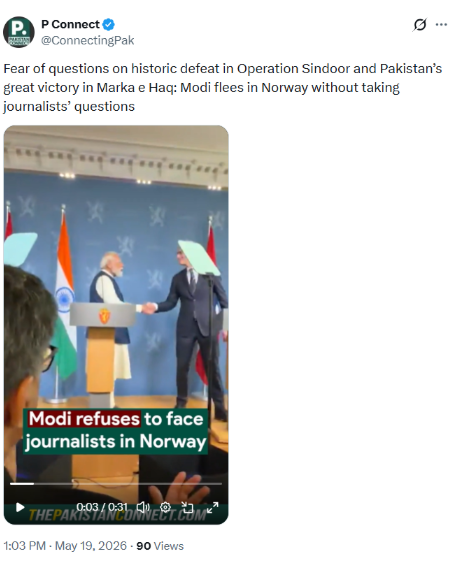
A post shared on X (formerly Twitter) on 19 May 2026 claims: “Fear of questions on historic defeat in Operation Sindoor and Pakistan’s great victory in Marka e Haq: Modi flees in Norway without taking journalists’ questions.”
The post, along with archived links and screenshots, has been circulated to support the misleading narrative.
Fact Check
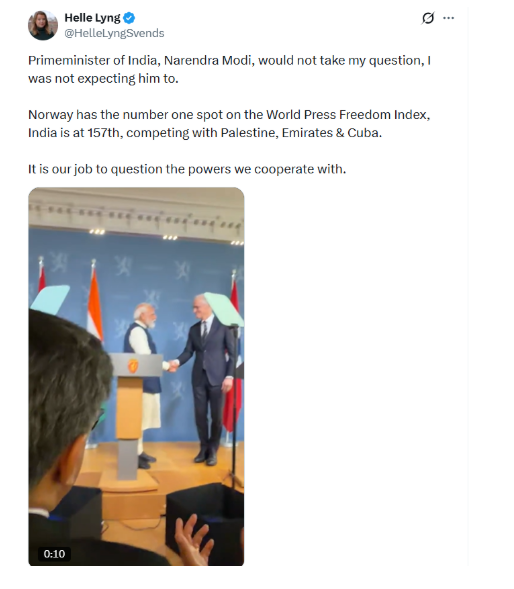
A review of journalist Helle Lyng’s official social media account shows the original video posted by her on 18 May. In the video, she can be heard asking:
“Prime Minister Modi, why don’t you take some questions from the freest press in the world?” In her caption, she stated that she did not expect PM Modi to take her question and highlighted press freedom rankings, noting Norway’s position at the top and India’s at 157th. She also emphasized that questioning cooperating governments is part of journalistic responsibility.
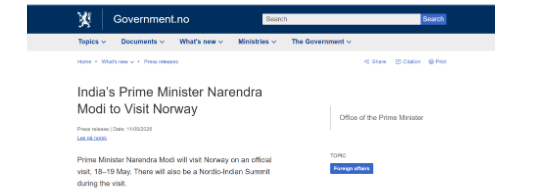
Further verification of the full press event published on the official Government of Norway portal shows no question related to alleged downed aircraft or military losses.
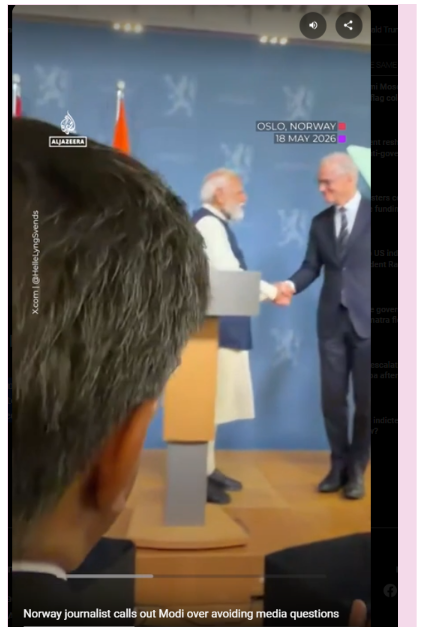
Additional reporting by Al Jazeera also confirms that a Norwegian journalist questioned PM Modi in Oslo about why he does not engage in open media briefings.
Conclusion:
The video is being shared with a misleading claim. It is a recent clip from 18 May in Oslo, and the journalist’s question was about press freedom—not about Operation Sindoor or any India–Pakistan conflict-related aircraft losses.

Related Blogs

Executive Summary:
A manipulated image showing someone making an offensive gesture towards Prime Minister Narendra Modi is circulating on social media. However, the original photo does not display any such behavior towards the Prime Minister. The CyberPeace Research Team conducted an analysis and found that the genuine image was published in a Hindustan Times article in May 2019, where no rude gesture was visible. A comparison of the viral and authentic images clearly shows the manipulation. Moreover, The Hitavada also published the same image in 2019. Further investigation revealed that ABPLive also had the image.

Claims:
A picture showing an individual making a derogatory gesture towards Prime Minister Narendra Modi is being widely shared across social media platforms.


Fact Check:
Upon receiving the news, we immediately ran a reverse search of the image and found an article by Hindustan Times, where a similar photo was posted but there was no sign of such obscene gestures shown towards PM Modi.

ABP Live and The Hitavada also have the same image published on their website in May 2019.


Comparing both the viral photo and the photo found on official news websites, we found that almost everything resembles each other except the derogatory sign claimed in the viral image.

With this, we have found that someone took the original image, published in May 2019, and edited it with a disrespectful hand gesture, and which has recently gone viral across social media and has no connection with reality.
Conclusion:
In conclusion, a manipulated picture circulating online showing someone making a rude gesture towards Prime Minister Narendra Modi has been debunked by the Cyberpeace Research team. The viral image is just an edited version of the original image published in 2019. This demonstrates the need for all social media users to check/ verify the information and facts before sharing, to prevent the spread of fake content. Hence the viral image is fake and Misleading.
- Claim: A picture shows someone making a rude gesture towards Prime Minister Narendra Modi
- Claimed on: X, Instagram
- Fact Check: Fake & Misleading
.webp)
Introduction
The unprecedented rise of social media, challenges with regional languages, and the heavy use of messaging apps like WhatsApp have all led to an increase in misinformation in India. False stories spread quickly and can cause significant harm, like political propaganda and health-related mis/misinformation. Programs that teach people how to use social media responsibly and attempt to check facts are essential, but they do not always connect with people deeply. Reading stories, attending lectures, and using tools that check facts are standard passive learning methods used in traditional media literacy programs.
Adding game-like features to non-game settings is called "gamification," it could be a new and interesting way to answer this question. Gamification involves engaging people by making them active players instead of just passive consumers of information. Research shows that interactive learning improves interest, thinking skills, and memory. People can learn to recognise fake news safely by turning fact-checking into a game before encountering it in real life. A study by Roozenbeek and van der Linden (2019) showed that playing misinformation games can significantly enhance people's capacity to recognise and avoid false information.
Several misinformation-related games have been successfully implemented worldwide:
- The Bad News Game – This browser-based game by Cambridge University lets players step into the shoes of a fake news creator, teaching them how misinformation is crafted and spread (Roozenbeek & van der Linden, 2019).
- Factitious – A quiz game where users swipe left or right to decide whether a news headline is real or fake (Guess et al., 2020).
- Go Viral! – A game designed to inoculate people against COVID-19 misinformation by simulating the tactics used by fake news peddlers (van der Linden et al., 2020).
For programs to effectively combat misinformation in India, they must consider factors such as the responsible use of smartphones, evolving language trends, and common misinformation patterns in the country. Here are some key aspects to keep in mind:
- Vernacular Languages
There should be games in Hindi, Tamil, Bengali, Telugu, and other major languages since that is how rumours spread in different areas and diverse cultural contexts. AI voice conversation and translation can help reduce literacy differences. Research shows that people are more likely to engage with and trust information in their native language (Pennycook & Rand, 2019).
- Games Based on WhatsApp
Interactive tests and chatbot-powered games can educate consumers directly within the app they use most frequently since WhatsApp is a significant hub for false information. A game with a WhatsApp-like interface where players may feel like they are in real life, having to decide whether to avoid, check the facts of, or forward messages that are going viral could be helpful in India.
- Detecting False Information
As part of a mobile-friendly game, players can pretend to be reporters or fact-checkers and have to prove stories that are going viral. They can do the same with real-life tools like reverse picture searches or reliable websites that check facts. Research shows that doing interactive tasks to find fake news makes people more aware of it over time (Lewandowsky et al., 2017).
- Reward-Based Participation
Participation could be increased by providing rewards for finishing misleading challenges, such as badges, diplomas, or even incentives on mobile data. This might be easier to do if there are relationships with phone companies. Reward-based learning has made people more interested and motivated in digital literacy classes (Deterding et al., 2011).
- Universities and Schools
Educational institutions can help people spot false information by adding game-like elements to their lessons. Hamari et al. (2014) say that students are more likely to join and remember what they learn when there are competitive and interactive parts to the learning. Misinformation games can be used in media studies classes at schools and universities by using models to teach students how to check sources, spot bias, and understand the psychological tricks that misinformation campaigns use.
What Artificial Intelligence Can Do for Gamification
Artificial intelligence can tailor learning experiences to each player in false games. AI-powered misinformation detection bots could lead participants through situations tailored to their learning level, ensuring they are consistently challenged. Recent natural language processing (NLP) developments enable AI to identify nuanced misinformation patterns and adjust gameplay accordingly (Zellers et al., 2019). This could be especially helpful in India, where fake news is spread differently depending on the language and area.
Possible Opportunities
Augmented reality (AR) scavenger hunts for misinformation, interactive misinformation events, and educational misinformation tournaments are all examples of games that help fight misinformation. India can help millions, especially young people, think critically and combat the spread of false information by making media literacy fun and interesting. Using Artificial Intelligence (AI) in gamified treatments for misinformation could be a fascinating area of study in the future. AI-powered bots could mimic real-time cases of misinformation and give quick feedback, which would help students learn more.
Problems and Moral Consequences
While gaming is an interesting way to fight false information, it also comes with some problems that you should think about:
- Ethical Concerns: Games that try to imitate how fake news spreads must ensure players do not learn how to spread false information by accident.
- Scalability: Although worldwide misinformation initiatives exist, developing and expanding localised versions for India's varied language and cultural contexts provide significant challenges.
- Assessing Impact: There is a necessity for rigorous research approaches to evaluate the efficacy of gamified treatments in altering misinformation-related behaviours, keeping cultural and socio-economic contexts in the picture.
Conclusion
A gamified approach can serve as an effective tool in India's fight against misinformation. By integrating game elements into digital literacy programs, it can encourage critical thinking and help people recognize misinformation more effectively. The goal is to scale these efforts, collaborate with educators, and leverage India's rapidly evolving technology to make fact-checking a regular practice rather than an occasional concern.
As technology and misinformation evolve, so must the strategies to counter them. A coordinated and multifaceted approach, one that involves active participation from netizens, strict platform guidelines, fact-checking initiatives, and support from expert organizations that proactively prebunk and debunk misinformation can be a strong way forward.
References
- Deterding, S., Dixon, D., Khaled, R., & Nacke, L. (2011). From game design elements to gamefulness: defining "gamification". Proceedings of the 15th International Academic MindTrek Conference.
- Guess, A., Nagler, J., & Tucker, J. (2020). Less than you think: Prevalence and predictors of fake news dissemination on Facebook. Science Advances.
- Hamari, J., Koivisto, J., & Sarsa, H. (2014). Does gamification work?—A literature review of empirical studies on gamification. Proceedings of the 47th Hawaii International Conference on System Sciences.
- Lewandowsky, S., Ecker, U. K., & Cook, J. (2017). Beyond misinformation: Understanding and coping with the “post-truth” era. Journal of Applied Research in Memory and Cognition.
- Pennycook, G., & Rand, D. G. (2019). Fighting misinformation on social media using “accuracy prompts”. Nature Human Behaviour.
- Roozenbeek, J., & van der Linden, S. (2019). The fake news game: actively inoculating against the risk of misinformation. Journal of Risk Research.
- van der Linden, S., Roozenbeek, J., Compton, J. (2020). Inoculating against fake news about COVID-19. Frontiers in Psychology.
- Zellers, R., Holtzman, A., Rashkin, H., Bisk, Y., Farhadi, A., Roesner, F., & Choi, Y. (2019). Defending against neural fake news. Advances in Neural Information Processing Systems.

Introduction
In today's relentless current of information, where social media is oftentimes both the stage and the playwright, the line between reality and spectacle can become distressingly blurry. In such a virtual Pantheon, the conflation of truth and fiction has recently surfaced in a particularly contentious instance. The central figure is Poonam Pandey, an entertainment personality known for transgressing traditional contours of celebrity boldness. Pandey found herself ensnared in a narrative of her own orchestration—a grim hoax purporting she had succumbed to cervical cancer. This deceptive foray, rather than awakening public consciousness as intended, spiralled into an ominous fable about the malignant spread of misinformation and the profound moral dilemmas it engenders.
The Deception
The tapestry of this event was woven with threads of tragedy and deception, framing Pandey both as the tragic hero and the ill-fated architect of a spectacle that unfolded with a haunting familiarity evocative of ancient Greek dramas. The monumental pillar of social media, on what seemed to be an ordinary day, was shattered by the startling declaration of Pandey's untimely passing. The statement, as bereft of nuance as it was devastating, proclaimed: 'We are deeply grieved to announce the loss of our cherished Poonam to cervical cancer.' The emotional pulse of the Indian Film Industry was jolted; waves of homage inundated the digital space, each tribute a poignant echo of the shock that rippled through her fanbase. Yet the crux of the matter had yet to be unveiled.
As the world grappled with this news, the scenario took an unforeseen detour. Poonam Pandey made a re-entrance onto the world stage, alive, revealing her alleged demise to be nothing more than a macabre masquerade. The public's reaction to this revelation was a stratified symphony of emotions—indignation mingled with disbelief, with an underlying crescendo of betrayal. Pandey's defense postured her act as a last resort to draw attention to the silent yet pervasive threat of cervical cancer. In the ensuing mire of reactions, an inescapable quandary emerged: is it ever permissible to employ deceit for the sake of presumed publicity?
The Chaos
Satyajeet Tambe, an esteemed Maharashtra legislator, emerged amidst the churning chaos as a paragon of principled reason. Advocating that such mendacious stunts, playing the chords of public emotion and adulterating truth, should be met with legal repercussions, Tambe called for judicious action against Pandey. His imploration resonated with the necessity of integrity in the public domain, stating, 'The announcement of an influencer/model succumbing to cervical cancer should not be wielded as a tool for awareness.' His pronouncement sent reverberations through the collective conscience, echoing the need for accountability in the face of such transgressions.
Repercussion
The All Indian Cine Workers Association, a custodian of the film industry's values, also voiced its reproach. They urged for an FIR to be lodged against Poonam Pandey, underlining their sentiments with disappointment and a keen sense of betrayal. Within their condemnation lay a profound recognition of the elevated emotional investment inherent in their industry—an industry where the reverence for life and the abhorrence of deceit intertwine, making the cultivation of such lowly stunts anathema.
This spectacle, while unique in the temerity of its execution, mirrors the broader pathological wave of misinformation that corrodes the foundations of our digital era: the malady of fake news. When delineated, fake news finds its essence as information chiselled specifically to deceive, a form of communication that is not merely slanted but entirely devoid of authenticity, manufactured with nefarious intent. A protean adversary, fake news adeptly masquerades as trustworthy news, ensnaring the unsuspecting in its tendrils. Its purveyors span a spectrum—from shadowy figures to ostensibly benign social media accounts—all contributing to a dystopian fabric where truth is persistently imperilled.
The conjurers of these illusions are, in a sense, cunning illusionists ensconced behind curtains of anonymity or masquerading under a cloak of transparency. They craft elaborate illusions devoid of truth, but dripping with sufficient plausibility to ensnare those who yearn for simplicity in an increasingly complex world. Destabilizing forces, such as hyper partisan media outlets, regurgitate a concoction of concocted 'facts' and distortions, deliberately smudging the once-clear line between empirical truth and partisan fabrication.
The Aftermath
The Poonam Pandey episode stands as a harrowing beacon of the ethical abyss we face. It compels us to confront the irony of utilising falsity to raise awareness for laudable causes and considers the ramifications for public figures influencing the dissemination of information. The tempest around this event demonstrates the potent gravitational pull of information and the overarching need for the conscientious stewardship of its power.
Yet, as we sail through the murky waters of the digital expanse, where the allure of sensationalism and clickbait headlines is ever-present, our vigilance must not wane. The imperative of truth cannot come at the altar of awareness or sensationalism. The sanctity of fact anchors our understanding of reality; devoid of it, we are adrift in an ocean of confusion and misinformation.
In the dust settled after the Poonam Pandey debacle, the contours of a new discourse have emerged, harboring vital interrogations. How do we balance the drive for poignant awareness initiatives against the cardinal principle of truth? What mechanisms can ensure that health campaigns and their noble aspirations are not tainted by the allure of deception? Addressing these queries is not a solitary task for policymakers or influencers but, indeed, a collective societal responsibility that will define our cultural ethics and the legacy we wish to preserve.
Conclusion
As we contemplate the broader implications of this incident, let us not allow its sensational nature to eclipse the very real and pressing issue of cervical cancer—a condition that, beyond the glare of controversy, continues to shadow lives with its lethal silence. Instead, let our focus pivot towards tangible, truth-driven efforts aimed at education and empowerment. Truth, after all, is the beacon that dispels the murky shadows of ignorance and guides us toward enlightenment and healing.
References
- https://www.hindustantimes.com/india-news/poonam-pandey-in-trouble-as-maharashtra-politician-seeks-case-for-faking-her-death-101707005742992.html
- https://www.nagpurtoday.in/state-mlc-tambe-demands-police-action-against-poonam-pandey-for-faking-her-death/02051417
