
#FactCheck- Viral Photo Claiming PM Modi Met ‘Cockroach Janata Party’ Founder Abhijeet Dipke Is AI-Generated
Executive Summary
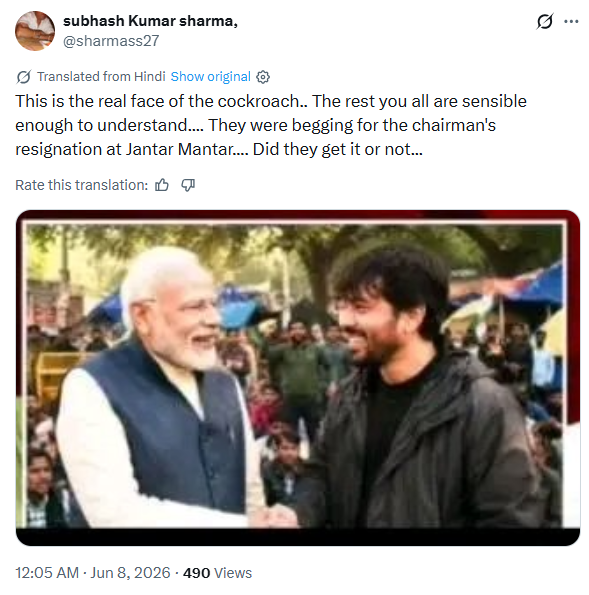
Following a recent protest at Delhi’s Jantar Mantar, members of the self-styled “Cockroach Janata Party” also staged a demonstration in Pune, Maharashtra, demanding the resignation of Union Education Minister Dharmendra Pradhan. Amid this backdrop, a photograph has gone viral on social media purportedly showing the party’s founder, Abhijeet Dipke, posing with Prime Minister Narendra Modi. CyberPeace Research Wing research found that the image is not genuine. The photograph has been created using Artificial Intelligence (AI) and does not depict a real meeting between the two individuals.
Claim
An X user, “subhash Kumar sharma,” shared the viral image on June 8, 2026, with the caption: “This is the real face of the Cockroach... the rest you all understand. They were begging for Pradhan’s resignation at Jantar Mantar… did they get it or not?” The archived and original links to the post can be seen below:
https://x.com/sharmass27/status/2063691212662686102?s=20
Fact Check
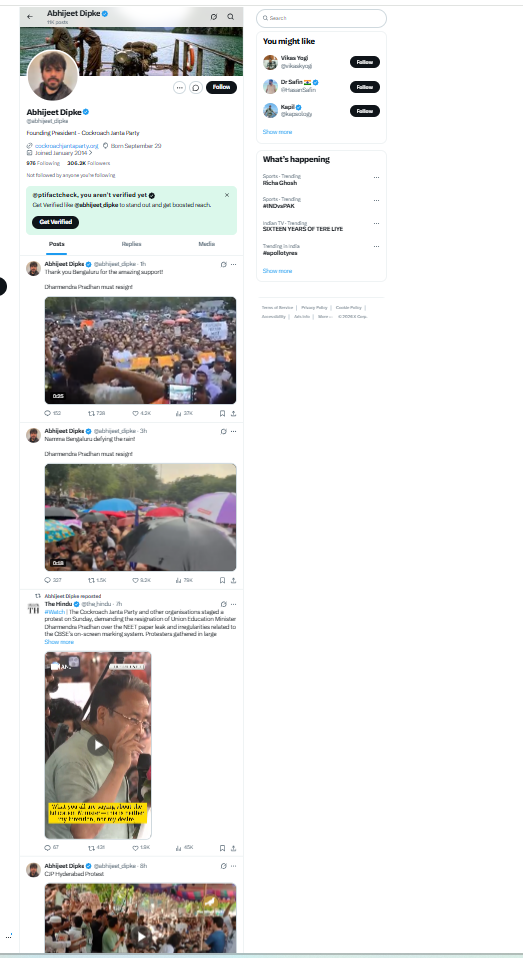
To verify the claim, we conducted a reverse image search using Google. However, we did not find any credible news reports related to the viral photograph. We also searched using relevant keywords, but no reliable information supporting the claim was found. We then examined the official X account of Abhijeet Dipke, founder of the “Cockroach Janata Party.” No post, photograph, or information related to any meeting with Prime Minister Narendra Modi was found on his account.
https://x.com/abhijeet_dipke?lang=en
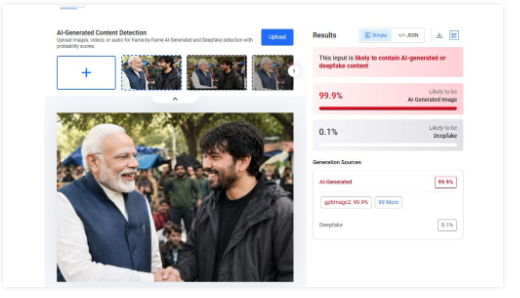
The absence of any credible evidence led us to suspect that the image may have been generated using AI. To further verify its authenticity, we analyzed the image using AI-detection tools. The first tool, Hive Moderation, indicated a nearly 99 percent probability that the image was AI-generated. The analysis also suggested signs consistent with content produced by generative AI models.
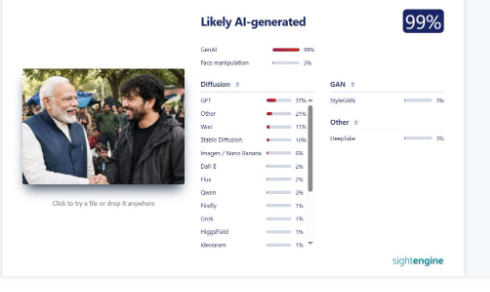
We then examined the image using another AI-detection platform, Sightengine. Its analysis likewise indicated a 99 percent likelihood that the image was AI-generated and showed characteristics commonly associated with AI-created visuals.
Conclusion
Our research found that the claim accompanying the viral image is false. The photograph purportedly showing Prime Minister Narendra Modi with Cockroach Janata Party founder Abhijeet Dipke is not real. The image has been generated using Artificial Intelligence and does not represent an actual meeting or event.

Related Blogs

Executive Summary:
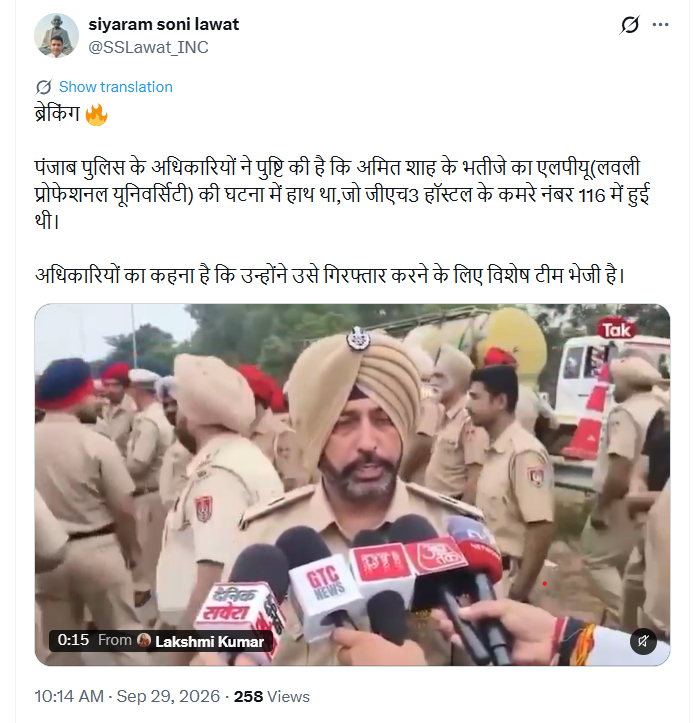
A video is going viral on social media with the claim that the protests and unrest at Lovely Professional University (LPU) over the alleged rape of a female student were linked to the nephew of Union Home Minister Amit Shah. The viral video purportedly shows a police officer telling the media that the involvement of an alleged relative of Amit Shah had surfaced in the case and that a police team had been sent to Delhi to arrest him. However, CyberPeace Research found that the original video has been digitally manipulated using AI and is being circulated with a misleading claim.
Claim:
The post caption reads: “Breaking Punjab Police officials have confirmed that Amit Shah’s nephew was involved in the LPU (Lovely Professional University) incident, which took place in Room No. 116 of GH3 Hostel. Officials say they have sent a special team to arrest him.” In the viral video, a police officer is purportedly heard telling the media: “We are receiving information that the person who committed this crime was a BJP worker and a relative of the Home Minister. This incident took place in Room 116 of GH3 Hostel. But now the Punjab Police is fully alert and an FIR has been registered. We will take action. The boy is currently in Delhi, but our teams have been sent there.
https://x.com/SSLawat_INC/status/2104794508311540147
Fact Check:
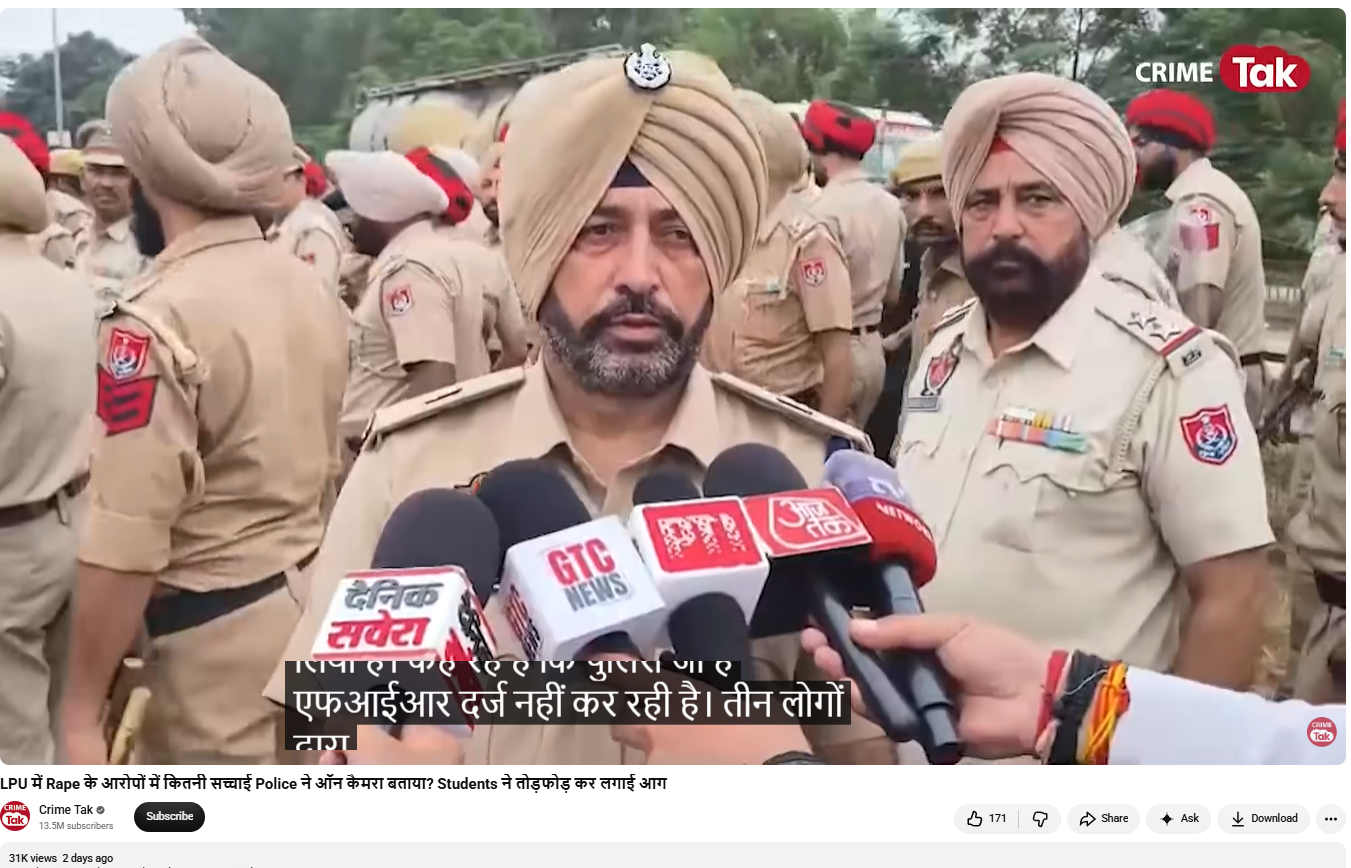
To verify the viral video claiming that the nephew of Union Home Minister Amit Shah was named as an accused in the LPU case in Punjab, we conducted a Google search using relevant keywords. During the search, we did not find any credible media reports in which the Punjab Police had made such a statement. Since the video carries the ‘Crime Tak’ logo, we checked the channel’s YouTube account. During our research, we found the original version of the viral video uploaded on the ‘Crime Tak’ YouTube channel on September 27. We found that the police officer seen in the video is Phagwara SP Major Singh. In the original video available on the ‘Crime Tak’ YouTube channel, SP Major Singh does not mention any involvement of Amit Shah’s relative. Instead, while speaking about the protests at LPU and rumours surrounding an alleged rape and suicide, he says that the police have not received any concrete information or complaint regarding the matter. He further states that if students provide any complaint or credible information, the police will take appropriate action as per the medical examination and investigation process.
https://www.youtube.com/watch?v=UY7cE0S65-k
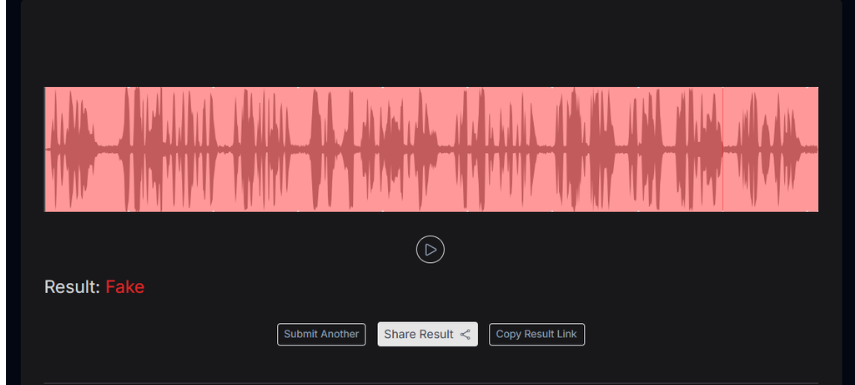
Since the police officer in the original video did not make any statement about Amit Shah’s nephew, it became clear that the viral video had been manipulated. To further verify this, we analyzed the audio in the video using the AI detection tool Resemble AI. The tool identified the voice of the police officer in the video as fake.
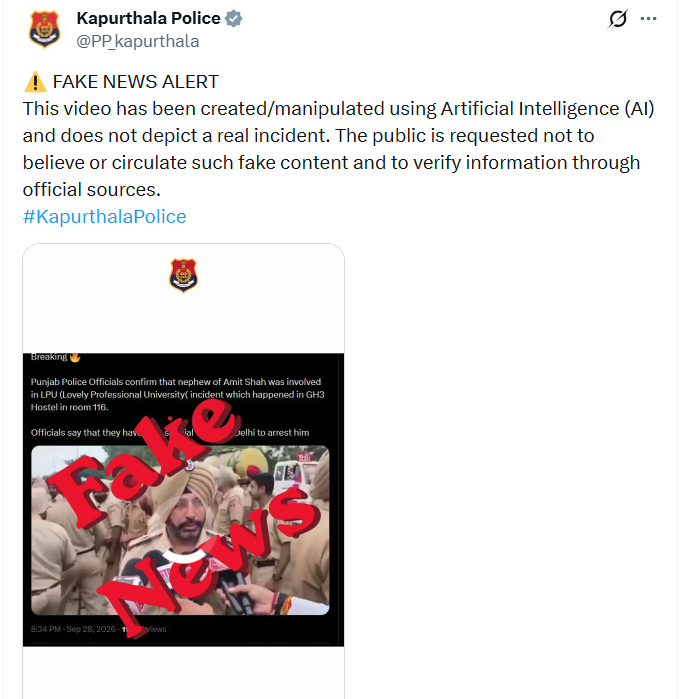
The Kapurthala Police posted on its official X handle on September 29, 2026, describing the video as fake.
Conclusion:
The evidence gathered during our research confirms that the video of a Punjab Police officer allegedly accusing Amit Shah’s relative has been digitally manipulated using AI. In the original video, the Punjab Police officer did not make any such statement while responding to questions from the media.

Introduction
Sexual Offences against children have recently come under scrutiny after the decision of the Madras High Court which has ruled that watching and downloading child sexual porn is an inchoate crime. In response, the Supreme Court, on 23 September 2024, ruled that Section 15 of the POCSO and Section 67B of the IT Act penalise any form of use of child pornography, including storing and watching such pornographic content. Along with this, the Supreme Court has further recommended replacing the term “Child Pornography” which it said acts as a misnomer and does not capture the full extent of the crime, with a more inclusive term “Child Sexual Exploitative and Abuse Material” (CESAM). This term would more accurately reflect the reality that these images and videos are not merely pornographic but are records of incidents, where a child has either been sexually exploited and abused or where any abuse of children has been portrayed through any self-generated visual depiction.
Intermediaries cannot claim exemption from Liability U/S 79
Previously, intermediaries claimed safe harbour by only complying with the requirements stipulated under the MOU. As per the decision of the SC, now, an intermediary cannot claim exemption from the liability under Section 79 of the IT Act for any third-party information, data, or communication link made available or hosted by it unless due diligence is conducted by it and compliance is made of these provisions of the POCSO Act. This is as per the provisions of Sections 19 and 20 of the POCSO read with Rule 11 of the POCSO Rules which have a mandatory nature.
The due diligence under section 79 of the IT Act includes the removal of child pornographic content and immediate reporting of such content to the concerned police units in the manner specified under the POCSO Act and the Rules. In this way, the Supreme Court has broadened the Interpretation and scope of the ‘Due Diligence’ obligation under section 79 of the IT Act. It was also stated that is to be duly noted that merely because an intermediary complies with the IT Act, will not absolve it of any liability under the POCSO. This is unless it duly complies with the requirements and procedure set out under it, particularly Section 20 of the POCSO Act and Rule 11 of the POCSO Rules.
Bar on Judicial Use of the term ‘Child Porn’
Supreme Court found that the term child pornography can be trivialised as pornography is often seen as a consensual act between adults. Supreme Court emphasised using the term Child Sexual Exploitative and Abuse Material (CESAM) as it would emphasise the exploitation of children highlight the criminality of the act and shift the focus to a more robust framework to counter these crimes. The Supreme Court also stated that the Union of India should consider amending the POCSO Act to replace the "child pornography" term with "child sexual exploitative and abuse material" (CSEAM). This would reflect more accurately on the reality of such offences. Supreme Court also directed that the term "child pornography" shall not be used in any judicial order or judgment, and instead, the term "CSEAM" should be endorsed.
Curbing CSEAM Content on Social Media Platforms
Social Media Intermediaries and Expert Organisations play an important role in curbing CESAM content. Per the directions of the Apex Court, a need to impart positive age-appropriate sex education to prevent youth from engaging in harmful sexual behaviours, including the distribution, and viewing of CSEAM is important and all stakeholders must engage in proactive measures to counter these offences which are under the umbrella of CSEAM. This should entail promoting age-appropriated and lawful content on social media platforms and social media platforms to ensure compliance with applicable provisions.
Conclusion
In light of the Supreme Court’s landmark ruling, it is imperative to acknowledge the pressing necessity of establishing a safer online environment that shields children from exploitation. The shift towards using "Child Sexual Exploitative and Abuse Material" (CSEAM) emphasizes the severity of the crime and the need for a vigilant response. The social media intermediaries must respect their commitment to report and remove exploitive content and must ensure compliance with POCSO and IT regulations. Furthermore, comprehensive, age-appropriate sex education can also be used as a preventive measure, educating young people about the moral and legal ramifications of sexual offences, encouraging respect and awareness and ensuring safer cyberspace.
References
- https://www.scconline.com/blog/post/2024/09/23/storing-watching-child-pornography-crime-supreme-court-pocso-it-act/#:~:text=Supreme%20Court%3A%20The%20bench%20of,watching%20of%20such%20pornographic%20content
- https://timesofindia.indiatimes.com/india/supreme-court-viewing-child-porn-is-offence-under-pocso-it-acts/articleshow/113613572.cms
- https://bwlegalworld.com/article/dont-use-term-child-pornography-says-sc-urges-parliament-to-amend-pocso-act-534053
- https://indianexpress.com/article/india/child-pornography-law-pocso-it-supreme-court-9583376/

Introduction
Significantly, in March 2023, the Prevention of Money Laundering Act, 2002's regulations placed Virtual Digital Asset Service Providers functioning located under the purview of the Anti Money Laundering/Counter Financing of Terrorism (AML-CFT) scheme. An important step toward controlling VDA SP operations and guaranteeing adherence to Anti-Money Laundering and Combating the Financing of Terrorism (AML-CFT) regulations.
The significance of AML-CFT procedures
The AML-CFT framework's incorporation of Virtual Digital Asset Service Providers (VDA SPs) is essential for protecting the banking industry from illegal activities including the laundering of funds and counter-financing of terrorist attacks. These regulations become more crucial as the market for digital assets develops and becomes more well-known.
The practice of money laundering is hiding the source of the sum received illegally, thus it's critical to have strict policies in place to track down and stop these kinds of operations. Furthermore, funding for terrorism is a serious danger to international safety, hence stopping the flow of money to terrorist companies is a top concern for global officials.
The goal of policymakers' move to include VDA SPs in the AML-CFT architecture is to set up control and surveillance procedures that will guarantee these organisations' open and honest operations. This involves tracking transactions, flagging questionable activity, and conducting extensive customer investigations. Incorporating such procedures not only reduces the potential for financial crimes but also builds confidence and trust in the electronic asset market.
It is important to see the significance of AML-CFT procedures and the changes in the legal framework to reflect the evolving characteristics of digital currencies. These procedures are essential to preserving the reliability and safety of the wider banking system.
Notifications of Compliance Show Cause
Under Section 13 of the PMLA Act 2002, FIU IND sent adherence Show Cause Notices to nine offshore Virtual Digital Asset Service Providers (VDA SPs) as part of its dedication to upholding compliance with regulations. This affirmative step requires organisations to be scrutinised and attempted to bring them under inspection.
Governmental Response
The Director of FIU IND has addressed the Secretary of the Ministry of Electronics and Information Technology to take further measures due to the disregard of offshore firms. According to the notification, URLs connected to these organisations that operate in India in violation of the PML Act's requirements must be blocked.
Mandatory Registration for VDA SPs
Virtual Digital Asset Service Providers (both onshore and offshore) who perform a range of operations, including the trading of digital goods for monetary currencies, the distribution of digital currency, and the management or preservation of electronic assets, are now obliged to register with FIU.
Range of Statutory Responsibilities
In accordance with the PML Act, VDA SPs are subject to several requirements, including documentation, disclosure, and other duties. One of their responsibilities is to register with the FIU IND. The primary focus is on guaranteeing that VDA SPs comply with AML-CFT protocols, hence enhancing the general reliability of the banking industry.
Difficulties with Offshore Compliance
There are many obstacles in guaranteeing that offshore organisations comply with Anti Money Laundering/Counter Financing of Terrorism (AML-CFT), chief amongst them being their unwillingness to undergo registration. Some overseas Virtual Digital Asset Service Providers (VDA SPs) have been reluctant to comply with the existing rules and regulations, even though they cater to a significant number of Indian users. There are several reasons for this hesitation, such as worries about heightened monitoring, the expense of compliance, and the apparent complexity of governmental processes. Regulatory organisations have taken steps to close the discrepancy between offshore businesses' real activities and the regulations they must follow. In addition to maintaining the trustworthiness of the economic system, resolving the issues with offshore adherence is essential for promoting confidence and openness in the market for electronic assets.
Conclusion
FIU IND has demonstrated its dedication to creating an effective regulatory framework for Virtual Digital Asset Service Providers through its recent measures. India hopes to fortify its countermeasures against money laundering and safeguard the financial well-being of its users by expanding the AML-CFT legislation to offshore firms. The continuous efforts to restrict the URLs of non-compliant companies show a proactive approach to stopping illicit activity and fostering a safe and law-abiding virtual asset ecosystem. The safety and soundness of the banking sector will be crucially maintained by laws and regulations as the digital world develops.
References
- https://pib.gov.in/PressReleasePage.aspx?PRID=1991372
- https://www.thehindubusinessline.com/books/reviews/business-economy/fiu-ind-issues-compliance-showcause-notices-to-nine-offshore-vda-sps/article67684613.ece
- https://business.outlookindia.com/news/fiu-issues-notice-to-9-offshore-crypto-platforms-writes-to-meity-for-blocking-of-urls
