
#FactCheck- Old Video from Pakistan’s Gwadar Falsely Shared as Iran’s Attack on US Military Base in Kuwait
Executive Summary
A video is being shared on social media with the claim that it shows Iran’s attack on a US military base located in Kuwait. It is being claimed that the video is from a recent attack carried out by Iran. CyberPeace Research Wing ’s research found the claim to be false. The research revealed that the video is actually from Panwan, a coastal town in southern Pakistan. The footage was published in connection with reports of a suicide attack carried out by a prominent militant organisation. The video has no connection with the alleged Iranian attack on a US military base in Kuwait.
Claim:
A Facebook post shared in the Sinhala language on July 25, 2026, claimed: “Iran targeted US-controlled Kuwaiti border checkpoints. The Abdali border checkpoint has been completely destroyed.” The post was shared along with a video of around one minute. In the video, a blue truck can be seen entering a secured compound. Within seconds, a massive explosion takes place, followed by a thick cloud of smoke rising into the sky. Text written in Sinhala on the video claimed: “Watch how Iran is attacking the US Abdali border crossing base located on the Kuwait border.”
https://www.facebook.com/reel/979364938493872
https://web.archive.org/web/20260730055635/https://www.facebook.com/reel/979364938493872

Factcheck
As part of the research, keyframes from the viral video were extracted and a reverse image search was conducted. During the search, we found a report published by India Today on July 4, 2026. According to the report, the footage actually shows a suicide attack carried out by the Pakistan-based Baloch Liberation Army (BLA) militant group.
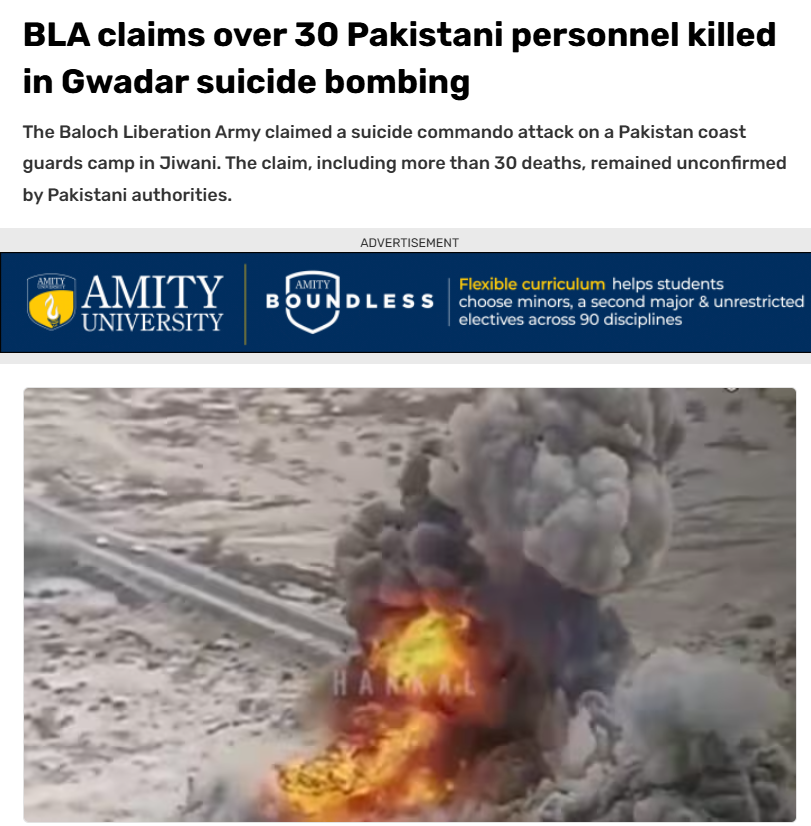
Further research led us to a report about a suicide bombing in Gwadar, Pakistan. According to the report, the BLA claimed responsibility for the attack and claimed that more than 30 security personnel were killed. Journalist Diksha Bisla also shared details about the incident.
https://www.facebook.com/watch/?v=1233630812123459

A search on Google Maps showed the Panwan area and a structure along Gwadar Road that resembles the location visible in the viral video.

Conclusion:
CyberPeace Research Wing ’s research found that the claim is false. The viral video is not related to any alleged Iranian attack on a US military base in Kuwait. The footage is from Panwan, a coastal town in southern Pakistan, and was circulated during reports of a suicide attack claimed by the Baloch Liberation Army (BLA).

Related Blogs
.webp)
Introduction
It might seem too good to be true: free movies, live TV and sports without any subscription plan are deals that no one in India could actually refuse, and that’s precisely the explanation as to why applications such as Pikashow have gained tremendous traction in India and all over the world as well. However, cybersecurity authorities have a strong cause of concern: the threat that this type of application poses towards lakhs of Indians with malicious software, stealing information and even money. Pikashow may be a perfect case study to establish this problem, but in fact, it all ties down to how downloading anything without the recognised applications has certain risks attached to it.
The Pikashow Warning
With no monthly subscription fees, Pikashow is a popular free app for streaming movies, web series, live TV channels and sports programmes. Since its development, Pikashow has had a reputation for never being found on the Google Play Store or Apple’s App Store, which necessitates a process of side-loading. A side load, in this case, entails downloading the Pikashow APK file from an unofficial third-party source and manually installing the app, circumventing the security measures of official download channels.
The latter is significant because security experts who have analysed Pikashow argue that it acts as an informal content aggregator; movies and TV series are illegally scooped up from online streaming services, then shared via various third-party links and streamed without a content licence or any agreement with legitimate providers.
Without going through the rigorous checks conducted by Google or Apple, security researchers discovered that even while the app appeared to be working fine with its promised streams, hidden malware within the installer can run silently, leading to potentially significant security risks such as data theft of user logins, one-time passwords, and private files, including banking credentials. This has been cited to be so problematic for India that law enforcement agencies like the Indian Cyber Crime Coordination Centre under the Ministry of Home Affairs and the Cyber Dost platform are expected to have issued public advisories linking Pikashow to a proliferation of cases of cybercrime. Users should take into account the legal implications alongside security concerns, as using piracy apps may not only lead to device-compromising issues but can also be against the Copyright Act of India as well, thus increasing the risk of legal prosecution.
Why This Isn't Just a "Pikashow Problem"
This should not be viewed as a single warning concerning one app. Pikashow is merely an illustration of one app from millions that exists outside official app stores and is built with the same mechanics that make Pikashow dangerous and applicable to virtually any app, game, or "modded" file which is downloaded from a random website, third-party app store, or Telegram channel.
Some issues that persist are-
- Official app stores are like a filter that is not perfect, but it is still critical to the security on a user's device. Both Google and Apple's App stores run automatic and manual malware scanners, screen permissions for legitimate use, and have the ability to remove malicious developers as necessary. Empirical research has estimated just how important this is: more than fifty-times more malware exists on sideloaded, "unofficial" apps versus official. Mobile security firm Zimperium claims nearly 40% of all devices tested with malware were infected due to downloading an app from outside the official app stores; furthermore, nearly 80% of malicious, sideloaded apps contained riskware or trojans.
- Informational channels can also be used to gain the trust of users by mimicking familiar brands One frequently mentioned scheme is one where malicious actors repackage popular apps with a malignant intent to syphon the app, disguised as a free, trustworthy app. Often when these apps are available, they work exactly the same as the legitimate app, as a matter of fact, but quietly in the background steal passwords or log keystrokes; this was discovered to be occurring with a financial trojan called TeaBot, where bank details and login info were intercepted through the device's Accessibility Service.
- There is generally no recourse or legal liability that applies once something has gone wrong. While official app stores are official developers that can be identified to submit complaints against them, if a third-party download leads to damages, that developer generally cannot be located to establish liability or legal standing.
- Excessive app permissions will often go undetected This occurs for the similar reasons that a malicious actor can include such a clause as explained above. There's really nothing to stop the developer from asking to utilise one's SMS, call log, camera, microphone, storage or location when there's not one reason for one application to need access to everything on the device.
- Expired software has the same or more risk It's actually very common to see apps that receive security updates out in the wild that either don't have the appropriate update sent over to third-party app stores or third-party stores don't have the capacity to update the affected applications. That's why most official third-party app downloads should be of fairly new versions; for example, outdated versions of a banking app, which is being patched as well as receiving other updates from Google or Apple still, will continue to persist on third-party download sites for some time after patching, which could then be malicious.
- Even legitimate, globally recognised apps can and have been compromised The same vulnerability was noted for TikTok in 2023, which, when found on unofficial APK download sites, contained hidden data-tracking malware yet looked identical to the official app version.
How to Protect Yourself
The reassuring thing is that the vast majority of this risk can be eliminated through simple, repeatable habits. Use trusted sources like Google Play and Apple's App Store, which are not faultless, of course, but they remove many infected apps from circulation following review.
- Be sceptical of "free" premium-paid apps.
- If something in a file from a site you don't recognise offers content or features that are normally behind a paywall and they want nothing to do with it, that is a bad sign, not a good deal. Review app permissions when you go to install anything. A flashlight doesn't need access to your SMS messages or contacts, as one recently downloaded on a colleague's Android allegedly attempted to acquire them from the Google Play store. After sideloading any app that you do not fully trust, it's always a wise idea to uninstall it and scan the handset to ensure malicious files aren't still lingering around.
- Choose legitimate services to avoid malware.
- In entertainment terms this will apply most clearly to piracy but applies similarly elsewhere in many senses. Trusted sources that are licensed include YouTube, JioCinema, Hotstar, Netflix, Amazon Prime Video, and MX Player, among others, which will offer content similar to illegally acquired or pirated versions without the security, as well as the legal risks. If you have recently used the file installation route to any degree of caution on a sensitive device, then also monitor banking and payment apps.
- That is not least because the most reported consequence of infection from an illicit or unknown source is the theft of financial account login details.
Conclusion
Free entertainment can look tempting, but as cybersecurity experts keep pointing out, "free" often just means the cost has been shifted from your wallet to your data, your device, and potentially your bank account. The safest rule of thumb remains simple: if an app isn't on an official store, ask why and think twice before installing it.
Sources
- Pikashow app risky, may expose users to malware and data theft: Experts — Times of India
- Free OTT Hack or Cyber Trap? Pikashow Flagged for Serious Security Risks — The420.in
- Pikashow Warning: Free Movies Could Empty Your Bank Account, Government Issues Strong Alert — The420.in
- Is Pikashow Safe or Risky to Use in 2025? Expert's Advice — AiPlex AntiPiracy
- Why Pikashow May Not Be Safe for Your Device — AiPlex AntiPiracy
- Concerns Rise Over the Safety of Popular Streaming App Pikashow — openPR
- Beyond the App Store: The Hidden Risks of Sideloading Apps — Zimperium
- App Sideloading: Risks, Rules, and How IT Admins Respond — Trio
- What Are the Risks of Sideloading Apps on Your Smartphone? — Bitdefender
- Sideloading Risk: Alternative App Stores and Brand Protection — Allure Security
- Building a Trusted Ecosystem for Millions of Apps: A Threat Analysis of Sideloading — Apple
Introduction
Public infrastructure has traditionally served as the framework for civilisation, transporting people, money, and ideas across time and space, from the iron veins of transcontinental railroads to the unseen arteries of the internet. In democracies where free markets and public infrastructure co-exist, this framework has not only facilitated but also accelerated progress. Digital Public Infrastructure (DPI), which powers inclusiveness, fosters innovation, and changes citizens from passive recipients to active participants in the digital age, is emerging as the new civic backbone as we move away from highways and towards high-speed data.
DPI makes it possible for innovation at the margins and for inclusion at scale by providing open-source, interoperable platforms for identities, payments, and data exchange. Examples of how the Global South is evolving from a passive consumer of technology to a creator of globally replicable governance models are India’s Aadhaar (digital identification), UPI (real-time payments), and DigiLocker (data empowerment). As the ‘digital commons’ emerges, DPI does more than simply link users; it also empowers citizens, eliminates inefficiencies from the past, and reimagines the creation and distribution of public value in the digital era.
Securing the Digital Infrastructure: A Contemporary Imperative
As humans, we are already the inhabitants of the future, we stand at the temporal threshold for reform. Digital Infrastructure is no longer just a public good. It’s now a strategic asset, akin to oil pipelines in the 20th century. India is recognised globally for the introduction of “India Stack”, through which the face of digital payments has also been changed. The economic value contributed by DPIs to India’s GDP is predicted to reach 2.9-4.2 percent by 2030, having already reached 0.9% in 2022. Its role in India’s economic development is partly responsible for its success; among emerging market economies, it helped propel India to the top of the revenue administrations’ digitalisation index. The other portion has to do with how India’s social service delivery has changed across the board. By enabling digital and financial inclusion, it has increased access to education (DIKSHA) and is presently being developed to offer agricultural (VISTAAR) and digital health (ABDM) services.
Securing the Foundations: Emerging Threats to Digital Public Infrastructure
The rising prominence of DPI is not without its risks, as adversarial forces are developing with comparable sophistication. The core underpinnings of public digital systems are the target of a new generation of cyber threats, ranging from hostile state actors to cybercriminal syndicates. The threats pose a great risk to the consistent development endeavours of the government. To elucidate, targeted attacks on Biometric databases, AI-based Misinformation and Psychological Warfare, Payment System Hacks, State-sponsored malware, cross-border phishing campaigns, surveillance spyware and Sovereign Malware are modern-day examples of cyber threats.
To secure DPI, a radical rethink beyond encryption methods and perimeter firewalls is needed. It requires an understanding of cybersecurity that is systemic, ethical, and geopolitical. Democracy, inclusivity, and national integrity are all at risk from DPI. To preserve the confidence and promise of digital public infrastructure, policy frameworks must change from fragmented responses to coordinated, proactive and people-centred cyber defence policies.
CyberPeace Recommendations
Powering Progress, Ignoring Protection: A Precarious Path
The Indian government is aware that cyberattacks are becoming more frequent and sophisticated in the nation. To address the nation’s cybersecurity issues, the government has implemented a number of legislative, technical, and administrative policy initiatives. While the initiatives are commendable, there are a few Non-Negotiables that need to be in place for effective protection:
- DPIs must be declared Critical Information Infrastructure. In accordance with the IT Act, 2000, the DPI (Aadhaar, UPI, DigiLocker, Account Aggregator, CoWIN, and ONDC) must be designated as Critical Information Infrastructure (CII) and be supervised by the NCIIPC, just like the banking, energy, and telecom industries. Give NCIIPC the authority to publish required security guidelines, carry out audits, and enforce adherence to the DPI stack, including incident response protocols tailored to each DPI.
- To solidify security, data sovereignty, and cyber responsibility, India should spearhead global efforts to create a Global DPI Cyber Compact through the “One Future Alliance” and the G20. To ensure interoperable cybersecurity frameworks for international DPI projects, promote open standards, cross-border collaboration on threat intelligence, and uniform incident reporting guidelines.
- Establish a DPI Threat Index to monitor vulnerabilities, including phishing attacks, efforts at biometric breaches, sovereign malware footprints, spikes in AI misinformation, and patterns in payment fraud. Create daily or weekly risk dashboards by integrating data from state CERTs, RBI, UIDAI, CERT-In, and NPCI. Use machine learning (ML) driven detection systems.
- Make explainability audits necessary for AI/ML systems used throughout DPI to make sure that the decision-making process is open, impartial, and subject to scrutiny (e.g., welfare algorithms, credit scoring). Use the recently established IndiaAI Safety Institute in line with India’s AI mission to conduct AI audits, establish explanatory standards, and create sector-specific compliance guidelines.
References
- https://orfamerica.org/newresearch/dpi-catalyst-private-sector-innovation?utm_source=chatgpt.com
- https://www.institutmontaigne.org/en/expressions/indias-digital-public-infrastructure-success-story-world
- https://www.pib.gov.in/PressReleasePage.aspx?PRID=2116341
- https://www.pib.gov.in/PressReleaseIframePage.aspx?PRID=2033389
- https://www.governancenow.com/news/regular-story/dpi-must-ensure-data-privacy-cyber-security-citizenfirst-approach
Executive Summary
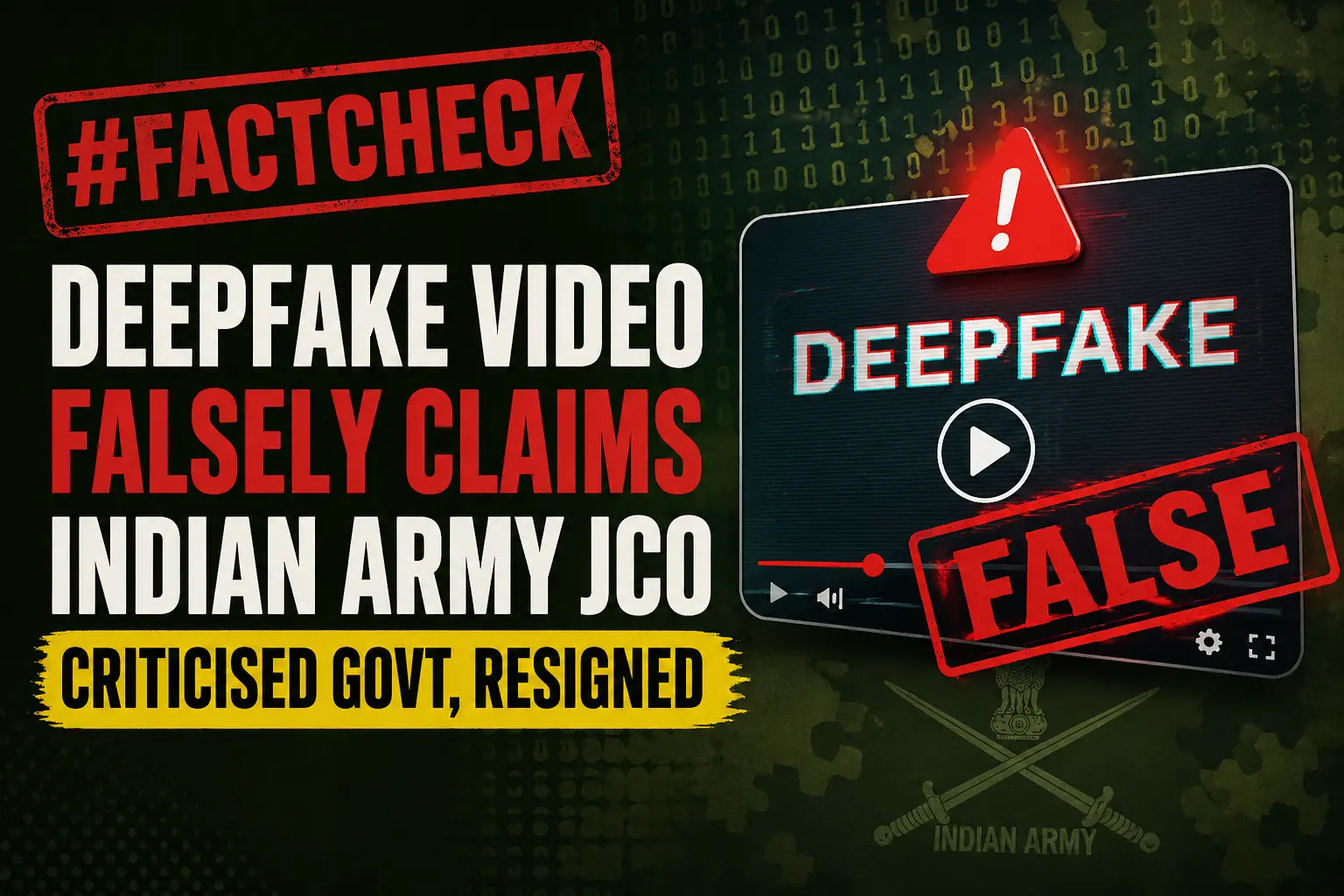
A video circulating on social media allegedly shows an Indian Army Air Defence JCO, identified as “Anurag Thakur,” criticising the Central government and announcing his resignation. In the clip, the individual is purportedly heard expressing disappointment with the government’s support for soldiers and claiming heavy casualties within his unit. However, an investigation by the CyberPeace Research Wing has found the claim to be false and the video manipulated.
Claim:
The viral post alleges that an Indian Army Air Defence JCO criticised the Centre and resigned, citing lack of support for soldiers and unacknowledged casualties.

Fact Check:
A keyword search using terms such as “Indian Army Air Defence JCO,” “Anurag Thakur,” and “resignation” did not yield any credible news reports supporting the claim. A reverse image search of the viral clip led to an original video posted by ANI on April 22, 2026. The ANI watermark is also visible in the viral footage, confirming that the clip has been sourced from this original video.
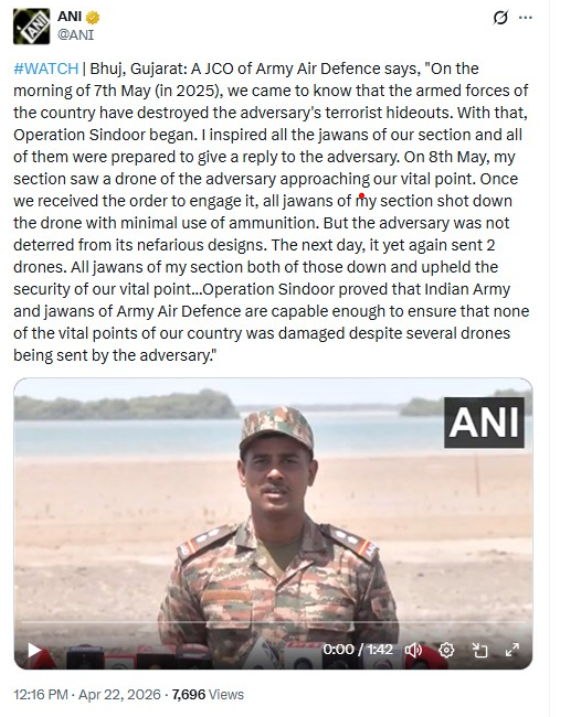
In the authentic version, the same personnel appears in the same setting, but he is speaking in Hindi about operations against adversary drones during “Operation Sindoor” in May 2025. He explains how his unit detected and neutralised multiple drones, successfully safeguarding a critical installation. Importantly, the original video does not identify the individual as Anurag Thakur, nor does it contain any reference to resignation, casualties, or criticism of the government.
Further technical analysis using the AI detection tool Hive Moderation indicated that the audio in the viral clip has an 86 percent likelihood of being artificially generated.
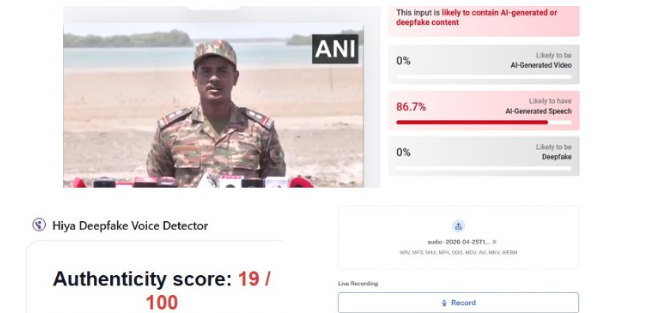
Conclusion:
The viral video has been altered with fabricated audio to falsely claim that an Indian Army officer criticised the government and resigned. The claim is baseless and the clip is a clear case of a deepfake created to mislead viewers.
