
#FactCheck- Old March Strike Video from Tehran Falsely Linked to Recent Iran–Israel Attacks
Executive Summary
Following recent escalations between Iran and Israel, where both countries reportedly exchanged missile strikes over the weekend, a video is now circulating on social media claiming to show the latest attacks between the two nations. However, CyberPeace Research Wing research found that the viral video is not related to the recent developments. The footage is actually from a March incident involving reported US-Israeli strikes in Tehran’s Jannat Abad area.
Claim
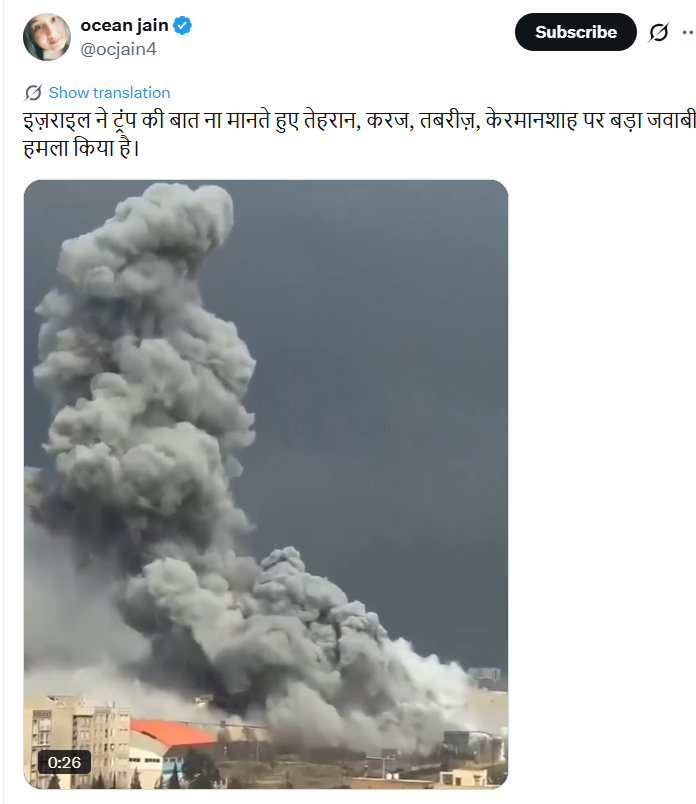
An X (formerly Twitter) user shared the viral video with the caption:“Israel, ignoring Trump’s advice, has carried out a major retaliatory strike on Tehran, Karaj, Tabriz, and Kermanshah.”
https://x.com/ocjain4/status/2063844698138239357?s=20
The video is being widely shared with claims that it shows recent Iran–Israel missile exchanges following Sunday’s reported attacks.
Fact Check
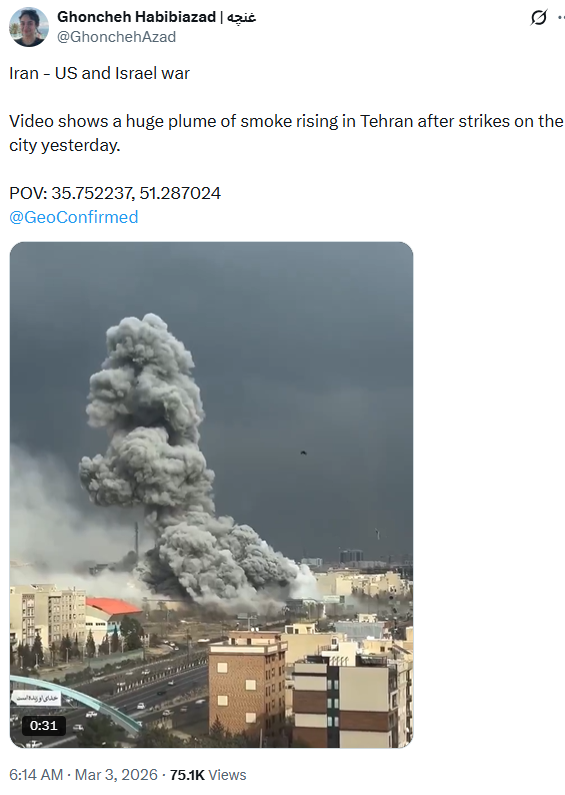
To verify the claim, we extracted keyframes from the viral video and conducted a reverse image search. The research led us to a post from BBC Persian journalist Ghoncheh Habibiazad’s X account dated 3 March. The video was shared with a caption describing it as showing a strike in Tehran attributed to US-Israeli action.
https://x.com/GhonchehAzad/status/2028632595156598874?s=20
Further verification found the same footage published by Sky News and uploaded on Al Arabiya’s YouTube channel on 3 March 2026. The accompanying descriptions referred to smoke rising from Tehran’s District 5 and near the Hemmat Expressway following the strike.
https://news.sky.com/video/smoke-seen-rising-after-strike-in-tehran-13514731
https://www.youtube.com/shorts/AceFmYiBkuA
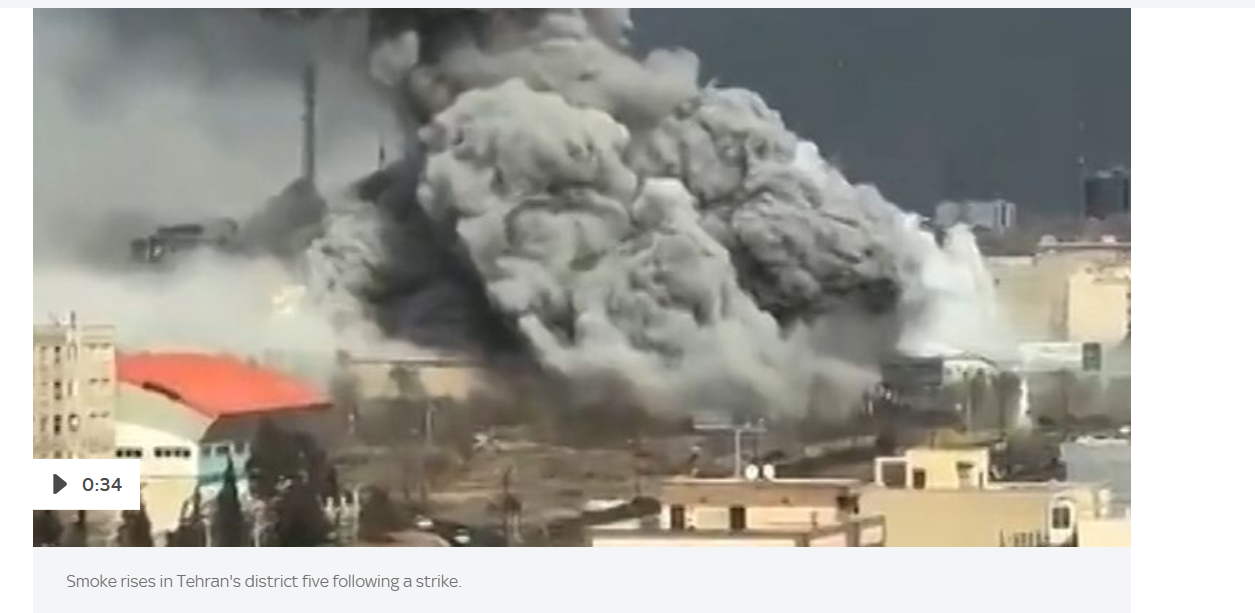
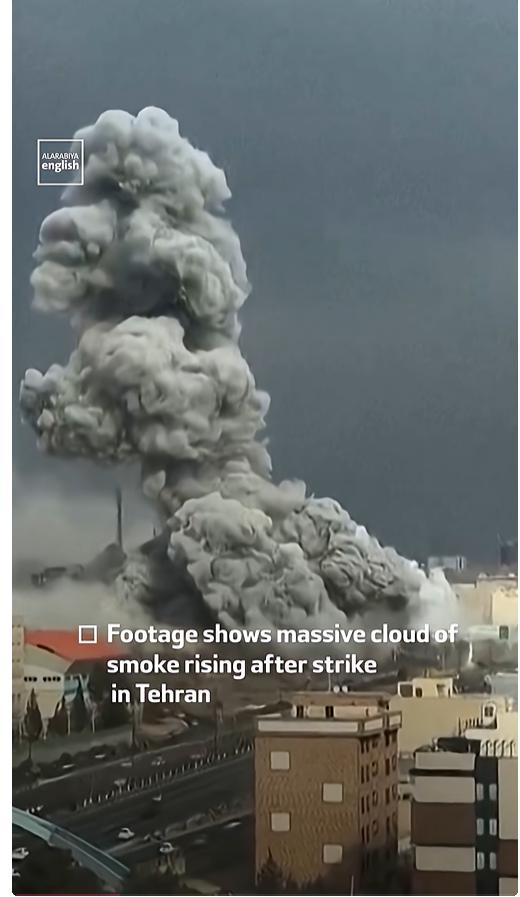
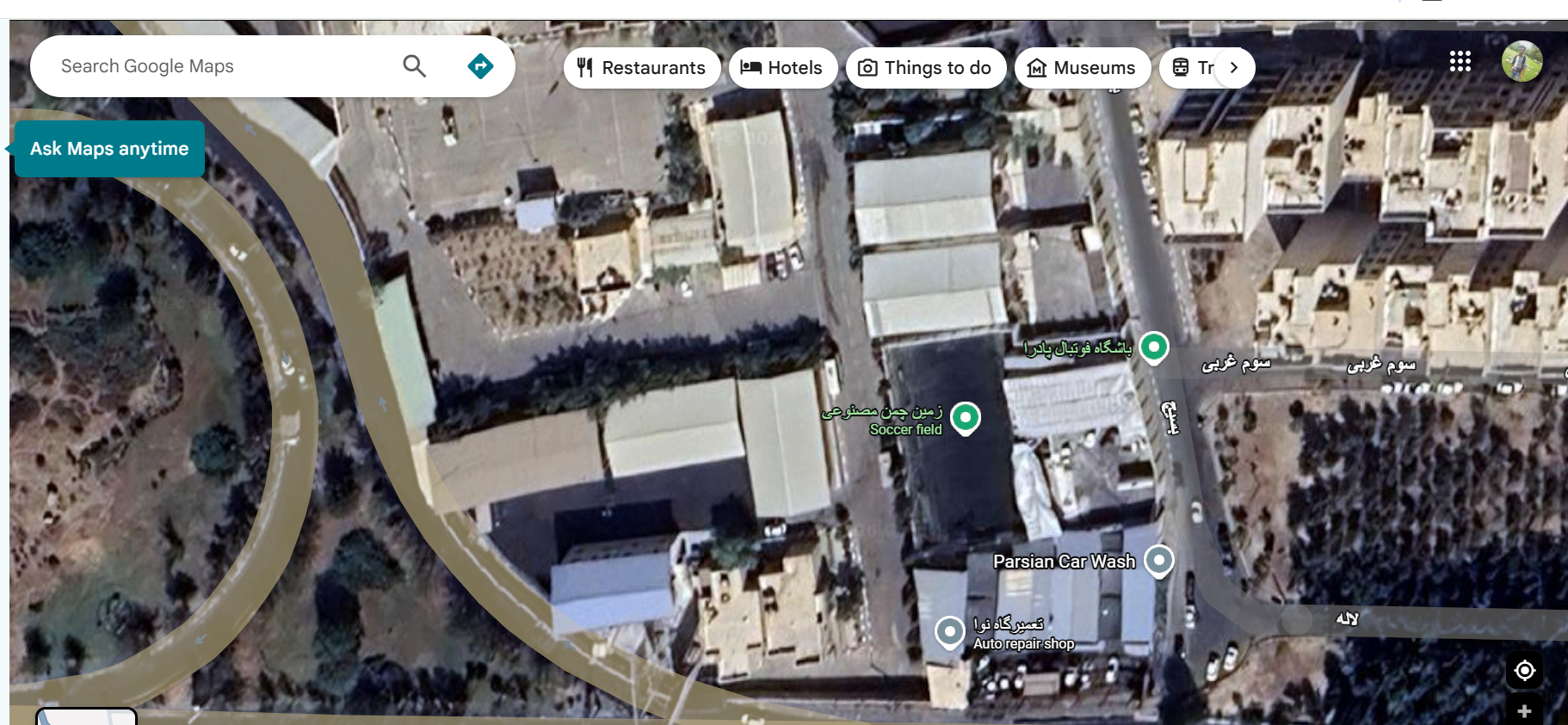
Additionally, a comparison using Google Satellite View confirmed that the location seen in the viral video matches the same area shown in the earlier March footage shared by BBC-affiliated reporting.
Conclusion
Our research confirms that the viral video has no connection to the recent Iran–Israel missile exchanges. The footage is from a March incident showing reported strikes in Tehran’s Jannat Abad area, and is being misleadingly shared as a recent escalation between the two countries.

Related Blogs
Executive Summary
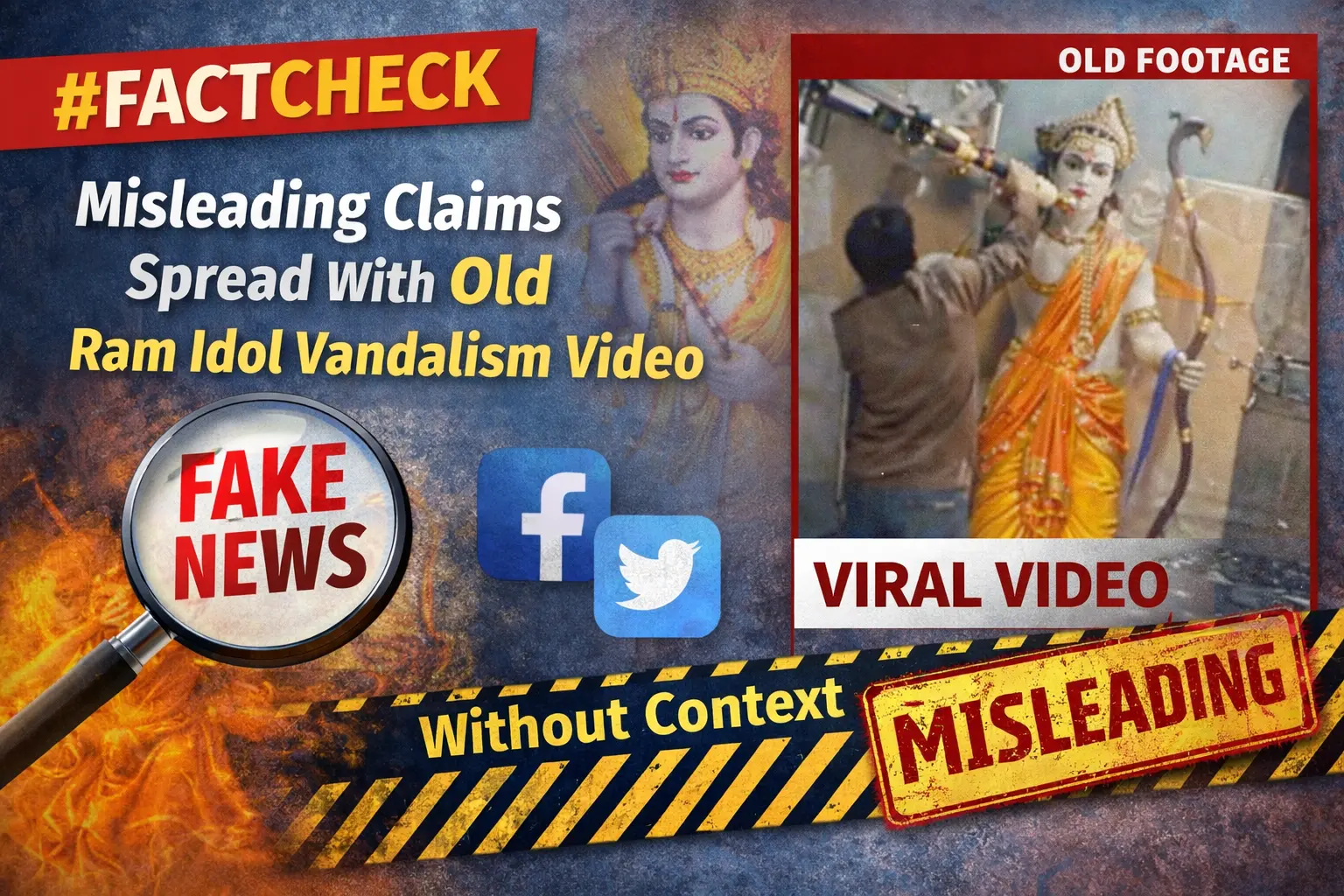
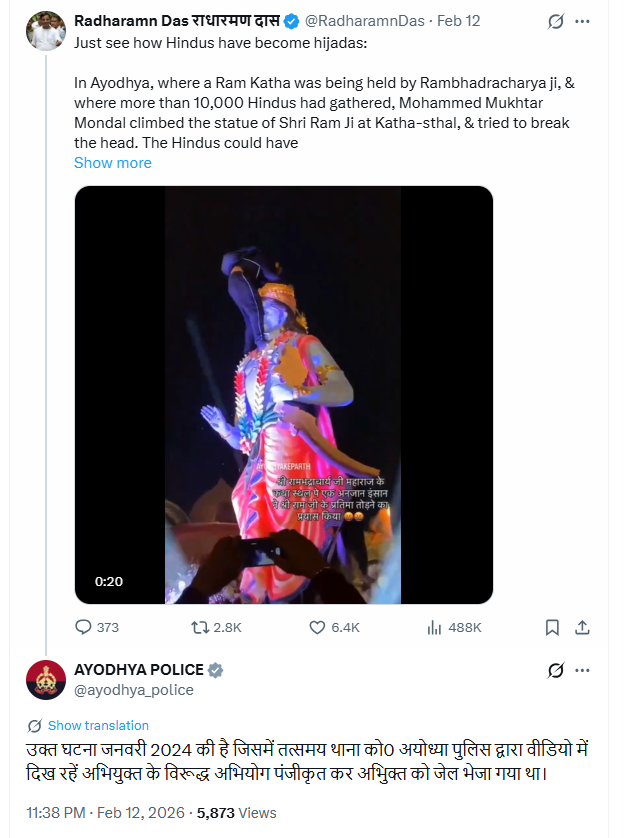
A video circulating on social media has sparked controversy, showing a man allegedly vandalising an idol of Lord Ram. Users sharing the clip claim that the incident recently took place in Ayodhya, Uttar Pradesh. The posts further allege that a Muslim individual climbed the idol and attempted to damage it. However, research by the CyberPeace found the viral claim to be misleading. The research revealed that the video is not recent but nearly three years old. At the time of the incident, the police had already arrested the accused. Social media users are now resharing the old video with false claims that it is a recent event.
Claim:
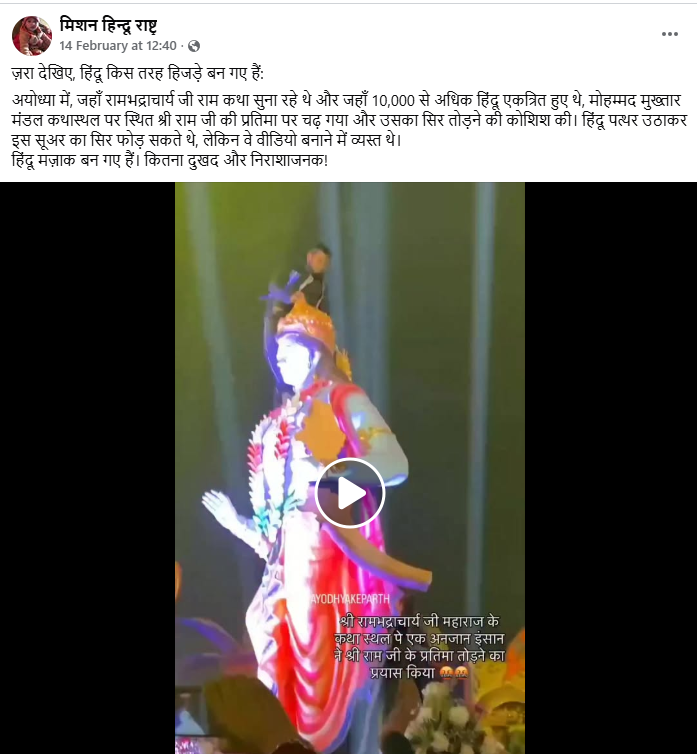
On February 14, 2026, a Facebook user shared the viral video claiming that the incident occurred in Ayodhya, where a large religious gathering was underway. The post alleged that a man identified as Mohammad Mukhtar Mandal climbed the idol of Lord Ram and attempted to break it. The post was widely circulated with inflammatory remarks. (Link and archived version of the post were provided along with a screenshot.)
Fact Check
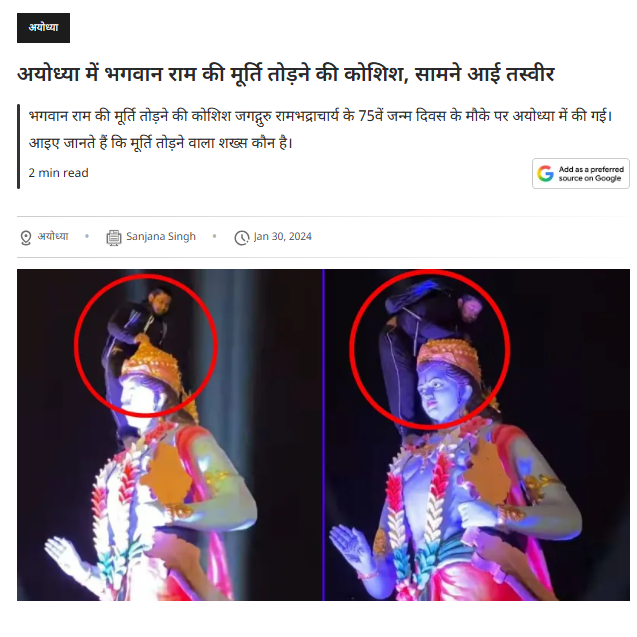
To verify the authenticity of the claim, we extracted key frames from the viral video and conducted a reverse image search using Google Lens. During the search, we found a report published on January 30, 2024, on the Hindi website of Patrika, which carried visuals matching the viral footage. According to the report, a video had surfaced showing a man climbing an idol of Lord Ram in Ayodhya and attempting to damage it. The video had gone viral at the time, following which police registered a case against the accused, Mukhtar Ali Mandal, and arrested him.
Further research led us to another Facebook post featuring the same video. In the comment section of that post, Uttar Pradesh Police clarified that the incident dated back to January 2024. The Ayodhya police had registered a case against the accused shown in the video and sent him to jail.
Conclusion:
The research confirms that the viral video is not recent but an old incident from January 2024. The accused was arrested at the time. The video is being reshared with misleading claims falsely presenting it as a recent event.

Executive Summary
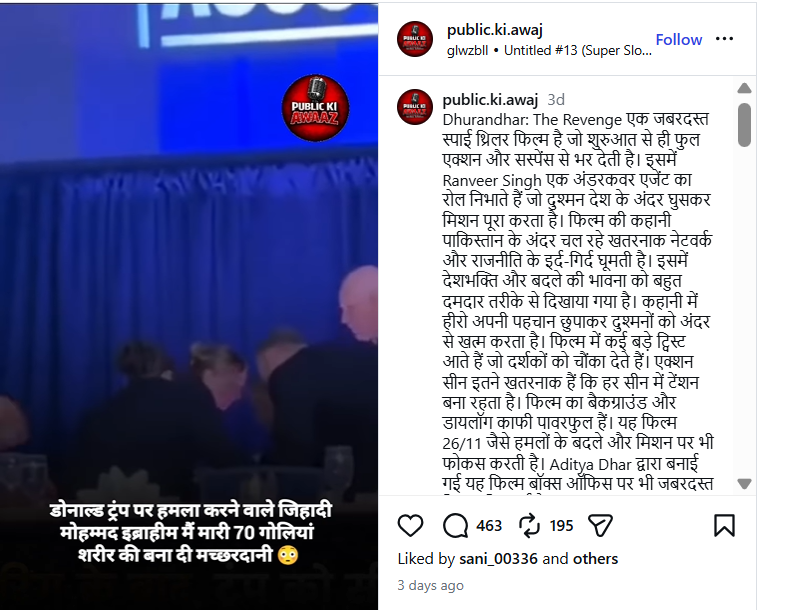
A social media post about the shooting incident during a dinner event for journalists covering the White House is going viral with the claim that the attacker was a Muslim man who was shot dead by security personnel. The accompanying video shows panic inside a hall and alert security officials responding to the situation. wHowever, research by the CyberPeace Research Wing found that the claim is false and misleading. The video is being shared with incorrect information about the identity and fate of the suspect.
Claim:
An Instagram user shared the video on April 26, 2026, claiming that the attacker who targeted Donald Trump was a “jihadi” named Mohammad Ibrahim and that he was killed after being shot multiple times.
Fact Check:
To verify the claim, relevant keyword searches were conducted online.
A report published by BBC on April 28, 2026, stated that the suspect accused of attempting to assassinate President Donald Trump during the Washington dinner event was identified as Cole Thomas Allen. The report said Allen lived with his parents in Los Angeles and was produced in court on April 28.
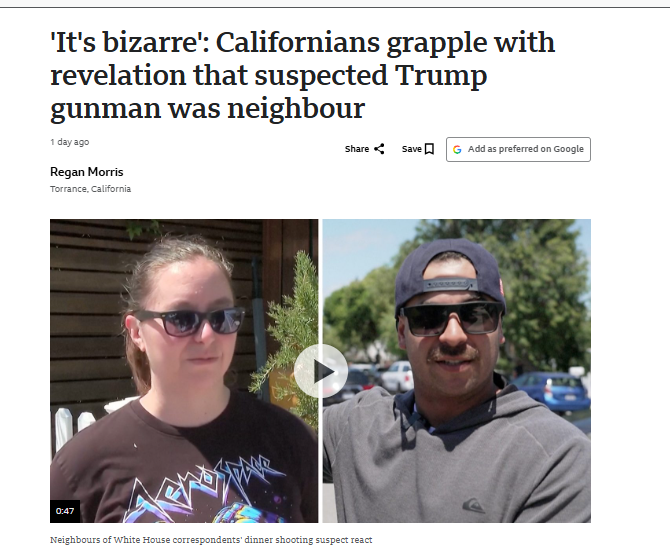
According to court documents cited in the report, Allen rushed past a security checkpoint carrying a semi-automatic handgun, a pump-action shotgun, and three knives. Authorities said one Secret Service agent was injured during the incident before Allen was subdued and taken into custody. A separate report published by NBC News on April 26, 2026, also identified the accused as Cole Thomas Allen and included visuals from the incident, showing the suspect after his arrest.

Conclusion:
The claim that the White House dinner party attacker was a Muslim man named Mohammad Ibrahim is false. The accused has been identified as Cole Thomas Allen, and he was arrested after the incident. Claims that he was killed are also incorrect.

Executive Summary:
A video has gone viral that claims to show Hon'ble Minister of Home Affairs, Shri Amit Shah stating that the BJP-Led Central Government intends to end quotas for scheduled castes (SCs), scheduled tribes (STs), and other backward classes (OBCs). On further investigation, it turns out this claim is false as we found the original clip from an official source, while he delivered the speech at Telangana, Shah talked about falsehoods about religion-based reservations, with specific reference to Muslim reservations. It is a digitally altered video and thus the claim is false.

Claims:
The video which allegedly claims that the Hon'ble Minister of Home Affairs, Shri Amit Shah will be terminating the reservation quota systems of scheduled castes (SCs), scheduled tribes (STs) and other backward classes (OBCs) if BJP government was formed again has been viral on social media platforms.

English Translation: If the BJP government is formed again we will cancel ST, SC reservations: Hon'ble Minister of Home Affairs, Shri Amit Shah


Fact Check:
When the video was received we closely observed the name of the news media channel, and it was V6 News. We divided the video into keyframes and reverse searched the images. For one of the keyframes of the video, we found a similar video with the caption “Union Minister Amit Shah Comments Muslim Reservations | V6 Weekend Teenmaar” uploaded by the V6 News Telugu’s verified Youtube channel on April 23, 2023. Taking a cue from this, we also did some keyword searches to find any relevant sources. In the video at the timestamp of 2:38, Hon'ble Minister of Home Affairs, Shri Amit Shah talks about religion-based reservations calling ‘unconstitutional Muslim Reservation’ and that the Government will remove it.

Further, he talks about the SC, ST, and OBC reservations having full rights for quota but not the Muslim reservation.
While doing the reverse image, we found many other videos uploaded by other media outlets like ANI, Hindustan Times, The Economic Times, etc about ending Muslim reservations from Telangana state, but we found no such evidence that supports the viral claim of removing SC, ST, OBC quota system. After further analysis for any sign of alteration, we found that the viral video was edited while the original information is different. Hence, it’s misleading and false.
Conclusion:
The video featuring the Hon'ble Minister of Home Affairs, Shri Amit Shah announcing that they will remove the reservation quota system of SC, ST and OBC if the new BJP government is formed again in the ongoing Lok sabha election, is debunked. After careful analysis, it was found that the video was fake and was created to misrepresent the actual statement of Hon'ble Minister of Home Affairs, Shri Amit Shah. The original footage surfaced on the V6 News Telugu YouTube channel, in which Hon'ble Minister of Home Affairs, Shri Amit Shah was explaining about religion-based reservations, particularly Muslim reservations in Telangana. Unfortunately, the fake video was false and Hon'ble Minister of Home Affairs, Shri Amit Shah did not mention the end of SC, ST, and OBC reservations.
- Claim: The viral video covers the assertion of Hon'ble Minister of Home Affairs, Shri Amit Shah that the BJP government will soon remove reservation quotas for scheduled castes (SCs), scheduled tribes (STs), and other backward classes (OBCs).
- Claimed on: X (formerly known as Twitter)
- Fact Check: Fake & Misleading
