
AIIMS Breach - Threat to Some, Lesson to All
Introduction
Data Breaches have taken over cyberspace as one of the rising issues, these data breaches result in personal data making its way toward cybercriminals who use this data for no good. As netizens, it's our digital responsibility to be cognizant of our data and the data of one's organization. The increase in internet and technology penetration has made people move to cyberspace at a rapid pace, however, awareness regarding the same needs to be inculcated to maximise the data safety of netizens. The recent AIIMS cyber breach has got many organisations worried about their cyber safety and security. According to the HIPPA Journal, 66% of healthcare organizations reported ransomware attacks on them. Data management and security is the prime aspect of clients all across the industry and is now growing into a concern for many. The data is primarily classified into three broad terms-
- Personal Identified Information (PII) - Any representation of information that permits the identity of an individual to whom the information applies to be reasonably inferred by either direct or indirect means.
- Non-Public Information (NPI) - The personal information of an individual that is not and should not be available to the public. This includes Social Security Numbers, bank information, other personal identifiable financial information, and certain transactions with financial institutions.
- Material Non-Public Information (MNPI) - Data relating to a company that has not been made public but could have an impact on its share price. It is against the law for holders of nonpublic material information to use the information to their advantage in trading stocks.
This classification of data allows the industry to manage and secure data effectively and efficiently and at the same time, this allows the user to understand the uses of their data and its intensity in case of breach of data. Organisations process data that is a combination of the above-mentioned classifications and hence in instances of data breach this becomes a critical aspect. Coming back to the AIIMS data breach, it is a known fact that AIIMS is also an educational and research institution. So, one might assume that the reason for any attack on AIIMS could be either to exfiltrate patient data or could be to obtain hands-on the R & D data including research-related intellectual properties. If we postulate the latter, we could also imagine that other educational institutes of higher learning such as IITs, IISc, ISI, IISERs, IIITs, NITs, and some of the significant state universities could also be targeted. In 2021, the Ministry of Home Affairs through the Ministry of Education sent a directive to IITs and many other institutes to take certain steps related to cyber security measures and to create SoPs to establish efficient data management practices. The following sectors are critical in terms of data protection-
- Health sector
- Financial sector
- Education sector
- Automobile sector
These sectors are generally targeted by bad actors and often data breach from these sectors result in cyber crimes as the data is soon made available on Darkweb. These institutions need to practice compliance like any other corporate house as the end user here is the netizen and his/her data is of utmost importance in terms of protection.Organisations in today's time need to be in coherence to the advancement in cyberspace to find out keen shortcomings and vulnerabilities they may face and subsequently create safeguards for the same. The AIIMS breach is an example to learn from so that we can protect other organisations from such cyber attacks. To showcase strong and impenetrable cyber security every organisation should be able to answer these questions-
- Do you have a centralized cyber asset inventory?
- Do you have human resources that are trained to model possible cyber threats and cyber risk assessment?
- Have you ever undertaken a business continuity and resilience study of your institutional digitalized business processes?
- Do you have a formal vulnerability management system that enumerates vulnerabilities in your cyber assets and a patch management system that patches freshly discovered vulnerabilities?
- Do you have a formal configuration assessment and management system that checks the configuration of all your cyber assets and security tools (firewalls, antivirus management, proxy services) regularly to ensure they are most securely configured?
- Do have a segmented network such that your most critical assets (servers, databases, HPC resources, etc.) are in a separate network that is access-controlled and only people with proper permission can access?
- Do you have a cyber security policy that spells out the policies regarding the usage of cyber assets, protection of cyber assets, monitoring of cyber assets, authentication and access control policies, and asset lifecycle management strategies?
- Do you have a business continuity and cyber crisis management plan in place which is regularly exercised like fire drills so that in cases of exigencies such plans can easily be followed, and all stakeholders are properly trained to do their part during such emergencies?
- Do you have multi-factor authentication for all users implemented?
- Do you have a supply chain security policy for applications that are supplied by vendors? Do you have a vendor access policy that disallows providing network access to vendors for configuration, updates, etc?
- Do you have regular penetration testing of the cyberinfrastructure of the organization with proper red-teaming?
- Do you have a bug-bounty program for students who could report vulnerabilities they discover in your cyber infrastructure and get rewarded?
- Do you have an endpoint security monitoring tool mandatory for all critical endpoints such as database servers, application servers, and other important cyber assets?
- Do have a continuous network monitoring and alert generation tool installed?
- Do you have a comprehensive cyber security strategy that is reflected in your cyber security policy document?
- Do you regularly receive cyber security incidents (including small, medium, or high severity incidents, network scanning, etc) updates from your cyber security team in order to ensure that top management is aware of the situation on the ground?
- Do you have regular cyber security skills training for your cyber security team and your IT/OT engineers and employees?
- Do your top management show adequate support, and hold the cyber security team accountable on a regular basis?
- Do you have a proper and vetted backup and restoration policy and practice?
If any organisation has definite answers to these questions, it is safe to say that they have strong cyber security, these questions should not be taken as a comparison but as a checklist by various organisations to be up to date in regard to the technical measures and policies related to cyber security. Having a strong cyber security posture does not drive the cyber security risk to zero but it helps to reduce the risk and improves the fighting chance. Further, if a proper risk assessment is regularly carried out and high-risk cyber assets are properly protected, then the damages resulting from cyber attacks can be contained to a large extent.

Related Blogs

Introduction
In the labyrinthine world of cybersecurity, a new spectre has emerged from the digital ether, casting a long shadow over the seemingly impregnable orchards of Apple's macOS. This phantom, known as SpectralBlur, is a backdoor so cunningly crafted that it remained shrouded in the obscurity of cyberspace, undetected by the vigilant eyes of antivirus software until its recent unmasking. The discovery of SpectralBlur is not just a tale of technological intrigue but a narrative that weaves together the threads of geopolitical manoeuvring, the relentless pursuit of digital supremacy, and the ever-evolving landscape of cyber warfare.
SpectralBlur, a term that conjures images of ghostly interference and elusive threats, is indeed a fitting moniker for this new macOS backdoor threat. Cybersecurity researchers have peeled back the layers of the digital onion to reveal a moderately capable backdoor that can upload and download files, execute shell commands, update its configuration, delete files, and enter states of hibernation or sleep, all at the behest of a remote command-and-control server. Greg Lesnewich, a security researcher whose name has become synonymous with the relentless pursuit of digital malefactors, has shed light on this new threat that overlaps with a known malware family attributed to the enigmatic North Korean threat actors.
SpectralBlur similar to Lazarus Group’s KANDYKORN
The malware shares its DNA with KANDYKORN, also known as SockRacket, an advanced implant that functions as a remote access trojan capable of taking control of a compromised host. It is a digital puppeteer, pulling the strings of infected systems with a malevolent grace. The KANDYKORN activity also intersects with another campaign orchestrated by the Lazarus sub-group known as BlueNoroff, or TA444, which culminates in the deployment of a backdoor referred to as RustBucket and a late-stage payload dubbed ObjCShellz.
Recently, the threat actor has been observed combining disparate pieces of these two infection chains, leveraging RustBucket droppers to deliver KANDYKORN. This latest finding is another sign that North Korean threat actors are increasingly setting their sights on macOS to infiltrate high-value targets, particularly those within the cryptocurrency and blockchain industries. 'TA444 keeps running fast and furious with these new macOS malware families,' Lesnewich remarked, painting a picture of a relentless adversary in the digital realm.
Patrick Wardle, a security researcher whose insights into the inner workings of SpectralBlur have further illuminated the threat landscape, noted that the Mach-O binary was uploaded to the VirusTotal malware scanning service in August 2023 from Colombia. The functional similarities between KANDYKORN and SpectralBlur have raised the possibility that they may have been built by different developers with the same requirements. What makes the malware stand out are its attempts to hinder analysis and evade detection while using grant to set up a pseudo-terminal and execute shell commands received from the C2 server.
The disclosure comes as 21 new malware families designed to target macOS systems, including ransomware, information stealers, remote access trojans, and nation-state-backed malware, were discovered in 2023, up from 13 identified in 2022. 'With the continued growth and popularity of macOS (especially in the enterprise!), 2024 will surely bring a bevvy of new macOS malware,' Wardle noted, his words a harbinger of the digital storms on the horizon.
Hackers are beefing up their efforts to go after the best MacBooks as security researchers have discovered a brand new macOS backdoor which appears to have ties to another recently identified Mac malware strain. As reported by Security Week, this new Mac malware has been dubbed SpectralBlur and although it was uploaded to VirusTotal back in August of last year, it remained undetected by the best antivirus software until it recently caught the attention of Proofpoint’s Greg Lesnewich.
Lesnewich explained that SpectralBlur has similar capabilities to other backdoors as it can upload and download files, delete files and hibernate or sleep when given commands from a hacker-controlled command-and-control (C2) server. What is surprising about this new Mac malware strain though is that it shares similarities to the KandyKorn macOS backdoor which was created by the infamous North Korean hacking group Lazarus.
Just like SpectralBlur, KandyKorn is designed to evade detection while providing the hackers behind it with the ability to monitor and control infected Macs. Although different, these two Mac malware strains appear to be built based on the same requirements. Once installed on a vulnerable Mac, SpectralBlur executes a function that allows it to decrypt and encrypt network traffic to help it avoid being detected. However, it can also erase files after opening them and then overwrite the data they contain with zeros..
How to keep your Apple computers safe from hackers
As with the best iPhones, keeping your Mac up to date is the easiest and most important way to keep it safe from hackers. Hackers often prey on users who haven’t updated their devices to the latest software as they can exploit unpatched vulnerabilities and security flaws.
Checking to see if you're running the latest macOS version is quite easy. Just click on the Apple Logo in the top right corner of your computer, head to System Preferences and then click on Software Update. If you need a bit more help, check out our guide on how to update a Mac for more detailed instructions with pictures.
Even though your Mac has its own built-in malware scanner from Apple called xProtect, you should consider using one of the best Mac antivirus software solutions for additional protection. Paid antivirus software is often updated more frequently and you often also get access to other extras to help keep you safe online like a password manager or a VPN.
Besides updating your Mac frequently and using antivirus software, you must be careful online. This means sticking to trusted online retailers, carefully checking the URLs of the websites you visit and avoiding opening links and attachments sent to you via email or social media from people you don’t know. Likewise, you should also learn how to spot a phishing scam to know which emails you want to delete right away.
Conclusion
The thing about hackers and other cybercriminals is that they are constantly evolving their tactics and attack methods. This helps them avoid detection and allows them to devise brand-new ways to trick ordinary people. With the surge we saw in Mac malware last year, though, Apple will likely be working on beefing up xProtect and macOS to better defend against these new threats.
References
- https://www.scmagazine.com/news/new-macos-malware-spectralblur-idd-as-north-korean-backdoor
- https://www.tomsguide.com/news/this-new-macos-backdoor-lets-hackers-take-over-your-mac-remotely-how-to-stay-safe
- https://thehackernews.com/2024/01/spectralblur-new-macos-backdoor-threat.html

Executive Summary
A picture is rapidly going viral on social media, showing Indian cricketer Virat Kohli and actor Anushka Sharma having breakfast together. Users are sharing this photo, presenting it as a "candid" (real) moment. Research by the CyberPeace Research Wing revealed that the photo of Virat Kohli and Anushka Sharma having breakfast is completely fake. This image does not depict a real moment, but has been created using Artificial Intelligence (AI).
Claim
A picture is rapidly going viral on social media, showing Indian cricketer Virat Kohli and actor Anushka Sharma having breakfast together. Users are sharing this photo, presenting it as a "candid" (real) moment.
https://www.facebook.com/groups/1132434027856845/posts/1677540760012833/

Fact Check
In our research, this image was found to be 'AI-generated'. When a reverse image search and keyword scan were conducted to verify this viral photo, no credible media reports, official photographs, or any such posts on the celebrity couple's official social media handles were found.
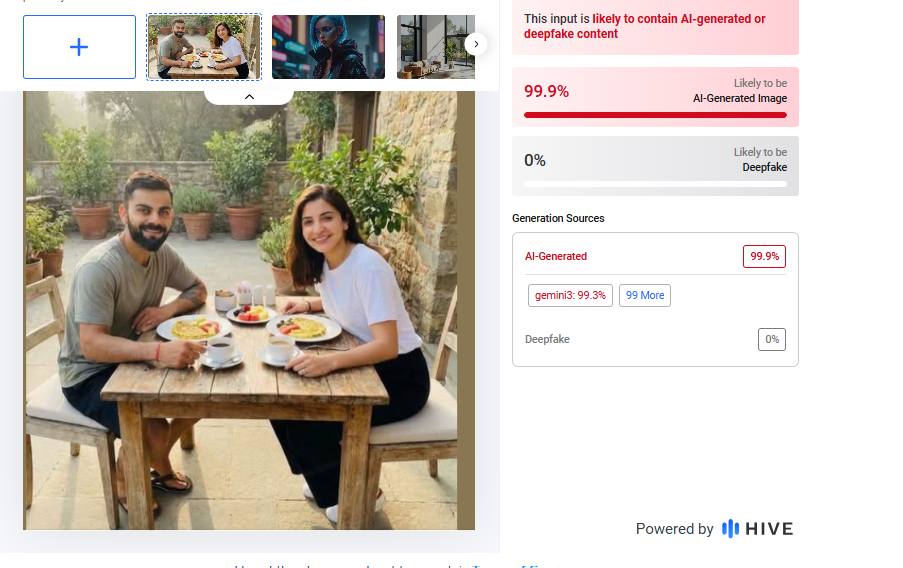
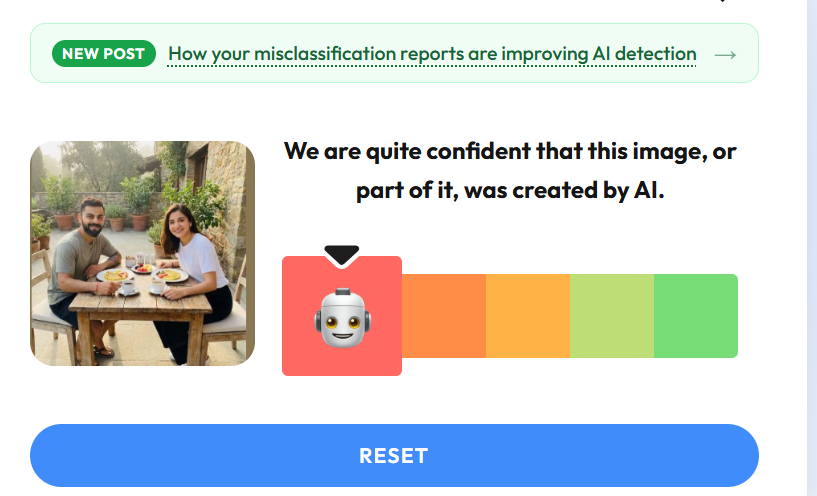
WASIT also confirmed that the image is 'AI-generated'.
Conclusion
Our research revealed that the photo of Virat Kohli and Anushka Sharma having breakfast is completely fake. This image does not depict a real moment, but has been created using Artificial Intelligence (AI).

Executive Summary:
A misleading video claiming to show fireworks at Dubai International Cricket Stadium following India’s 2025 ICC Champions Trophy win has gone viral, causing confusion among viewers. Our investigation confirms that the video is unrelated to the cricket tournament. It actually depicts the fireworks display from the December 2024 Arabian Gulf Cup opening ceremony at Kuwait’s Jaber Al-Ahmad Stadium. This incident underscores the rapid spread of outdated or misattributed content, particularly in relation to significant sports events, and highlights the need for vigilance in verifying such claims.

Claim:
The circulated video claims fireworks and a drone display at Dubai International Cricket Stadium after India's win in the ICC Champions Trophy 2025.

Fact Check:
A reverse image search of the most prominent keyframes in the viral video led it back to the opening ceremony of the 26th Arabian Gulf Cup, which was hosted by Jaber Al-Ahmad International Stadium in Kuwait on December 21, 2024. The fireworks seen in the video correspond to the imagery in this event. A second look at the architecture of the stadium also affirms that the venue is not Dubai International Cricket Stadium, as asserted. Additional confirmation from official sources and media outlets verifies that there was no such fireworks celebration in Dubai after India's ICC Champions Trophy 2025 win. The video has therefore been misattributed and shared with incorrect context.

Fig: Claimed Stadium Picture

Conclusion:
A viral video claiming to show fireworks at Dubai International Cricket Stadium after India's 2025 ICC Champions Trophy win is misleading. Our research confirms the video is from the December 2024 Arabian Gulf Cup opening ceremony at Kuwait’s Jaber Al-Ahmad Stadium. A reverse image search and architectural analysis of the stadium debunk the claim, with official sources verifying no such celebration took place in Dubai. The video has been misattributed and shared out of context.
- Claim: Fireworks in Dubai celebrate India’s Champions Trophy win.
- Claimed On: Social Media
- Fact Check: False and Misleading
