
#FactCheck -AI-Manipulated Video Falsely Claims ₹50 Crore Deal Involving Bhupen Bora
Executive Summary
A purported news clip circulating on social media claims that the Bharatiya Janata Party (BJP) purchased Bhupen Bora, a leader of the Indian National Congress, for ₹50 crore as part of a political deal in Assam. The viral clip further alleges that the transaction took place under the leadership of Assam Chief Minister Himanta Biswa Sarma and included an agreement to induct several Congress leaders into the BJP.
However, research by CyberPeace found the viral claim to be false and revealed that the original news video had been manipulated using AI and shared with misleading claims.
Claim
On February 18, 2026, a user shared the viral video on Facebook, claiming that the Assam BJP had bought a Congress leader who had lost the last three elections for ₹50 crore, and that the alleged deal led by Himanta Biswa Sarma had drawn public criticism.

Fact Check:
To verify the authenticity of the claim, we extracted key frames from the viral video and conducted a reverse image search using Google Lens. During the research, we found the original version of the video published on the website of Aaj Tak on February 16, 2026. In the original report, the anchor is only seen reporting on Bhupen Bora’s resignation from the party. The report does not mention any alleged financial transaction or political deal, contrary to the claims made in the viral clip.

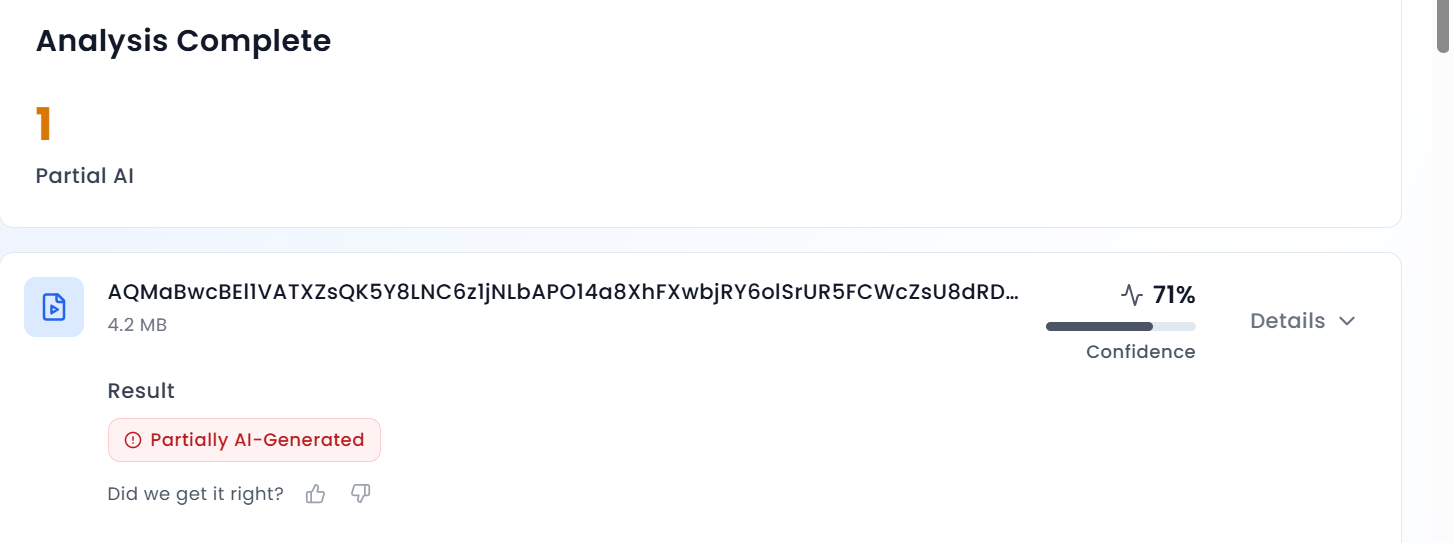
In the next stage of the research, the viral video was analysed using the AI detection tool AURGIN AI, which identified the video as AI-generated.
Conclusion
Our research found that users had manipulated the original news broadcast using AI and shared it with misleading claims. The viral clip does not show any real financial deal between Bhupen Bora and the Assam Chief Minister.

Related Blogs

Executive Summary
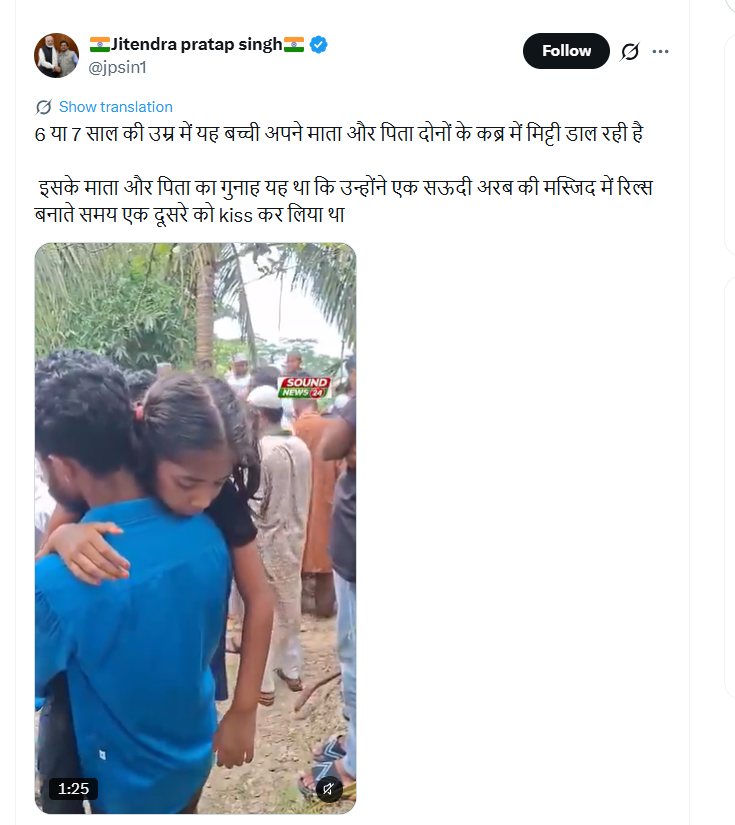
A disturbing video showing a girl placing soil on a grave is going viral on social media. In the video, a young girl can be seen crying as she places soil on a grave in the presence of several people. The video is being shared in connection with Bangladeshi nationals allegedly killed in Saudi Arabia. It is claimed that her parents were killed while making a reel inside a mosque in Saudi Arabia and that she is placing soil on their grave.
CyberPeace Research found that the video of the girl placing soil on a grave dates back to May 2026. In reality, a Bangladeshi national named Sajal died in Saudi Arabia after a tree fell on him while he was eating. The girl seen in the video is Sajal’s daughter. The video is now being shared with a false claim linking it to a man and a woman who were recently sentenced to death in Saudi Arabia.
Claim:
A user on X shared the video with the caption: “At the age of 6 or 7, this little girl is placing soil on the graves of both her mother and father. Their crime was that they kissed each other while making reels inside a mosque in Saudi Arabia.”
https://x.com/jpsin1/status/2112109435393024287
Fact Check
During our research, we found a photograph of the girl seen in the viral video in a report published on May 6, 2026, by another Bangladeshi news website, Bhorer Kagoj (bhorerkagoj.net). The report stated that Sajal Howlader, 31, son of Imadul Howlader, a resident of Ward No. 4 of Khanda village under Rayenda Union No. 3 in Sharankhola Upazila, died after being crushed by a tree in Saudi Arabia.
According to the report, Sajal’s father, Imadul, said that on May 2, at around 4:30 p.m. Saudi Arabia time, Sajal and five other people were sitting under a tree and eating rice when a large she-oak tree fell on them. The five other people sitting under the tree survived, but Sajal died after being crushed by it.
The report also stated that Sajal’s daughter had appealed to Bangladesh Prime Minister Tarique Rahman to bring her father’s body back from Saudi Arabia.
https://www.bhorerkagoj.net/country/786354

Upon further research, we found a detailed report about the incident published by the Bangladeshi news website Daily Ajker Songram (dailyajkersongram.com). The report stated that 31-year-old Mohammad Sajal died in Saudi Arabia after a tree fell on him.
His body arrived at Hazrat Shahjalal International Airport at around 11 a.m. on May 25, 2026. After the completion of the legal formalities, Sajal’s body reached his hometown of Sharankhola on May 26, 2026.
https://www.dailyajkersongram.com/2026/05/27/

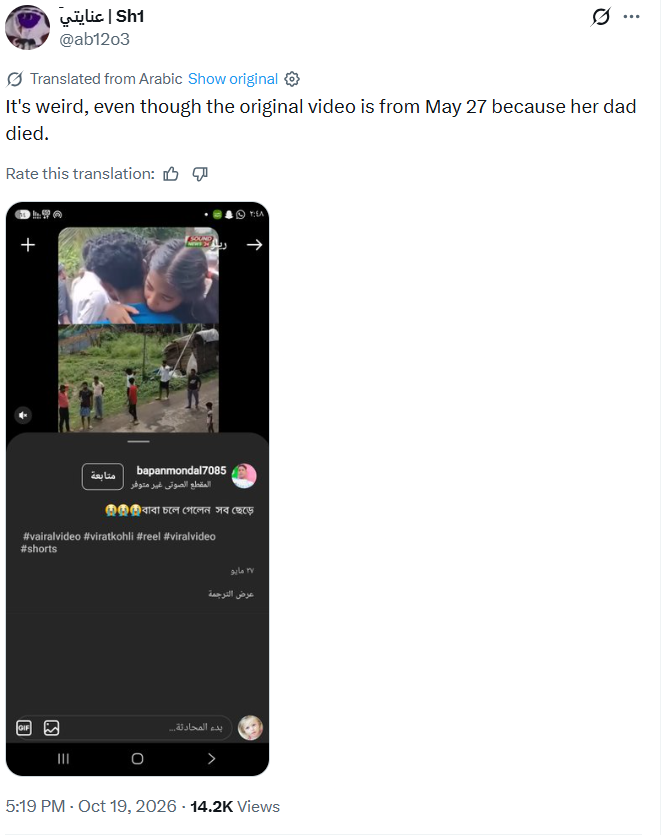
An X account also shared the video, claiming that the original video dates back to May 27, when the girl’s father had died.
https://x.com/ab12o3/status/2112149070764482702
Conclusion
Our research found that the video showing a girl placing soil on a grave dates back to May 2026. In reality, a Bangladeshi national named Sajal died in Saudi Arabia after a tree fell on him while he was eating. The girl seen in the video is Sajal’s daughter. The video is now being shared with a false claim linking it to a man and a woman who were recently sentenced to death in Saudi Arabia.

In the rich history of humanity, the advent of artificial intelligence (AI) has added a new, delicate aspect. The aspect of promising technological advancement has the potential to either enrich the nest of our society or destroy it entirely. The latest straw in this complex nest is generative AI, a frontier teeming with both potential and perils. It is a realm where the ethereal concepts of cyber peace and resilience are not just theoretical constructs but tangible necessities.
The spectre of generative AI looms large over the digital landscape, casting a long shadow on the sanctity of data privacy and the integrity of political processes. The seeds of this threat were sown in the fertile soil of the Cambridge Analytica scandal of 2018, a watershed moment that unveiled the extent to which personal data could be harvested and utilized to influence electoral outcomes. However despite the indignation, the scandal resulted in meagre alterations to modus operandi of digital platforms.
Fast forward to the present day, and the spectre has only grown more ominous. A recent report by Human Rights Watch has shed light on the continued exploitation of data-driven campaigning in Hungary's re-election of Viktor Orbán. The report paints a chilling picture of political parties leveraging voter databases for targeted social media advertising, with the ruling Fidesz party even resorting to the unethical use of public service data to bolster its voter database.
The Looming Threat of Disinformation
As we stand on the precipice of 2024, a year that will witness over 50 countries holding elections, the advancements in generative AI could exponentially amplify the ability of political campaigns to manipulate electoral outcomes. This is particularly concerning in countries where information disparities are stark, providing fertile ground for the seeds of disinformation to take root and flourish.
The media, the traditional watchdog of democracy, has already begun to sound the alarm about the potential threats posed by deepfakes and manipulative content in the upcoming elections. The limited use of generative AI in disinformation campaigns has raised concerns about the enforcement of policies against generating targeted political materials, such as those designed to sway specific demographic groups towards a particular candidate.
Yet, while the threat of bad actors using AI to generate and disseminate disinformation is real and present, there is another dimension that has largely remained unexplored: the intimate interactions with chatbots. These digital interlocutors, when armed with advanced generative AI, have the potential to manipulate individuals without any intermediaries. The more data they have about a person, the better they can tailor their manipulations.
Root of the Cause
To fully grasp the potential risks, we must journey back 30 years to the birth of online banner ads. The success of the first-ever banner ad for AT&T, which boasted an astounding 44% click rate, birthed a new era of digital advertising. This was followed by the advent of mobile advertising in the early 2000s. Since then, companies have been engaged in a perpetual quest to harness technology for manipulation, blurring the lines between commercial and political advertising in cyberspace.
Regrettably, the safeguards currently in place are woefully inadequate to prevent the rise of manipulative chatbots. Consider the case of Snapchat's My AI generative chatbot, which ostensibly assists users with trivia questions and gift suggestions. Unbeknownst to most users, their interactions with the chatbot are algorithmically harvested for targeted advertising. While this may not seem harmful in its current form, the profit motive could drive it towards more manipulative purposes.
If companies deploying chatbots like My AI face pressure to increase profitability, they may be tempted to subtly steer conversations to extract more user information, providing more fuel for advertising and higher earnings. This kind of nudging is not clearly illegal in the U.S. or the EU, even after the AI Act comes into effect. The market size of AI in India is projected to touch US$4.11bn in 2023.
Taking this further, chatbots may be inclined to guide users towards purchasing specific products or even influencing significant life decisions, such as religious conversions or voting choices. The legal boundaries here remain unclear, especially when manipulation is not detectable by the user.
The Crucial Dos/Dont's
It is crucial to set rules and safeguards in order to manage the possible threats related to manipulative chatbots in the context of the general election in 2024.
First and foremost, candor and transparency are essential. Chatbots, particularly when employed for political or electoral matters, ought to make it clear to users what they are for and why they are automated. By being transparent, people are guaranteed to be aware that they are interacting with automated processes.
Second, getting user consent is crucial. Before collecting user data for any reason, including advertising or political profiling, users should be asked for their informed consent. Giving consumers easy ways to opt-in and opt-out gives them control over their data.
Furthermore, moral use is essential. It's crucial to create an ethics code for chatbot interactions that forbids manipulation, disseminating false information, and trying to sway users' political opinions. This guarantees that chatbots follow moral guidelines.
In order to preserve transparency and accountability, independent audits need to be carried out. Users might feel more confident knowing that chatbot behavior and data collecting procedures are regularly audited by impartial third parties to ensure compliance with legal and ethical norms.
Important "don'ts" to take into account. Coercion and manipulation ought to be outlawed completely. Chatbots should refrain from using misleading or manipulative approaches to sway users' political opinions or religious convictions.
Another hazard to watch out for is unlawful data collecting. Businesses must obtain consumers' express agreement before collecting personal information, and they must not sell or share this information for political reasons.
At all costs, one should steer clear of fake identities. Impersonating people or political figures is not something chatbots should do because it can result in manipulation and false information.
It is essential to be impartial. Bots shouldn't advocate for or take part in political activities that give preference to one political party over another. In encounters, impartiality and equity are crucial.
Finally, one should refrain from using invasive advertising techniques. Chatbots should ensure that advertising tactics comply with legal norms by refraining from displaying political advertisements or messaging without explicit user agreement.
Present Scenario
As we approach the critical 2024 elections and generative AI tools proliferate faster than regulatory measures can keep pace, companies must take an active role in building user trust, transparency, and accountability. This includes comprehensive disclosure about a chatbot's programmed business goals in conversations, ensuring users are fully aware of the chatbot's intended purposes.
To address the regulatory gap, stronger laws are needed. Both the EU AI Act and analogous laws across jurisdictions should be expanded to address the potential for manipulation in various forms. This effort should be driven by public demand, as the interests of lawmakers have been influenced by intensive Big Tech lobbying campaigns.
At present, India doesn’t have any specific laws pertaining to AI regulation. Ministry of Electronics and Information Technology (MEITY), is the executive body responsible for AI strategies and is constantly working towards a policy framework for AI. The Niti Ayog has presented seven principles for responsible AI which includes equality , inclusivity, safety, privacy, transparency, accountability, dependability and protection of positive human values.
Conclusion
We are at a pivotal juncture in history. As generative AI gains more power, we must proactively establish effective strategies to protect our privacy, rights and democracy. The public's waning confidence in Big Tech and the lessons learned from the techlash underscore the need for stronger regulations that hold tech companies accountable. Let's ensure that the power of generative AI is harnessed for the betterment of society and not exploited for manipulation.
Reference
McCallum, B. S. (2022, December 23). Meta settles Cambridge Analytica scandal case for $725m. BBC News. https://www.bbc.com/news/technology-64075067
Hungary: Data misused for political campaigns. (2022, December 1). Human Rights Watch. https://www.hrw.org/news/2022/12/01/hungary-data-misused-political-campaigns
Statista. (n.d.). Artificial Intelligence - India | Statista Market forecast. https://www.statista.com/outlook/tmo/artificial-intelligence/india
Introduction
The Department of Telecommunications (DoT) changed course just 48 hours after the directive dated December 1, 2025, sparked controversy. On December 3, 2025, the department publicly reversed its directive to smartphone manufacturers to pre-install the Sanchar Saathi app starting in March of the following year. The withdrawal marked the ending of a tumultuous, quick-paced event that highlighted how dynamic digital policy can be in a democracy.
The DoT explained its move in calculated terms. The government said that the first mandate was no longer necessary due to an abrupt increase in voluntary app downloads brought on by the public furore. The agency stated , “The mandate to install the app was meant to accelerate the process because the number of users has been growing rapidly.”
The app in question is not new. When it was first introduced in 2023, it was intended to be a public safety where people could report suspicious calls, identify numbers registered in their name, block stolen devices using their IMEI, confirm the authenticity of their handset, and report fraudulent international calls that were disguised as Indian numbers. The platform has quietly expanded over the past two years with features like utilities to check mobile connections, as well as Chakshu for reporting fraud. When used freely, it has helped numerous people in navigating the increasingly complex web of online scams.
Balancing Protection and Personal Freedom
In India, there isn’t much precedent for requiring all phones to have a certain government backed app installed. While operators supported TRAI’s DND app in 2018 and emergency numbers were integrated during the pandemic, they did not go into the territory of compulsory pre-installation.
Legal experts have time and again pointed out that although the government can control telecommunications for security reasons, any mandatory action pertaining to personal devices may be subject to constitutional review under the right to privacy, as stated in the Puttaswamy ruling. Not because the app is flawed in and of itself, but rather because every transition from voluntary adoption to mandatory compliance necessitates a higher standard of necessity, proportionality, and protections.
The Pulse of the Policy
The DoT’s stated rationale was clear: fake, duplicated or spoofed IMEIs represent a major cyber-security threat. India currently faces some of the world’s highest levels of SIM misuse, digital impersonation, online extortion, and device cloning crimes. Even a small fraction of compromised devices can do great harm in a nation with over a billion active mobile users.
The DoT’s AI and Digital Intelligence Unit, a small seven-person team in charge of SIM security, fighting illicit telecom setups, and collaborating with financial regulators on quickly changing fraud patterns, issued the Sanchar Saathi directive as part of a larger set of security-focused measures. One order required platforms such as WhatsApp to make sure that web sessions were terminated after six hours and that accounts only functioned when the registered SIM card was present in the device.
When taken as a whole, these orders indicate a clear strategic goal, the government is working to close systemic gaps that organised crime, particularly identity theft and device-level fraud, exploits. However, they also highlight the complex relationship between public opinion and security requirements. The government’s quick reversal in the Sanchar Saathi case demonstrated a crucial realization: digital safety mechanisms can only be effective when people feel educated, valued, and in charge.
CyberPeace Perspective & The Middle Path
CyberPeace stated that whenever a digital tool comes into contact with identity, data, or mobile access, public concern is inevitable. However, it is also emphasised that Sanchar Saathi is not a surveillance tool, instead can empower citizens.
Even with the rolled back mandate, it is reaffirmed that cornerstones of digital trust are accountability, openness, audits, and unambiguous permissions. India can maintain both safety and rights through responsible implementation, ethical design, and open communication.
References
- https://www.thehindu.com/sci-tech/technology/what-is-the-sanchar-saathi-app-why-is-the-government-mandating-its-pre-installation/article70350322.ece
- https://theprint.in/opinion/sharp-edge/sanchar-saathi-app-modi-govt/2797917/
- https://www.pib.gov.in/PressReleasePage.aspx?PRID=2198110®=3&lang=2
- https://sancharsaathi.gov.in/SancharSaathiDocuments/ImportantDocuments/DoT%20issues%20directions%20for%20pre-installation%20of%20Sanchar%20Saathi%20App%20in%20mobile%20handsets%20to%20verify%20the%20genuineness%20of%20mobile%20handsets.pdf
- https://cyberpeace.org/resources/blogs/sanchar-saathi-portal-a-solution-for-mobile-phone-theft-and-data-protection
- https://cyberpeace.org/resources/blogs/chakshu-and-dip-shielding-citizens-from-online-frauds
- https://cyberpeace.org/resources/blogs/financial-risk-indicator-launched-by-dot-to-strengthen-cybersecurity
