
#FactCheck - AI-Generated Flyover Collapse Video Shared With Misleading Claims
Executive Summary
A video showing a flyover collapse is going viral on social media. The clip shows a flyover and a road passing beneath it, with vehicles moving normally. Suddenly, a portion of the flyover appears to collapse and fall onto the road below, with some vehicles seemingly coming under its impact. The video has been widely shared by users online. However, research by the CyberPeace found the viral claim to be false. The probe revealed that the video is not real but has been created using artificial intelligence.
Claim:
On X (formerly Twitter), a user shared the viral video on February 13, 2026, claiming it showed the reality of India’s infrastructure development and criticizing ongoing projects. The post quickly gained traction, with several users sharing it as a real incident. Similarly, another user shared the same video on Facebook on February 13, 2026, making a similar claim.

Fact Check:
To verify the claim, key frames from the viral video were extracted and searched using Google Lens. During the search, the video was traced to an account named “sphereofai” on Instagram, where it had been posted on February 9. The post included hashtags such as “AI Creator” and “AI Generated,” clearly indicating that the video was created using AI. Further examination of the account showed that the user identifies themselves as an AI content creator.


To confirm the findings, the viral video was also analysed using Hive Moderation. The tool’s analysis suggested a 99 percent probability that the video was AI-generated.

Conclusion:
The research established that the viral flyover collapse video is not authentic. It is an AI-generated clip being circulated online with misleading claims.

Related Blogs

Introduction
According to the Finance Ministry's data, the incidence of domestic Unified Payment Interface (UPI) fraud rose by 85% in FY 2023-24 compared to FY 2022-23. Further, as of September of FY 2024-25, 6.32 lakh fraud cases had been already reported, amounting to Rs 485 crore. The data was shared on 25th November 2024, by the Finance Ministry in response to a question in Lok Sabha’s winter session about the fraud in UPI transactions during the past three fiscal years.
Statistics

UPI Frauds and Government's Countermeasures
On the query as to measures taken by the government for safe and secure UPI transactions and prevention of fraud in the transactions, the ministry has highlighted the measures as follows:
- The Reserve Bank of India (RBI) has launched the Central Payment Fraud Information Registry (CPFIR), a web-based tool for reporting payment-related frauds, operational since March 2020, and it requires requiring all Regulated Entities (RE) to report payment-related frauds to the said CPFIR.
- The Government, RBI, and National Payments Corporation of India (NPCI) have implemented various measures to prevent payment-related frauds, including UPI transaction frauds. These include device binding, two-factor authentication through PIN, daily transaction limits, and limits on use cases.
- Further, NPCI offers a fraud monitoring solution for banks, enabling them to alert and decline transactions using AI/ML models. RBI and banks are also promoting awareness through SMS, radio, and publicity on 'cyber-crime prevention'.
- The Ministry of Home Affairs has launched a National Cybercrime Reporting Portal (NCRP) (www.cybercrime.gov.in) and a National Cybercrime Helpline Number 1930 to help citizens report cyber incidents, including financial fraud. Customers can also report fraud on the official websites of their bank or bank branches.
- The Department of Telecommunications has introduced the Digital Intelligence Platform (DIP) and 'Chakshu' facility on the Sanchar Saathi portal, enabling citizens to report suspected fraud messages via call, SMS, or WhatsApp.
Conclusion
UPI is India's most popular digital payment method. As of June 2024, there are around 350 million active users of the UPI in India. The Indian Cyber Crime Coordination Centre (I4C) report indicates that ‘Online Financial Fraud’, a cyber crime category under NCRP, is the most prevalent among others. The rise of financial fraud, particularly UPI fraud is cause for alarm, the scammers use sophisticated strategies to deceive victims. It is high time for netizens to exercise caution and care with their personal and financial information, stay aware of common tactics used by fraudsters, and adhere to best security practices for secure transactions and the safe use of UPI services.
References

Executive Summary:
The photograph of a bridge allegedly in Mumbai, India circulated through social media was found to be false. Through investigations such as reverse image searches, examination of similar videos, and comparison with reputable news sources and google images, it has been found that the bridge in the viral photo is the Qingdao Jiaozhou Bay Bridge located in Qingdao, China. Multiple pieces of evidence, including matching architectural features and corroborating videos tell us that the bridge is not from Mumbai. No credible reports or sources have been found to prove the existence of a similar bridge in Mumbai.

Claims:
Social media users claim a viral image of the bridge is from Mumbai.



Fact Check:
Once the image was received, it was investigated under the reverse image search to find any lead or any information related to it. We found an image published by Mirror News media outlet, though we are still unsure but we can see the same upper pillars and the foundation pillars with the same color i.e white in the viral image.

The name of the Bridge is Jiaozhou Bay Bridge located in China, which connects the eastern port city of the country to an offshore island named Huangdao.
Taking a cue from this we then searched for the Bridge to find any other relatable images or videos. We found a YouTube Video uploaded by a channel named xuxiaopang, which has some similar structures like pillars and road design.

In reverse image search, we found another news article that tells about the same bridge in China, which is more likely similar looking.

Upon lack of evidence and credible sources for opening a similar bridge in Mumbai, and after a thorough investigation we concluded that the claim made in the viral image is misleading and false. It’s a bridge located in China not in Mumbai.
Conclusion:
In conclusion, after fact-checking it was found that the viral image of the bridge allegedly in Mumbai, India was claimed to be false. The bridge in the picture climbed to be Qingdao Jiaozhou Bay Bridge actually happened to be located in Qingdao, China. Several sources such as reverse image searches, videos, and reliable news outlets prove the same. No evidence exists to suggest that there is such a bridge like that in Mumbai. Therefore, this claim is false because the actual bridge is in China, not in Mumbai.
- Claim: The bridge seen in the popular social media posts is in Mumbai.
- Claimed on: X (formerly known as Twitter), Facebook,
- Fact Check: Fake & Misleading
Executive Summary
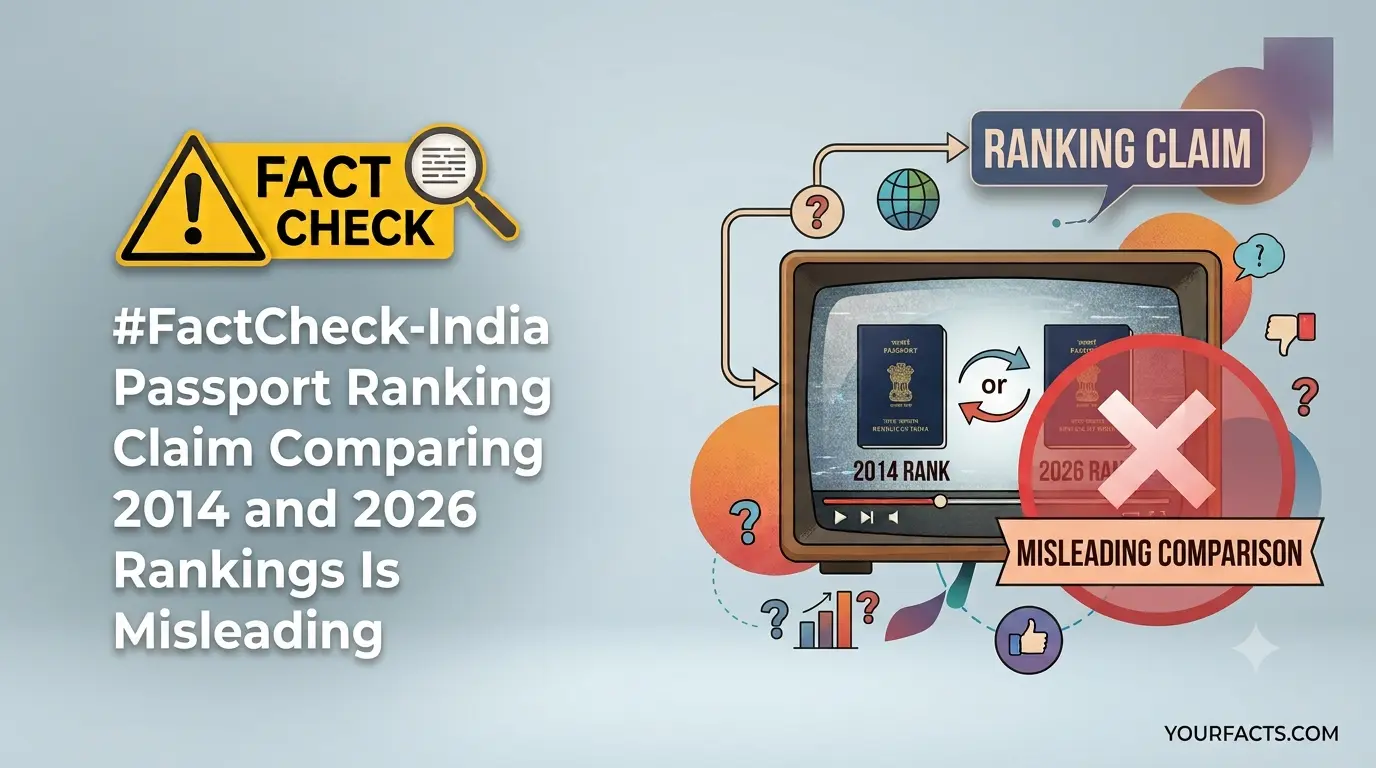
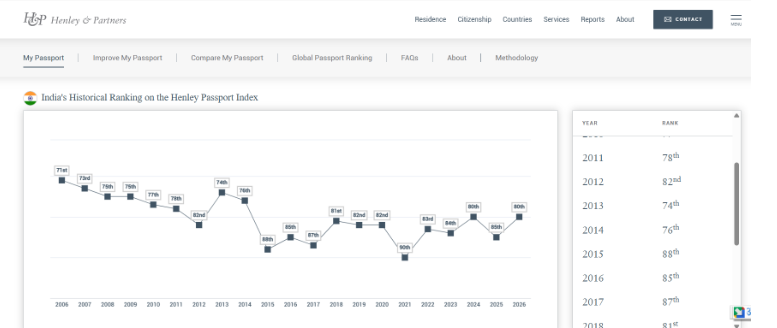
A claim is going viral on social media stating that India’s passport ranking has declined from the 76th position in 2014 to the 125th position this year. CyberPeace Research Wing’s research found the claim to be misleading. The two rankings mentioned in the viral claim were issued by different agencies. The 76th rank in 2014 was given by the Henley Passport Index, while the 125th rank this year was assigned by the Global Passport Index.
Claim
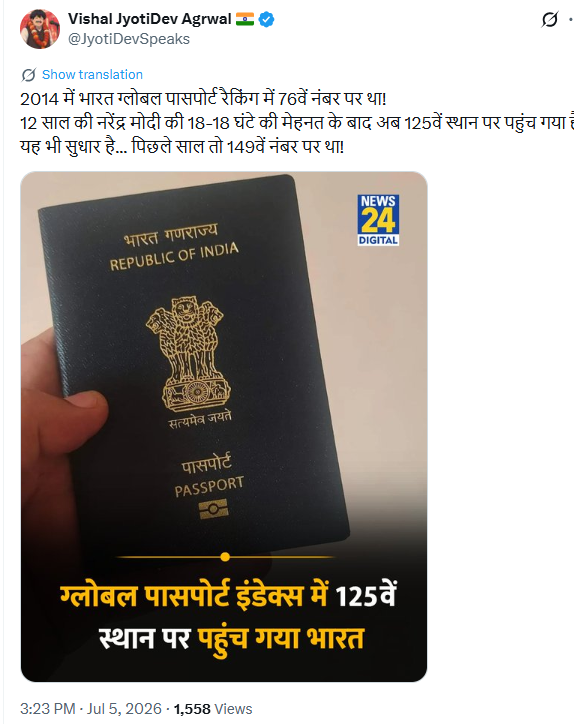
The viral claim states that India’s passport ranking, which was 76th in 2014, has fallen to the 125th position this year. The claim was shared on X (formerly Twitter) with a Hindi caption.
https://x.com/JyotiDevSpeaks/status/2073706900437508468
FactCheck
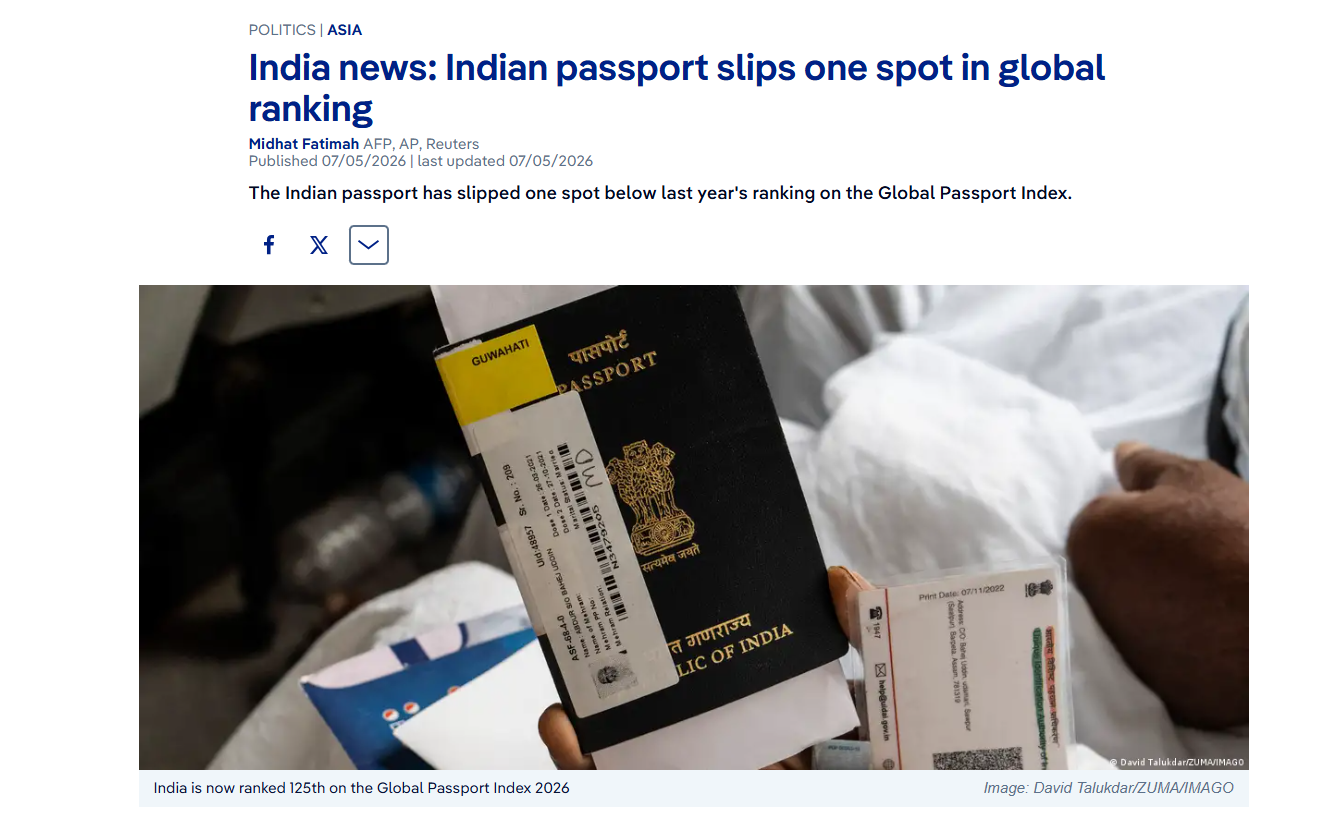
To verify the claim, we first searched relevant news reports and found that India’s passport has been ranked 125th in the latest Global Passport Index.
https://www.dw.com/en/india-news-indian-passport-slips-one-spot-in-global-ranking/live-77836287
We then checked the official website of Global Citizen Solutions, the organization that publishes the Global Passport Index. The data available on the website confirms that India’s passport has been placed at the 125th position in the latest ranking.
https://www.globalcitizensolutions.com/passport-index/india/
Further, we investigated which organization had ranked the Indian passport 76th in 2014. The search revealed that the ranking was issued by the Henley Passport Index, published by Henley & Partners. According to the information available on the Henley Global website, India’s passport was ranked 76th in 2014, while it stands at the 80th position in the 2026 Henley Passport Index. The rankings assigned to the Indian passport from 2006 to 2026 can be seen in the image below.
https://www.henleyglobal.com/passport-index
Conclusion
Our research found that the claim stating India’s passport ranking declined from 76th position to 125th position is misleading. The two rankings cited in the viral claim were issued by different organizations and cannot be compared directly. The 2014 ranking came from the Henley Passport Index, while the 125th position refers to the Global Passport Index.
