
#FactCheck -AI-Generated Video Falsely Shared as BJP-Led Border Fencing on West Bengal-Bangladesh Border
Executive Summary
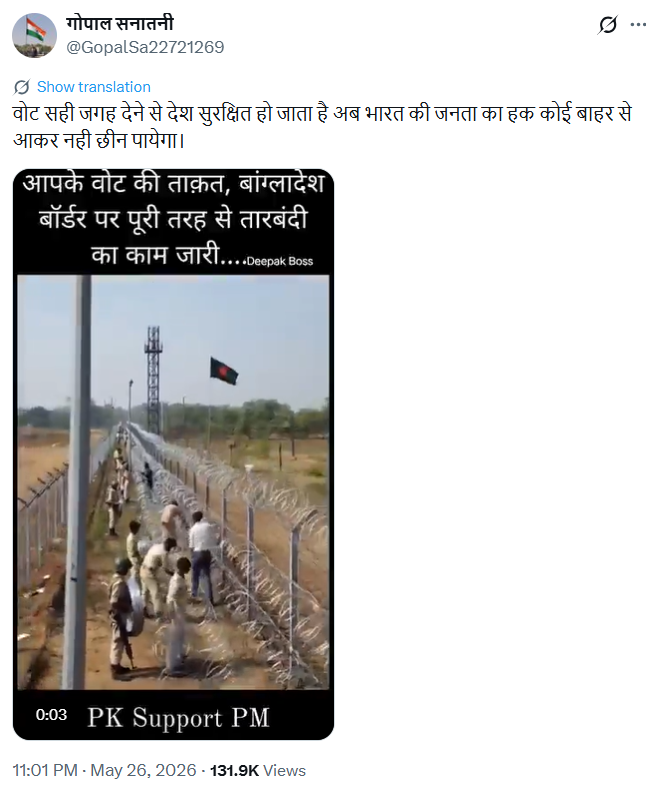
A video showing people installing fencing along a border has gone viral on social media. In the clip, several individuals along with security personnel can be seen laying barbed wire fencing near a border area. The video is being shared with the claim that it shows fencing work underway on the India-Bangladesh border in West Bengal after the Bharatiya Janata Party (BJP) allegedly came to power in the state.
However, CyberPeace Research Wing investigation found the viral claim to be false. The video is not from a real incident and has been created using Artificial Intelligence (AI).
Claim
An X user named “Gopal Sanatani” shared the viral video on May 26, 2026, with the caption:“Voting in the right place keeps the country secure. Now no outsider will be able to snatch the rights of Indian citizens.”The archived link to the post is provided below.
Fact Check
To verify the authenticity of the viral claim, we extracted several key frames from the video and conducted reverse image searches using Google. However, we could not find any credible information or authentic reports related to the visuals shown in the clip. We also searched using relevant keywords on Google, but no trustworthy news reports connected to the claim were found.
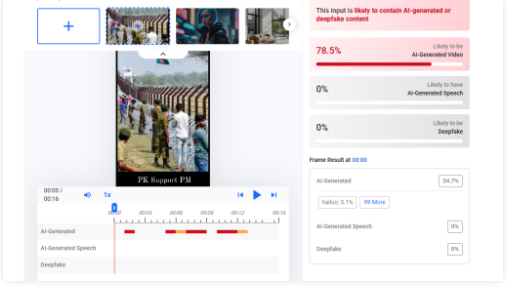
Upon closely examining the video, several visual inconsistencies became noticeable. At one point, an object resembling a piece of paper suddenly appears in a soldier’s hand and then disappears moments later. In another scene, a man installing the fencing appears to pass directly through the barbed wire and emerges unharmed, despite the sharp wires visible in the video. These irregularities raised suspicion that the clip had been artificially generated. To further investigate, we analysed the video using AI detection tools. The analysis conducted through Hive Moderation indicated a high probability — around 80 percent — that the video was AI-generated.
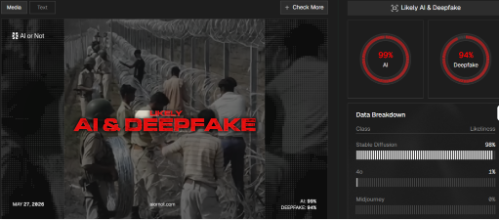
Additionally, the video was examined using another AI detection platform, “AI or Not,” which indicated nearly a 99 percent likelihood that the clip had been created using artificial intelligence.
Conclusion
Our investigation found that the viral video claiming to show fencing work along the West Bengal-Bangladesh border is fake. The footage does not depict a real incident and was generated using Artificial Intelligence (AI).

Related Blogs

Introduction
On 20th March 2024, the Indian government notified the Fact Check Unit (FCU) under the Press Information Bureau (PIB) of the Ministry of Information and Broadcasting as the Fact Check Unit (FCU) of the Central Government. This PIB FCU is notified under the provisions of Rule 3(1)(b)(v) of the Information Technology (Intermediary Guidelines and Digital Media Ethics Code) Amendment Rules 2023 (IT Amendment Rules 2023).
However, the next day, on 21st March 2024, the Supreme Court stayed the Centre's decision. The IT Amendment Rules of 2023 provide that the Ministry of Electronics and Information Technology (MeitY) can notify a fact-checking body to identify and tag what it considers fake news with respect to any activity of the Centre. The stay will be in effect till the Bombay High Court finally decides the challenges to the IT Rules amendment 2023.
The official notification dated 20th March 2024 read as follows:
“In exercise of the powers conferred by sub-clause (v) of clause (b) of sub-rule (1) of rule 3 of the Information Technology (Intermediary Guidelines and Digital Media Ethics Code) Rules, 2021, the Central Government hereby notifies the Fact Check Unit under the Press Information Bureau of the Ministry of Information and Broadcasting as the fact check unit of the Central Government for the purposes of the said sub-clause, in respect of any business of the Central Government.”
Impact of the notification
The impact of notifying PIB’s FCU under Rule 3(1)(b)(v)will empower the PIB’s FCU to issue direct takedown directions to the concerned Intermediary. Any information posted on social media in relation to the business of the central government that has been flagged as fake or false by the FCU has to be taken down by the concerned intermediary. If it fails to do so, it will lose the 'safe harbour' immunity against legal proceedings arising out of such information posted offered under Section 79 of IT Act, 2000.
Safe harbour provision u/s 79 of IT Act, 2000
Section 79 of the IT Act, 2000 serves as a safe harbour provision for intermediaries. The provision states that "an intermediary shall not be liable for any third-party information, data, or communication link made available or hosted by him". However, it is notable that this legal immunity cannot be granted if the intermediary "fails to expeditiously" take down a post or remove a particular content after the government or its agencies flag that the information is being used unlawfully. Furthermore, intermediaries are obliged to observe due diligence on their platforms.
Rule 3 (1)(b)(v) Under IT Amendment Rules 2023
Rule 3(1)(b)(v) of The Information Technology(Intermediary Guidelines and Digital Media Ethics Code) Rules, 2021 [updated as on 6.4.2023] provides that all intermediaries [Including a social media intermediary, a significant social media intermediary and an online gaming intermediary], are required to make "reasonable efforts” or perform due diligence to ensure that their users do not "host, display, upload, modify, publish, transmit, store, update or share” any information that “deceives or misleads the addressee about the origin of the message or knowingly and intentionally communicates any misinformation or information which is patently false and untrue or misleading in nature or, in respect of any business of the Central Government, is identified as fake or false or misleading by such fact check unit of the Central Government as the Ministry may, by notification published in the Official Gazette, specify”.
PIB - FCU
The PIB - Fact Check Unit(FCU) was established in November 2019 to prevent the spread of fake news and misinformation about the Indian government. It also provides an accessible platform for people to report suspicious or questionable information related to the Indian government. This FCU is responsible for countering misinformation on government policies, initiatives, and schemes. The FCU is tasked with addressing misinformation about government policies, initiatives, and schemes, either directly (Suo moto) or through complaints received. On 20th March 2024,via a gazetted notification, the Centre notified the Press Information Bureau's fact-check unit (FCU) as the nodal agency to flag fake news or misinformation related to the central government. However, The Supreme Court stayed the Centre's notification of the Fact-Check Unit under IT Amendment Rules 2023.
Concerns with IT Amendment Rules 2023
The Ministry of Electronics and Information Technology(MeitY) amended the IT Rules of 2021. The ‘Information Technology (Intermediary Guidelines and Digital Media Ethics Code) Amendment Rules, 2023’ (IT Amendment Rules 2023) were notified by the Ministry of Electronics and Information Technology on 6 April 2023. The rules introduced new provisions to establish a fact-checking unit with respect to “any business of the central government” and also made other provisions pertaining to online gaming.
The Constitutional validity of IT Amendment Rules 2023 has been challenged through a writ petition challenging the IT Rules 2023 in the Bombay High Court. The contention is that the rules raise "serious constitutional questions," and Rule 3(1)(b)(v), as amended in 2023, impacts the fundamental right to freedom of speech and expression would fall for analysis by the High Court.
Supreme Court Stays Setting up of FCU
A bench comprising Chief Justice DY Chandra Hud, Justices JB Pardiwala and Manoj Misra convened to hear Special Leave Petitions filed by Kunal Kamra, the Editors Guild of India and the Association of Indian Magazines challenging the refusal of the Bombay High Court to stay the implementation of the IT Rules 2023. The Supreme Court has stayed the Union's notification of the Fact-Check Unit under the IT Amendment Rules 2023, pending the Bombay High Court's decision on the challenges to the IT Rules Amendment 2023.
Emphasizing Freedom of Speech in the Democratic Environment
The advent of advanced technology has also brought with it a new generation of threats and concerns: the misuse of said technology in the form of deepfakes and misinformation is one of the most pressing concerns plaguing society today. This realization has informed the critical need for stringent regulatory measures. The government is rightly prioritizing the need to immediately address digital threats, but there must be a balance between our digital security policies and the need to respect free speech and critical thinking. The culture of open dialogue is the bedrock of democracy. The ultimate truth is shaped through free trade in ideas within a competitive marketplace of ideas. The constitutional scheme of democracy places great importance on the fundamental value of liberty of thought and expression, which has also been emphasized by the Supreme Court in its various judgements.
The IT Rules, 2023,provide for creating a "fact check unit" to identify fake or false or misleading information “in relation to any business of the central government "This move raised concerns within the media fraternity, who argued that the determination of fake news cannot be placed solely in the hands of the government. It is also worth noting that if users post something illegal, they can still be punished under laws that already exist in the country.
We must take into account that freedom of speech under Article 19 of the Constitution is not an absolute right. Article 19(2) imposes restrictions on the Right to Freedom of Speech and expression. Hence, there has to be a balance between regulatory measures and citizens' fundamental rights.
Nowadays, the term ‘fake news’ is used very loosely. Additionally, there is a dearth of clearly established legal parameters that define what amounts to fake or misleading information. Clear definitions of the terms should be established to facilitate certainty as to what content is ‘fake news’ and what content is not. Any such restriction on speech must align with the exceptions outlined in Article19(2) of the Constitution.
Conclusion
Through a government notification, PIB - FCU was intended to act as a government-run fact-checking body to verify any information about the Central Government. However, the apex court of India stayed the Centre's notification. Now, the matter is sub judice, and we hope for the judicial analysis of the validity of IT Amendment Rules 2023.
Notably, the government is implementing measures to combat misinformation in the digital world, but it is imperative that we strive for a balance between regulatory checks and individual rights. As misinformation spreads across all sectors, a centralised approach is needed in order to tackle it effectively. Regulatory reforms must take into account the crucial roleplayed by social media in today’s business market: a huge amount of trade and commerce takes place online or is informed by digital content, which means that the government must introduce policies and mechanisms that continue to support economic activity. Collaborative efforts between the government and its agencies, technological companies, and advocacy groups are needed to deal with the issue better at a higher level.
References
- https://egazette.gov.in/(S(xzwt4b4haaqja32xqdiksbju))/ViewPDF.aspx
- https://pib.gov.in/PressReleasePage.aspx?PRID=2015792
- https://economictimes.indiatimes.com/tech/technology/govt-notifies-fact-checking-unit-under-pib-to-check-fake-news-misinformation-related-to-centre/articleshow/108653787.cms?from=mdr
- https://www.epw.in/journal/2023/43/commentary/it-amendment-rules-2023.html#:~:text=The%20Information%20Technology%20Amendment%20Rules,to%20be%20false%20or%20misleading
- https://www.livelaw.in/amp/top-stories/supreme-court-kunal-kamra-editors-guild-notifying-fact-check-unit-it-rules-2023-252998
- https://www.aljazeera.com/news/2024/3/21/india-top-court-stays-government-move-to-form-fact-check-unit-under-it-laws
- https://www.meity.gov.in/writereaddata/files/Information%20Technology 28Intermediary%20Guidelines%20and%20Digital% 20Media%20Ethics%20Code%29%20Rules%2C%202021%20%28updated%2006.04.2023%29-.pdf
- 2024 SCC On Line Bom 360

Executive Summary:
Recently, there has been a massive amount of fake news about India’s standing in the United Security Council (UNSC), including a veto. This report, compiled scrupulously by the CyberPeace Research Wing, delves into the provenance and credibility of the information, and it is debunked. No information from the UN or any relevant bodies has been released with regard to India’s permanent UNSC membership although India has swiftly made remarkable progress to achieve this strategic goal.

Claims:
Viral posts claim that India has become the first-ever unanimously voted permanent and veto-holding member of the United Nations Security Council (UNSC). Those posts also claim that this was achieved through overwhelming international support, granting India the same standing as the current permanent members.


Factcheck:
The CyberPeace Research Team did a thorough keyword search on the official UNSC official website and its associated social media profiles; there are presently no official announcements declaring India's entry into permanent status in the UNSC. India remains a non-permanent member, with the five permanent actors- China, France, Russia, United Kingdom, and USA- still holding veto power. Furthermore, India, along with Brazil, Germany, and Japan (the G4 nations), proposes reform of the UNSC; yet no formal resolutions have come to the surface to alter the status quo of permanent membership. We then used tools such as Google Fact Check Explorer to uncover the truth behind these viral claims. We found several debunked articles posted by other fact-checking organizations.

The viral claims also lack credible sources or authenticated references from international institutions, further discrediting the claims. Hence, the claims made by several users on social media about India becoming the first-ever unanimously voted permanent and veto-holding member of the UNSC are misleading and fake.
Conclusion:
The viral claim that India has become a permanent member of the UNSC with veto power is entirely false. India, along with the non-permanent members, protests the need for a restructuring of the UN Security Council. However, there have been no official or formal declarations or commitments for alterations in the composition of the permanent members and their powers to date. Social media users are advised to rely on verified sources for information and refrain from spreading unsubstantiated claims that contribute to misinformation.
- Claim: India’s Permanent Membership in UNSC.
- Claimed On: YouTube, LinkedIn, Facebook, X (Formerly Known As Twitter)
- Fact Check: Fake & Misleading.

Executive Summary
Despite a truce announced in mid-April, sporadic violence has continued between Israel and the Iran-backed Hezbollah in Lebanon. Meanwhile, a video circulating widely on social media shows a multi-storey building engulfed in flames, with users falsely linking it to the ongoing conflict. Posts sharing the clip claim it depicts a Hezbollah strike on an Israeli military headquarters, alleging that several soldiers were killed and that Israel is censoring visuals from the incident. However, research by the CyberPeace Research Wing found the claim to be misleading. The video is unrelated to the Israel-Hezbollah conflict. Verification shows that the footage actually captures a fire at an apartment building in New York City. Firefighters can be seen at the scene attempting to control the blaze.
Claim
A Facebook post shared on April 16, 2026, read: “Breaking news; Hezbollah targeted an Israeli military headquarters; many Israeli soldiers lost their lives at the scene… Israel is censoring these images.” The video has garnered more than 240,000 views.
- https://perma.cc/BQ6X-4LAT
- https://www.facebook.com/watch/?v=1283830349750737

Fact Check
A reverse image search using keyframes from the viral clip led to a higher-quality version posted on April 12, 2026, by an Instagram account titled “FDNY response video.” The caption stated: “Happening now — Major 3 alarm fire on 22nd Street and 7th Avenue at 216 7th Avenue.”
- https://www.instagram.com/p/DXB0ePqjgGD/

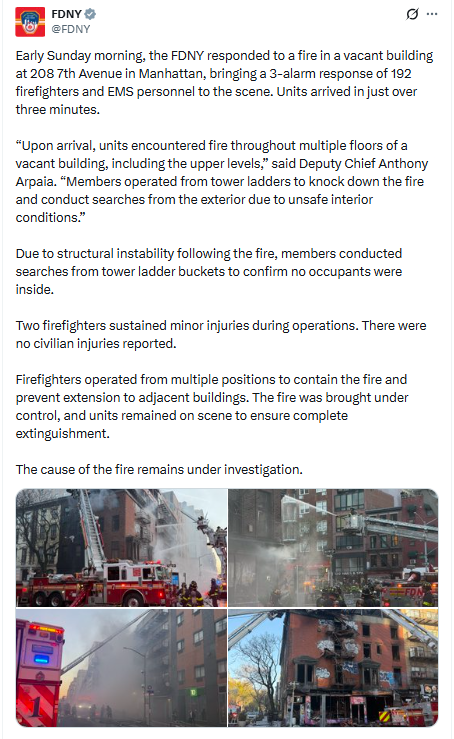
Further verification found that images of the same incident were shared on April 13, 2026, by the official X account of the New York City Fire Department. According to the post, no civilians were injured in the fire, although two firefighters sustained minor injuries while battling the blaze.
Using the location details mentioned in the posts, visible structures in the video were matched with Google Maps street imagery, confirming that the footage was indeed filmed in New York City.

Conclusion
The research establishes that the viral video is being shared with a false claim. It does not show any attack on an Israeli military facility but rather a residential building fire in New York City.
