
#FactCheck -AI-Generated Crowd Video Falsely Tied to Epstein Files Release
Executive Summary
The U.S. Department of Justice recently released nearly three million pages of documents, along with thousands of videos and photographs, related to its research into convicted offender Jeffrey Epstein. Meanwhile, a video showing a massive crowd protesting on a street is going viral on social media The video, which had earlier circulated with false claims linking it to anti-government protests in Iran, is now being shared by several users who claim that the protest took place in the United States after the release of the Epstein files. Research by CyberPeace found the viral claim to be false. The video being linked to protests in the United States following the release of the Epstein files is not real and was generated using artificial intelligence (AI).
Claim:
An Instagram user uploaded the viral video on February 9, 2026, with the caption: “After Epstein files released in America. All eyes on America.”
- https://www.instagram.com/reel/DUjLe-XE5lA
- https://ghostarchive.org/archive/tkP6W

Fact Check:
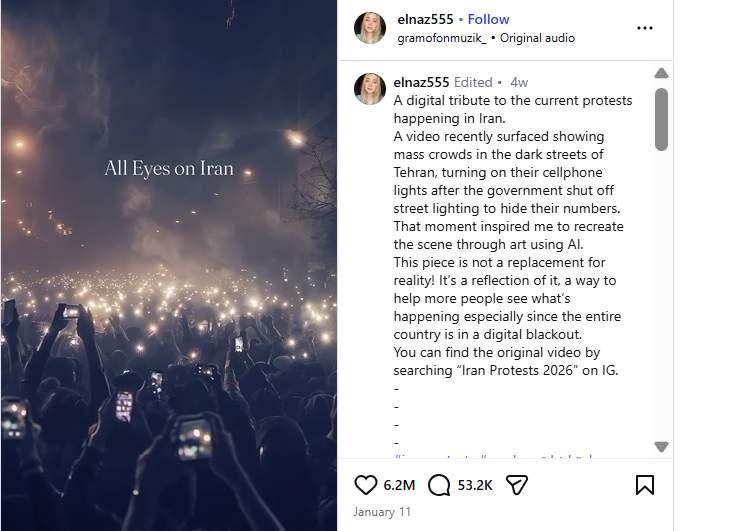
To verify the claim, we first conducted a reverse search of the viral video using Google Lens. The same video was found posted on January 10, 2026, by an Instagram account named “elnaz555,” where it was shared in the context of recent protests in Iran. The post also mentioned that the video was created using AI.
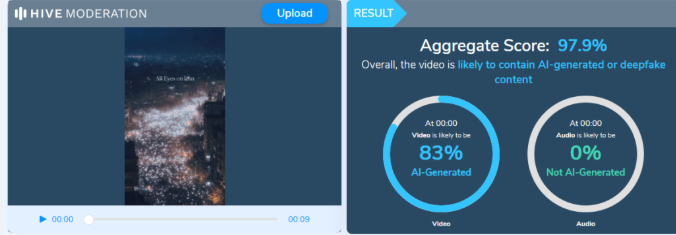
Based on this lead, we further analyzed a higher-quality version of the viral video using Hive Moderation, a tool used to detect AI-generated images and videos. The analysis indicated a 97.9% probability that the video was generated using artificial intelligence. The research clearly shows that the video is not authentic and has been falsely linked to protests in the United States after the release of the Epstein files.
Conclusion:
The claim circulating on social media is false. The viral video allegedly showing protests in the United States following the release of the Epstein files is AI-generated and not related to any real event.

Related Blogs
Introduction
Imagine a scenario where a call is received by a senior citizen. The phone rings, he picks up. On the other side of the line is a polite and seemingly genuine bank official who informs him that his bank account has somehow been jeopardised and that he should quickly move his money to a safer escrow account right away. Or another situation where a police officer ends up threatening a senior citizen over a video call and places him under a digital arrest, pressuring him to pay up money in order to be set free.
This is not the storyline of a heist movie. This is the frightening new digital reality of millions of elderly people living all over the world.
Cybercrime against senior citizens has surged dramatically over the last few years. The year 2023 witnessed people (aged 60 and above), who submitted more than 101,000 complaints to the Federal Bureau of Investigation’s (FBI) Internet Crime Complaint Centre (IC3) in the United States. The total losses reached approximately 3.4 billion dollars, which reflected an increase of 11% in comparison to the previous year. Tech-support scams, investment frauds, government impersonation schemes, etc., have been some of the most recent and significant risks to the financial security of senior citizens.
This sharp increase in cyber fraud that has been targeting the seniors has shocked everyone, from the authorities to families. From phishing emails to fake customer care numbers to various digital payment scams, cyber criminals have deliberately been exploiting the senior population. They have repeatedly displayed the ability to wipe out a senior’s entire lifetime of savings in just a matter of minutes. The rise in cyber scams has been so alarming that even the Supreme Court of India expressed a deep concern over an estimated 3,000 crore rupees that was lost due to digital arrest scams.
Behind these statistics, there have been several individual cases that have revealed the true reality and the personal impact of such scams. The scale of this threat was clearly illustrated when, reportedly, an 86-year-old woman from Mumbai lost 20 crore rupees in a well-planned digital arrest scam in a timeline of 3-4 months between December 2024 and March 2025. In other real-life instances, in December 2025, multiple senior citizens from Hyderabad and Delhi were manipulated into transferring tens of lakhs under the false implication of undergoing a legal action.
This blog aims to focus specifically on the ways and means of:
- How cybercriminals operate against senior citizens,
- The most typical online scams that target seniors and
- How to quickly identify them.
Revealing the Insides of the Scammer’s Playbook: How They Operate, Trick and Steal
- Picking out the prey: Fraudsters use classified information from various leaked online databases, social media profiles, online images, phone directories and in some instances, even obituaries, to build comprehensive lists of potential and vulnerable senior citizen targets. It may be shocking to know that these scammers could already be aware of your age, bank, city and the details of your family members.
- Masquerading and trust theatrics: Scammers pose as authoritative figures such as bank officers, RBI (Reserve Bank of India) or tax officials, telecom staff, Microsoft or Apple tech support, CBI (Central Bureau of Investigation), ED (Enforcement Directorate) and even judges. They further support this spectacle by creating professional emails, logos, illegal websites and forged notices. Caller IDs can be spoofed and can even appear in the name of a trusted bank or a government helpline. In digital arrest scams, scammers may build a fake courtroom or police station to showcase their authority and authenticity over video calls.
- Tugging at emotions and pulling the strings of fear: Cyber fraudsters rarely rely on logic as the basis. Instead, they attack emotions. They may make statements such as: ‘your account is being used for money laundering, you may be arrested today’, thus creating feelings of fear and panic in the mind of the targeted individual. ‘You’ve won a lottery!’, another example that appeals to the emotions of greed and excitement, or ‘Grandma, I’ve been in an accident; please send money and don’t tell anyone’, a classic example that preys on the emotions of love, urgency and concern.
There are more such illustrations: ‘Once in a lifetime investment opportunity’, ‘verify your details in the next 10 minutes or else your account will be frozen, ‘your computer has been hacked; only our technical team can fix it’, and the list goes on.
- The final grab: Cash, Credentials and Control: After all that pretending and emotional manipulation, cyber criminals make their last and final move that essentially closes the deal. They may ask for OTPs (one-time passwords), internet banking credentials, or remote access via screen sharing mode. In other cases, they may pressurise their victims into making direct UPI (Unified Payments Interface) transfers, RTGS (Real-time Gross Settlement) / NEFT (National Electronic Funds Transfer) transfers and payment in the form of gift cards, vouchers or cryptocurrency. This marks the extraction phase. This is the moment where access and control is attained by the fraudster. After this, financial accounts, sensitive information, data, etc., can all be quickly drained, beyond any chance of recovery.
Unveiling the Cyber Scam Spectrum
Below are some of the most commonly deployed online scams that are targeted towards the senior citizens of the present day.
- Imposters in Power: Impersonation scams, on a global level, have proved to be one of the fastest-growing and costliest frauds that occur against seniors. The scammers feign and impersonate officials from banks, income tax departments or even big companies such as Amazon. They would generally warn you about a failed KYC (Know Your Customer) update, your account being blocked or a legal violation. The victim is basically caught off-guard and is forced to share crucial details such as login credentials and OTPs.
- The Digital Arrest Scam: From Call to Con: Lately, digital arrest has become one of the most terrifying scams that senior citizens have had to face. Seniors receive a voice call or a video call from someone who claims to be a police officer or a CBI/ED officer. Then, in a strict and authoritative tone, they make false claims about how the elderly’s Aadhaar, PAN (Permanent Account Number) or phone details have come under scrutiny for being linked to serious crimes such as drug trafficking, money laundering and terrorism. They threaten the elderly that they could be put under immediate arrest, their property could be seized, or they could be publicly humiliated. Once they have established fear, they then go on to show fake documents or court orders to corroborate their assertions.
Thereafter, the senior citizen is informed that he or she has been placed under a digital house arrest. They force the victim to stay on the video call, sometimes for hours and days, ask them to follow certain instructions and repeatedly warn them not to communicate with anyone else. Scammers further exploit the fear of being jailed or the fear of legal action, and gradually extract huge sums of money from the victim. In some cases, this scam can unfold and continue over an extended timeline spanning several months.
- Tech Support Hoax: When Help turns Hostile: As per the FBI and other multiple security analyses, tech support scams are the most commonly reported senior citizen-related frauds in the US.
A pop-up may appear on the elderly’s screen stating that: ‘your computer is infected, call this number now’. Or they might receive a call from a person posing as a tech support person from either Microsoft, Apple, a bank’s IT team or as an internet service provider. He then goes on to guide the elderly to install certain remote access software or to grant screen control access to fix the issue. Once they gain access, they pretend to find some serious infection in the user’s system or they talk about how the speed of the internet is slow and that it needs to be fixed. As a result, they quietly steal passwords, introduce malware into perfectly healthy systems, lock user access and demand ransom in return.
- Payment App Scams: Phishing, Deadly Links and OTP Snares: Phishing as a cyber scam tactic sits at the heart of many payment app scams that target senior citizens. It may begin with a harmless SMS, an email or a WhatsApp alert. These correspondences may look like they have been received from a trusted bank or a familiar online payment platform.
The messages are engineered in a way that aim at grabbing attention and trigger a feeling of panic and pressure. They push the elderly users who spring into action without any caution or thought. The victim may be urged to click a link, coupled with warnings of a blocked account, a failed transaction, a failed delivery or a KYC update. The message may also ask the user to ‘verify’ certain account details. They send urgent payment links that put pressure on the senior citizen to act immediately and transfer the said amount of money.
There are also instances where an SMS or WhatsApp link may claim to offer some kind of discount or reward only if the user enters his or her card details, UPI pin or OTP. This is an extremely dangerous scenario. If these details are given away, scammers acquire access to the user’s bank account.
- Family in Crisis: Staging Fake Emergencies: These cyber-enabled scams, also known as ‘grandparent scams’, specifically target senior citizens by impersonating their kin and creating a fake impression of them being in some kind of trouble. With the help of methods such as AI (Artificial Intelligence) voice cloning, fraudsters mimic the voice of a grandchild or a family member (which they originally obtain from social media posts or videos), making their deception tactics extremely believable. The caller may claim to be in an accident or could say they have been arrested or are stranded somewhere. They may plead with the senior citizen to make an immediate payment.
In order to avoid cross verification of their fraudulent claims, they may insist on maintaining secrecy and brainwash their victim to not inform other family members of their made-up dilemma.
- Fraudulent Friendships and Hijacked Hearts: For many senior citizens who live alone and in the absence of family and support systems, isolation becomes a vulnerability that is very hard to overcome. Fraudsters, who closely monitor such individuals, wait to seize any opportunity to use this weakness as a gateway to carry out their deceptive schemes.
‘Companionship scams’ and ‘romance scams’ are slowly turning into a serious problem among older adults. Cyber criminals befriend or connect with older adults on social networking, matrimonial and dating apps under false pretences. As time goes by, sometimes over weeks or months, these scammers work on building emotional intimacy and trust. Once this is accomplished, they then start making requests for money. These requests can be for (fake) medical emergencies, visas, travel tickets or business deals. Sadly, victims, who are already deeply invested emotionally, end up making these money transfers, sometimes losing their lifetime savings in the process.
In some cases, when things go too far, intimate photos or private conversations are later used by cyber fraudsters for sextortion. They threaten to leak these personal materials unless the victim pays money, further adding elements of fear and pressure to an already manipulative situation.
- Fraud in the name of Health and Benefits: For most senior citizens, their daily life depends on access to basic healthcare, uninterrupted pensions and government benefits. These systems are put in place to provide not just for the seniors’ financial stability, but also to ensure their peace of mind.
Conversely, fraudsters exploit this dependability. Fake medical offers, insurance plans, benefit claims and pension enhancement schemes, etc., are some of the methods that are being used to defraud the seniors. Scammers offer free medical equipment or health checkups in exchange for personal information related to banking and finances.
Another dangerous facet of these scams is ‘counterfeit medications’. These are sold under false claims and big promises and are advertised in a manner that tempts seniors to go for it. These fake medicines not only lead to loss of money but also gravely impact the elderly’s health.
Spot the Scam: Tips to Identify Early Warning Signs before the Scam Unfolds
Cyber criminals are clever, creative and notorious, but their tricks come with familiar warning signs. Timely recognition of these signs can save senior citizens from falling into the scammer’s trap. Some of the most common and apparent warning signs are discussed below:
- Don’t think fast, think twice! The urgency ploy: Cyber criminals thrive on creating a situation of panic and urgency. In instances where a senior citizen feels that he or she is being pushed towards rushed choices, it is better to take a step back to pause and think. Any unreasonable demand to act ‘immediately’ or within minutes, especially when it involves a transfer of money or confidential information, is very likely to be a scam. Not giving in to this hasty push can save the individual from getting tangled in the scammer’s web of lies.
- Scammer’s best friend: Secrecy and silence: First comes the urgency, and then comes the demand to stay silent. Scammers strategically cite and invent so-called ‘security reasons’ and instruct their elderly victims not to inform their bank, friends or family of their situation. This secrecy prevents verification and keeps the victim trapped. Recognising this forced isolation can stop a cybercrime before it escalates and gets out of hand.
- Red flag! When the deal sounds unreal: Scammers lure elderly victims with extraordinary offers and deals. Lottery wins, miracle investment returns, massive discounts or exclusive time-bound rewards are a few examples. These larger-than-life promises are designed in a manner that clouds an elderly person’s sound judgment. Therefore, if an offer feels too good to be true and unlike anything anyone’s ever heard before, then that’s the time to pause and take a step back. In almost all such cases, these unbelievable deals are simply a bait for a looming scam.
- Beware! They want your access codes: Senior citizens need to exercise extra caution when it comes to handing out their personal access codes. No legitimate bank, government office or reputable company will directly ask for OTPs, PINs or full passwords over calls or messaging apps. If someone asks for such details, it is an indication that a fraud may be imminent.
- Don’t pay just yet! Dubious payment gambits: If demands for payments are made in the form of gift cards, cryptocurrency or wire transfers to personal or unknown accounts, it is most definitely a scam. Scammers use these unconventional payment methods to avoid traceability. This strategy allows them to easily disappear with the victim’s funds, which in turn makes recovery of the stolen money nearly impossible.
- Threats and intimidation over a phone call: Hang up! It’s a scam: It is important to understand that legitimate police and court proceedings do not take place over calls or messaging apps. Genuine officials will never demand or negotiate fines, legal payments or bail online. If someone uses the intimidation ploy on a senior citizen and threatens him with legal trouble or police action unless some money is paid, then that’s a clear warning sign of a cyber scam.
Empowered, not Exploited: When Knowledge Becomes the Best Defence
Cyber scams targeting senior citizens are a deliberate and very well-orchestrated industry that thrives on uncertainty, ignorance and fear. The call of the moment is for the elderly and their families to turn awareness into armour. Knowledge about how scammers operate, how they steal, and the techniques they employ can prepare and empower our seniors to protect themselves in such critical situations. The early warning signs mentioned above are more than just mere cautions. They should be taken as ‘cues’ to ‘pause, reflect and re-check’. Being wary of unsolicited communication, safeguarding financial information, double-checking hurried correspondences, etc., can nip a scam in the bud before it plays out. Most importantly, digital safety for the senior citizens is a unified and collaborative responsibility that every responsible individual of the society needs to undertake.
References
- https://frontline.thehindu.com/social-issues/ai-deepfake-digital-arrest-scams-india-cybercrime/article70587955.ece
- https://www.ic3.gov/annualreport/reports/2023_ic3elderfraudreport.pdf
- https://www.thehindu.com/news/national/supreme-court-shocked-over-3000-crore-loss-in-digital-arrest-scams/article70235621.ece
- https://www.thehindu.com/news/cities/mumbai/elderly-woman-loses-20-crore-to-digital-arrest-fraud-3-held/article69353437.ece
- https://timesofindia.indiatimes.com/city/hyderabad/three-senior-citizens-duped-of-rs-1-7cr-in-digital-arrest-scam-spree/articleshow/125876194.cms
- https://www.aninews.in/news/national/general-news/82-year-old-senior-citizen-digitally-arrested-and-cheated-of-rs-116-crore-cyber-cell-arrests-three-key-members-of-syndicate20251213145528/
- https://crr.bc.edu/preventing-cyber-scams-that-target-seniors/
- https://dos.ny.gov/scams-targeting-older-adults
- https://indianexpress.com/article/cities/chandigarh/victims-in-8-of-top-10-digital-arrest-scams-in-chandigarh-are-senior-citizens-data-reveals-10444252/
- https://www.seniorliving.org/research/common-elderly-scams/
- https://www.ftc.gov/news-events/data-visualizations/data-spotlight/2025/08/false-alarm-real-scam-how-scammers-are-stealing-older-adults-life-savings
- https://www.psca.org/news/psca-news/2025/8/scams-against-seniors-increasing-dramatically-ftc-warns/
- https://www.pcmatic.com/blog/the-rising-threat-of-elder-fraud-insights-from-ic3s-2023-report/?srsltid=AfmBOorC069NIYFwFO0W56nPcg_K0Wfv_oq0V-MI7fImI5ityAUrQTO9
- https://www.quickheal.co.in/knowledge-centre/guarding-our-elders-a-comprehensive-report-on-the-elder-fraud-epidemic-in-india/?srsltid=AfmBOorviPvoRuecjsOtAfVxyQEJF2vyICnr15GqbDfP1m3UXAnXndMw
- https://www.ncoa.org/article/top-5-financial-scams-targeting-older-adults/
- https://www.uchealth.org/today/elder-fraud-is-rising-and-it-is-hurting-more-than-just-finances/
- https://centerlighthealthcare.org/protecting-yourself-online-recognizing-and-avoiding-online-scams/

Executive Summary
A video showing a large crowd disrespecting the Indian tricolor along with American and Israeli flags is being widely shared on social media. Users sharing the video claim that the incident recently took place in Iran's capital, Tehran, showcasing "Iran's hatred towards India." However, a fact-check done by the CyberPeace Research Wing has revealed that this claim is misleading. The viral video was not filmed in Iran, but rather during a procession in Karachi, Pakistan.
The Claim
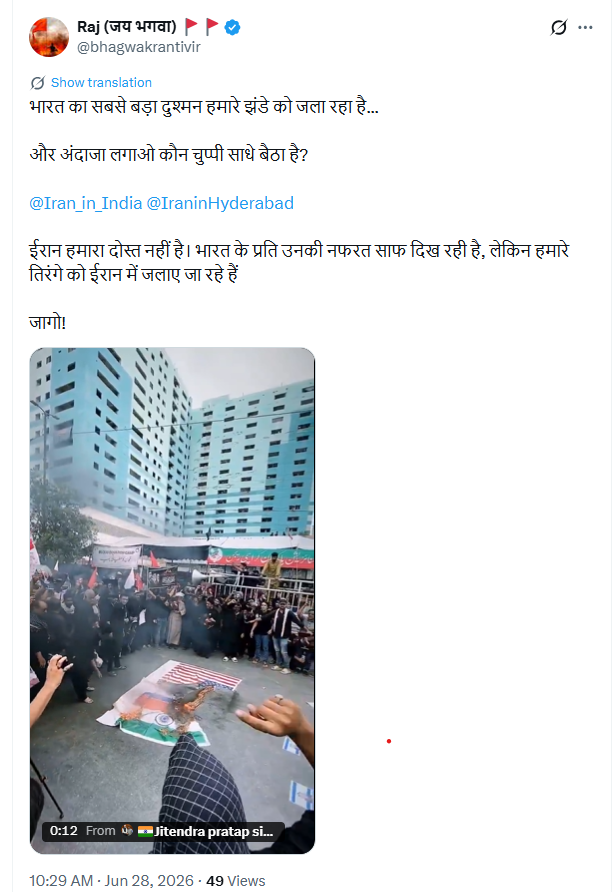
A user on the social media platform X (formerly Twitter) shared the video with the caption: "India’s biggest enemy is burning our flag and guess who is sitting silently? Iran is not our friend. Their hatred towards India is clearly visible, but our tricolor is being burnt in Iran." https://x.com/bhagwakrantivir/status/2071096021183246667 , https://archive.ph/6mGE8
Factcheck
Keyframes extracted from the viral video were searched using Google Lens. This led to an Instagram post containing the exact same footage. The caption of this post identified the location as Karachi, Pakistan, noting that the demonstration was held in support of Iran, during which flags of India, the US, and Israel were burnt.
https://www.instagram.com/reels/DaDLQO6obcK/

Further keyword searches led to the official Instagram account of the 'Imamia Students Organization Karachi'. A video uploaded on June 25, 2026, showed the same event captured from a different camera angle. According to the caption, the footage is from a '9th Muharram' procession in Karachi.
https://www.instagram.com/p/DaApSBfIpNQ/

To conclusively establish the location, Google Maps Street View was used to cross-reference the physical landmarks seen in the video.The visual elements perfectly match Mohammad Ali Jinnah Road in Karachi, Pakistan.A distinct blue building named 'Mid Town', visible in the viral video, matches the Google Street View imagery of the location.

Conclusion
The research confirms that the video showing the burning and desecration of the Indian national flag is from Karachi, Pakistan, and not Tehran, Iran. The social media claims linking this incident to Iran are false and contextually misleading.

Executive Summary
A video is being shared on social media showing a young calf running behind a milk truck on a road. A large image of a white cow is printed on the back of the truck. The calf appears to mistake the image for its real mother and tries to reach its udders. The video is being widely shared online with emotional captions. Research by the CyberPeace Research Wing found the viral claim to be false. Our research revealed that the viral video is AI-generated.
Claim:
An Instagram user shared the viral video with the caption: “A helpless calf was so hungry that it mistook the cow shown in the poster for its mother and tried to drink milk from her. This heartwarming video of innocence is rapidly going viral on social media.
https://www.instagram.com/reels/Dc5Gh-1DUl7/

Fact Check
To verify the viral claim, we conducted a Google search using relevant keywords but found no credible media reports supporting the claim. In the next step of our research, we extracted keyframes from the video and performed a reverse image search on Google. This led us to the same video on an account named ‘realishai’. Our research found that the account creates and shares AI-generated videos.”
https://www.instagram.com/realishai/

We also found several other AI-generated videos similar to the viral clip on the same account.

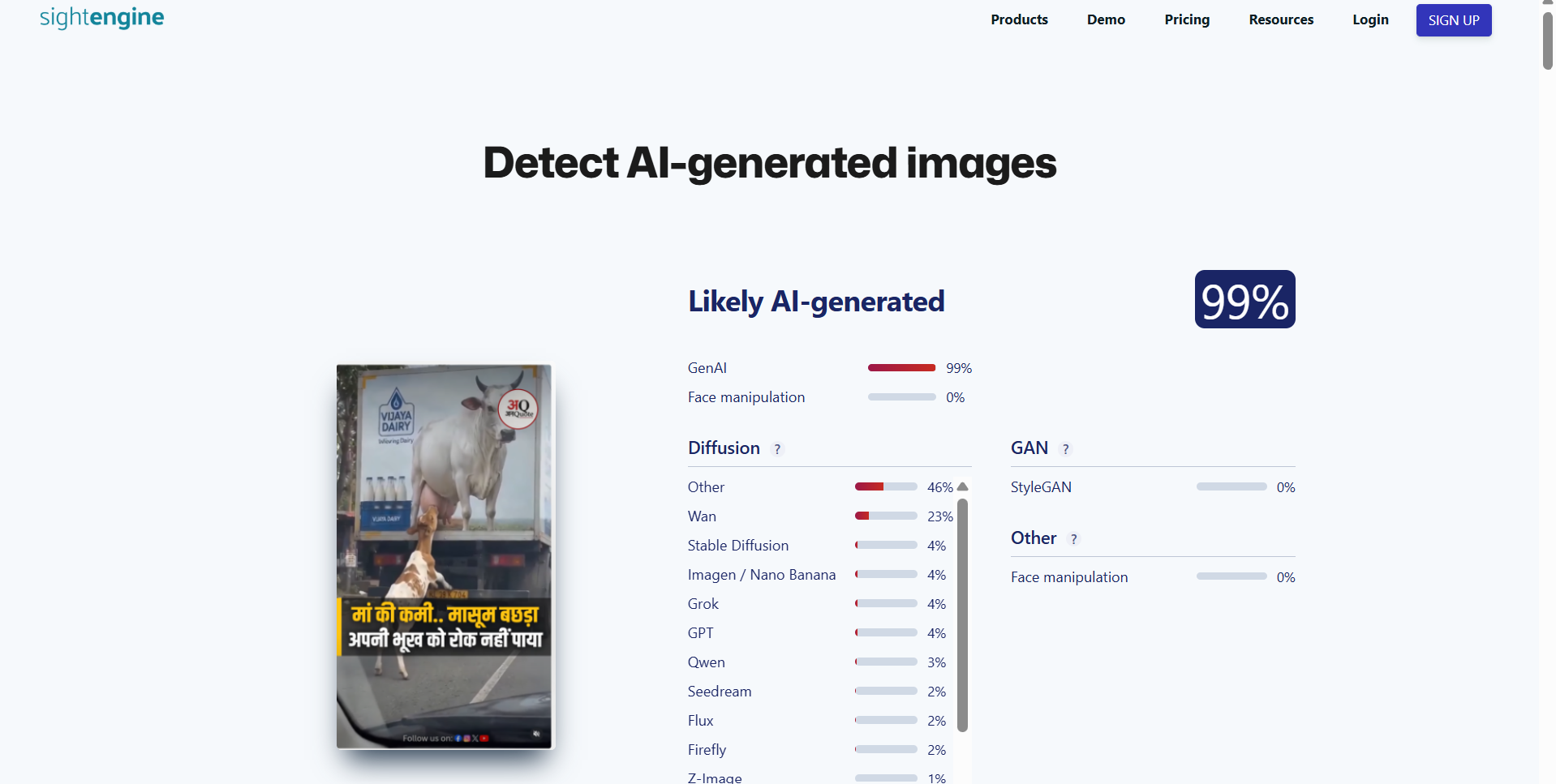
In the next step of our research, we scanned the viral video using the AI detection tool Sightengine. According to the results, the viral video is 99 per cent AI-generated.
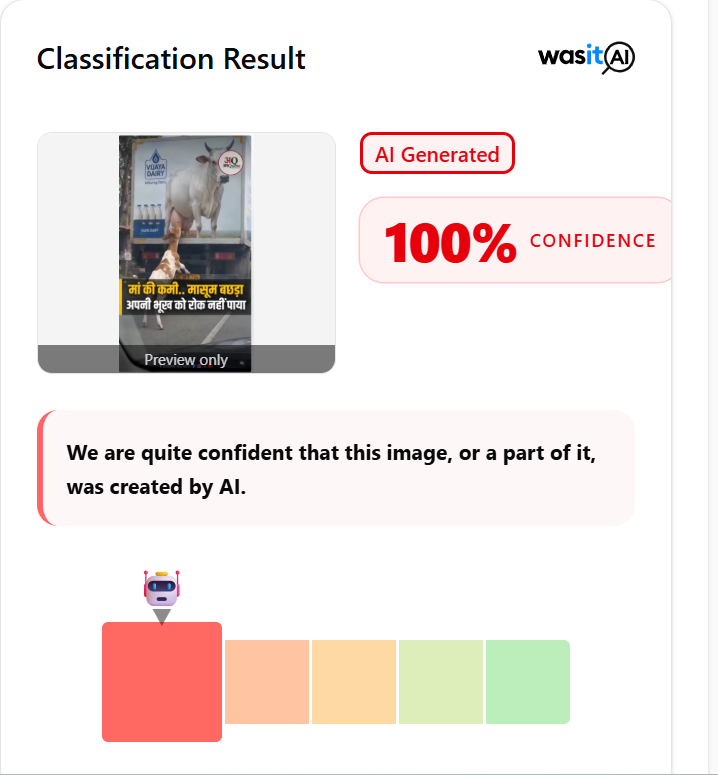
In the next step of our research, we scanned the viral video using the AI detection tool Wasit AI. According to the results, the viral video is AI-generated.
Conclusion
Our research found the viral claim to be false. The research established that the viral video is AI-generated and does not depict a real incident.
