
#FactCheck- AI-Generated Image of PM Modi Misleadingly Shared as Assam Campaign Shoot Setup
Executive Summary
An image of Prime Minister Narendra Modi is being widely circulated on social media. The picture is being shared with the claim that during an election campaign in Assam, a full-fledged shooting set was arranged in a tea garden where Modi interacted with women workers, complete with cameras, microphones, lights, and a director-led production team. However, research by the CyberPeace has found the claim to be false. Our research reveals that the viral image is AI-generated and is being shared with a misleading narrative.
Claim
An Instagram user shared the viral image with the caption suggesting that such a large-scale “shoot” setup had been arranged and questioned the cost involved.
Post link:

Fact Check
To verify the claim, we conducted a keyword-based search on Google. However, we did not find any credible media reports supporting the claim that such a shooting setup was arranged during Prime Minister Modi’s visit to Assam. Upon closely examining the viral image, we noticed several visual inconsistencies that raised suspicion about it being artificially generated. To confirm this, we analyzed the image using the AI detection tool Hive Moderation, which indicated that the image is approximately 99% AI-generated.
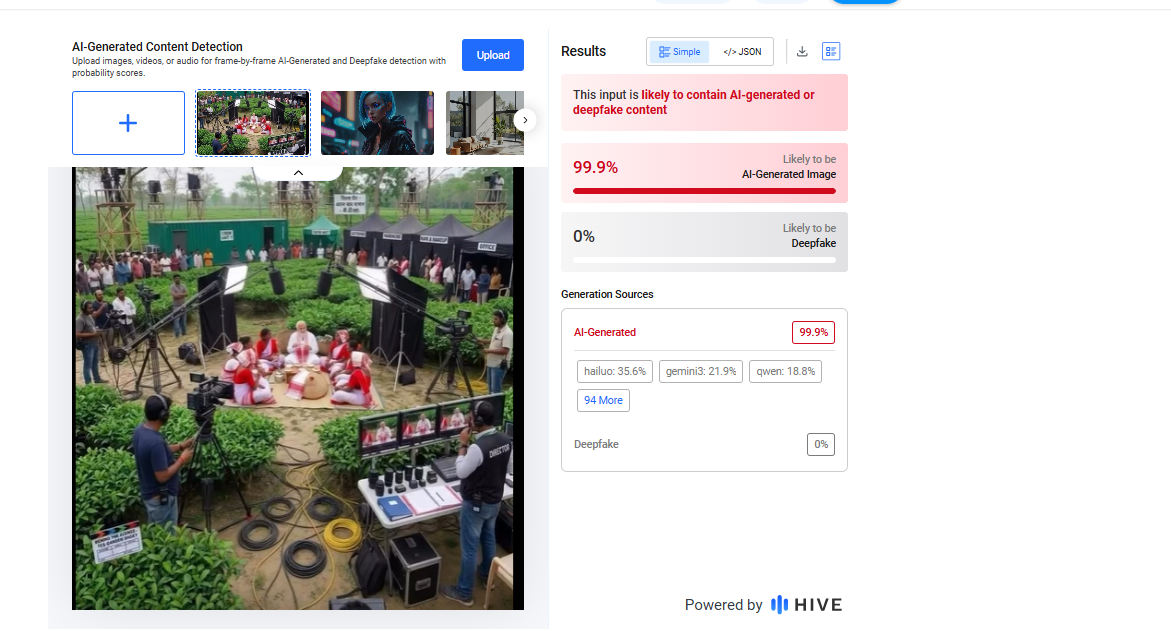
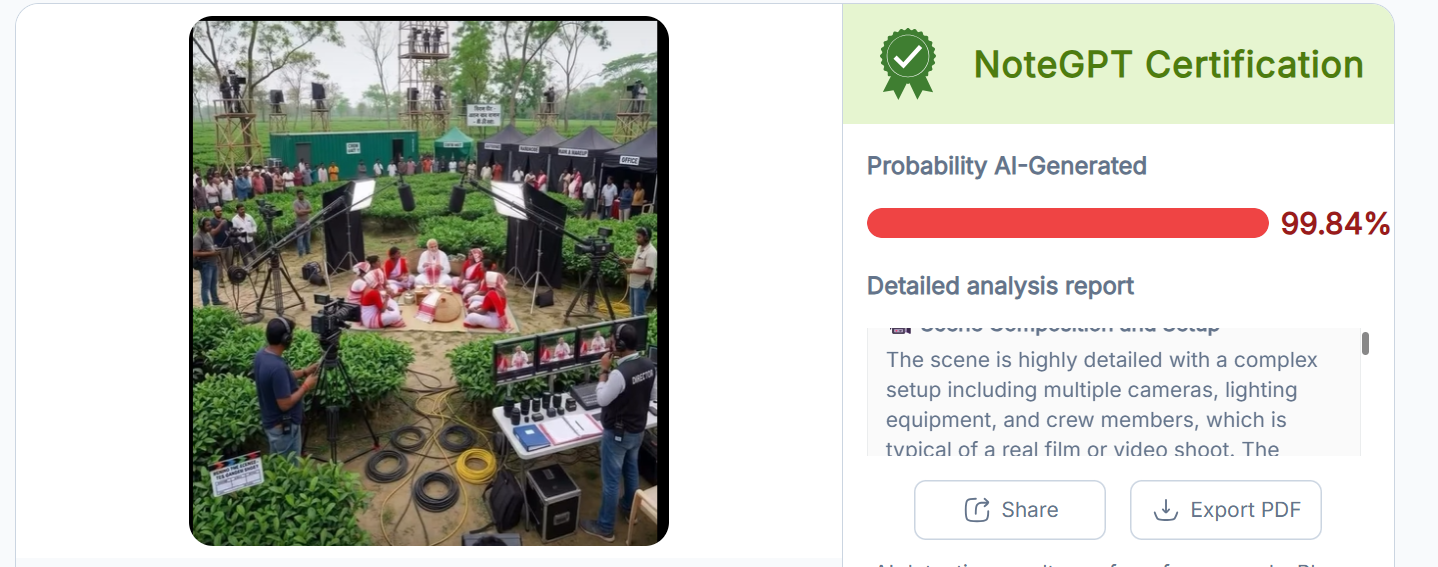
To further validate the findings, we also tested the image using another AI detection tool, NoteGPT, which similarly classified the image as 99% AI-generated.
For context, ahead of the 2026 Assam Assembly elections, Prime Minister Narendra Modi has been on a campaign visit to the state. According to a report by DD News, he visited a tea garden in Dibrugarh, where he interacted with women workers and even plucked tea leaves himself.

Conclusion
Our research clearly establishes that the viral image of Prime Minister Narendra Modi is not authentic and has been digitally created using AI tools. There is no evidence to support the claim that a staged shooting setup involving cameras, lights, and a production crew was arranged during his visit. The image is being circulated with a misleading narrative to create a false impression. This case highlights how AI-generated visuals can be used to distort real events and spread misinformation.

Related Blogs

Introduction
AI has revolutionized the way we look at growing technologies. AI is capable of performing complex tasks in fasten time. However, AI’s potential misuse led to increasing cyber crimes. As there is a rapid expansion of generative AI tools, it has also led to growing cyber scams such as Deepfake, voice cloning, cyberattacks targeting Critical Infrastructure and other organizations, and threats to data protection and privacy. AI is empowered by giving the realistic output of AI-created videos, images, and voices, which cyber attackers misuse to commit cyber crimes.
It is notable that the rapid advancement of technologies such as generative AI(Artificial Intelligence), deepfake, machine learning, etc. Such technologies offer convenience in performing several tasks and are capable of assisting individuals and business entities. On the other hand, since these technologies are easily accessible, cyber-criminals leverage AI tools and technologies for malicious activities or for committing various cyber frauds. By such misuse of advanced technologies such as AI, deepfake, and voice clones. Such new cyber threats have emerged.
What is Deepfake?
Deepfake is an AI-based technology. Deepfake is capable of creating realistic images or videos which in actuality are created by machine algorithms. Deepfake technology, since easily accessible, is misused by fraudsters to commit various cyber crimes or deceive and scam people through fake images or videos that look realistic. By using the Deepfake technology, cybercriminals manipulate audio and video content which looks very realistic but, in actuality, is fake. Voice cloning is also a part of deepfake. To create a voice clone of anyone's, audio can be deepfaked too, which closely resembles a real one but, in actuality, is a fake voice created through deepfake technology.
How Deepfake Can Harm Organizations or Enterprises?
- Reputation: Deepfakes have a negative impact on the reputation of the organization. It’s a reputation which is at stake. Fake representations or interactions between an employee and user, for example, misrepresenting CEO online, could damage an enterprise’s credibility, resulting in user and other financial losses. To be protective against such incidents of deepfake, organisations must thoroughly monitor online mentions and keep tabs on what is being said or posted about the brand. Deepfake-created content can also be misused to Impersonate leaders, financial officers and officials of the organisation.
- Misinformation: Deepfake can be used to spread misrepresentation or misinformation about the organisation by utilising the deepfake technology in the wrong way.
- Deepfake Fraud calls misrepresenting the organisation: There have been incidents where bad actors pretend to be from legitimate organisations and seek personal information. Such as helpline fraudsters, fake representatives from hotel booking departments, fake loan providers, etc., where bad actors use voice clones or deepfake-oriented fake video calls in order to propose themselves as belonging to legitimate organisations and, in actuality, they are deceiving people.
How can organizations combat AI-driven cybercrimes such as deepfake?
- Cybersecurity strategy: Organisations need to keep in place a wide range of cybersecurity strategies or use advanced tools to combat the evolving disinformation and misrepresentation caused by deepfake technology. Cybersecurity tools can be utilised to detect deepfakes.
- Social media monitoring: Social media monitoring can be done to detect any unusual activity. Organisations can select or use relevant tools and implement technologies to detect deepfakes and demonstrate media provenance. Real-time verification capabilities and procedures can be used. Reverse image searches, like TinEye, Google Image Search, and Bing Visual Search, can be extremely useful if the media is a composition of images.
- Employee Training: Employee education on cybersecurity will also play a significant role in strengthening the overall cybersecurity posture of the organisation.
Conclusion
There have been incidents where AI-driven tools or technology have been misused by cybercriminals or bad actors. Synthetic videos developed by AI are used by bad actors. Generative AI has gained significant popularity for many capabilities that produce synthetic media. There are concerns about synthetic media, such as its misuse of disinformation operations designed to influence the public and spread false information. In particular, synthetic media threats that organisations most often face include undermining the brand, financial gain, threat to the security or integrity of the organisation itself and Impersonation of the brand’s leaders for financial gain.
Synthetic media attempts to target organisations intending to defraud the organisation for financial gain. Example includes fake personal profiles on social networking sites and deceptive deepfake calls, etc. The organisation needs to have the proper cyber security strategy in place to combat such evolving threats. Monitoring and detection should be performed by the organisations and employee training on empowering on cyber security will also play a crucial role to effectively deal with evolving threats posed by the misuse of AI-driven technologies.
References:
- https://media.defense.gov/2023/Sep/12/2003298925/-1/-1/0/CSI-DEEPFAKE-THREATS.PDF
- https://www.securitymagazine.com/articles/98419-how-to-mitigate-the-threat-of-deepfakes-to-enterprise-organizations
Executive Summary
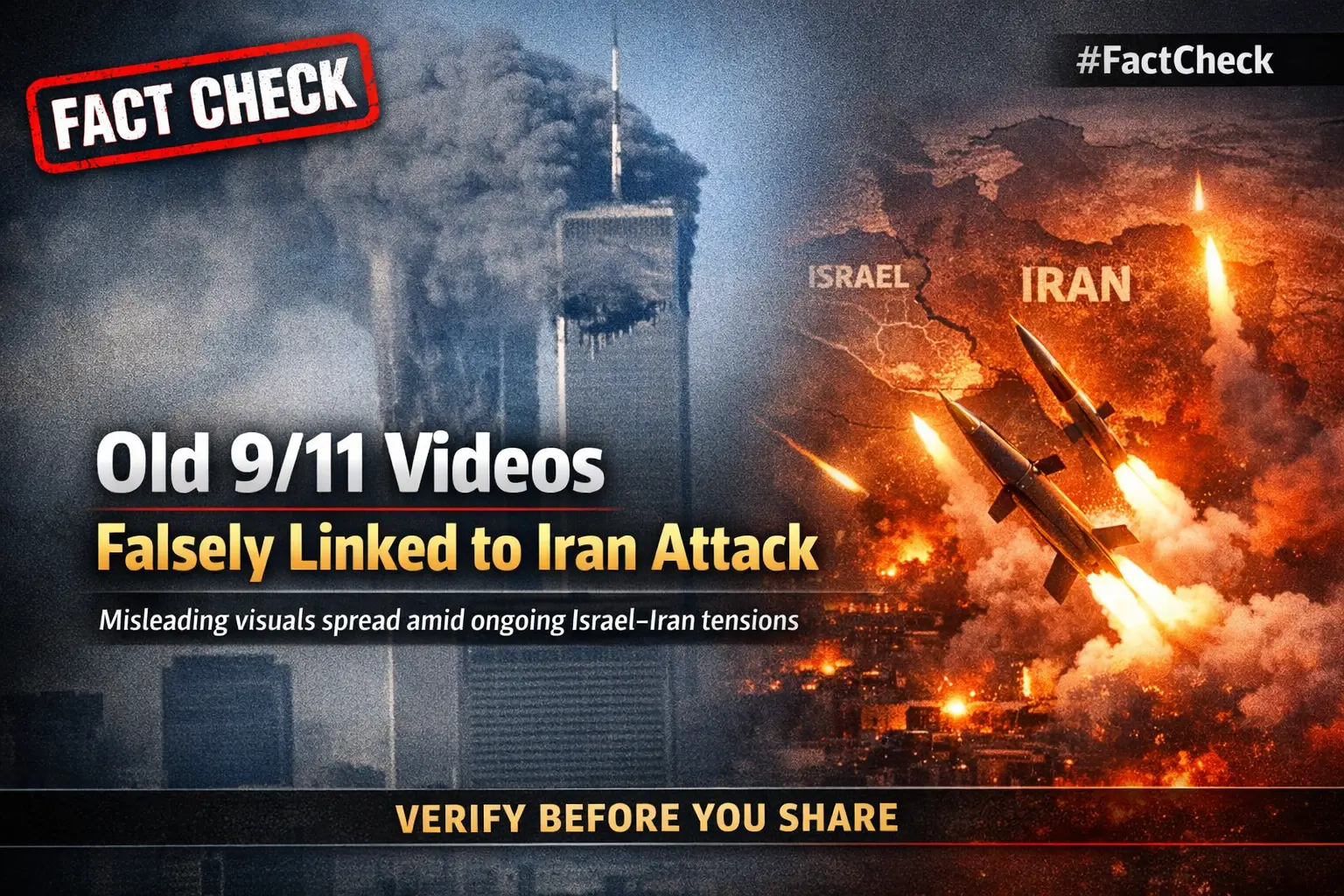
Amid the ongoing war between the United States–Israel alliance and Iran since February 28, 2026, two videos are going viral across social media platforms. The clips show people running in panic, with visuals suggesting a large-scale attack. Users are sharing these videos with the claim that they depict Iran’s recent strikes on Israel. However, a research by the CyberPeace has found both claims to be false. The viral posts are misleading, as the videos are actually from the 9/11 terrorist attacks on the World Trade Center in New York, United States. They have no connection to the current conflict involving Iran or Israel.
Claim
A Facebook page titled ‘Bihar Ko Nihar’ shared one of the videos on March 25, 2026, with the caption: “Iran has launched its most powerful attack on Israel so far. Thousands of soldiers are reported dead, triggering massive protests within the country, and Israel appears completely helpless.” Similarly, another video is being circulated with the false claim that Iran has launched a missile attack on the United States.
The above claims are being widely shared by multiple users across different social media platforms. Archived versions of these posts are also available.
- https://www.facebook.com/reel/4317571078525937
- https://www.facebook.com/reel/1485000739860984
- https://perma.cc/E98R-A4CT

Fact Check
To verify the authenticity of the videos, keyframes were extracted and analyzed using Google Lens. The first viral clip was traced back to a YouTube video uploaded on September 11, 2007, by a channel named ‘Jumperwtc’, which clearly identifies the footage as being from the World Trade Center attacks in the United States. This confirms that the viral video is a segment from that older footage.

For the second video, reverse image searches led to a report published on CBS8.com on September 10, 2021, where the same visuals were found. Further reesearch revealed that the footage also appears in a video uploaded on September 11, 2021, by the YouTube channel ‘CBS 8 San Diego’. The viral segment can be seen around the 1:11 timestamp in that video.

Conclusion
Both viral videos being shared as recent attacks by Iran on Israel or the United States are actually old clips from the 9/11 attacks on the World Trade Center in New York. The claims are false, and the videos are unrelated to the ongoing conflict in West Asia.

Introduction:
Digital Forensics, as the term goes, “It is the process of collecting, preserving, identifying, analyzing, and presenting digital evidence in a way that the evidence is legally admitted.”
It is like a detective work in the digital realm, where investigators use various specific methods to find deleted files and to reveal destroyed messages.
The reason why Digital Forensics is an important field is because with the advancement of technology and the use of digital devices, the role of Digital Forensics in preserving the evidence and protecting our data from cybercrime is becoming more and more crucial.
Digital Forensics is used in various situations such as:
- Criminal Investigations: Digital Forensics enables investigators to trace back cyber threat actors and further identify victims of the crime to gather evidence needed to punish criminals.
- Legal issues: Digital Forensics might aid in legal matters involving intellectual property infringement and data breaches etc.
Types of Digital Data in Digital Forensics:
1.Persistent (Non-volatile) Data :-
- This type of Data Remains Intact When The Computer Is Turned Off.
- ex. Hard-disk, Flash-drives
2. Volatile Data :-
- These types of Data Would Be Lost When The Computer Is Turned Off.
- ex. Temp. Files, Unsaved OpenFiles, etc.
The Digital Forensics Process
The process is as follows

- Evidence Acquisition: This process involves making an exact copy (forensic image) of the storage devices such as hard drives, SSD or mobile devices. The goal is to preserve the original data without changing it.
- Data Recovery: After acquiring the forensic image, the analysts use tools to recover deleted, hidden or the encrypted data inside the device .
- Timeline Analysis: Analysts use timestamp information from files, and system logs to reconstruct the timeline of activities on a device. This helps in understanding how an incident spanned out and who was involved in it.
- Malware Analysis: In cases involving security breaches, analysts analyze malware samples to understand their behavior, impact, and origins. various reverse engineering techniques are used to analyze the malicious code.
Types of tools:
- Faraday Bags: Faraday bags are generally the first step in digital evidence capture. These bags are generally made of conductive materials, which are used to shield our electronic devices from external waves such as WiFi, Bluetooth, and mobile cellular signals, which in turn protects the digital evidence from external tampering.
- Data recovery : These types of software are generally used for the recovery of deleted files and their associated data. Ex. Magnet Forensics, Access data, X-Ways
- Disk imaging and analysis :These types of softwares are Generally used to replicate the data storage devices and then perform further analysis on it ex. FTKImager, Autopsy, and, Sleuth Kit
- File carving tools: They are generally used to extract information from the embedded files in the image made. Ex.Foremost, Binwalk, Scalpel
Some common tools:
- EnCase: It is a tool for acquiring, analyzing, and reporting digital evidence.
- Autopsy: It is an open-source platform generally used for analyzing hard drives and smartphones.
- Volatility: It is a framework used generally for memory forensics to analyze volatile memory dumps and extract info.
- Sleuth Kit: It is a package of CLI tools for investigating disk images and its associated file systems.
- Cellebrite UFED: It is a tool generally used for mobile forensics.
Challenges in the Field:
- Encryption: Encryption plays a major challenge as the encrypted data requires specialized techniques and tools for decryption.
- Anti-Forensic Techniques: Anti-Forensics techniques play a major challenge as the criminals often use anti-forensic methods to cover their tracks, making it challenging to get the digital evidence.
- Data Volume and Complexity: The large volume of digital data and the diversity of various devices create challenges in evidence collection and analysis.
The Future of Digital Forensics: A Perspective
With the growth of technology and the vast presence of digital data, the challenges and opportunities in Digital Forensics keep on updating themselves. Due to the onset of new technology and the ever growing necessity of cloud storage, mobile devices, and the IoT (Internet of Things), investigators will have to develop new strategies and should be ready to adapt and learn from the new shaping of the tech world.
Conclusion:
Digital Forensics is an essential field in the recent era for ensuring fairness in the digital era. By collecting, inspecting, and analyzing the digital data, the Digital Forensics investigators can arrive lawfully at the prosecution of criminals and the settlement of civil disputes. Nowadays with technology on one hand progressing continuously, the discipline of Digital Forensics will certainly become even more pivotal in the case of investigations in the years to come.
