
#FactCheck- AI-Generated Image of Narendra Modi Goes Viral Ahead of Kerala Elections
Executive Summary
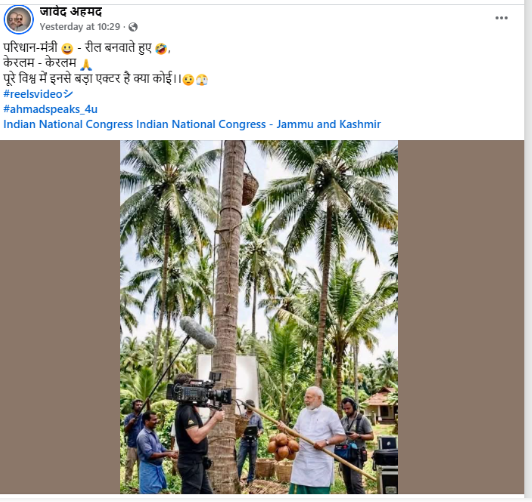
As Kerala gears up for its upcoming Assembly elections, political activity has intensified across the state. Amid this charged atmosphere, a purported image of Narendra Modi has gone viral on social media. The image shows the Prime Minister holding coconuts, with several photographers around him. It is being claimed that the photo was taken during his recent visit for the 2026 Kerala Assembly election campaign.
However, an research by the CyberPeace has debunked the claim, confirming that the image is fake and generated using artificial intelligence.
Claim
A Facebook user named “Javed Ahmad” shared the viral image on April 6, 2026, with a sarcastic caption suggesting that the Prime Minister was posing for reels during his Kerala visit.
- https://www.facebook.com/Ahmadspeaks4u/posts/pfbid0aRnhwXBjnfSXF9S48vaH1gTQrGQmxnRmhpJCRxMWazqLJhYs6zxM9rot51qtBgRLl
- https://perma.cc/N3AM-Q2YC
Fact Check
To verify the claim, we conducted keyword searches on Google but found no credible news reports supporting it. A reverse image search also did not yield any reliable sources. Additionally, a thorough review of the Prime Minister’s official social media accounts showed no trace of such an image or event. Given these inconsistencies, suspicion arose about the image’s authenticity.
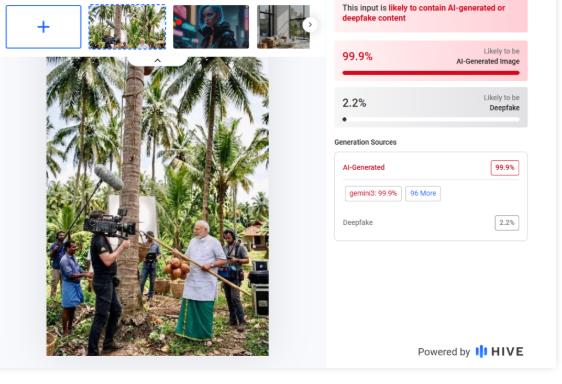
The viral image was then analyzed using AI detection tools. Results from HIVE Moderation indicated a 99% probability that the image is AI-generated.
Another tool, Wasit AI, also confirmed that the image is artificially created.

Conclusion
The claim is false. The viral image of Prime Minister Narendra Modi is not real and has been generated using AI tools, likely similar to Google AI.

Related Blogs

Executive Summary
Israel’s parliament, the Knesset, recently passed a bill allowing military courts to impose the death penalty on Palestinians convicted of killing Israelis. Amid this backdrop, a video has gone viral on social media showing men in black uniforms beating detainees inside a prison, with claims linking it to alleged torture by Israeli forces. However, a research by the CyberPeace found the claim to be false. The viral video is not related to Israel or any real incident, but is actually from an Iraqi television series titled “Beit Umm Layla.”
Claim
Sharing the video, a user on X (formerly Twitter) wrote:“Live footage: IDF soldiers always torture Palestinian hostages before executing them. Please don’t let us die in silence.”

Fact Check
To verify the claim, we extracted keyframes from the viral video and conducted a reverse image search. This led us to a longer version of the clip posted on March 9 by the Iraqi channel Al-Iraqiya on its Facebook and Instagram pages.
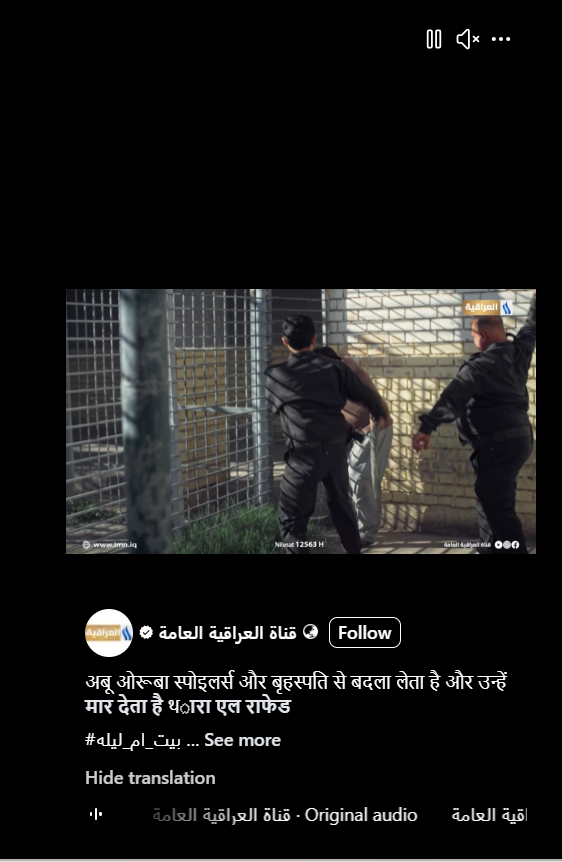

The posts clearly identified the footage as part of “Beit Umm Layla,” a popular Iraqi TV series. Further research showed that the full series is available on Al-Iraqiya’s official YouTube channel, where 25 episodes were uploaded between February 19 and March 20. The viral clip corresponds to Episode 16 of the show.

Additionally, information available on the Arabic entertainment website elCinema indicates that the series, released on February 18, is a socio-political drama focusing on prisoners and the psychological struggles faced by them and their families.
Conclusion
The viral claim is false and misleading. The video does not depict any real incident involving Israeli forces or Palestinian detainees. Instead, it is a fictional scene from an Iraqi television drama series.There is no credible evidence to support the claim that the footage shows torture by Israeli soldiers. The clip has been taken out of context and shared with a misleading narrative to provoke emotional reactions.

Executive Summary:
A video clip being circulated on social media allegedly shows the Hon’ble President of India, Smt. Droupadi Murmu, the TV anchor Anjana Om Kashyap and the Hon’ble Chief Minister of Uttar Pradesh, Shri Yogi Adityanath promoting a medicine for diabetes. While The CyberPeace Research Team did a thorough investigation, the claim was found to be not true. The video was digitally edited, with original footage of the heavy weight persons being altered to falsely suggest their endorsement of the medication. Specific discrepancies were found in the lip movements and context of the clips which indicated AI Manipulation. Additionally, the distinguished persons featured in the video were actually discussing unrelated topics in their original footage. Therefore, the claim that the video shows endorsements of a diabetes drug by such heavy weights is debunked. The conclusion drawn from the analysis is that the video is an AI creation and does not reflect any genuine promotion. Furthermore, it's also detected by AI voice detection tools.

Claims:
A video making the rounds on social media purporting to show the Hon'ble President of India, Smt. Draupadi Murmu, TV anchor Anjana Om Kashyap, and Hon'ble Chief Minister of Uttar Pradesh Shri Yogi Adityanath giving their endorsement to a diabetes medicine.

Fact Check:
Upon receiving the post we carefully watched the video and certainly found some discrepancies between lip synchronization and the word that we can hear. Also the voice of Chief Minister of Uttar Pradesh Shri Yogi Adityanath seems to be suspicious which clearly indicates some sign of fabrication. In the video, we can hear Hon'ble President of India Smt. Droupadi Murmu endorses a medicine that cured her diabetes. We then divided the video into keyframes, and reverse-searched one of the frames of the video. We landed on a video uploaded by Aaj Tak on their official YouTube Channel.

We found something similar to the same viral video, we can see the courtesy written as Sansad TV. Taking a cue from this we did some keyword searches and found another video uploaded by the YouTube Channel Sansad TV. In this video, we found no mention of any diabetes medicine. It was actually the Swearing in Ceremony of the Hon’ble President of India, Smt. Droupadi Murmu.

In the second part, there was a man addressed as Dr. Abhinash Mishra who allegedly invented the medicine that cures diabetes. We reverse-searched the image of that person and landed at a CNBC news website where the same face was identified as Dr Atul Gawande who is a professor at Harvard School of Public Health. We watched the video and found no sign of endorsing or talking about any diabetes medicine he invented.

We also extracted the audio from the viral video and analyzed it using the AI audio detection tool named Eleven Labs, which found the audio very likely to be created using the AI Voice generation tool with the probability of 98%.

Hence, the Claim made in the viral video is false and misleading. The Video is digitally edited using different clips and the audio is generated using the AI Voice creation tool to mislead netizens. It is worth noting that we have previously debunked such voice-altered news with bogus claims.
Conclusion:
In conclusion, the viral video claiming that Hon'ble President of India, Smt. Droupadi Murmu and Chief Minister of Uttar Pradesh Shri Yogi Adityanath promoted a diabetes medicine that cured their diabetes, is found to be false. Upon thorough investigation it was found that the video is digitally edited from different clips, the clip of Hon'ble President of India, Smt. Droupadi Murmu is taken from the clip of Oath Taking Ceremony of 15th President of India and the claimed doctor Abhinash Mishra whose video was found in CNBC News Outlet. The real name of the person is Dr. Atul Gawande who is a professor at Harvard School of Public Health. Online users must be careful while receiving such posts and should verify before sharing them with others.
Claim: A video is being circulated on social media claiming to show distinguished individuals promoting a particular medicine for diabetes treatment.
Claimed on: Facebook
Fact Check: Fake & Misleading

Executive Summary:
A viral claim circulated in social media that Anant Ambani and Radhika Merchant wore clothes made of pure gold during their pre-wedding cruise party in Europe. Thorough analysis revealed abnormalities in image quality, particularly between the face, neck, and hands compared to the claimed gold clothing, leads to possible AI manipulation. A keyword search found no credible news reports or authentic images supporting this claim. Further analysis using AI detection tools, TrueMedia and Hive Moderator, confirmed substantial evidence of AI fabrication, with a high probability of the image being AI-generated or a deep fake. Additionally, a photo from a previous event at Jio World Plaza matched with the pose of the manipulated image, further denying the claim and indicating that the image of Anant Ambani and Radhika Merchant wearing golden outfit during their pre-wedding cruise was digitally altered.

Claims:
Anant Ambani and Radhika Merchant wore clothes made of pure gold during their pre-wedding cruise party in Europe.


Fact Check:
When we received the posts, we found anomalies that were usually found in edited images or AI manipulated images, particularly between the face, neck, and hands.

It’s very unusual in any image. So we then checked in AI Image detection software named Hive Moderation detection tool and found it to be 95.9% AI manipulated.

We also checked with another widely used AI detection tool named True Media. True Media also found it to be 100% to be made using AI.


This implies that the image is AI-generated. To find the original image that has been edited, we did keyword search. We found an image with the same pose as in the manipulated image, with the title "Radhika Merchant, Anant Ambani pose with Mukesh Ambani at Jio World Plaza opening”. The two images can be compared to verify that the digitally altered image is the same.

Hence, it’s confirmed that the viral image is digitally altered and has no connection with the 2nd Pre-wedding cruise party in Europe. Thus the viral image is fake and misleading.
Conclusion:
The claim that Anant Ambani and Radhika Merchant wore clothes made of pure gold at their pre-wedding cruise party in Europe is false. The analysis of the image showed signs of manipulation, and a lack of credible news reports or authentic photos supports that it was likely digitally altered. AI detection tools confirmed a high probability that the image was fake, and a comparison with a genuine photo from another event revealed that the image had been edited. Therefore, the claim is false and misleading.
- Claim: Anant Ambani and Radhika Merchant wore clothes made of pure gold during their pre-wedding cruise party in Europe.
- Claimed on: YouTube, LinkedIn, Instagram
- Fact Check: Fake & Misleading
