
#FactCheck -AI-Generated Image Falsely Shows Amit Shah and Jay Shah Travelling in Charter Plane Amid Austerity Appeal
Executive Summary
Prime Minister Narendra Modi recently appealed to citizens to reduce the consumption of gold and edible oil for a year. He also urged people to conserve petrol, diesel, and cooking gas amid the crisis arising from the ongoing tensions in West Asia involving the United States, Israel, and Iran. Amid this backdrop, a purported image of Union Home Minister Amit Shah and his son Jay Shah, who currently serves as Chairman of the International Cricket Council, has gone viral on social media. The image shows them seated inside a chartered aircraft along with two other individuals. Several social media users shared the picture as genuine while targeting the central government and Amit Shah.
However, CyberPeace Research Wing reseach found that the viral image is fake and was generated using Artificial Intelligence (AI).
Claim
An Instagram user named “Om Prakash Shukla” shared the viral image on May 24, 2026, with the caption:“People are sacrificing their desires for the nation, while they are enjoying luxury.”
https://www.instagram.com/p/DYuFqnmCh7T

Fact Check
To verify the authenticity of the viral image, we conducted a Google Lens search. However, the image was not found on any credible news platform, which raised suspicion about its authenticity. We also performed keyword-based searches related to the image using Google Search, but found no authentic reports or media coverage associated with the picture.
Further reseach involved analysing the image using AI detection tools. We first examined the picture using the “Sight Engine” AI detection tool, which indicated a 99 percent probability that the image was AI-generated.
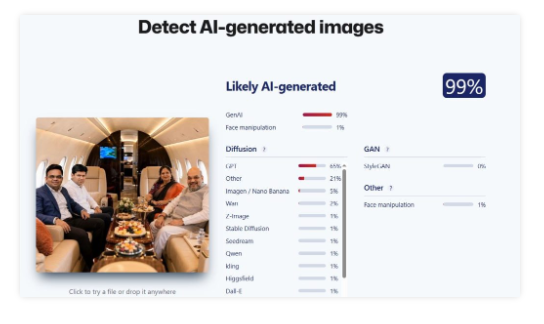
We also tested the image using another AI detection platform called “TruthScan.” This tool likewise suggested, with around 97 percent probability, that the image had been created using artificial intelligence

Conclusion
The reseach found that the viral image featuring Union Home Minister Amit Shah and ICC Chairman Jay Shah inside a chartered aircraft is AI-generated. The image was digitally created using AI tools, and the viral claim associated with it is false.

Related Blogs

Overview:
The rapid digitization of educational institutions in India has created both opportunities and challenges. While technology has improved access to education and administrative efficiency, it has also exposed institutions to significant cyber threats. This report, published by CyberPeace, examines the types, causes, impacts, and preventive measures related to cyber risks in Indian educational institutions. It highlights global best practices, national strategies, and actionable recommendations to mitigate these threats.

Significance of the Study:
The pandemic-induced shift to online learning, combined with limited cybersecurity budgets, has made educational institutions prime targets for cyberattacks. These threats compromise sensitive student, faculty, and institutional data, leading to operational disruptions, financial losses, and reputational damage. Globally, educational institutions face similar challenges, emphasizing the need for universal and localized responses.
Threat Faced by Education Institutions:
Based on the insights from the CyberPeace’s report titled 'Exploring Cyber Threats and Digital Risks in Indian Educational Institutions', this concise blog provides a comprehensive overview of cybersecurity threats and risks faced by educational institutions, along with essential details to address these challenges.
🎣 Phishing: Phishing is a social engineering tactic where cyber criminals impersonate trusted sources to steal sensitive information, such as login credentials and financial details. It often involves deceptive emails or messages that lead to counterfeit websites, pressuring victims to provide information quickly. Variants include spear phishing, smishing, and vishing.
💰 Ransomware: Ransomware is malware that locks users out of their systems or data until a ransom is paid. It spreads through phishing emails, malvertising, and exploiting vulnerabilities, causing downtime, data leaks, and theft. Ransom demands can range from hundreds to hundreds of thousands of dollars.
🌐 Distributed Denial of Service (DDoS): DDoS attacks overwhelm servers, denying users access to websites and disrupting daily operations, which can hinder students and teachers from accessing learning resources or submitting assignments. These attacks are relatively easy to execute, especially against poorly protected networks, and can be carried out by amateur cybercriminals, including students or staff, seeking to cause disruptions for various reasons
🕵️ Cyber Espionage: Higher education institutions, particularly research-focused universities, are vulnerable to spyware, insider threats, and cyber espionage. Spyware is unauthorized software that collects sensitive information or damages devices. Insider threats arise from negligent or malicious individuals, such as staff or vendors, who misuse their access to steal intellectual property or cause data leaks..
🔒 Data Theft: Data theft is a major threat to educational institutions, which store valuable personal and research information. Cybercriminals may sell this data or use it for extortion, while stealing university research can provide unfair competitive advantages. These attacks can go undetected for long periods, as seen in the University of California, Berkeley breach, where hackers allegedly stole 160,000 medical records over several months.
🛠️ SQL Injection: SQL injection (SQLI) is an attack that uses malicious code to manipulate backend databases, granting unauthorized access to sensitive information like customer details. Successful SQLI attacks can result in data deletion, unauthorized viewing of user lists, or administrative access to the database.
🔍Eavesdropping attack: An eavesdropping breach, or sniffing, is a network attack where cybercriminals steal information from unsecured transmissions between devices. These attacks are hard to detect since they don't cause abnormal data activity. Attackers often use network monitors, like sniffers, to intercept data during transmission.
🤖 AI-Powered Attacks: AI enhances cyber attacks like identity theft, password cracking, and denial-of-service attacks, making them more powerful, efficient, and automated. It can be used to inflict harm, steal information, cause emotional distress, disrupt organizations, and even threaten national security by shutting down services or cutting power to entire regions
Insights from Project eKawach
The CyberPeace Research Wing, in collaboration with SAKEC CyberPeace Center of Excellence (CCoE) and Autobot Infosec Private Limited, conducted a study simulating educational institutions' networks to gather intelligence on cyber threats. As part of the e-Kawach project, a nationwide initiative to strengthen cybersecurity, threat intelligence sensors were deployed to monitor internet traffic and analyze real-time cyber attacks from July 2023 to April 2024, revealing critical insights into the evolving cyber threat landscape.
Cyber Attack Trends
Between July 2023 and April 2024, the e-Kawach network recorded 217,886 cyberattacks from IP addresses worldwide, with a significant portion originating from countries including the United States, China, Germany, South Korea, Brazil, Netherlands, Russia, France, Vietnam, India, Singapore, and Hong Kong. However, attributing these attacks to specific nations or actors is complex, as threat actors often use techniques like exploiting resources from other countries, or employing VPNs and proxies to obscure their true locations, making it difficult to pinpoint the real origin of the attacks.
Brute Force Attack:
The analysis uncovered an extensive use of automated tools in brute force attacks, with 8,337 unique usernames and 54,784 unique passwords identified. Among these, the most frequently targeted username was “root,” which accounted for over 200,000 attempts. Other commonly targeted usernames included: "admin", "test", "user", "oracle", "ubuntu", "guest", "ftpuser", "pi", "support"
Similarly, the study identified several weak passwords commonly targeted by attackers. “123456” was attempted over 3,500 times, followed by “password” with over 2,500 attempts. Other frequently targeted passwords included: "1234", "12345", "12345678", "admin", "123", "root", "test", "raspberry", "admin123", "123456789"

Insights from Threat Landscape Analysis
Research done by the USI - CyberPeace Centre of Excellence (CCoE) and Resecurity has uncovered several breached databases belonging to public, private, and government universities in India, highlighting significant cybersecurity threats in the education sector. The research aims to identify and mitigate cybersecurity risks without harming individuals or assigning blame, based on data available at the time, which may evolve with new information. Institutions were assigned risk ratings that descend from A to F, with most falling under a D rating, indicating numerous security vulnerabilities. Institutions rated D or F are 5.4 times more likely to experience data breaches compared to those rated A or B. Immediate action is recommended to address the identified risks.


Risk Findings :
The risk findings for the institutions are summarized through a pie chart, highlighting factors such as data breaches, dark web activity, botnet activity, and phishing/domain squatting. Data breaches and botnet activity are significantly higher compared to dark web leakages and phishing/domain squatting. The findings show 393,518 instances of data breaches, 339,442 instances of botnet activity, 7,926 instances related to the dark web and phishing & domain activity - 6711.

Key Indicators: Multiple instances of data breaches containing credentials (email/passwords) in plain text.


- Botnet activity indicating network hosts compromised by malware.

- Credentials from third-party government and non-governmental websites linked to official institutional emails

- Details of software applications, drivers installed on compromised hosts.

- Sensitive cookie data exfiltrated from various browsers.


- IP addresses of compromised systems.
- Login credentials for different Android applications.

Below is the sample detail of one of the top educational institutions that provides the insights about the higher rate of data breaches, botnet activity, dark web activities and phishing & domain squatting.
Risk Detection:
It indicates the number of data breaches, network hygiene, dark web activities, botnet activities, cloud security, phishing & domain squatting, media monitoring and miscellaneous risks. In the below example, we are able to see the highest number of data breaches and botnet activities in the sample particular domain.

Risk Changes:

Risk by Categories:

Risk is categorized with factors such as high, medium and low, the risk is at high level for data breaches and botnet activities.

Challenges Faced by Educational Institutions
Educational institutions face cyberattack risks, the challenges leading to cyberattack incidents in educational institutions are as follows:
🔒 Lack of a Security Framework: A key challenge in cybersecurity for educational institutions is the lack of a dedicated framework for higher education. Existing frameworks like ISO 27001, NIST, COBIT, and ITIL are designed for commercial organizations and are often difficult and costly to implement. Consequently, many educational institutions in India do not have a clearly defined cybersecurity framework.
🔑 Diverse User Accounts: Educational institutions manage numerous accounts for staff, students, alumni, and third-party contractors, with high user turnover. The continuous influx of new users makes maintaining account security a challenge, requiring effective systems and comprehensive security training for all users.
📚 Limited Awareness: Cybersecurity awareness among students, parents, teachers, and staff in educational institutions is limited due to the recent and rapid integration of technology. The surge in tech use, accelerated by the pandemic, has outpaced stakeholders' ability to address cybersecurity issues, leaving them unprepared to manage or train others on these challenges.
📱 Increased Use of Personal/Shared Devices: The growing reliance on unvetted personal/Shared devices for academic and administrative activities amplifies security risks.
💬 Lack of Incident Reporting: Educational institutions often neglect reporting cyber incidents, increasing vulnerability to future attacks. It is essential to report all cases, from minor to severe, to strengthen cybersecurity and institutional resilience.
Impact of Cybersecurity Attacks on Educational Institutions
Cybersecurity attacks on educational institutions lead to learning disruptions, financial losses, and data breaches. They also harm the institution's reputation and pose security risks to students. The following are the impacts of cybersecurity attacks on educational institutions:
📚Impact on the Learning Process: A report by the US Government Accountability Office (GAO) found that cyberattacks on school districts resulted in learning losses ranging from three days to three weeks, with recovery times taking between two to nine months.
💸Financial Loss: US schools reported financial losses ranging from $50,000 to $1 million due to expenses like hardware replacement and cybersecurity upgrades, with recovery taking an average of 2 to 9 months.
🔒Data Security Breaches: Cyberattacks exposed sensitive data, including grades, social security numbers, and bullying reports. Accidental breaches were often caused by staff, accounting for 21 out of 25 cases, while intentional breaches by students, comprising 27 out of 52 cases, frequently involved tampering with grades.
⚠️Data Security Breach: Cyberattacks on schools result in breaches of personal information, including grades and social security numbers, causing emotional, physical, and financial harm. These breaches can be intentional or accidental, with a US study showing staff responsible for most accidental breaches (21 out of 25) and students primarily behind intentional breaches (27 out of 52) to change grades.
🏫Impact on Institutional Reputation: Cyberattacks damaged the reputation of educational institutions, eroding trust among students, staff, and families. Negative media coverage and scrutiny impacted staff retention, student admissions, and overall credibility.
🛡️ Impact on Student Safety: Cyberattacks compromised student safety and privacy. For example, breaches like live-streaming school CCTV footage caused severe distress, negatively impacting students' sense of security and mental well-being.
CyberPeace Advisory:
CyberPeace emphasizes the importance of vigilance and proactive measures to address cybersecurity risks:
- Develop effective incident response plans: Establish a clear and structured plan to quickly identify, respond to, and recover from cyber threats. Ensure that staff are well-trained and know their roles during an attack to minimize disruption and prevent further damage.
- Implement access controls with role-based permissions: Restrict access to sensitive information based on individual roles within the institution. This ensures that only authorized personnel can access certain data, reducing the risk of unauthorized access or data breaches.
- Regularly update software and conduct cybersecurity training: Keep all software and systems up-to-date with the latest security patches to close vulnerabilities. Provide ongoing cybersecurity awareness training for students and staff to equip them with the knowledge to prevent attacks, such as phishing.
- Ensure regular and secure backups of critical data: Perform regular backups of essential data and store them securely in case of cyber incidents like ransomware. This ensures that, if data is compromised, it can be restored quickly, minimizing downtime.
- Adopt multi-factor authentication (MFA): Enforce Multi-Factor Authentication(MFA) for accessing sensitive systems or information to strengthen security. MFA adds an extra layer of protection by requiring users to verify their identity through more than one method, such as a password and a one-time code.
- Deploy anti-malware tools: Use advanced anti-malware software to detect, block, and remove malicious programs. This helps protect institutional systems from viruses, ransomware, and other forms of malware that can compromise data security.
- Monitor networks using intrusion detection systems (IDS): Implement IDS to monitor network traffic and detect suspicious activity. By identifying threats in real time, institutions can respond quickly to prevent breaches and minimize potential damage.
- Conduct penetration testing: Regularly conduct penetration testing to simulate cyberattacks and assess the security of institutional networks. This proactive approach helps identify vulnerabilities before they can be exploited by actual attackers.
- Collaborate with cybersecurity firms: Partner with cybersecurity experts to benefit from specialized knowledge and advanced security solutions. Collaboration provides access to the latest technologies, threat intelligence, and best practices to enhance the institution's overall cybersecurity posture.
- Share best practices across institutions: Create forums for collaboration among educational institutions to exchange knowledge and strategies for cybersecurity. Sharing successful practices helps build a collective defense against common threats and improves security across the education sector.
Conclusion:
The increasing cyber threats to Indian educational institutions demand immediate attention and action. With vulnerabilities like data breaches, botnet activities, and outdated infrastructure, institutions must prioritize effective cybersecurity measures. By adopting proactive strategies such as regular software updates, multi-factor authentication, and incident response plans, educational institutions can mitigate risks and safeguard sensitive data. Collaborative efforts, awareness, and investment in cybersecurity will be essential to creating a secure digital environment for academia.

Introduction
The term ‘super spreader’ is used to refer to social media and digital platform accounts that are able to quickly transmit information to a significantly large audience base in a short duration. The analogy references the medical term, where a small group of individuals is able to rapidly amplify the spread of an infection across a huge population. The fact that a few handful accounts are able to impact and influence many is attributed to a number of factors like large follower bases, high engagement rates, content attractiveness or virality and perceived credibility.
Super spreader accounts have become a considerable threat on social media because they are responsible for generating a large amount of low-credibility material online. These individuals or groups may create or disseminate low-credibility content for a number of reasons, running from social media fame to garnering political influence, from intentionally spreading propaganda to seeking financial gains. Given the exponential reach of these accounts, identifying, tracing and categorising such accounts as the sources of misinformation can be tricky. It can be equally difficult to actually recognise the content they spread for the misinformation that it actually is.
How Do A Few Accounts Spark Widespread Misinformation?
Recent research suggests that misinformation superspreaders, who consistently distribute low-credibility content, may be the primary cause of the issue of widespread misinformation about different topics. A study[1] by a team of social media analysts at Indiana University has found that a significant portion of tweets spreading misinformation are sent by a small percentage of a given user base. The researchers conducted a review of 2,397,388 tweets posted on Twitter (now X) that were flagged as having low credibility and details on who was sending them. The study found that it does not take a lot of influencers to sway the beliefs and opinions of large numbers. This is attributed to the impact of what they describe as superspreaders. The researchers collected 10 months of data, which added up to 2,397,388 tweets sent by 448,103 users, and then reviewed it, looking for tweets that were flagged as containing low-credibility information. They found that approximately a third of the low-credibility tweets had been posted by people using just 10 accounts, and that just 1,000 accounts were responsible for posting approximately 70% of such tweets.[2]
Case Study
- How Misinformation ‘Superspreaders’ Seed False Election Theories
During the 2020 U.S. presidential election, a small group of "repeat spreaders" aggressively pushed false election claims across various social media platforms for political gain, and this even led to rallies and radicalisation in the U.S.[3] Superspreaders accounts were responsible for disseminating a disproportionately large amount of misinformation related to the election, influencing public opinion and potentially undermining the electoral process.
In the domestic context, India was ranked highest for the risk of misinformation and disinformation according to experts surveyed for the World Economic Forum’s 2024 Global Risk Report. In today's digital age, misinformation, deep fakes, and AI-generated fakes pose a significant threat to the integrity of elections and democratic processes worldwide. With 64 countries conducting elections in 2024, the dissemination of false information carries grave implications that could influence outcomes and shape long-term socio-political landscapes. During the 2024 Indian elections, we witnessed a notable surge in deepfake videos of political personalities, raising concerns about the influence of misinformation on election outcomes.
- Role of Superspreaders During Covid-19
Clarity in public health communication is important when any grey areas or gaps in information can be manipulated so quickly. During the COVID-19 pandemic, misinformation related to the virus, vaccines, and public health measures spread rapidly on social media platforms, including Twitter (Now X). Some prominent accounts or popular pages on platforms like Facebook and Twitter(now X) were identified as superspreaders of COVID-19 misinformation, contributing to public confusion and potentially hindering efforts to combat the pandemic.
As per the Center for Countering Digital Hate Inc (US), The "disinformation dozen," a group of 12 prominent anti-vaccine accounts[4], were found to be responsible for a large amount of anti-vaccine content circulating on social media platforms, highlighting the significant role of superspreaders in influencing public perceptions and behaviours during a health crisis.
There are also incidents where users are unknowingly engaged in spreading misinformation by forwarding information or content which are not always shared by the original source but often just propagated by amplifiers, using other sources, websites, or YouTube videos that help in dissemination. The intermediary sharers amplify these messages on their pages, which is where it takes off. Hence such users do not always have to be the ones creating or deliberately popularising the misinformation, but they are the ones who expose more people to it because of their broad reach. This was observed during the pandemic when a handful of people were able to create a heavy digital impact sharing vaccine/virus-related misinformation.
- Role of Superspreaders in Influencing Investments and Finance
Misinformation and rumours in finance may have a considerable influence on stock markets, investor behaviour, and national financial stability. Individuals or accounts with huge followings or influence in the financial niche can operate as superspreaders of erroneous information, potentially leading to market manipulation, panic selling, or incorrect impressions about individual firms or investments.
Superspreaders in the finance domain can cause volatility in markets, affect investor confidence, and even trigger regulatory responses to address the spread of false information that may harm market integrity. In fact, there has been a rise in deepfake videos, and fake endorsements, with multiple social media profiles providing unsanctioned investing advice and directing followers to particular channels. This leads investors into dangerous financial decisions. The issue intensifies when scammers employ deepfake videos of notable personalities to boost their reputation and can actually shape people’s financial decisions.
Bots and Misinformation Spread on Social Media
Bots are automated accounts that are designed to execute certain activities, such as liking, sharing, or retweeting material, and they can broaden the reach of misinformation by swiftly spreading false narratives and adding to the virality of a certain piece of content. They can also artificially boost the popularity of disinformation by posting phony likes, shares, and comments, making it look more genuine and trustworthy to unsuspecting users. Bots can exploit social network algorithms by establishing false identities that interact with one another and with real users, increasing the spread of disinformation and pushing it to the top of users' feeds and search results.
Bots can use current topics or hashtags to introduce misinformation into popular conversations, allowing misleading information to acquire traction and reach a broader audience. They can lead to the construction of echo chambers, in which users are exposed to a narrow variety of perspectives and information, exacerbating the spread of disinformation inside restricted online groups. There are incidents reported where bot's were found as the sharers of content from low-credibility sources.
Bots are frequently employed as part of planned misinformation campaigns designed to propagate false information for political, ideological, or commercial gain. Bots, by automating the distribution of misleading information, can make it impossible to trace the misinformation back to its source. Understanding how bots work and their influence on information ecosystems is critical for combatting disinformation and increasing digital literacy among social media users.
CyberPeace Policy Recommendations
- Recommendations/Advisory for Netizens:
- Educating oneself: Netizens need to stay informed about current events, reliable fact-checking sources, misinformation counter-strategies, and common misinformation tactics, so that they can verify potentially problematic content before sharing.
- Recognising the threats and vulnerabilities: It is important for netizens to understand the consequences of spreading or consuming inaccurate information, fake news, or misinformation. Netizens must be cautious of sensationalised content spreading on social media as it might attempt to provoke strong reactions or to mold public opinions. Netizens must consider questioning the credibility of information, verifying its sources, and developing cognitive skills to identify low-credibility content and counter misinformation.
- Practice caution and skepticism: Netizens are advised to develop a healthy skepticism towards online information, and critically analyse the veracity of all information sources. Before spreading any strong opinions or claims, one must seek supporting evidence, factual data, and expert opinions, and verify and validate claims with reliable sources or fact-checking entities.
- Good netiquette on the Internet, thinking before forwarding any information: It is important for netizens to practice good netiquette in the online information landscape. One must exercise caution while sharing any information, especially if the information seems incorrect, unverified or controversial. It's important to critically examine facts and recognise and understand the implications of sharing false, manipulative, misleading or fake information/content. Netizens must also promote critical thinking and encourage their loved ones to think critically, verify information, seek reliable sources and counter misinformation.
- Adopting and promoting Prebunking and Debunking strategies: Prebunking and debunking are two effective strategies to counter misinformation. Netizens are advised to engage in sharing only accurate information and do fact-checking to debunk any misinformation. They can rely on reputable fact-checking experts/entities who are regularly engaged in producing prebunking and debunking reports and material. Netizens are further advised to familiarise themselves with fact-checking websites, and resources and verify the information.
- Recommendations for tech/social media platforms
- Detect, report and block malicious accounts: Tech/social media platforms must implement strict user authentication mechanisms to verify account holders' identities to minimise the formation of fraudulent or malicious accounts. This is imperative to weed out suspicious social media accounts, misinformation superspreader accounts and bots accounts. Platforms must be capable of analysing public content, especially viral or suspicious content to ascertain whether it is misleading, AI-generated, fake or deliberately misleading. Upon detection, platform operators must block malicious/ superspreader accounts. The same approach must apply to other community guidelines’ violations as well.
- Algorithm Improvements: Tech/social media platform operators must develop and deploy advanced algorithm mechanisms to detect suspicious accounts and recognise repetitive posting of misinformation. They can utilise advanced algorithms to identify such patterns and flag any misleading, inaccurate, or fake information.
- Dedicated Reporting Tools: It is important for the tech/social media platforms to adopt robust policies to take action against social media accounts engaged in malicious activities such as spreading misinformation, disinformation, and propaganda. They must empower users on the platforms to flag/report suspicious accounts, and misleading content or misinformation through user-friendly reporting tools.
- Holistic Approach: The battle against online mis/disinformation necessitates a thorough examination of the processes through which it spreads. This involves investing in information literacy education, modifying algorithms to provide exposure to varied viewpoints, and working on detecting malevolent bots that spread misleading information. Social media sites can employ similar algorithms internally to eliminate accounts that appear to be bots. All stakeholders must encourage digital literacy efforts that enable consumers to critically analyse information, verify sources, and report suspect content. Implementing prebunking and debunking strategies. These efforts can be further supported by collaboration with relevant entities such as cybersecurity experts, fact-checking entities, researchers, policy analysts and the government to combat the misinformation warfare on the Internet.
References:
- https://journals.plos.org/plosone/article?id=10.1371/journal.pone.0302201 {1}
- https://phys.org/news/2024-05-superspreaders-responsible-large-portion-misinformation.html#google_vignette {2}
- https://phys.org/news/2024-05-superspreaders-responsible-large-portion-misinformation.html#google_vignette {3}
- https://counterhate.com/research/the-disinformation-dozen/ {4}
- https://phys.org/news/2024-05-superspreaders-responsible-large-portion-misinformation.html#google_vignette
- https://journals.plos.org/plosone/article?id=10.1371/journal.pone.0302201
- https://www.nytimes.com/2020/11/23/technology/election-misinformation-facebook-twitter.html
- https://www.wbur.org/onpoint/2021/08/06/vaccine-misinformation-and-a-look-inside-the-disinformation-dozen
- https://healthfeedback.org/misinformation-superspreaders-thriving-on-musk-owned-twitter/
- https://www.ncbi.nlm.nih.gov/pmc/articles/PMC8139392/
- https://www.jmir.org/2021/5/e26933/
- https://www.yahoo.com/news/7-ways-avoid-becoming-misinformation-121939834.html
Introduction
We inhabit an era where digital connectivity, while empowering, has also unleashed a relentless tide of cyber vulnerabilities, where personal privacy is constantly threatened, and crimes like sextortion are the perfect example of the sinister side of our hyperconnected world. Social media platforms, instant messaging apps, and digital content-sharing tools have all grown rapidly, changing how people communicate with one another and making it harder to distinguish between the private and public domains. The rise of sophisticated cybercrimes that use the very tools meant to connect us is the price paid for this unparalleled convenience. Sextortion, a portmanteau of “sex’ and “extortion”, stands out among them as a particularly pernicious kind of internet exploitation. Under the threat of disclosing their private information, photos, or videos, people are forced to engage in sexual behaviours or provide intimate content. Sextortion’s psychological component is what makes it particularly harmful, it feeds on social stigma, shame, and fear, which discourage victims from reporting the crime and feed the cycle of victimisation and silence. This cybercrime targets vulnerable people from all socioeconomic backgrounds and is not limited by age, gender, or location.
The Economy of Shame: Sextortion as a Cybercrime Industry
A news report from June 03, 2025, reveals a sextortion racket busted in Delhi, where a money trail of over Rs. 5 crore was identified by different teams of the Crime branch. From synthetic financial identities to sextortion and other cyber frauds, a recipe for a sophisticated cybercrime chain was found. To believe this is an aberration is to overlook the reality that it is symptomatic of a much wider and largely uncharted criminal framework. According to the FBI’s 2024 IC3 report, “extortion (including sextortion)” has skyrocketed to 86,415 complaints with losses of $143 million reported in the United States (US) alone. This indicates that coercive image-based threats are no longer an isolated cybercrime but an everyday occurrence. Sextortion is no longer an isolated cybercrime; it has metamorphosed into a systematic, industrialised criminal enterprise. Another news report dated 19th July, 2025, where Delhi Police has detained four people suspected of participating in a sextortion scheme that targeted a resident of the Bhagwanpur Khera neighbourhood of Shahdara. The suspected people were allegedly arrested on a complaint wherein the victim was manipulated and fell prey to a dating site.
The threat is amplified by the usage of deepfake technology, which allows offenders to create obscene content that looks believable. The approach, which relies on the stigma attached to sexual imagery in conservative societies like India, is that victims frequently give in to requests out of fear of damaging their reputations. The combination of cybercrime and cutting-edge technology highlights the lopsided power that criminals possess, leaving victims defenceless and law enforcement unable to keep up.
Legal Remedies and the Evolving Battle Against Sextortion
Given the complexity of these crimes, India has recognised sextortion and similar cyber-enabled financial crimes under a number of legal frameworks. A change to recognising cyber-enabled sexual exploitation as an organised criminal business is shown by the introduction of specific provisions like Section 111 in the Bhartiya Nyaya Sanhita (BNS), 2023, which classifies organised cybercrimes including extortion and frauds which fall under its expansive interpretation, as a serious offence. Similarly, Section 318 (2) criminalises cheating with a maximum sentence of three years in prison or a fine, whereas Section 336 (2) makes digital forgery a crime with a maximum sentence with a maximum sentence of two years in prison or a fine. In addition to these regulations, cheating by personation through computer resources is punishable by the Information Technology Act, 2000, specifically Section 66D, which carries a maximum sentence of three years in prison and a maximum fine of Rs. 1 lakh. Due to issues with attribution, cross-border jurisdiction, and the discreet nature of digital evidence, enforcement is still inconsistent even with current statutory restrictions.
The government and its agencies recognise that laws achieve real impact only when backed by awareness initiatives and accessible, localised mechanisms for redressal. Several Indian states and the Department of Telecommunications launched numerous campaigns to educate the public about and safeguard their mobile communication assets against identity theft, financial fraud, and cyberscams. Initiatives like Cyber Saathi Initiative and Cyber Dost by MHA, with the goal of improving forensic and victim reporting skills.
Conclusion
At CyberPeace, we understand that the best defence against online abuse is prevention. Our goal is to provide people with the information and resources to identify, avoid and report sextortion attempts like CyberPeace Helpline and organise awareness campaigns on safe digital habits. In order to remain updated with the constantly looming danger, our research and policy advocacy also focus on developing more robust legal and technological safeguards.
To every reader: think before you share, secure your accounts, and never let shame silence you. If you or someone you know becomes a victim, report it immediately, help is available, and justice is possible. Together we can reclaim the internet as a space of trust, not terror.
References
- https://www.hindustantimes.com/india-news/delhi-police-busts-sextortion-cyberfraud-rackets-6-held-101748959601825.html
- https://timesofindia.indiatimes.com/city/delhi/delhi-police-arrests-four-for-sextortion-and-blackmail-in-shahdara/articleshow/122767656.cms
- https://cdn.ncw.gov.in/wp-content/uploads/2025/05/CyberSaheli.pdf
