
#FactCheck - Viral Video Claiming Attack on Burj Khalifa is AI-Generated
Executive Summary
Amid rising tensions between the United States, Israel, and Iran, a video is circulating on social media claiming that Burj Khalifa in Dubai has been attacked. The clip is being widely shared with users alleging that a strike took place near the iconic skyscraper. However, research by CyberPeace found the claim to be misleading. Our research revealed that the viral video is not real and was generated using artificial intelligence.
Claim
On March 1, 2026, a Facebook user shared the viral clip claiming that an attack had taken place in Dubai. The post was shared with the caption: “Dubai has been attacked.” The link to the post and its archive is provided below along with a screenshot.

Fact Check
To verify the claim, we first searched Google using relevant keywords. During this process, we found a report published on March 1, 2026, by the Indian news outlet Dainik Bhaskar.

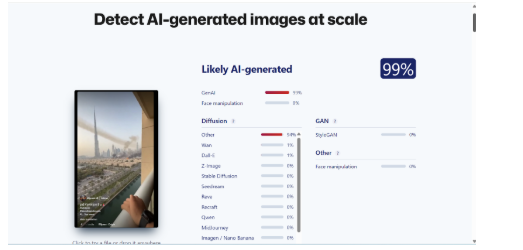
According to the report, tensions in the Middle East escalated amid the Israel–Iran conflict, impacting several countries in the region. A drone incident reportedly occurred near Burj Khalifa, prompting authorities to evacuate the building as a precautionary measure and temporarily switch off its lights. However, the visuals seen in the viral video do not match the details or imagery described in the report. Upon closely examining the viral clip, we noticed several technical inconsistencies and unusual visual elements, raising suspicions that the video might have been generated using artificial intelligence. To verify this, we analyzed the video using the AI detection tool Sightengine. The results indicated a 99% probability that the video was AI-generated.
Conclusion
Our research found that the viral video circulating on social media is not authentic. The footage was created using artificial intelligence and does not depict a real attack on Burj Khalifa.

Related Blogs

Introduction
युद्धे सूर्यास्ते युध्यन्तः समाप्तयन्ति, In ancient times, after the day’s battle had ended and the sun had set, warriors would lay down their arms and rest, allowing their minds and bodies to recover before facing the next challenge, and giving warriors time to rest and prepare mentally and physically for the next day. Today, as we remain endlessly connected to work through screens and notifications, the Right to Disconnect bill seeks to restore that same rhythm of rest and renewal in the digital age. By giving individuals the space to disconnect, it aims to restores balance, protects psychological health, and acknowledges that human resilience is not limitless, even in a world dominated by technology.
The Right to Disconnect Bill, 2025, was recently introduced in the lower house of Parliament during the winter session, which began on 1st December 2025, as a private member’s bill by Ms. Supriya Sule, Lok Sabha MP.
Understanding the Psychology Behind the Proposed Right to disconnect Bill
The purpose of this law is based on neuroscience for humans. When workers are always in a state of being "always on", the situation of their bodies gets to the chronic stress response state where they are getting overwhelmed with cortisol, which is the main human stress hormone. The constant vigilance that the body and mind are under forces the nervous system into always being in a state of sympathetic activation, while depriving it of the restorative (parasympathetic) states that are necessary for genuine recovery. Neuroscience studies show that 96% of heavy users of technology suffer from anxiety and lack of sleep due to technology. This phenomenon is known medically as "bytemares." The brain tries to attend to several things at once, and this way its cognitive capacity becomes thinner, so there is a reduction in focus, productivity is decreased, and the stress level is increased considerably.
Increasingly, the mental suffering that people get through is not only the physical and psychological aspects of it. The digital fatigue generated by the "always-on culture" getting chronic takes its toll on the emotional capacity of the staff, interrupts their sleep cycles (particularly depriving them of REM sleep), and leads to lower melatonin secretion.
Employees in such environments have a 23% increased chance of suffering from burnout, which the World Health Organisation defines as an occupational syndrome consisting of emotional exhaustion, depersonalization, and downgrading of performance. Mental health is the silent destruction that goes on without anyone noticing; the individuals who are affected show productive performance while their neuroendocrine systems are dying little by little.
Hence, the intent of the Indian legislature is clear, which is to prioritize the human dimension, allowing employees, the warriors of the digital age, to pause and recover, fostering work‑life balance without compromising commitment or productivity, and reflecting a thoughtful, humane approach in the modern technology driven world.
The proposed Right to Disconnect Bill takes position as a law that can greatly help with the mental health of employees and therefore keep them healthy. The bill allows employees to legally disconnect from electronic communication related to their jobs outside of the working hours set by the employer; this way, it recognises more or less that the human brain was never meant to be always connected.
The Need for Digital Detox from a Scientific Perspective
Digital detoxification is the process through which the brain resets its dopamine receptors, hence stopping the process of instant gratification that is constantly reinforced through notifications. The employees who cut off their connection can focus better, remain emotionally stable, and lead healthier lives, the effect of which is measurable. Not only on single persons, but also the World Health Organisation, through its studies, has declared that mental health interventions in workplaces can yield a return of 4:1 on investment through increased productivity and decline in absenteeism.
Digital Detox: Structured Disconnection, Not Digital Rejection
One of the most important aspects of the proposed bill is the acknowledgment of digital detox as a supportive tool. However, it is very important to note that digital detox does not mean completely cutting off technology. It is the rule-based disengagement that brings back cognitive balance. Measures like limiting notifications after work hours, protecting weekends and holidays from routine communication and creating offline time zones facilitate the brain's resetting process. Psychological studies associate such practices with better concentration, emotional control, sleep quality and finally productivity in the long run. The initiative of having digital detox centres and offering counselling services is an indication that the issue of overexposure is not just a matter of personal lack of discipline, but rather a problem of modern working designs.
Positioning Mental Well-Being as Core
The fundamental aspect of the bill is based on the constitutional assurance provided by Article 21 (Constitution of India), the Right to Life and personal Liberty, which has been interpreted by the courts to cover health of mind and body as well as time for leisure. This law reform grants a right to not be available at work, which means that employers will not be able to require constant availability at work without suffering legal consequences. The Right to Disconnect Bill finally illustrates society's unanimity that, amidst our digital age, mental well-being protection is no more a nice-to-have it is a must-have. The bill permits the guarding of the recovery periods, and at the same time, it recognises that the productivity that is sustainable comes from employees who are rested and mentally healthy, not from the constantly depleted workforce in the digital chains.
The psychological Rationale
Psychological analysis indicates that this always-on condition impacts productivity in measurable ways. The human brain may get overloaded to distinguish between important and unimportant information due to the uninterrupted flow of alerts and communications. The whole process leads to a situation, continuous exposure to alerts diminishes the ability to notice the really important events thus allowing the critical ones to go unnoticed. Burnout results as a natural consequence. Research shows that the psychological state resulting from digital overstimulation is anxiety, sleep problems, tiredness, and inability to focus.
Work Culture in the Cybersecurity Realm and Analysis of the Right to Disconnect
Although every sector today demands high productivity and significant commitment from its workforce, the Cybersecurity professionals, IT engineers, SOC analysts, incident responders, cyberseucrity researchers, cyber lawyers and digital operations teams are often engage in 24x7 loop because they deal with uniquely critical responsibilities, if ignored or delayed, can compromise sensitive systems, data integrity, and national security.
It is notable that the flow of activities has been silently but significantly changing the paradigm. Availability has replaced accountability, and often responsiveness is regarded as performance. The “on duty” and “off duty” line blurs when a client escalation or a suspected breach alert calls the phone at midnight. This way, an unspoken rule develops that the worker has to be reachable irrespective of the time as being reachable has become part of the job.
In India, the 48-hour work week that is already among the world's most demanding has been made even more intense by digital connectivity. The work intensity of remote and hybrid models has further crossed spatial and temporal boundaries producing a psychologically endless workday. Hence, the cyber workforce lives in a constant state of low-grade alertness, i.e., never fully sleeping, never fully offline. For professionals working in cyber security, this issue of wellbeing is not just a personal issue but also a business issue. Mental fatigue may lead to poor decision making, slower response time in case of incidents, and more errors being made unintentionally by people.
Hence comes the relevance of the proposed Right to Disconnect bill, Implementing it in the cybersecurity realm may require employers to plan for additional task forces so that productivity remains unaffected, while ensuring that employees receive the rest and balance they need. This approach not only protects mental well‑being but also creates opportunities for new roles, distributes workloads fairly, and strengthens the overall resilience and efficiency of the organization.
Legislature Intent - The Right to Disconnect as a preventive control
In this scenario, the Right to Disconnect Bill, 2025, which was presented in the Lok Sabha as a private member's bill, can be seen as a precautionary measure in the digital risk ecosystem instead of merely as a employee welfare initiative. It intends to create legally enforceable lines of demarcation between the demands of a job and one's personal life. The bill provisions, like the right not to answer work calls and texts after office hours, protection from being fired, pay for overtime, and agreed-upon emergency protocols, are all tools to set new norms rather than to impose restrictions on the output.
This can be seen as security logic that has been established in the cyber governance sphere. Even the best systems require planned downtimes for patching, upgrading, and recovery. Humans cannot be treated differently. Loss of operation without recovery will only increase the likelihood of failure. The Right to Disconnect works as a human-layer security, which reduces the risk of incidents caused by fatigue and burnout among employees.
The Legislative Recognition of Human Needs
The Right to Disconnect Bill is a landmark change of thinking, moving from the perception of disconnection as unprofessional to the acknowledgement of it as a basic requirement for human dignity and health. The Indian legislation, which was passed through a private member's bill, clearly defines the limits of professional and personal time. By providing the employees with the legal right to disconnect, the bill affirms what psychological science has been telling us for a long time: people need real breaks to be at their best.
Conclusion
The Proposed Right to Disconnect Bill, 2025, is a progressive move in law, which, among others confirms that a digital world, constant connectivity may undermines both individual health and company/orgnisation’s buisness continuity. A balanced approach is essential, with clearly agreed-upon emergency norms to guide situations where employees may need to work extra hours in a reasonable and lawful manner. It recognises that people are the backbone of the digital ecosystem and need time off to work effectively and securely. In a connected economy, protecting mental bandwidth is as crucial as protecting technical networks, making the Right to Disconnect a key element of sustainable resilience.
From a cybersecurity perspective, no secure digital future can emerge from exhausted minds. A strong digital and cyber‑India will have laws like the Right to Disconnect Bill, signaling a shift in policy thinking. This law moves the burden from individuals having to adapt to always-on technologies onto systems, organisations, and governance structures to respect human limits. By recognising mental well-being as an essential factor of employee’s wellbeing, the bill reinforces that resilient work ecosystems depend not only on robust infrastructure and controls but also on well-rested, focused, and secure individuals.
References
- https://www.shankariasparliament.com/blogs/pdf/right-to-disconnect-bill-2025
- https://ijlr.iledu.in/wp-content/uploads/2025/04/V5I653.pdf
- https://timesofindia.indiatimes.com/education/news/no-calls-and-emails-after-office-hours-right-to-disconnect-bill-introduced-in-lok-sabha-to-set-workplace-boundaries/articleshow/125806984.cms
- https://www.hindustantimes.com/india-news/what-is-right-to-disconnect-bill-introduced-in-lok-sabha-and-can-it-clear-parliament-101765025582585.html

Assembly elections are due to be held in Assam later this year, with polling likely in April or May. Ahead of the elections, a video claiming to be an Aaj Tak news bulletin is being widely circulated on social media.
In the viral video, Aaj Tak anchor Rajiv Dhoundiyal is allegedly seen stating that a leaked intelligence report has issued a warning for the ruling Bharatiya Janata Party (BJP) in Assam. The clip claims that according to this purported report, the BJP may suffer significant losses in the upcoming Assembly elections. Several social media users sharing the video have also claimed that the alleged intelligence report signals the possible removal of Assam Chief Minister Himanta Biswa Sarma from office.
However, an investigation by the Cyber Peace Foundation found the viral claim to be false. Our probe clearly established that no leaked intelligence report related to the Assam Assembly elections exists.
Further, Aaj Tak has neither published nor broadcast any such report on its official television channel, website, or social media platforms. The investigation also revealed that the viral video itself is not authentic and has been created using deepfake technology.
Claim
On social media platform Facebook, a user shared the viral video claiming that the BJP has been pushed on the back foot following organisational changes in the Congress—appointing Priyanka Gandhi Vadra as chairperson of the election screening committee and Gaurav Gogoi as the Assam Pradesh Congress Committee president. The post further claims that an Intelligence Bureau report predicts that the current Assam government will not return to power.
(Link to the post, archive link, and screenshots are available.)
FactCheck:
To verify the claim, we first searched for reports related to any alleged leaked intelligence assessment concerning the Assam Assembly elections using relevant keywords. However, no credible or reliable reports supporting the claim were found. We then reviewed Aaj Tak’s official website, social media pages, and YouTube channel. Our examination confirmed that no such news bulletin has been published or broadcast by the network on any of its official platforms.
- https://www.facebook.com/aajtak/?locale=hi_IN
- https://www.instagram.com/aajtak/
- https://x.com/aajtak
- https://www.youtube.com/channel/UCt4t-jeY85JegMlZ-E5UWtA
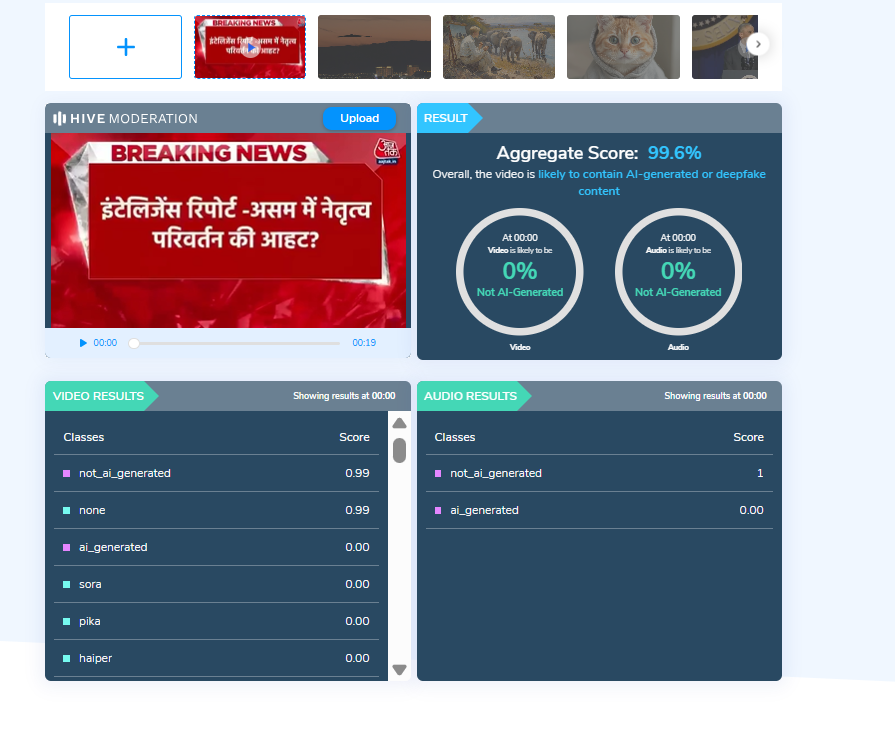
To further verify the authenticity of the video, its audio was scanned using the deepfake voice detection tool HIVE Moderation.
The analysis revealed that the voice heard in the video is 99 per cent AI-generated, clearly indicating that the audio is not genuine and has been artificially created using artificial intelligence.
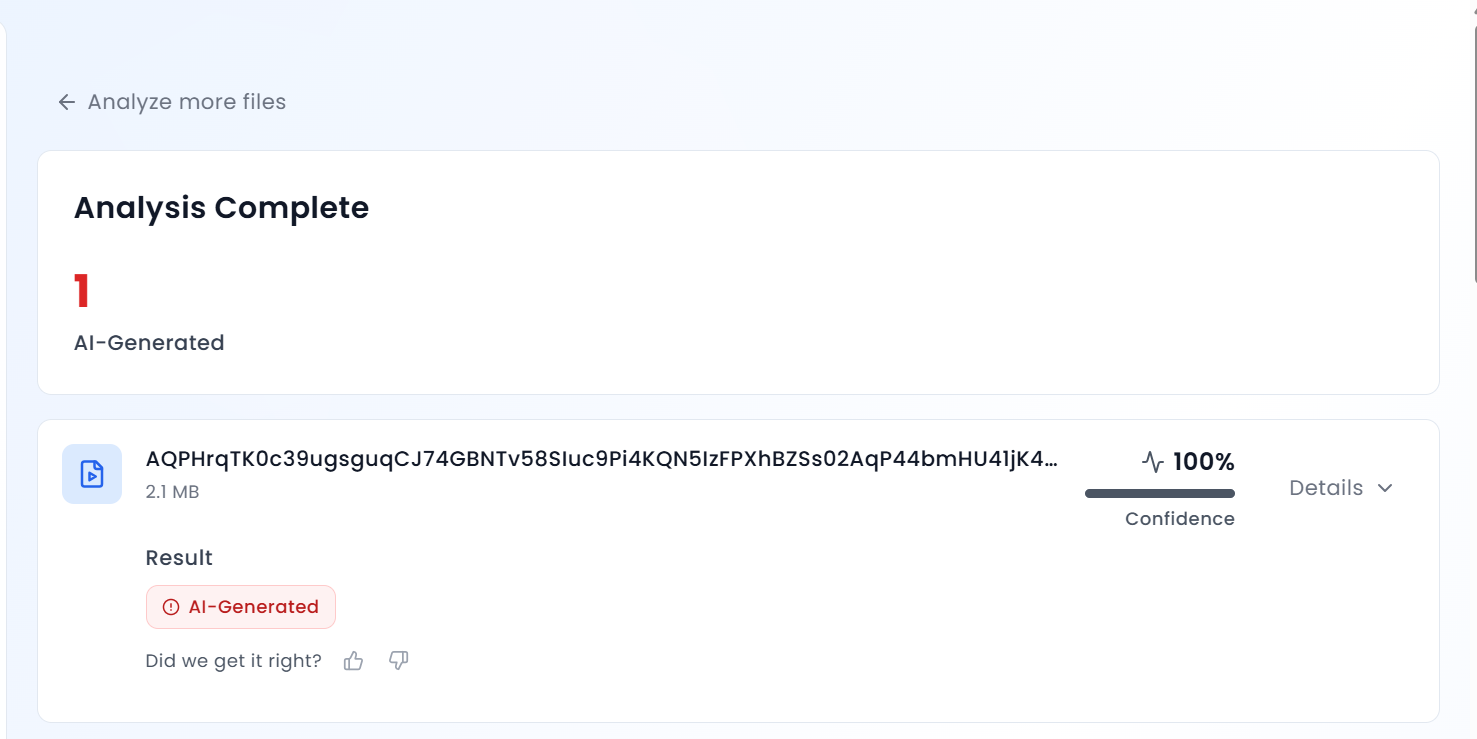
Additionally, the video was analysed using another AI detection tool, Aurigin AI, which also identified the viral clip as AI-generated.
Conclusion:
The investigation clearly establishes that there is no leaked intelligence report predicting BJP’s defeat in the Assam Assembly elections. Aaj Tak has not published or broadcast any such content on its official platforms. The video circulating on social media is not authentic and has been created using deepfake technology to mislead viewers.

Introduction
Entrusted with the responsibility of leading the Global Education 2030 Agenda through the Sustainable Development Goal 4, UNESCO’s Institute for Lifelong Learning in collaboration with the Media and Information Literacy and Digital Competencies Unit has recently launched a Media and Information Literacy Course for Adult Educators. The course aligns with The Pact for The Future adopted at The United Nations Summit of the Future, September 2024 - asking for increased efforts towards media and information literacy from its member countries. The course is free for Adult Educators to access and is available until 31st May 2025.
The Course
According to a report by Statista, 67.5% of the global population uses the internet. Regardless of the age and background of the users, there is a general lack of understanding on how to spot misinformation, targeted hate, and navigating online environments in a manner that is secure and efficient. Since misinformation (largely spread online) is enabled by the lack of awareness, digital literacy becomes increasingly important. The course is designed keeping in mind that many active adult educators are yet to get an opportunity to hone their skills with regard to media and information through formal education. Self-paced, a total of 10 hours, this course covers basics such as concepts of misinformation and disinformation, artificial intelligence, and combating hate speech, and offers a certificate on completion.
CyberPeace Recommendations
As this course is free of cost, can be done in a remote capacity, and covers basics regarding digital literacy, all eligible are encouraged to take it up to familiarise themselves with such topics. However, awareness regarding the availability of this course, alongside who can avail of this opportunity can be further worked on so a larger number can avail its benefits.
CyberPeace Recommendations To Enhance Positive Impact
- Further Collaboration: As this course is open to adult educators, one can consider widening the scope through active engagement with Independent organisations and even Individual internet users who are willing to learn.
- Engagement with Educational Institutions: After launching a course, an interactive outreach programme and connecting with relevant stakeholders can prove to be beneficial. Since this course requires each individual adult educator to sign up to avail the course, partnering with educational universities, institutes, etc. is encouraged. In the Indian context, active involvement with training institutes such as DIET (District Institute of Education and Training), SCERT (State Council of Educational Research and Training), NCERT (National Council of Educational Research and Training), and Open Universities, etc. could be initiated, facilitating greater awareness and more participation.
- Engagement through NGOs: NGOs (focused on digital literacy) with a tie-up with UNESCO, can aid in implementing and encouraging awareness. A localised language approach option can be pondered upon for inclusion as well.
Conclusion
Though a long process, tackling misinformation through education is a method that deals with the issue at the source. A strong foundation in awareness and media literacy is imperative in the age of fake news, misinformation, and sensitive data being peddled online. UNESCO’s course launch garners attention as it comes from an international platform, is free of cost, truly understands the gravity of the situation, and calls for action in the field of education, encouraging others to do the same.
References
- https://www.uil.unesco.org/en/articles/media-and-information-literacy-course-adult-educators-launched
- https://www.unesco.org/en/articles/celebrating-global-media-and-information-literacy-week-2024
- https://www.unesco.org/en/node/559#:~:text=UNESCO%20believes%20that%20education%20is,must%20be%20matched%20by%20quality.
