
Agentic AI and the New Attack Surface
Introduction
Agentic AI systems are autonomous systems that can plan, make decisions, and take actions by interacting with external tools and environments. But they shift the nature of risk by blurring the lines among input, decision, and execution. A conventional model generates an output and stops. An agent takes input, makes plans, invokes tools, updates its state and repeats the cycle. This creates a system where decisions are continuously revised through interaction with external tools and environments, rather than being fixed at the point of input.
This means the attack surface expands in size and becomes more dynamic. Instead of remaining confined to components as in traditional computational systems, they spread in layers and can continue to grow through time. To understand this shift, the system can be analysed through functional layers such as inputs, memory, reasoning, and execution, while recognising that risk does not remain isolated within these layers but emerges through their interaction.
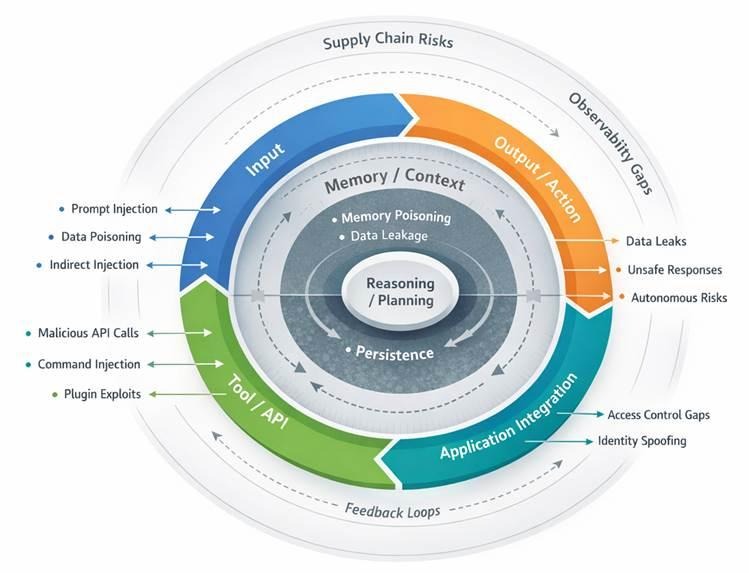
Agentic AI Attack Surface
A layered view of how risks emerge across input, memory, reasoning, execution, and system integration, including feedback loops and cross-system dependencies that amplify vulnerabilities.
Input Layer: Where Untrusted Data Becomes Control
The entry point of an agent is no longer one prompt. The documents, APIs, files, system logs and the outputs of other agents can now be considered input. This diversity is significant due to the fact that every source of input carries its own trust assumptions, and in the majority of cases, they are weak.
The most obvious threat is prompt injection, where inputs are treated as instructions rather than data. Since inputs are treated as instructions, a virus, a malicious webpage, or a document can contain instructions that override system goals without necessarily being detected as something harmful.
Indirect prompt injection extends this risk beyond direct user interaction. Instead of targeting the interface, attackers compromise the retrieval process by embedding malicious instructions within external data sources. When the agent retrieves and processes the data, it treats the embedded content as legitimate input. As a result, the attack is executed through normal reasoning processes, allowing the system to act on untrusted data without recognising the manipulation.
Data poisoning also occurs at runtime. In contrast to classical poisoning (where training data is manipulated), runtime poisoning distorts the agent’s perception of its environment as it runs. This can change decisions without causing apparent failures.
Obfuscation introduces another indirect attacker vector. Encoded instructions or complicated forms may bypass human review but remain readable to the model. This creates asymmetry whereby the system knows more about the attack than those operating it. Once compromised at this layer, the agent implements compromised instructions which affect downstream operations.
Context and Memory: Persistence of Influence
Agentic systems depend on memory to operate efficiently. They often retain context across sessions and frequently store information between sessions.
This introduces a different type of risk: persistence. Through memory poisoning, attackers can insert false or adversarial information into sorted context, which then influences future decisions. Unlike prompt injection, which is often limited to a single interaction, this effect carries forward. Over time, the agent begins to operate on a distorted internal state, shaping decisions in ways that may not be immediately visible.
Another issue is cross-session leakage. Information in a particular context may be replayed in a different context when memory is being shared or there is insufficient memory separation. This is specifically dangerous in those systems that combine retrieval and long-term storage. The context management in itself becomes a weakness. Agents are required to make decisions on what to retain and what to discard. This is susceptible to attackers who can flood the context or manipulate what is still visible and indirectly affect reasoning.
The underlying problem is structural. Memory turns data into a state. Once state is corrupted, the system cannot easily distinguish valid knowledge from adversarial influence.
The issue is structural. Memory converts temporary data into a persistent state. Once this state is weakened, the system cannot reliably separate valid information from adversarial influence, making recovery significantly more difficult.
Reasoning and Planning: Manipulating Intent Without Breaking Logic
The reasoning layer is where agentic AI stands apart from traditional systems. The model no longer reacts to inputs alone. It actively breaks down objectives, analyses alternatives, and ranks actions.
At the reasoning stage, the nature of risk shifts. The concern is no longer limited to injecting instructions, but to influencing how decisions are made. One example is goal manipulation, where the agent subtly reinterprets its objective and produces outcomes that are technically correct but strategically harmful. Reasoning hijacking operates within intermediate steps, altering how constraints are evaluated or how trade-offs are prioritised. The system may remain internally consistent, which makes such deviations difficult to detect.
Tool selection becomes a critical control point. Agents decide which tools to use and when, so influencing these choices can redirect execution without directly accessing the tools themselves. Hallucinations also take on a different role here. In static systems, they remain errors. In agentic systems, they can trigger actions. A perceived need or incorrect judgement can translate into real-world consequences.
This layer introduces probabilistic failure. The system is not fully weakened, but it is nudged towards decisions that appear reasonable yet are incorrect. The risk lies in how those decisions are justified.
Tool and Execution: When Decisions Gain Reach
Once an agent begins interacting with tools, its behaviour extends beyond the model into external systems. APIs, databases, and services become part of the execution path.
One key risk is the use of unauthorised tools. When agents operate with broad permissions, any manipulation of the upstream can be converted into real-world actions. This makes access control a central security concern. Command injection also takes a different form here. The agent generates commands based on its reasoning, so if that reasoning is compromised, the resulting actions may still appear valid despite being harmful.
External tool outputs introduce another risk. If these systems return corrupted or misleading data, the agent may accept it without verification and incorporate it into its decisions. It is also becoming increasingly reliant on third-part tools and plugins adds to this exposure. If these components are compromised, they can affect behaviour without directly attacking the core system, creating a supply-side risk.
At this stage, the agent effectively operates as an insider. It holds legitimate credentials and interacts with systems in expected ways, making misuse harder to identify.
Application and Integration: System-Level Exposure
Agentic systems rarely operate in isolation. They are embedded in larger environments, interacting with identity systems, business logic, and operational workflows.
Access control becomes a major vulnerability. Agents tend to operate across multiple systems with various permission models, creating irregularities that can be exploited. Risks also arise from identity and delegation. In case an agent is operating on behalf of a user, then any vulnerabilities in authentication or session management can allow attackers to assume that authority.
Workflow execution amplifies these risks. Agents can initiate multi-step processes such as transactions, updates, or approvals. Manipulating a single step can change the result of the entire workflow. As integrations increase, so do the number of interaction points, making cumulative risk harder to track.
At this layer, failures are not isolated. They propagate into business operations, making consequences harder to contain.
Output and Action: Where Failures Become Visible
The output layer is where failures become visible, though they rarely originate there.
Data leakage has been a key concern. Agents may disclose information they are allowed to access, especially when tasks boundaries are not clearly defined. Misinformation and unsafe outputs are also important, particularly when outputs directly influence actions or decisions.
Generated code and commands introduce execution risk. If outputs are used without validation, errors or manipulations can have system-level effects. The shift towards autonomous action increases this risk, as small upstream deviations can lead to significant consequences without human intervention. This layer reflects symptoms rather than root causes. Addressing it alone does not reduce the underlying risk.
Beyond Layers: The Missing Dimension
A layered view helps, but it does not capture the full picture. Agentic systems are defined by continuous interaction across layers.
The key missing dimension is the runtime loop. Inputs shape reasoning, reasoning drives action, and actions feed back into both reasoning and memory. These cycles create feedback loops, where small manipulations may escalate over time. This also reduces observability. With multiple interacting components, it becomes difficult to trace cause and effect or identify where failures originate.
Supply chain dependencies add another layer of risk. Models, datasets, APIs, and plugins each introduce their own points of failure. A compromise at any of these points can propagate across the system. The attack surface also includes governance. Weak supervision, unclear responsibility, or excessive autonomy increase overall risk. Human control is not external to the system; it is part of its security.
Conclusion: Structuring the Attack Surface
Agentic AI expands the attack surface beyond traditional systems. It is both recursive and stateful. Risk does not just accumulate across layers; it moves and changes as the system operates.
Any useful representation must go beyond a linear stack. It should capture feedback loops, persistent state, and cross-layer dependencies that characterise the way these systems actually behave. The system is not a pipeline but a cycle. That is where both its capability and its risk emerge.

Related Blogs

Introduction
The Ministry of Electronics and Information Technology (MeitY) recently issued the “Email Policy of Government of India, 2024.” It is an updated email policy for central government employees, requiring the exclusive use of official government emails managed by the National Informatics Centre (NIC) for public duties. The policy replaces 2015 guidelines and prohibits government employees, contractors, and consultants from using their official email addresses on social media or other websites unless authorised for official functions. The policy aims to reinforce cybersecurity measures and protocols, maintain secure communications, and ensure compliance across departments. It is not legally binding, but its gazette notification ensures compliance and maintains cyber resilience in communications. The updated policy is also aligned with the newly enacted Digital Personal Data Protection Act, 2023.
Brief Highlights of Email Policy of Government of India, 2024
- The Email Policy of the Government of India, 2024 is divided into three parts namely, Part I: Introduction, Part II: Terms of Use, Part III: Functions, duties and Responsibilities, and with an annexe attached to it defining the meaning of certain organisation types in relation to this policy.
- The policy direct to not use NICeMail address for registering on any social media or other websites or mobile applications, save for the performance of official duties or with due authorisation from the authority competent.
- Under this new policy, “core use organisations” (central government departments and other government-controlled entities that do not provide goods or services on commercial terms) and its users shall use only NICeMail for official purposes.
- However, where the Core Use Organisation has an office or establishment outside India, to ensure availability of local communication channels under exigent circumstances may use alternative email services hosted outside India with all due approval.
- Core Use Organisations, including those dealing with national security, have their own independent email servers and can continue operating their independent email servers provided the servers are hosted in India. They should also consider migrating their email services to NICeMail Services for security and uniform policy enforcement.
- The policy also requires departments that currently use @gov.in or @nic.in to instead migrate to @departmentname.gov.in mail domains so that information sanctity and integrity can be maintained when officials are transferred from one department/ministry to another, and so that the ministry/department doesn’t lose access to the official communication. For this, the department or ministry in question must register the domain name with NIC. For instance, MeitY has registered the mail domain @meity.gov.in. The policy gives government departments six months time period complete this migration.
- The policy also makes distinction between (1) Organisation-linked email addresses and (2) Service-linked email addresses. The policy in respect of “organisation-linked email addresses” is laid down in paragraphs 5.3.2(a) and 5.4 to 5.6.3. And the policy in respect of “service-linked email addresses” is laid down in paragraphs 5.3.2(b) and 5.7 to 5.7.2 under the official document of said policy.
- Further, the new policy includes specific directives on separating the email addresses of regular government employees from those of contractors or consultants to improve operational clarity.
CyberPeace Policy Outlook
The revised Email Policy of the Government of India reflects the government’s proactive response to countering the evolving cybersecurity challenges and aims to maintain cyber resilience across the government department’s email communications. The policy represents a significant step towards securing inter government and intra-government communications. We as a cybersecurity expert organisation emphasise the importance of protecting sensitive data against cyber threats, particularly in a world increasingly targeted by sophisticated phishing and malware attacks, and we advocate for safe and secure online communication and information exchange. Email communications hold sensitive information and therefore require robust policies and mechanisms in place to safeguard the communications and ensure that sensitive data is shielded through regulated and secure email usage with technical capabilities for safe use. The proactive step taken by MeitY is commendable and aligned with securing governmental communication channels.
References:
- https://www.meity.gov.in/writereaddata/files/Email-policy-30-10-2024.pdf-(Official document for Email Policy of Government of India, 2024.
- https://www.hindustantimes.com/india-news/dont-use-govt-email-ids-for-social-media-central-govt-policy-for-employees-101730312997936.html#:~:text=Government%20employees%20must%20not%20use,email%20policy%20issued%20on%20Wednesday
- https://bwpeople.in/article/new-email-policy-issued-for-central-govt-employees-to-strengthen-cybersecurity-measures-537805
- https://www.thehindu.com/news/national/centre-notifies-email-policy-for-ministries-central-departments/article68815537.ece

Executive Summary
A video is being widely shared on social media after a fire incident in Aliganj, Lucknow. The approximately 15-second clip shows a building engulfed in flames, where a woman is seen hanging her small child outside a window while desperately seeking help. The video is being circulated as if it shows the recent Lucknow fire incident. CyberPeace Research Wing research found the claim to be misleading. The viral video is not related to the Lucknow fire incident. In fact, the clip is around 16 years old and originates from a completely different incident in the United States. It is being falsely shared on social media with a misleading context.
Claim:
A Facebook user shared the viral video on June 22, 2026, claiming: “A mother’s love is so powerful that even in front of death, she goes to any extent to save her child.” The post link, archived link, and screenshots are provided below.
https://www.facebook.com/reel/1168968548755052

Factcheck
To verify the claim, we conducted a reverse image search of the video keyframes using Google Lens. During the research, we found the same visuals published in a HuffPost report dated 2010. According to the report, the incident shows a fire in an apartment in the Bronx, New York, USA. https://www.huffpost.com/entry/photo-captures-baby-dangl_n_463780

Further research led us to another report published by Gothamist in 2010, which also confirmed that the footage is related to a fire incident in the Bronx apartment building in New York. https://gothamist.com/news/baby-held-out-window-in-bronx-fire-is-healthy-adorable

According to a report by Dainik Bhaskar, a fire incident at a coaching center in Aliganj, Lucknow resulted in the death of around 15 people. The government suspended four officials and police arrested four accused in connection with the incident. However, it was confirmed that the actual footage from the Lucknow coaching center fire is different from the viral video and has no relation to it. https://www.bhaskar.com/local/uttar-pradesh/lucknow/news/lucknow-coaching-center-fire-children-rescue-effort-138258629.html

Conclusion:
Our research confirms that the viral video is not related to the Lucknow fire incident. The footage is actually from a 16-year-old fire incident in the Bronx, New York, USA, and is being falsely shared with a misleading context on social media.

Introduction
On April 30, 2025, the Supreme Court of India delivered a landmark judgment that cast a sharp light on one of the most overlooked yet pressing issues in modern governance—digital inequity. In a country that has a staggering 900 million Internet users, the ruling highlights a disheartening reality, a paradox that brings the “digital divide” to centre stage. While India may be the world’s second-largest online market, a significant segment of its population remains digitally disenfranchised. The judgment, delivered in response to two interconnected petitions, underscored that access to the internet is no longer a luxury but a lifeline integral to exercising fundamental rights. The court pointed out in clear terms that the government must build a digital ecosystem that is inclusive and accessible to all and attributed the right to digital access as an intrinsic part of the right to life and liberty under Article 21 as enshrined under the Indian Constitution.
Understanding the Context: What Prompted the Petitions?
The judgment springs out of two writ petitions, which sought instructions or guidelines for people with blindness or limited vision and acid attack survivors, respectively, to conduct digital Know Your Customer (KYC)/e-KYC/video KYC mandated by RBI’s KYC Master Directions, 2016, which were reserved for judgment on January 28. The court delivered the judgment on April 30, 2025, emphasising the fact that true inclusion in this digital era is confounded in an inclusive digital infrastructure, and it must provide reasonable accommodation to those who face impediments due to any disability or disfigurement.
In consonance with its view, it laid down various guidelines that ensure that all persons with disabilities or acid attack survivors are treated even when digital processes are involved in accordance with the provisions of the Right of Persons with Disabilities Act, 2016 (hereinafter referred to as “RPwD Act”)
Another major observation made by the Honourable SC judges is that the mode of facilitation of government services is through digital platforms, i.e., e-governance, and access to all these welfare schemes is the right of every citizen, irrespective of the fact that they suffer from any disability. The failure of the provisioning of e-governance of these facilities to these individuals is a gross failure of the objectives of these schemes.
Key Observations and Directives
The court directed the government to release fresh guidelines that establish alternative methods to conduct digital KYC/e-KYC for all persons who suffer any impairment, low vision, or disfigurement with greater sensitivity, particularly for acid-attack survivors. The court made its intention very clear that the right to digital access is intrinsic to the right to life and liberty. All the tasks that are included within the ambit of digital KYC, such as pen-on-paper signatures, screen signatures, and the brief window for OTP entry, create an inaccessible and exclusionary framework, violating not just the dignity but the legal rights granted protection under the RPwD Act, 2016. The ruling directs a fundamental reimagining of digital governance through the lens of inclusion, equality, and dignity.
Conclusion
The court is not mincing its words when it declares digital accessibility as a constitutional imperative; it has made it clear that bridging the digital divide is no longer optional but a legal duty. The decision marks the new beginning and a propeller of digital transformation, and a delightful amalgamation of digital access and the rights of people. The effect of this judgment will not be restricted to one class of people. Still, it will cater to all those individuals who face these obstacles on a daily basis due to the exclusionary nature of digital platforms.
References
