
Why Trump's New AI Cybersecurity Order Matters Beyond the United States
Introduction
On June 2, 2026, U.S. President Donald Trump signed an executive order called "Promoting Artificial Intelligence Innovation and Security." The order tells federal agencies to improve cyber defences against AI-based threats and creates a system where AI companies can choose to let the government access powerful new models before they are released to the public. This happens as the U.S. and China are in a heated competition to lead the next generation of AI. While the order only affects the United States, its impact could reach the global AI industry, including India.
What Does the Executive Order Do?
The White House order focuses on three areas: First, it aims to upgrade government cyber security. Federal agencies must strengthen their information systems with AI-enabled defences within 30 days. Cyber Security and Infrastructure Agency (CISA) will issue new guidelines for civilian agencies, and an AI Cyber security Clearinghouse will be established for the government and private companies to share and resolve software vulnerabilities.
Second, the order introduces a voluntary pre-release review process for advanced AI models. Before a new model is publicly available, AI companies can give the government up to 30 days to evaluate it for cyber security risks. An earlier draft proposed a 90-day review period, but this was cut back due to feedback from the technology industry. The government will also create classified benchmarks to figure out which models qualify as a “covered frontier model” and are therefore subject to this review process.
Finally, the order emphasises criminal enforcement. It prioritises legal action against those who use AI tools to commit cybercrimes.
According to the White House, the aim is to promote AI innovation and security by collaborating with the private sector to modernise government and private information systems and protect them from external threats.
Why Does This Matter Globally?
- AI Is Now a National Security Issue Until recently, most governments viewed AI as an economic or scientific issue. This order officially changes that for the United States, placing advanced AI alongside other sensitive technologies that need government oversight before deployment. When the world's largest military makes this change, other governments pay attention. Countries allied with or partnering with the U.S. will likely revisit their own AI governance frameworks in the months ahead.
- Two Competing Models for the World The U.S. and EU represent two different approaches to AI governance. The EU AI Act lays down strict rules, is focused on ethics, and requires heavy compliance. The US approach is lighter on ethics, promoting voluntary cooperation, prioritising security, and encouraging innovation. Countries developing their own AI policies will either continue to align with one of these models or take ideas from both. The Atlantic Council has pointed out that if the U.S. model is successful, it could influence international security standards for AI development, even without formal global agreements.
- The China Factor Trump initially delayed signing the order, worried it would slow down American companies and give China an edge. The final version avoids mandatory licensing requirements but clearly indicates that the U.S. aims to lead, not only in building AI but also in securing it. China is likely to respond by speeding up its own evaluation systems, creating another global framework.
What Could This Mean for India?
India has taken a careful, non-mandatory approach to AI governance. MeitY's India AI Governance Guidelines, issued in November 2025, are based on principles and are not binding. India's AI Safety Institute has been announced but is not fully operational. Efforts to create binding regulation have been seen in actions like the Private Member's Bill, the AI Ethics and Accountability Bill, 2025, introduced in the Lok Sabha. This bill suggests mandatory reviews for high-risk AI systems but has not been passed yet. It's important to note that groups like the AI Governance Expert Group (AIGEG) and the Technology and Policy Expert Committee (TPEC) serve only in an advisory role; they do not have legislative power. As a result, nothing binding has been implemented so far. The Trump order puts additional pressure on India to pass measurable, binding AI-security-related measures. As AI use increases in banking, healthcare, telecommunications, and government services and frontier AI models continue to evolve without global oversight, stronger security evaluation methods are becoming necessary, especially in critical sectors.
Recent events prove this need. In June 2026, a Distributed Denial-of-Service (DDoS) attack hit the CBSE's On-Screen Marking portal. It saw 1.5 million requests in two minutes and over one lakh unauthorised file access attempts targeting a system used by millions of students. Similar attacks have impacted AIIMS Delhi and other public digital infrastructure. As AI tools make these attacks easier to carry out, security testing before deployment can no longer be seen as optional.
For Indian AI companies aiming at global markets, the U.S. framework is also important for business. Standards that are set voluntarily in Washington often become necessary for international partnerships and contracts.
Conclusion
Trump's AI cyber security order signals a shift. A government that resisted regulating AI has now recognised that powerful models need oversight before they reach the public. Its immediate impact affects U.S. agencies and developers. However, the broader message is that advanced AI is a national security concern. This will influence policy conversations around the world. For India, the priority is to develop its own security evaluation capacity now, rather than waiting to adopt frameworks created for other contexts.
References
- White House Executive Order, "Promoting Advanced Artificial Intelligence Innovation and Security," June 2, 2026
- Federal Register — Executive Order Publication, June 5, 2026
- Council on Foreign Relations — Assessing Trump's Executive Order on AI Oversight, June 4, 2026
- Atlantic Council — Reading Between the Lines of Trump's New Executive Order on AI, June 3, 2026
- Times of India — Donald Trump Passes AI Cyber security Order
- MeitY India AI Governance Guidelines, November 2025
- AI Ethics and Accountability Bill, 2025 — Explained
- NPR — Trump Signs EO Seeking Early Government Access to Powerful AI Models

Related Blogs

Introduction
As the world is being "Digitally Interlaced", cyber security has become a continuous wrangle. The “Gambling industry” is considered an incredibly lucrative mark for cybercriminals, principally due to the enormous quantities of cash on hand and the sensitive details it processes day to day. Cybercriminals may use susceptibilities in gambling scaffolds to achieve financial scams or launder unlawful funds. An analysis by Security Scorecard discovered that the online gambling industry was ranked third in the possibility of encountering a cyber attack, following the energy and financial services sectors. Similarly, Online gambling is a bending matter that demands meticulous contemplation by policymakers and nationals. The incredible rise of online gambling has led to a terse acclivity in unlawful activities such as online scams, fraud, etc. Also, online sports gambling has become a thriving endeavour in contemporary years as millions of people are putting stakes and gambles on their electronic devices.
The Challenges
Online gambling has thus become a widespread frolicking for numerous youngsters, with the industry tossed to be worth billions of dollars in the forthcoming decades. The prominent cyber security challenges in the gambling industry are money laundering, financial laundering, ransomware, personal information theft, data breaches, distributed Denial of Service (DDoS), system disruptions and Insider perils and employee malfeasance. Challenges of online gambling also include being properly not regulated and a lack of social interaction with near and dear ones. The spread of Internet gambling has presented many problems affecting consumer behaviour online, motivations to gamble, problem gambling, security of websites, and the righteousness and virtue of the games. The rise of online gambling among young people due to the lack of clear regulations has likewise produced an abundant backdrop for financial ruination.
Web games and betting are among the fastest-evolving areas of the Internet. Over the past several years, there has been an international flare-up in online gambling, permitting customers to play from the convenience of home, work, and public locations. Numerous offshore betting websites and apps usually permit parties to win in the start with sound returns, whereas after the user gets addicted and invests considerable sums, they either keep failing or have the website refuse to cash out the winnings. Also, the information demonstrates that online games have been employed to commit wrongdoings (Child sexual exploitive material, religious conversion, cyberbullying, fraud, betting in virtual online casinos, etc.)
India's laws and regulations surrounding online gambling are complex and constantly evolving. While the legal framework is not entirely clear, a few state in India have their own set of rules.
Recently In April 2023, the Union Ministry of Electronics and Information Technology (“MeitY”), by virtue of the rule-making powers available to the central government under the Information Technology Act, 2000 (“IT Act 2000”), implemented a new central legal framework for online gaming through amendments to the Information Technology (Intermediary Guidelines and Digital Media Ethics Code) Rules, 2021 (“IT Rules 2021”). These amendments (“Online Gaming Rules”) propose a light-touch, co-regulatory regime whereby MeitY-recognised, independent self-regulatory bodies (“SRB”) will verify whether an “online real-money game” is to be made available to the general public or not – in accordance with the baseline criteria prescribed by the Online Gaming Rules.
The Online Gaming Rules attempt to regulate online gaming platforms by treating them as an “online gaming intermediary” (“OGI”) and prescribing intermediary due diligence obligations for them under the IT Rules 2021. An OGI has been defined in the Online Gaming Rules as “any intermediary that enables the users of its computer resource to access one or more online games”. Under the Online Gaming Rules, an online game can be a “permissible online game” if (i) it is not an online real-money game, or (ii) it is an online real-money game but is “verified” by an SRB in accordance with the baseline criteria prescribed by the Online Gaming Rules and any additional criteria prescribed by the SRB itself.
Global Perspective
The global gaming industry worth over US$227 billion in 2022 is further projected to grow to US$312 billion by 2027. Several countries have set regulatory frameworks about online gaming, though these are skewed, concentrating mainly on gambling and circumventing numerous of the more typical cyber threats. The US spends about $60 billion annually on online gambling and sports betting. In Europe, gambling is an even larger moneymaker. Also, numerous countries in Europe, like the UK, have legalised gambling. Nevertheless, it is prohibited for a US based company to operate an online gambling site. Yet, sports betting online is permitted in some states.
Today, though the gaming market has been overpowered by China and the US, future growth in the sector is anticipated to come from emerging economies like India with increasing populations. The permitted status of online gambling in India is nonetheless imprecise, vamoosing space for exploitation by cyber criminals and disarray for players involved. One of the climactic points that ought to be addressed is the sudden upsurge of online games, which increases gambling. Skill-based games such as poker, rummy etc., have additionally been developed to circumvent the legal definition of gambling in India. The recent instances of the online gaming industry not being properly regulated have also come to light in India. For instance, the Enforcement Directorate (ED) is still investigating the vast Mahadev Online Betting scandal, exposing an unknown money laundering method using Unified Payment Interface (UPI) IDs. Also, the Cyber Cell in Agra has taken proactive action against copyright violations, illegal online gambling and betting activities, shutting down 27 Illegal cricket betting sites in major operations, safeguarding several lakhs of Indians with thousands of crores from being transferred to overseas shores principally China.
Consequently, though India has announced new regulations on online gaming, its contemporary policy framework cannot contend with the problems endangering this sector. The Public Gambling Act of 1867 makes it unlawful to use a public gambling house or to be seen in one. Nevertheless, the act does not explicitly cite online gambling, leading to further interpretation. The Ministry of Home Affairs (MHA) has released a further awareness campaign for offshore illegal gambling apps, notifying users to be mindful of foreign apps as they may be fraudulent and might induce monetary damage to the user. Also, state laws control gambling in India with each state having its own directive on the subject. Yet, the Supreme Court of India has maintained that skilled games are not gambling and are thus legal. Furthermore, the Information Technology (IT) Act, of 2000 does not precisely handle online gambling or games that enable gambling.
Today, developers have strived for new ways to monetise the growing popularity of online gaming, which oversaw the creation of in-game currencies that can be bought using actual money, usually through credit cards. Several nations have prohibited the usage of in-game currency and loot boxes, considering them a kind of online gambling. The in-game currency has thus caused much disagreement about becoming a state of hunting monetisation by developers, especially targeting minor or newbie players. The gambling industry, therefore, faces unique cybersecurity challenges that require a comprehensive and proactive approach to cybersecurity.
Conclusion
Presently, there are approximately 3.09 billion active video game players worldwide, and the number is expected to reach 3.32 billion by 2024 as of 2023. In the contemporary digital era, information is priceless, and encryption acts as a necessary means to safeguard it. Thus, Regulators are working to maintain the swiftness of shift in the industry, as the dearth of transparency in the law has made it challenging to implement regulations. There is also less awareness about cyber security in India due to the following grounds such as the lack of ethical hackers in the country, companies in India lacking focus on cyber security and hiring a team of ethical hackers and cyber security experts. Furthermore, there has been a lack of knowledge among the citizens as well.
It is essential to realise the conceivable social and economic consequences and take measures to handle the online gambling industry. The industry has thus been undersized in the mode of research following online crime and Internet gambling, even though it is an acute emphasis. There is also a pressing necessity to rebuild these regulations to tackle the more unbridled cyber security hazards swarming the gaming industry. Similarly, there is an urgent need for governments and policymakers around the world to start paying more attention to the gaming industry as cyber security threats continue to rise. There should be a further need to strengthen the regulatory framework, establish Self Regulatory Organizations (SROs), create ethical gaming designs and increase awareness among gamers. The Government of India should consider devising its own rating system to rate games so that players under 18 cannot access them.
Eventually, cyber security is a shared commitment, and everyone in the online gambling ecosystem must function jointly to provide a secure and safe setting for all.
References:
- https://truefort.com/gambling-industry-cybersecurity/
- https://www.orfonline.org/research/cybersecurity-threats-in-online-gaming-learnings-for-india
- https://www.hackread.com/chinese-scammers-cloned-websites-gambling-network/
- https://www.civilsdaily.com/news/cybersecurity-threats-from-online-gaming/
- https://www.linkedin.com/pulse/legal-considerations-online-gambling-india-sudden-increase-mathur/
- https://www.jsheld.com/insights/articles/the-importance-of-cybersecurity-in-the-online-sports-betting-industry
- https://www.the420.in/agra-cyber-cell-takes-down-27-illegal-betting-sites/
- https://g2g.news/gaming/ministry-of-home-affairs-releases-new-awareness-campaign-for-online-gaming-in-india/
- https://smestreet.in/technology/kaspersky-warns-of-increased-phishing-scams-and-data-breaches-in-apac-for-2024-2381601
- https://economictimes.indiatimes.com/tech/newsletters/morning-dispatch/govt-bans-mahadev-other-illegal-betting-apps-cyber-attacks-against-india-spike/articleshow/104996017.cms?from=mdr
- https://cipher.com/cybersecurity-for-gambling/
- https://www.mangalorean.com/tightening-the-reins-indian-government-blocks-over-550-illegal-betting-and-gambling-apps/
- https://cybersecurityasean.com/news-press-releases/kaspersky-predicts-rise-cyber-threats-across-apac-2024
- https://www.cnbctv18.com/technology/mahadev-betting-app-scam-ed-money-laundering-upi-celebrities-under-scanner-17815661.htm
- https://iclg.com/practice-areas/gambling-laws-and-regulations/india

Introduction
Considering the development of technology, Voice cloning schemes are one such issue that has recently come to light. Scammers are moving forward with AI, and their methods and plans for deceiving and scamming people have also altered. Deepfake technology creates realistic imitations of a person’s voice that can be used to conduct fraud, dupe a person into giving up crucial information, or even impersonate a person for illegal purposes. We will look at the dangers and risks associated with AI voice cloning frauds, how scammers operate and how one might protect themselves from one.
What is Deepfake?
Artificial intelligence (AI), known as “deepfake,” can produce fake or altered audio, video, and film that pass for the real thing. The words “deep learning” and “fake” are combined to get the name “deep fake”. Deepfake technology creates content with a realistic appearance or sound by analysing and synthesising diverse volumes of data using machine learning algorithms. Con artists employ technology to portray someone doing something that has never been in audio or visual form. The best example is the American President, who used deep voice impersonation technology. Deep voice impersonation technology can be used maliciously, such as in deep voice fraud or disseminating false information. As a result, there is growing concerned about the potential influence of deep fake technology on society and the need for effective tools to detect and mitigate the hazards it may provide.
What exactly are deepfake voice scams?
Artificial intelligence (AI) is sometimes utilised in deepfake speech frauds to create synthetic audio recordings that seem like real people. Con artists can impersonate someone else over the phone and pressure their victims into providing personal information or paying money by using contemporary technology. A con artist may pose as a bank employee, a government official, or a friend or relative by utilising a deep false voice. It aims to earn the victim’s trust and raise the likelihood that they will fall for the hoax by conveying a false sense of familiarity and urgency. Deep fake speech frauds are increasing in frequency as deep fake technology becomes more widely available, more sophisticated, and harder to detect. In order to avoid becoming a victim of such fraud, it is necessary to be aware of the risks and take appropriate measures.
Why do cybercriminals use AI voice deep fake?
In order to mislead users into providing private information, money, or system access, cybercriminals utilise artificial intelligence (AI) speech-deep spoofing technology to claim to be people or entities. Using AI voice-deep fake technology, cybercriminals can create audio recordings that mimic real people or entities, such as CEOs, government officials, or bank employees, and use them to trick victims into taking activities that are advantageous to the criminals. This can involve asking victims for money, disclosing login credentials, or revealing sensitive information. In phishing assaults, where fraudsters create audio recordings that impersonate genuine messages from organisations or people that victims trust, deepfake AI voice technology can also be employed. These audio recordings can trick people into downloading malware, clicking on dangerous links, or giving out personal information. Additionally, false audio evidence can be produced using AI voice-deep fake technology to support false claims or accusations. This is particularly risky regarding legal processes because falsified audio evidence may lead to wrongful convictions or acquittals. Artificial intelligence voice deep fake technology gives con artists a potent tool for tricking and controlling victims. Every organisation and the general population must be informed of this technology’s risk and adopt the appropriate safety measures.
How to spot voice deepfake and avoid them?
Deep fake technology has made it simpler for con artists to edit audio recordings and create phoney voices that exactly mimic real people. As a result, a brand-new scam called the “deep fake voice scam” has surfaced. In order to trick the victim into handing over money or private information, the con artist assumes another person’s identity and uses a fake voice. What are some ways to protect oneself from deepfake voice scams? Here are some guidelines to help you spot them and keep away from them:
- Steer clear of telemarketing calls
- One of the most common tactics used by deep fake voice con artists, who pretend to be bank personnel or government officials, is making unsolicited phone calls.
- Listen closely to the voice
- Anyone who phones you pretending to be someone else should pay special attention to their voice. Are there any peculiar pauses or inflexions in their speech? Something that doesn’t seem right can be a deep voice fraud.
- Verify the caller’s identity
- It’s crucial to verify the caller’s identity in order to avoid falling for a deep false voice scam. You might ask for their name, job title, and employer when in doubt. You can then do some research to be sure they are who they say they are.
- Never divulge confidential information
- No matter who calls, never give out personal information like your Aadhar, bank account information, or passwords over the phone. Any legitimate companies or organisations will never request personal or financial information over the phone; if they do, it’s a warning sign that they’re a scammer.
- Report any suspicious activities
- Inform the appropriate authorities if you think you’ve fallen victim to a deep voice fraud. This may include your bank, credit card company, local police station, or the nearest cyber cell. By reporting the fraud, you could prevent others from being a victim.
Conclusion
In conclusion, the field of AI voice deep fake technology is fast expanding and has huge potential for beneficial and detrimental effects. While deep fake voice technology has the potential to be used for good, such as improving speech recognition systems or making voice assistants sound more realistic, it may also be used for evil, such as deep fake voice frauds and impersonation to fabricate stories. Users must be aware of the hazard and take the necessary precautions to protect themselves as AI voice deep fake technology develops, making it harder to detect and prevent deep fake schemes. Additionally, it is necessary to conduct ongoing research and develop efficient techniques to identify and control the risks related to this technology. We must deploy AI appropriately and ethically to ensure that AI voice-deep fake technology benefits society rather than harming or deceiving it.
Reference

Executive Summary
A video showing a damaged building allegedly belonging to Amazon is going viral on social media. The clip is being shared with the claim that it depicts the aftermath of an Iranian missile strike on an Amazon data center in Bahrain on April 1, 2026. However, research by CyberPeace has found the claim to be misleading. While reports confirm that Iran targeted a U.S.-linked cloud infrastructure in Bahrain, the viral video itself is not real footage and has been created using artificial intelligence.
Claim
A Facebook user, “Tripti Speaks,” shared the viral video on April 2, 2026, with the caption:“Iranian attack on Amazon’s cloud computing data center in Bahrain. IRGC fired missiles at Batelco in Bahrain where AWS infrastructure is located, damaging servers and disrupting services.”
- Archived link::https://perma.cc/XH7S-QTX6

Fact Check
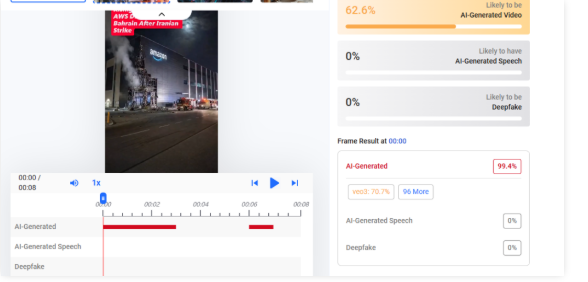
To verify the claim, we extracted multiple keyframes from the viral video and conducted a reverse image search using Google. However, we did not find any credible sources or reports featuring this specific footage. This raised suspicion about the authenticity of the video. We then analyzed it using the AI detection tool Hive Moderation, which indicated a 63% probability that the video is AI-generated.
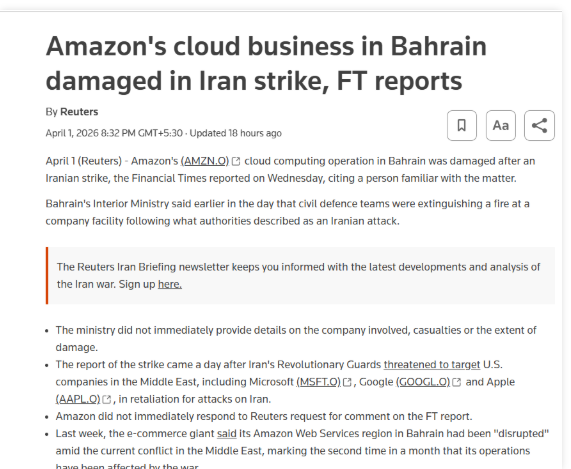
According to a report published by Reuters on April 1, 2026, Iran launched a missile attack targeting Amazon’s cloud computing operations in Bahrain. The Islamic Revolutionary Guard Corps (IRGC) had earlier warned that U.S.-linked companies in the Middle East—including Microsoft, Google, and Apple—could be targeted.
Conclusion
Our research found that while there are credible reports confirming an Iranian attack on cloud infrastructure linked to Amazon in Bahrain, the viral video circulating on social media does not depict the real incident. The footage shows no presence in verified news coverage and has been flagged by AI detection tools as likely artificial. Therefore, the video is AI-generated and misleadingly linked to the incident.
