
#FactCheck - Viral Video Claiming UK PM Keir Starmer Was Thrown Out of a Pub Is Misleading
A video circulating on social media claims that British Prime Minister Keir Starmer was forcibly thrown out of a pub by its owner. The clip has been widely shared by users, many of whom are drawing political comparisons and questioning democratic norms. However, research conducted by Cyber Peace Foundation has found that the viral claim is misleading. Our research reveals that the video dates back to 2021, a time when Keir Starmer was not the Prime Minister of the United Kingdom, but the leader of the opposition Labour Party.
Claim
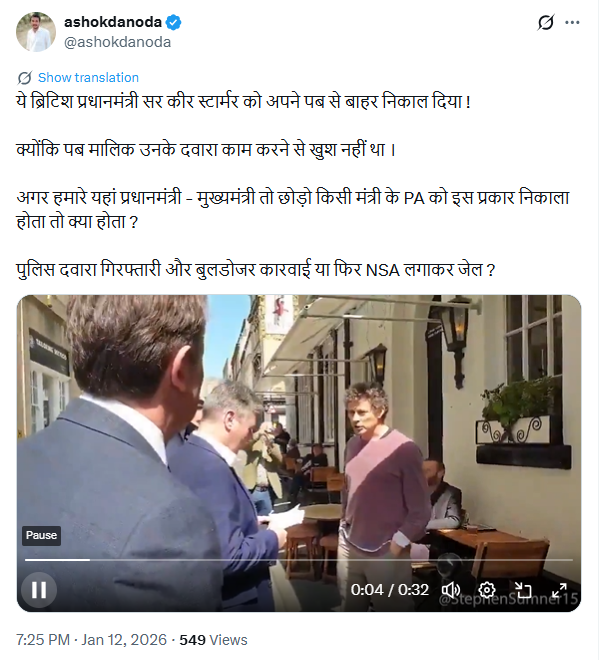
On January 12, 2026, a video was shared on social media platform X (formerly Twitter) with the claim that British Prime Minister Sir Keir Starmer was asked to leave a pub by its owner. The post suggests that the pub owner was unhappy with Starmer’s performance and contrasts the incident with how political dissent is allegedly handled in India. The viral video, approximately 32 seconds long, shows a man angrily confronting Keir Starmer in English, stating that he had supported the Labour Party all his life but was disappointed with Starmer’s leadership. The man is then heard asking Starmer to leave the pub.
Links to the viral post and its archived version were reviewed as part of the research.
Fact Check
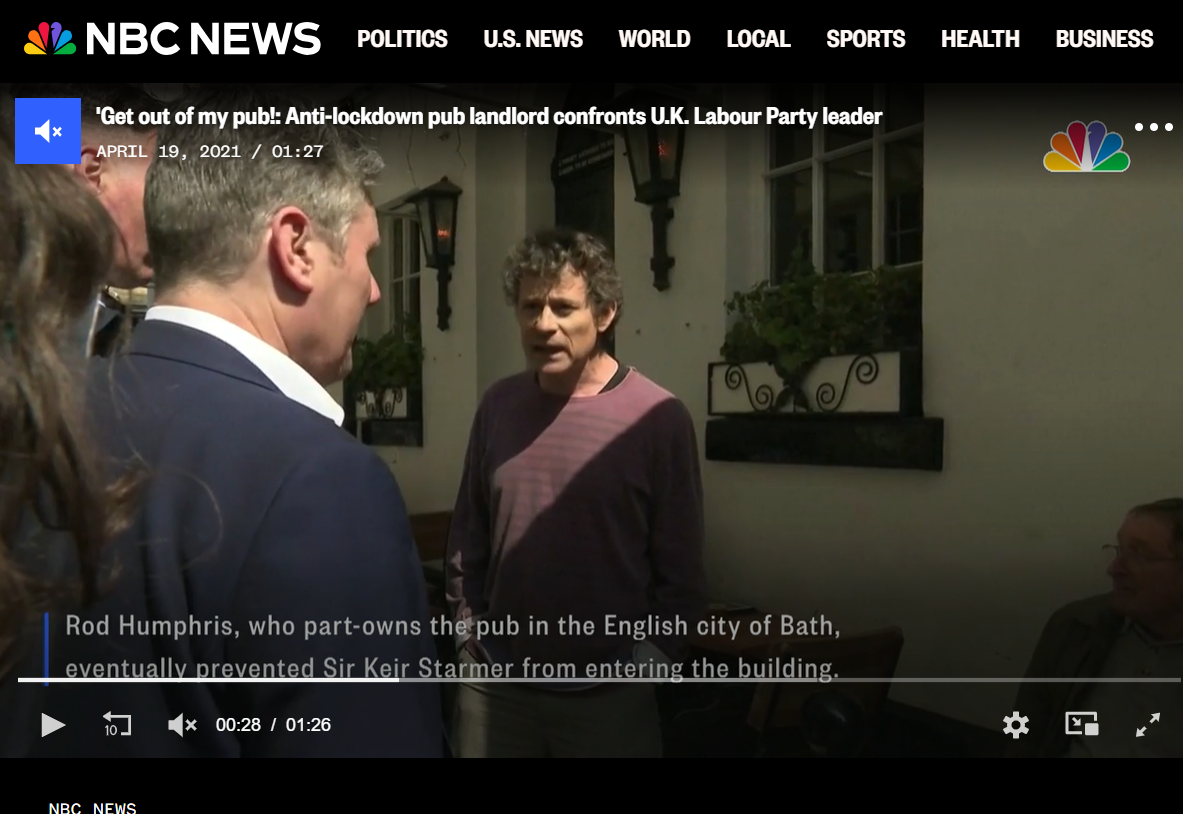
To verify the claim, we extracted key frames from the viral video and conducted a Google reverse image search. During this process, we found the same video posted on an X account on April 19, 2021.The visuals in the 2021 post matched the viral video exactly, clearly indicating that the footage is not recent.The original post described the incident as an event involving Labour Party leader Keir Starmer during his visit to the Raven pub in Bath, and included a warning about strong language used by the pub owner, Rod Humphries. Here is the link to the original video, along with a screenshot:

Further keyword searches led us to a report published by NBC News on April 19, 2021. According to the report, Keir Starmer, then the leader of the UK’s opposition Labour Party, was confronted and asked to leave a pub in the city of Bath. The pub owner reportedly accused Starmer of failing to oppose COVID-19 lockdown measures strongly enough at a time when strict restrictions were in place across the UK.
- https://www.nbcnews.com/video/anti-lockdown-pub-landlord-screams-at-u-k-labour-party-leader-to-get-out-of-his-pub-110466117702
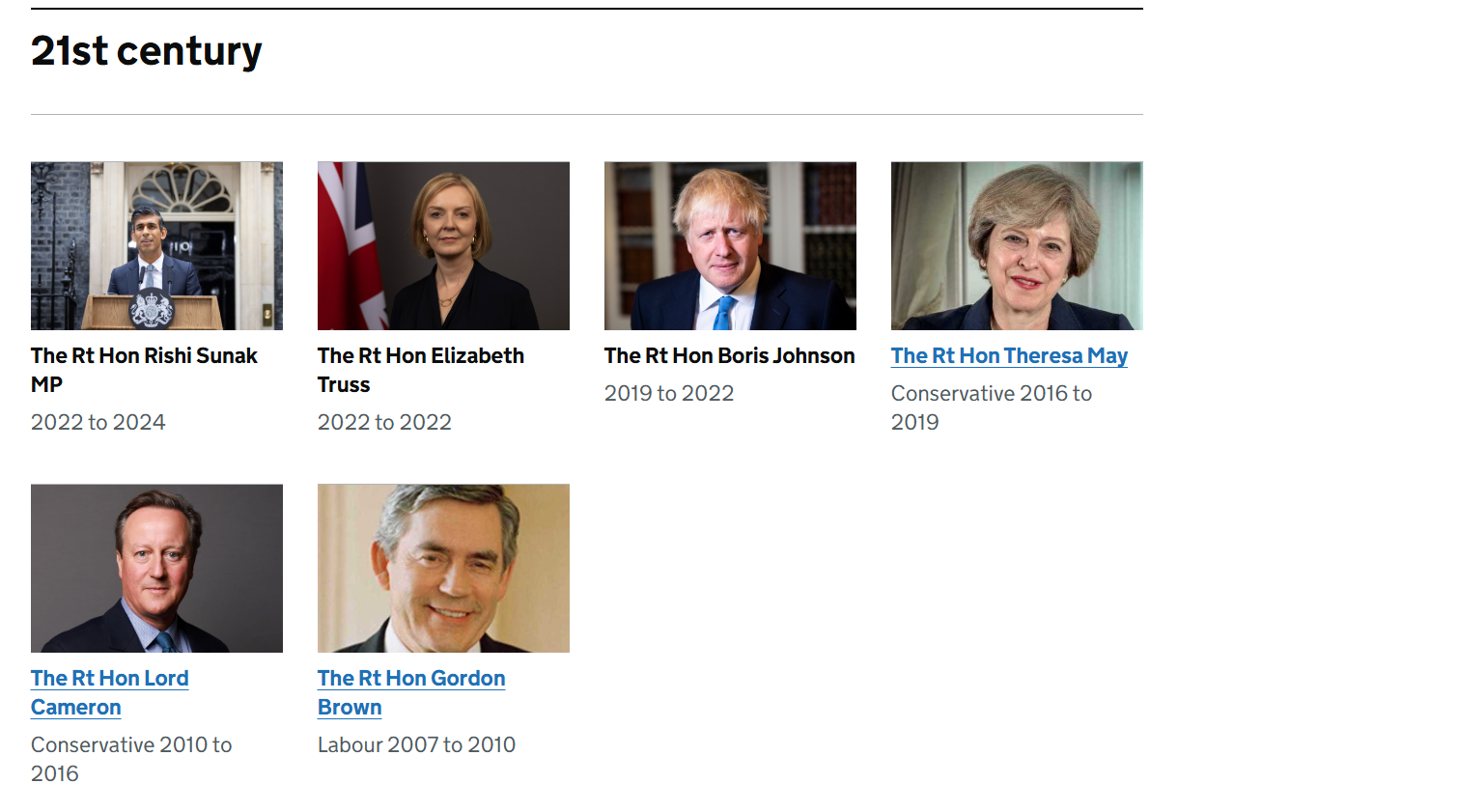
We also verified who held the office of British Prime Minister in 2021. Official UK government records confirm that Boris Johnson was the Prime Minister at that time, while Keir Starmer served as the Leader of the Opposition.
Conclusion
Our research confirms that the viral video is old and misleadingly presented. The footage is from 2021, when Keir Starmer was not the Prime Minister of the United Kingdom, but the opposition Labour Party leader. Sharing the video with the claim that it shows a current British Prime Minister being thrown out of a pub is factually incorrect.

Related Blogs
Executive Summary
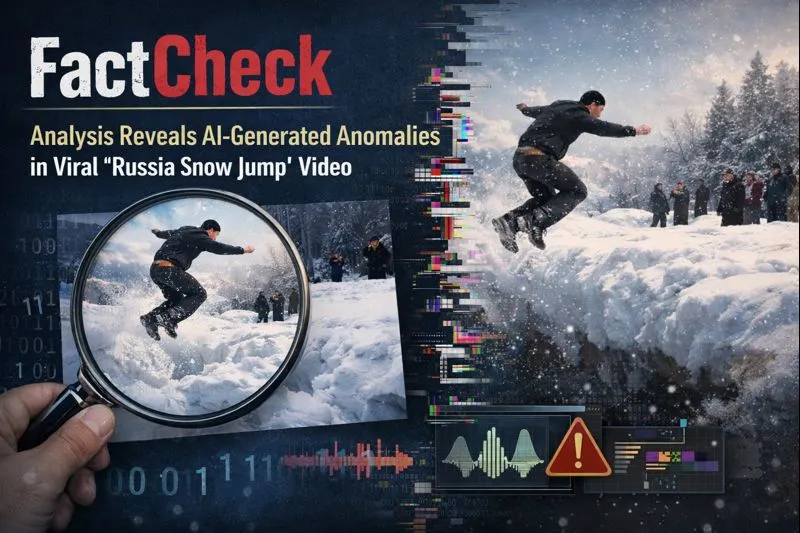
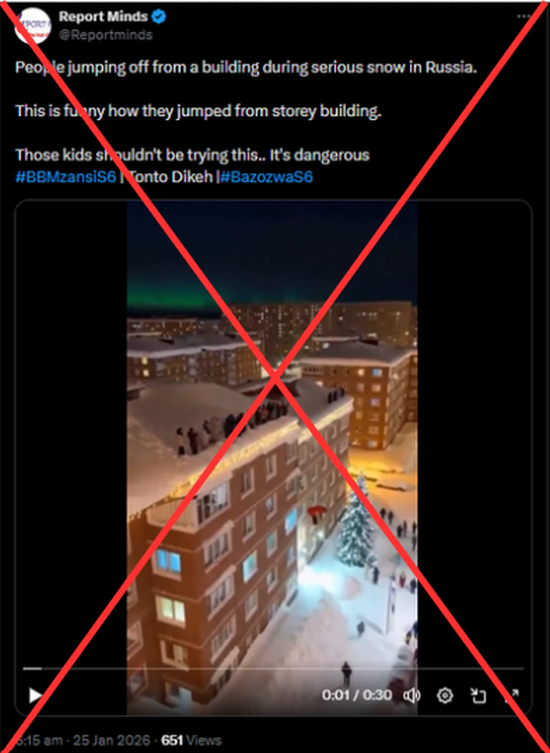
A dramatic video showing several people jumping from the upper floors of a building into what appears to be thick snow has been circulating on social media, with users claiming that it captures a real incident in Russia during heavy snowfall. In the footage, individuals can be seen leaping one after another from a multi-storey structure onto a snow-covered surface below, eliciting reactions ranging from amusement to concern. The claim accompanying the video suggests that it depicts a reckless real-life episode in a snow-hit region of Russia.
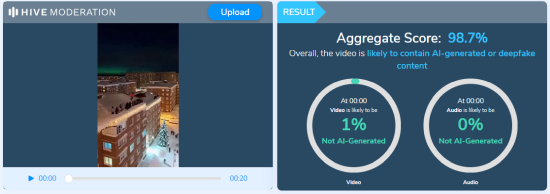
A thorough analysis by CyberPeace confirmed that the video is not a real-world recording but an AI-generated creation. The footage exhibits multiple signs of synthetic media, including unnatural human movements, inconsistent physics, blurred or distorted edges, and a glossy, computer-rendered appearance. In some frames, a partial watermark from an AI video generation tool is visible. Further verification using the Hive Moderation AI-detection platform indicated that 98.7% of the video is AI-generated, confirming that the clip is entirely digitally created and does not depict any actual incident in Russia.
Claim:
The video was shared on social media by an X (formerly Twitter) user ‘Report Minds’ on January 25, claiming it showed a real-life event in Russia. The post caption read: "People jumping off from a building during serious snow in Russia. This is funny, how they jumped from a storey building. Those kids shouldn't be trying this. It's dangerous." Here is the link to the post, and below is a screenshot.
Fact Check:
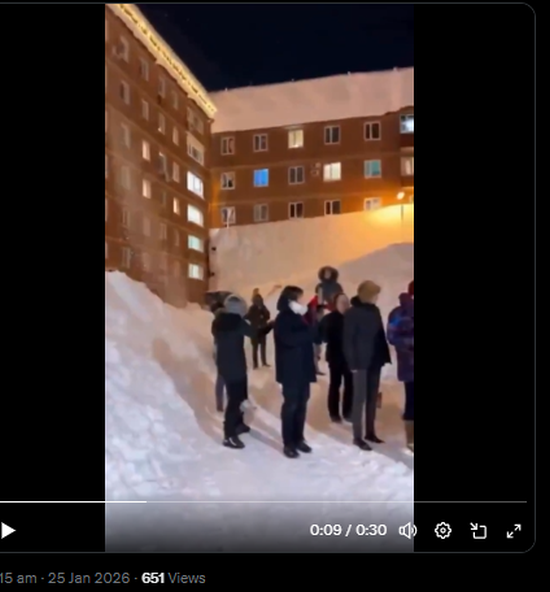
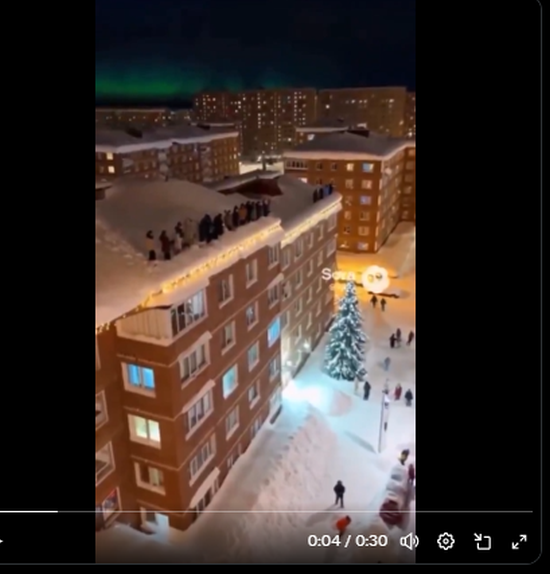
The Desk used the InVid tool to extract keyframes from the viral video and conducted a reverse image search, which revealed multiple instances of the same video shared by other users with similar claims. Upon close visual examination, several anomalies were observed, including unnatural human movements, blurred and distorted sections, a glossy, digitally-rendered appearance, and a partially concealed logo of the AI video generation tool ‘Sora AI’ visible in certain frames. Screenshots highlighting these inconsistencies were captured during the research .
- https://x.com/DailyLoud/status/2015107152772297086?s=20
- https://x.com/75secondes/status/2015134928745164848?s=20
The video was analyzed on Hive Moderation, an AI-detection platform, which confirmed that 98.7% of the content is AI-generated.
The viral video showing people jumping off a building into snow, claimed to depict a real incident in Russia, is entirely AI-generated. Social media users who shared it presented the digitally created footage as if it were real, making the claim false and misleading.

Introduction
The Telecommunications Act of 2023 was passed by Parliament in December, receiving the President's assent and being published in the official Gazette on December 24, 2023. The act is divided into 11 chapters 62 sections and 3 schedules. Sections 1, 2, 10-30, 42-44, 46, 47, 50-58, 61 and 62 already took effect on June 26, 2024.
On July 04, 2024, the Centre issued a Gazetted Notification and sections 6-8, 48 and 59(b) were notified to be effective from July 05, 2024. The Act aims to amend and consolidate the laws related to telecommunication services, telecommunication networks, and spectrum assignment and it ‘repeals’ certain older colonial-era legislations like the Indian Telegraph Act 1885 and Indian Wireless Telegraph Act 1933. Due to the advancements in technology in the telecom sector, the new law is enacted.
On 18 July 2024 Thursday, the telecom minister while launching the theme of Indian Mobile Congress (IMC), announced that all rules and provisions of the new Telecom Act would be notified within the next 180 days, hence making the Act operational at full capacity.
Important definitions under Telecommunications Act, 2023
- Authorisation: Section 2(d) entails “authorisation” means a permission, by whatever name called, granted under this Act for— (i) providing telecommunication services; (ii) establishing, operating, maintaining or expanding telecommunication networks; or (iii) possessing radio equipment.
- Telecommunication: Section 2(p) entails “Telecommunication” means transmission, emission or reception of any messages, by wire, radio, optical or other electro-magnetic systems, whether or not such messages have been subjected to rearrangement, computation or other processes by any means in the course of their transmission, emission or reception.
- Telecommunication Network: Section 2(s) entails “telecommunication network” means a system or series of systems of telecommunication equipment or infrastructure, including terrestrial or satellite networks or submarine networks, or a combination of such networks, used or intended to be used for providing telecommunication services, but does not include such telecommunication equipment as notified by the Central Government.
- Telecommunication Service: Section 2(t) entails “telecommunication service” means any service for telecommunication.
Measures for Cyber Security for the Telecommunication Network/Services
Section 22 of the Telecommunication Act, 2023 talks about the protection of telecommunication networks and telecommunication services. The section specifies that the centre may provide rules to ensure the cybersecurity of telecommunication networks and telecommunication services. Such measures may include the collection, analysis and dissemination of traffic data that is generated, transmitted, received or stored in telecommunication networks. ‘Traffic data’ can include any data generated, transmitted, received, or stored in telecommunication networks – such as type, duration, or time of a telecommunication.
Section 22 further empowers the central government to declare any telecommunication network, or part thereof, as Critical Telecommunication Infrastructure. It may further provide for standards, security practices, upgradation requirements and procedures to be implemented for such Critical Telecommunication Infrastructure.
CyberPeace Policy Wing Outlook:
The Telecommunication Act, 2023 marks a significant change & growth in the telecom sector by providing a robust regulatory framework, encouraging research and development, promoting infrastructure development, and measures for consumer protection. The Central Government is empowered to authorize individuals for (a) providing telecommunication services, (b) establishing, operating, maintaining, or expanding telecommunication networks, or (c) possessing radio equipment. Section 48 of the act provides no person shall possess or use any equipment that blocks telecommunication unless permitted by the Central Government.
The Central Government will protect users by implementing different measures, such as the requirement of prior consent of users for receiving particular messages, keeping a 'Do Not Disturb' register to stop unwanted messages, the mechanism to enable users to report any malware or specified messages received, the preparation and maintenance of “Do Not Disturb” register, to ensure that users do not receive specified messages or class of specified messages without prior consent. The authorized entity providing telecommunication services will also be required to create an online platform for users for their grievances pertaining to telecommunication services.
In certain limited circumstances such as national security measures, disaster management and public safety, the act contains provisions empowering the Government to take temporary possession of telecom services or networks from authorised entity; direct interception or disclosure of messages, with measures to be specified in rulemaking. This entails that the government gains additional controls in case of emergencies to ensure security and public order. However, this has to be balanced with appropriate measures protecting individual privacy rights and avoiding any unintended arbitrary actions.
Taking into account the cyber security in the telecommunication sector, the government is empowered under the act to introduce standards for cyber security for telecommunication services and telecommunication networks; and encryption and data processing in telecommunication.
The act also promotes the research and development and pilot projects under Digital Bharat Nidhi. The act also promotes the approach of digital by design by bringing online dispute resolution and other frameworks. Overall the approach of the government is noteworthy as they realise the need for updating the colonial era legislation considering the importance of technological advancements and keeping pace with the digital and technical revolution in the telecommunication sector.
References:
- The Telecommunications Act, 2023 https://acrobat.adobe.com/id/urn:aaid:sc:AP:88cb04ff-2cce-4663-ad41-88aafc81a416
- https://pib.gov.in/PressReleasePage.aspx?PRID=2031057
- https://pib.gov.in/PressReleaseIframePage.aspx?PRID=2027941
- https://economictimes.indiatimes.com/industry/telecom/telecom-news/new-telecom-act-will-be-notified-in-180-days-bsnl-4g-rollout-is-monitored-on-a-daily-basis-scindia/articleshow/111851845.cms?from=mdr
- https://www.azbpartners.com/wp-content/uploads/2024/06/Update-Staggered-Enforcement-of-Telecommunications-Act-2023.pdf
- https://telecom.economictimes.indiatimes.com/blog/analysing-the-impact-of-telecommunications-act-2023-on-digital-india-mission/111828226

Executive Summary:
A viral video showing flames and thick smoke from large fuel tanks has been shared widely on social media. Many claimed it showed a recent Russian missile attack on a fuel depot in Ukraine. However, our research found that the video is not related to the Russia-Ukraine conflict. It actually shows a fire that happened at Al Hamriyah Port in Sharjah, United Arab Emirates, on May 31, 2025. The confusion was likely caused by a lack of context and misleading captions.

Claim:
The circulating claim suggests that Russia deliberately bombed Ukraine's fuel reserves and the viral video shows evidence of the bombing. The posts claim the fuel depot was destroyed purposefully during military operations, implying an increase in violence. This narrative is intended to generate feelings and reinforce fears related to war.

Fact Check:
After doing a reverse image search of the key frames of the viral video, we found that the video is actually from Al Hamriyah Port, UAE, not from the Russia-Ukraine conflict. During further research we found the same visuals were also published by regional news outlets in the UAE, including Gulf News and Khaleej Times, which reported on a massive fire at Al Hamriyah Port on 31 May 2025.
As per the news report, a fire broke out at a fuel storage facility in Al Hamriyah Port, UAE. Fortunately, no casualties were reported. Fire Management Services responded promptly and successfully brought the situation under control.


Conclusion:
The belief that the viral video is evidence of a Russian strike in Ukraine is misleading and incorrect. The video is actually of a fire at a commercial port in the UAE. When you share misleading footage like that, you distort reality and incite fear based on lies. It is simply a reminder that not all viral media is what it appears to be, and every viewer should take the time to check and verify the content source and context before accepting or reposting. In this instance, the original claim is untrue and misleading.
- Claim: Fresh attack in Ukraine! Russian military strikes again!
- Claimed On: Social Media
- Fact Check: False and Misleading
