
The Reserve Bank of India (Know Your Customer) Amendment Directions, 2026: Protecting Victims Without Freezing Innocent Accounts
Introduction
With the development of a digital economy in India, merchants in the country are often caught in a tough situation where their bank accounts have been placed under a debit freeze, due to a suspected link of the bank account with some form of cyber fraud. These merchants are left in a tough situation, as their funds, including their personal earnings, and money earned through the running of their business, have become frozen, regardless of whether or not the account holder had knowingly or intentionally engaged in any kind of illicit activity. The funds of legitimate businesses have become tied up due to this activity.
This concern was recognized and was addressed by the Supreme Court of India in their order, which was issued in 2026, which prompted the RBI to issue their draft Directions, in 2026. The draft directions are aimed at balancing the need of the state to stop the rapid withdrawal of stolen funds, while also trying to balance the needs of law-abiding citizens to hold and access their own money and maintain some financial stability.
Understanding Money-Mule Accounts
A "money mule" account is used for depositing and/or layering/integrating illicit money. There is a broad range of culpability when a person uses their bank account as a money mule account. Some people knowingly give someone else control over their bank account and use that control to commit illegal acts to make some money. Others, however, are unsuspecting and fall victim to fraudulent activities such as online ads offering bogus jobs or romance scams.
The proliferation of these accounts introduces severe systemic friction into cybercrime investigations, as stolen assets are rapidly dispersed across multiple tranches and jurisdictions before law enforcement can trace the primary beneficiaries. Accordingly, banking institutions bear a rigorous compliance burden to deploy real-time transaction monitoring systems capable of identifying anomalous patterns to pre-emptively mitigate the dissipation of fraudulent proceeds.
However, having an account involved in a questionable money transfer does not make the person account holding automatically a money mule. There is the innocent account holder who is being used as a transferrer for money to a person who has something to trade in exchange, or perhaps an account holder whose account was taken over. There are also accounts who have unknowingly been victim to identity theft. Due process requires a framework that allows an account holder to contest their money hold while providing regulatory safeguards to protect consumers.
What Does the RBI’s Draft Propose?
1. Temporary debit holds on suspicious transactions
The Draft Directions mandate that banking institutions institute temporary debit holds upon detecting transactions or accounts exhibiting a suspected nexus with money mule activities or cyber-enabled financial fraud. Real-time transaction monitoring systems leveraging advanced Artificial Intelligence (AI) and Machine Learning (ML) architectures shall be deployed to identify anomalous or suspicious transactions capturing a threshold value of ₹1,000 or more.
2. Notice and an opportunity to explain
Procedural safeguards within the framework include notice being provided by the banking institution to the customer within a statutory time period following a debit hold. The notice must specify the reason(s) behind the hold, and the procedures for a customer to request for the hold to be vacated, as well as providing information and contact details of the officer handling the matter.
- Showing Cause: The account holder shall ordinarily be granted a statutory window of 20 days from the receipt of notice to show cause and establish the legitimacy of the transaction or account.
- Adjudication by Bank: Upon submission of the customer's explanation, the bank is mandated to adjudicate the matter within 10 days. If the explanation is deemed statutorily satisfactory, the institution must vacate the hold instanter.
- Law Enforcement Referral: In the event the response is found to be lacking in substance, the bank can make a referral to the concerned law enforcement authority through the Citizen Financial Cyber Fraud Reporting and Management System (CFCFRMS) portal of the National Cybercrime Reporting Portal (NCRP).
- Temporal Sunset Clauses: The framework includes stringent temporal provisions for law enforcement actions to ensure that administrative delays do not turn the temporary holds into perpetual financial incapacitation:
- The 30-Day Directive Rule: In case the competent law enforcement authority does not issue a formal directive for the need to maintain the hold beyond the stipulated period within 30 days of the referral, then the bank is statutorily bound to remove the restriction after 30 days.
- Absolute Maximum Ceiling: In the absence of an explicit overriding direction from a competent judicial or statutory authority, the absolute maximum tenure of any temporary hold shall remain 60 days from the date of initiation of the hold.
3. Greater accountability for banks
Beyond the mechanics of fraud detection, the proposed framework also imposes greater responsibilities on banks with respect to compliance and governance. This implies that the banks need to have an internal policy on detection, implementation and release of the hold order, standardized customer communication, coordination with the law enforcement authorities, and also grievances redressal.
Balancing Fraud Prevention with Customer Rights
The promise of a proportionate approach
The core efficacy of the proposed regulatory framework rests upon its adherence to the constitutional doctrine of proportionality, seeking to calibrate administrative restrictions strictly to the scope of the alleged wrongdoing. Historically, the imposition of indiscriminate, blanket account freezes by banking institutions has induced severe financial disenfranchisement. These overreaching actions effectively inhibit the citizen’s ability to ensure basic necessities for oneself, meet one’s tenancy responsibilities, meet one’s medical liabilities, and remain solvent within the commercial environment.
For proprietary firms, micro-traders, and small-to-medium enterprises (SMEs), an inaccessible bank account means instant cessation of business activity, inability to pay salaries, and inability to pay suppliers. A transaction-based debit block, contingent upon statutory justification and limited by time is considerably less disruptive to the economic consequences.
The risks that remain
While Draft Directions are innovative, their effectiveness still rests on the ability of algorithms to detect fraud. An anomaly detection machine learning model is good at finding variations and deviations in transactions and the order of transactions. However, there are many variations in legitimate transactions, such as a large transfer in an otherwise small transaction account. An automated transaction system cannot identify fraud alone.
An over-reliance on unverified automated alerts creates an acute risk of systemic recidivism, wherein innocent depositors face iterative, unwarranted financial restrictions. Without legal and procedural support, automated fraud detection systems should not be used in banking and legal systems.
From an evidentiary standpoint, informal workers, small-scale vendors, and consumers lacking advanced digital literacy face severe structural barriers when ordered to establish the legitimacy of a transaction within the statutory 20-day window. These demographics frequently operate without formal invoices, digital ledger entries, or direct access to professional legal and banking assistance.
To prevent the reversing of the burden of proof onto the vulnerable, banking institutions must be mandated to provide simplified, multilingual channels for showing cause, accept alternative forms of secondary evidence, and eschew overly burdensome compliance hurdles. Crucially, where a depositor submits credible exculpatory evidence, clear statutory escalation and appellate pathways must be available to counter institutional inertia.
Recommendations for Effective Implementation
First, banks need to implement explainable and risk-based detection mechanisms, if needed, accompanied by human review. Secondly, banks need to give customers timely notice regarding the blocked transaction with explanation on what amount it concerns, steps to be taken and how one can submit additional evidence.
Thirdly, the RBI should ensure that grievance redressal is effective in practice, with urgent review of cases concerning necessary expenses and business hardship. Finally, coordination between banks and law-enforcement agencies must improve so that referrals are acted upon within the prescribed timelines.
Conclusion
The RBI’s Draft Know Your Customer Amendment Directions, 2026, represents a significant regulatory effort to resolve the systemic friction between combating cyber-enabled financial fraud and protecting consumer property rights. By introducing transaction-specific holds, mandatory customer notification, a statutory right to be heard, and strict temporal ceilings, the framework introduces a much-needed ethos of accountability into the digital ecosystem.
The sustainability of India’s digital economy in the long run cannot be contingent on a structure that inhibits the flow of illegitimate money through imposing severe, extrajudicial monetary disabilities on innocent people because the true effectiveness of any system entails not only inhibiting the criminals behind cybercrime but also protecting the financial safety and liquidity of regular depositors.
References
- Reserve Bank of India, Draft Reserve Bank of India (Know Your Customer) Amendment Directions, 2026 (11 September 2026) RBI official website.
- In Re: Victims of Digital Arrest Related to Forged Documents, Suo Motu Writ Petition (Criminal) No. 3 of 2025 (Supreme Court of India, Order dated August 4, 2026)
- Reserve Bank of India, Reserve Bank of India (Know Your Customer) Directions, 2025
- ‘RBI Proposes Temporary Debit Holds on Suspected Money Mule Accounts’, Business Standard (13 September 2026), https://www.business-standard.com/finance/news/rbi-proposes-temporary-debit-holds-on-suspected-money-mule-accounts-126091300603_1.html.
- ‘RBI Proposes Framework to Freeze Only Disputed Transaction Amount in Suspected Cyber Fraud Cases’, News on AIR (14 September 2026), https://newsonair.gov.in/rbi-proposes-framework-to-freeze-only-disputed-transaction-amount-in-suspected-cyber-fraud-cases/.
- Reserve Bank of India, Draft Reserve Bank of India (Know Your Customer) Amendment Directions, 2026 (11 September 2026).

Related Blogs

Introduction
Web applications are essential in various sectors, including online shopping, social networks, banking, and healthcare systems. However, they also pose numerous security threats, including Cross-Site Scripting (XSS), a client-side code injection vulnerability. XSS attacks exploit the trust relationship between users and websites, allowing them to change web content, steal private information, hijack sessions, and gain full control of user accounts without breaking into the core server. This vulnerability is part of the OWASP Top 10 Web Application Security Risks.
What is Cross-Site Scripting (XSS)?
An XSS attack occurs when an attacker injects client-side scripts into web pages viewed by other users. When users visit the affected pages, their browsers naively execute the inserted scripts. The exploit takes advantage of web applications that allow users to submit content without properly sanitising inputs or encoding outputs. These scripts can cause a wide range of damage, including but not limited to stealing session cookies for session hijacking, redirecting users to malicious sites, logging keystrokes to capture credentials, and altering the DOM to display fake or phishing content.
How Does XSS Work?
- Injection: A malicious user submits code through a website input, like a comment or form.
- Execution: The submitted code runs automatically in the browsers of other users who view the page.
- Exploitation:The attacker can steal session information, capture credentials, redirect users, or modify the page content.
The fundamental cause behind the XSS vulnerabilities is the application of:
- Accepting trusted input from the users.
- After users' input, web pages have the strings embedded without any sanitisation.
- Not abiding by security policies like Content Security Policy (CSP).
With such vulnerabilities, attackers can generate malicious payloads like: <script>alert('XSS');</script>
This code might seem simple, but its execution provides the attacker with the possibility to do the following:
- Copy session tokens through hidden HTTP requests.
- From attacker-controlled domains, load attacker scripts.
- Change the DOM structure to show fake login forms for phishing.
Types of XSS Attacks: XSS (Cross-Site Scripting) attacks can occur in three main variations:
- Stored XSS: This type of attack occurs when an attacker injects an administered payload into the database or a message board. The script then runs whenever a user visits the affected board.
- Reflected XSS: In this attack, the danger lies in a parameter of the URL. Its social engineering techniques are attacks, in which it requires tricking people to click on a specially designed link. For example:
- DOM-Based XSS: This technique injects anything harmful without the need for server-side scripts, in contrast to other approaches. It targets JavaScript client-side scripts such as `document.write` and `innerHTML`. Without carrying out any safety checks, these scripts will alter the page's look (DOM stands for Document Object Model). If the hash is given a malicious string, it is run directly within the browser.
What Makes XSS a Threat?
A Cross-Site Scripting attack is only a primary attack vector, and can lead to significant damage that includes the following:
- Statement Hijacking. This uses scripts to steal cookies, which are then used to pose as authorized users.
- Theft of Credentials. Users’ passwords and usernames are wrenched from keystroke trackers.
- Phishing. Users are prompted with deceitful login forms that are used to capture sensitive details.
- Website Vandalism. Modified website material lowers the esteem of the brand.
- Monetary and Legal Consequences. There are compounding effects to GDPR and DPDP Act compliance in case of Data breaches, which incur penalties and fines.
Incidents in the Real World
In 2021, an XSS Stored attack occurred on a famous e-commerce platform eBay, through their product review system. The malicious JavaScript code was set to trigger every time an infected product page was accessed by customers. This caused a lot of problems, including account takeovers, unauthorised purchases, and damage to the company’s reputation. This example further worsens the fact that even reputed platforms can be targeted by XSS attacks.
How to Prevent XSS?
Addressing XSS vulnerabilities demands attention to detail and coordinated efforts across functions, as illustrated in the steps below:
Input Validation and Output Encoding:
- Ensure input validation is in place on the client and server.
- Perform output encoding relative to context: HTML: <, >, &.
- JavaScript: Escape quotes and slashes
Content Security Policy (CSP): CSP allows scripts to be executed only from the verified sources, which helps diminish the odds of harmful scripts running on your website. For example, the Header in the code could look to some degree like this: Content-Security-Policy: script-src 'self';
Unsafe APIs should be dodged: Avoid the use of document.write(), innerHTML, and eval(), and make sure to use:
- TextContent for inserting text.
- CreateElement() and other DOM creation methods for structured content.
Secure Cookies: Apply the HttpOnly and Secure cookie flags to block JavaScript access.
Framework Protections: Use the protective features in frameworks such as:
- React, which escapes data embedded in JSX automatically.
- Angular, which uses context-aware sanitisation.
Periodic Security Assessment:
- Use DAST tools to test the security posture of an application.
- Perform thorough penetration testing and security-oriented code reviews.
Best Practices for Developers: Assume a Secure Development Lifecycle (SDLC) integrating XSS stoppage at each point.
- Educate developers on OWASP secure coding guidelines.
- Automate scanning for vulnerabilities in CI/CD pipelines.
Conclusion:
To reduce the potential danger of XSS, both developers and companies must be diligent in their safety initiatives, ranging from using Content Security Policies (CSP) to verifying user input. Web applications can shield consumers and the company from the subtle but long-lasting threat of Cross-Site Scripting if security controls are implemented during the web application development stage and regular vulnerability scans are conducted.
References
- https://owasp.org/www-community/attacks/xss/
- https://www.paloaltonetworks.com/cyberpedia/xss-cross-site-scripting
- https://developer.mozilla.org/en-US/docs/Glossary/Cross-site_scripting
- https://www.cloudflare.com/learning/security/threats/cross-site-scripting/

Introduction
In a significant step, the Indian Army beefed up its information warfare capacity on June 25, 2026, with the operationalisation of @MythbusterXX, its dedicated fact-checking handle designed to counter any form of misinformation, disinformation, malinformation, and deepfakes on the army swiftly. Adopting the motto 'Verify Before You Amplify,' the service seeks to pivot from reactive statements to active cognitive warfare. In a milieu where manipulated narratives can be as decisive in shaping public perception as kinetic force is on the battlefield, truth itself has transformed into a critical national security objective.
This is clear proof that protecting India’s digital battleground will from now on be defined not just by troop deployments but also by its institutional verification capacities, swift attribution mechanisms, and public awareness.
When the Battlefield Went Digital
Today warfare extends to timelines, group chats, and prime-time graphics packages. The distinction between misinformation , disinformation , and malinformation is crucial to operations. After all, they necessitate different types of counters. Generative AI just exponentially increased their velocity, cost, and the creepy believability of synthesized audio, video, and images. Operation Sindoor, India's May 2025 military response to a Pahalgam terror attack, provides a blueprint for just how large it can get.
According to the fact-checking site BOOM, 68% of fact checks in May related to Operation Sindoor, describing the campaign as a misinformation superspreader, and, more directly, India's Chief of Defence Staff General Anil Chauhan lamented at last year’s Shangri-La Dialogue that roughly 15% of his military’s operational time was spent on countering false news. New Delhi matched this response level; the Ministry of Information and Broadcasting had blocked over 1,400 URLs, many bearing false information or communally inciteful narratives from accounts in Pakistan. These challenges won't be vanishing any time soon. Microsoft's July 2025 Digital Defence Report lists India among the top countries targeted for AI-powered state-backed hacking, noting the automation of attacks and generation of fake content used to influence opinion.
CyberPeace's regulatory tracking also indicates steps toward building infrastructure to mitigate this, a Rule 7 complaint system for deepfakes, and efforts to foster local detection capabilities under the IndiaAI mission signal it's now an infrastructural threat.
Why the Army Chose to Speak First
On 1 June 2026, the Indian government’s official fact-checking unit debunked a deepfake of former Army Chief General Dhiraj Seth talking about India’s engagement with the Taliban that emanated from Pakistan-affiliated propaganda sources, appearing within days of a change of military command. Barely days after General Dhiraj Seth was elevated to Chief of Army Staff, the 31st person to hold the post, another fabricated deepfake used spliced authentic footage with AI-cloned audio to falsely allege he had blamed the past army leadership for hiding the bodies of soldiers to protect their image.
Such a dual targeting of India’s army chiefs with deepfakes in such close succession is a testament as to why an authoritative, constantly running fact-check machine isn’t an optional extra but a strategic must-have.
Architecture is as important as architecture itself. India tried a statutory fact-checking model with a government-owned Fact Check Unit under the Information Technology (IT) Rules of 2023 through the Press Information Bureau (PIB). It had to retreat from the edge of the constitutional cliff. In September 2024, when the Bombay High Court struck down key provisions of these rules. It ruled it unconstitutional to empower the state to declare digital content relating to the state itself as fake, false, or misleading. A similar reading of the analysis by CyberPeace found that digital speech should be given the same protections as offline speech, and this should be the benchmark for any counter-misinformation policy.
MythbusterXX carefully avoids the constitutional controversy by acting as an institutional avenue that produces verified information and rebuttals in response to disinformation. There is a profound distinction between answering falsehoods with factual, credible speech versus shutting them down with state power, the very proportionality that civil libertarians have said must govern a democracy's approach to online misinformation.
Platforms as Accelerants, Not Just Conduits
Part of the issue lies upstream, with the algorithms and broadcasters that favor speedy falsehood over careful confirmation. A month’s supply of “false and misleading stories,” the Reuters Institute for the Study of Journalism observed, streamed online within hours of Operation Sindoor's onset: one fact-checker identified approximately seventy false claims by the close of day one. Meanwhile, on the small screen, graphics depicting escalating conflicts were being televised, with broadcasters forced to scramble under 24/7 competition.
Amplified manipulation of the crisis narrative is also a factor; studies show that thousands of accounts have been reposting exactly the same party content for three years, making crisis-induced viral narratives predictable rather than organic phenomena. For the most part, the platforms that manage these narratives and the algorithms that direct content on both sides of the divide are not just innocent delivery systems.
Digital Literacy as the First Line of Defence
Institutional rebuttals only go so far if citizens lack the reflex to pause before sharing, which is where CyberPeace's own work becomes directly relevant. Through a multi-year, Google.org-backed initiative, CyberPeace Foundation aims to reach over 40 million Indian internet users, including 9 million underserved beneficiaries, through a multilingual resource centre offering 650 hours of content, state-level helplines, and quick-response teams staffed by digital forensics and fact-checking experts. Longer-running efforts such as the Digital Shakti campaign and the annual eRaksha competition, run with NCERT, have built a culture of responsible digital citizenship among young and first-time internet users since 2019, while CyberPeace Corps, the foundation's volunteer arm, carries the same message into classrooms and campuses through cyber-awareness sessions run with universities and school networks nationwide. Notably, CyberPeace's own research on children's online safety had already flagged manipulated Army-related videos as a category of digital manipulation designed to cast doubt on official military positions, well before @MythbusterXX existed. The Army's tagline and CyberPeace's mission converge on the same insight: verification is a civic skill, not merely an institutional service.
A Season of Deepfakes
The history book of compromised defence material in the past year alone would be edifying. The International Federation of Journalists recorded one such deepfake widely circulated that relied on AI voice cloning and lip-sync tools to present the Pakistani PM conceding defeat, though the video actually contained his praise for the Pakistani air force’s performance following Operation Sindoor.
Other similar videos featured the Indian Prime Minister, External Affairs Minister, and Home Minister allegedly apologising to Pakistan and a deepfake with a foreign head of state in voice-cloned style applauding India’s armed forces. None needed a state’s resources, but just a laptop, voice cloning available readily, and a citizenry ready to spread rather than confirm the authenticity of any such sensational information before spreading it on to the masses.
Building the Verification Reflex
A resilient information ecosystem needs different actors playing complementary roles:
- Citizens: Do not equate virality with credibility. Verify all national security-related information through official sources, such as @MythbusterXX, before reposting or forwarding it.
- Journalists: Apply rigorous verification standards to live broadcasts, war-room graphics, and breaking reports, just as you would to print journalism, and avoid speculation during fast-moving military operations.
- Researchers and fact-checkers: Use open-source forensic and AI-detection technologies to authenticate questionable material. BOOM researchers, for instance, used Deepfake-o-meter to scrutinize misleading videos of political leaders before fact-checking and publishing them.
- Policymakers: Favored constitutionally proportional and carefully tailored regulations over broad-based takedown mandates. While the 2026 IT Amendment Rules require platforms to shift their obligations from compliance with takedowns towards preventive diligence on synthetic media, implementation should continue to be informed by judicial protections afforded to freedom of speech and due process.
Cyber Resilience Is National Security Now
Legal scholars examining Operation Sindoor have drawn a useful distinction between coordinated information warfare, which is strategic and intentional, and the diffuse, uncoordinated mis/disinformation that dominated timelines during the conflict, cautioning that disproportionate state responses to the latter can compromise citizens' right to know just as much as the falsehoods themselves. Getting that balance right, between speed and due process, between institutional voice and censorship, is the real test facing India's information ecosystem, in defence and far beyond it. CyberPeace has made a related argument in its own work on AI-enabled espionage: institutions such as the National Critical Information Infrastructure Protection Centre and the Defence Cyber Agency are already folding AI-based monitoring into their processes, yet no amount of institutional surveillance substitutes for a citizenry trained to spot manipulation on sight.
@MythbusterXX will not end deepfakes, and no single handle can. But it signals something CyberPeace has argued for years: resilience against synthetic and manipulated media requires authoritative institutional voices, digitally literate citizens, forensically equipped researchers, and proportionate policy, all pulling in the same direction. "Verify before you amplify" is not just an Army campaign. It is the operating discipline a democracy needs to protect its own information age.
Conclusion
@MythbusterXX can't possibly kill deepfakes and disinformation, but this marks a milestone shift towards developing an institutional resilience for India's info battlefield. For, after all, national security in the age of info warfare depends less on tech and more on robust institutions, constitutional balance in policymaking, responsible social platforms, and a citizenry that clicks "forward" only after clicking "verify."
* * * * *
This piece is part of CyberPeace's ongoing work on misinformation, disinformation, and digital citizenship in India. For more on CyberPeace's initiatives in digital literacy and cyber resilience, visit cyberpeace.org.
Key Sources
- Dynamite News, "Indian Army launches fact-check push against deepfake videos and fake military claims" (June 2026)
- ADG PI – Indian Army, official announcement on X (@adgpi)
- Press Information Bureau, Government of India, press release on countering misinformation during Operation Sindoor
- Reuters Institute for the Study of Journalism, "Truth is the casualty: How Indian fact-checkers debunked false claims during the India-Pakistan crisis"
- International Federation of Journalists, "AI, Deepfakes, and the Fog of War" and "Operation Sindoor and the Two Wars" (June 2025)
- Republic World, "Operation Sindoor Haunts Pakistan: Islamabad's Latest AI Deepfake Bid Against Indian Army Chief General Dhiraj Seth Exposed" (July 2026)
- TechPolicy Press, "Sanity Prevails as Bombay High Court Strikes Down India Government's Fact Check Unit", and LiveLaw, coverage of the tie-breaker verdict, on the IT Amendment Rules, 2023 (Fact-Check Unit)
- Dark Reading, "Indian Army Propaganda Spread by 1.4K AI-Powered Social Media Accounts"
- Inforrm, "(Dis)information warfare and the right to know: lessons from Operation Sindoor"
- CyberPeace Foundation, initiatives page and The CyberPeace Initiative (Google.org-backed digital literacy programme)
- CyberPeace Foundation, "AI-Powered Espionage: How India's Cybersecurity Strategy Must Evolve"
- CyberPeace Foundation, "From Deepfakes to Due Diligence – Decoding India's IT Amendment Rules"
- Wikipedia, CyberPeace Foundation (background on Digital Shakti and eRaksha)
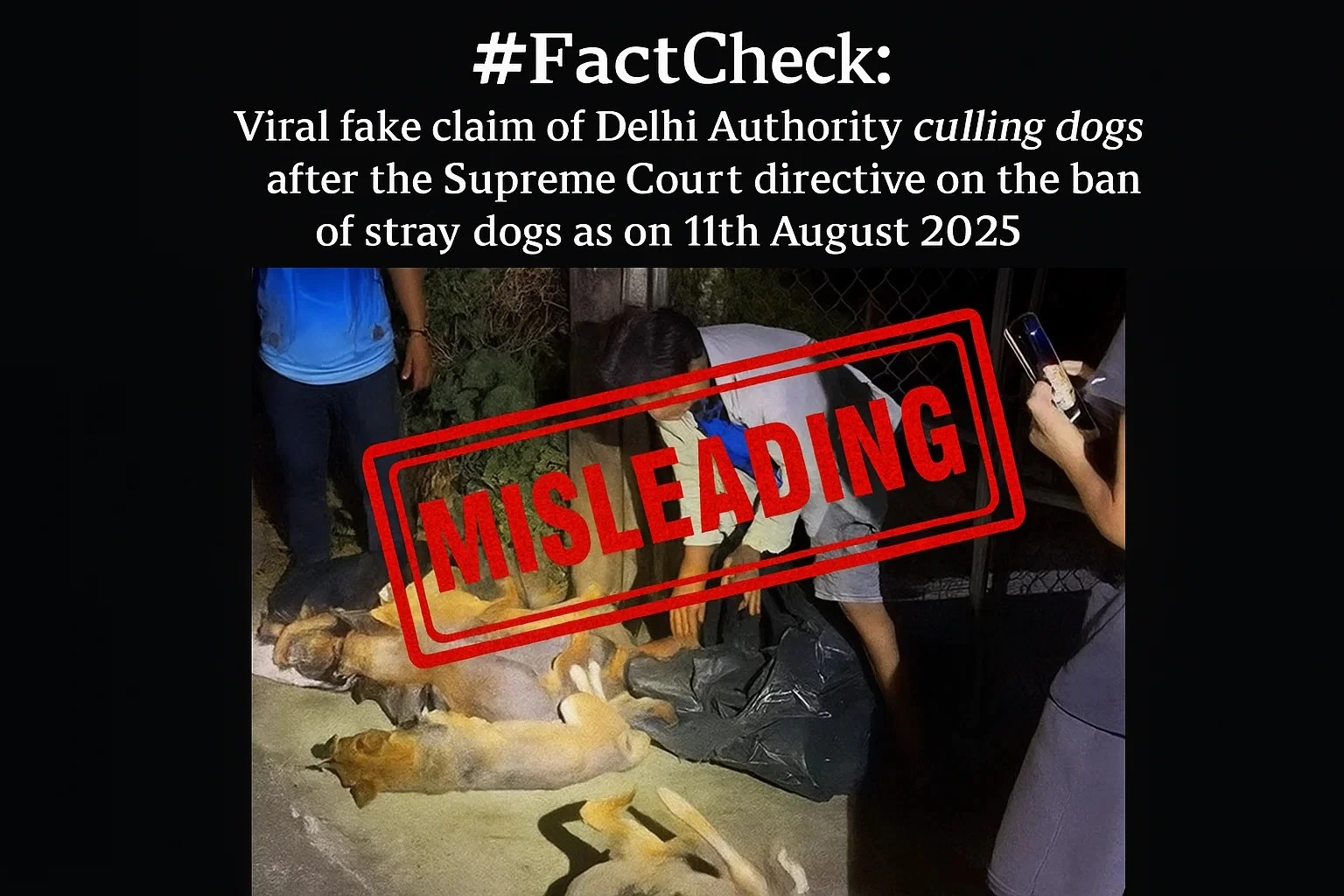
Executive Summary:
A viral claim alleges that following the Supreme Court of India’s August 11, 2025 order on relocating stray dogs, authorities in Delhi NCR have begun mass culling. However, verification reveals the claim to be false and misleading. A reverse image search of the viral video traced it to older posts from outside India, probably linked to Haiti or Vietnam, as indicated by the use of Haitian Creole and Vietnamese language respectively. While the exact location cannot be independently verified, it is confirmed that the video is not from Delhi NCR and has no connection to the Supreme Court’s directive. Therefore, the claim lacks authenticity and is misleading
Claim:
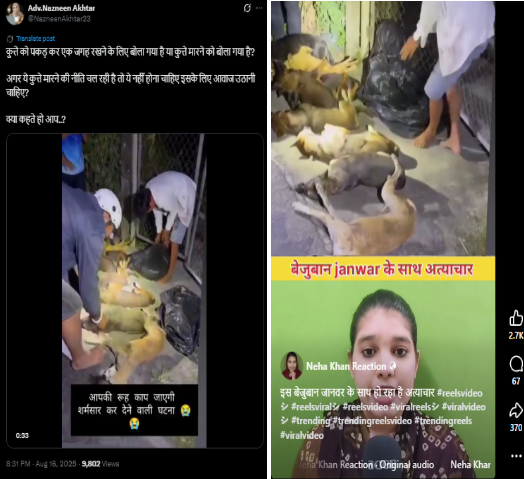
There have been several claims circulating after the Supreme Court of India on 11th August 2025 ordered the relocation of stray dogs to shelters. The primary claim suggests that authorities, following the order, have begun mass killing or culling of stray dogs, particularly in areas like Delhi and the National Capital Region. This narrative intensified after several videos purporting to show dead or mistreated dogs allegedly linked to the Supreme Court’s directive—began circulating online.
Fact Check:
After conducting a reverse image search using a keyframe from the viral video, we found similar videos circulating on Facebook. Upon analyzing the language used in one of the posts, it appears to be Haitian Creole (Kreyòl Ayisyen), which is primarily spoken in Haiti. Another similar video was also found on Facebook, where the language used is Vietnamese, suggesting that the post associates the incident with Vietnam.
However, it is important to note that while these posts point towards different locations, the exact origin of the video cannot be independently verified. What can be established with certainty is that the video is not from Delhi NCR, India, as is being claimed. Therefore, the viral claim is misleading and lacks authenticity.


Conclusion:
The viral claim linking the Supreme Court’s August 11, 2025 order on stray dogs to mass culling in Delhi NCR is false and misleading. Reverse image search confirms the video originated outside India, with evidence of Haitian Creole and Vietnamese captions. While the exact source remains unverified, it is clear the video is not from Delhi NCR and has no relation to the Court’s directive. Hence, the claim lacks credibility and authenticity.
Claim: Viral fake claim of Delhi Authority culling dogs after the Supreme Court directive on the ban of stray dogs as on 11th August 2025
Claimed On: Social Media
Fact Check: False and Misleading
