
The Online Disinhibition Effect and the Rise of Cyberbullying
Introduction
The digital landscape has altered human communication, iInteractions over the internet lack the social cues present in physical environments and this shift creates a phenomenon where individuals behave differently online than they do in physical settings. Researchers identify this change as the online disinhibition effect, the effect explains why people express themselves openly and why they engage in aggressive acts such as cyberbullying. The absence of physical presence weakens the psychological barriers that regulate social behavior as a lot of the unspoken yet understood social norms base themselves on physical human presence to enforce themselves, these toxic disinhibitions lead to rude language and criticism that degrade digital safety. Addressing these issues requires a thorough examination of how digital interfaces influence human psychology and social interaction.
The Psychological Mechanisms of Disinhibition
- Dissociative Anonymity and Identity: One factor driving harmful behavior online is dissociative anonymity, when users navigate digital platforms they can conceal their identities and detach their online actions from their physical lives and this separation allows individuals to dissociate themselves from the responsibility for hostile behaviors. Users convince themselves that their online actions do not reflect their character and the feeling of being unknown removes the fear of social repercussion and encourages aggression. The unidentifiability factor makes users feel unaccountable for their negative actions, therefore the loss of accountability promotes abusive behaviors that individuals would normally suppress.
- Invisibility and the Absence of Eye Contact : Invisibility further amplifies the online disinhibition effect, human beings are very sensitive to nonverbal communication like eye movements and shifting body language, however text based communication removes the ability to see or hear other individuals. People do not have to worry about how others react physically to their statements, seeing a frown usually inhibits hostile expressions in physical conversations. Research demonstrates that the lack of eye contact is a chief contributor to toxic online disinhibition, eye contact regulates interpersonal interaction and expresses intimacy. Without eye contact users experience a decrease in available social cues and this reduces empathy and makes it easier for users to direct hostility toward others.
- The Social Identity Model of Deindividuation The impact of the online disinhibition effect expands when users interact within groups, the social identity model of deindividuation effects explains how anonymity shifts attention from the personal self to a shared group identity. When individuals feel immersed in an anonymous group they conform more intensely to the norms of that group and if a group promotes hostility the members will adopt aggressive behaviors to maintain their shared identity. Stripping away personal cues does not produce chaos but instead strengthens in group loyalty and out group hostility. This dynamic transforms individual users into a collective mob along with that the loss of individual self focus in a faceless channel deepens the commitment to group actions.
- The Cycle of Online Hate: The observation of harmful behavior influences the actions of bystanders, adolescents who observe online hate are more likely to become perpetrators of online hate themselves. Toxic online disinhibition moderates the relationship between being a bystander and becoming an aggressor, when individuals witness hateful writing online they may become desensitized to the severity of the aggression. Social learning theory as propounded by Albert Bandura suggests that observing deviant behavior makes individuals more likely to engage in similar behavior, frequent exposure to cyberbullying normalizes the activity within the peer group while bystanders who feel less inhibited online are susceptible to adopting inappropriate coping strategies.
CyberPeace Interventions and Strategies
- Designing Behavioral Friction: To combat the online disinhibition effect technology platforms must implement strategic interventions, one approach involves introducing behavioral friction into user interfaces. Friction based posting delays force users to pause before publishing aggressive content and this delay allows individuals time to shift from automatic emotional reactions to deliberate cognitive processing. Active empathy prompts can ask users to reconsider their words before sending a hostile message, these prompts simulate the missing social cues that typically regulate physical conversations. Increasing self control and learning techniques for critical self monitoring can reduce the effects of toxic online disinhibition, platforms should design systems that encourage users to recognize social cues and practice self reflection whereas educational campaigns can train individuals to identify their vulnerabilities to disinhibition.
- Fostering Digital Empathy: Building resilience against cyberbullying requires a focus on digital empathy, online environments must be structured to remind users of the human presence behind the screen. Implementing features that require verified identities can mitigate the sense of dissociative anonymity, while total anonymity provides privacy it also enables harassment, balancing freedom of expression with digital safety requires careful policy design. Social media providers should prioritize the removal of online hate material and reduce the exposure of bystanders to toxic content, prevention programs can help individuals understand that human rights apply equally to the digital world.
Conclusion
The online disinhibition effect fundamentally alters human interaction in digital spaces. Dissociative anonymity and invisibility dismantle the social cues that naturally regulate behavior and encourage empathy, the lack of eye contact reduces self awareness and fuels aggressive acts such as cyberbullying. Group dynamics further escalate these behaviors by replacing individual accountability with hostile group norms, addressing these challenges requires structural changes to digital platforms and communication systems. Implementing behavioral friction and active empathy prompts can restore the psychological barriers that prevent toxic disinhibition. Fostering digital literacy and self reflection will empower users to resist the normalization of online hate, protecting digital communities depends on designing technology that promotes human empathy and mitigates the psychological vulnerabilities exploited by the online environment.
References
1. https://aura-lab.siue.edu/theories/social-identity-model-of-deindividuation-effects-side/
2. https://www.researchgate.net/publication/8451443_The_Online_Disinhibition_Effect
3. https://pmc.ncbi.nlm.nih.gov/articles/PMC6163978/
4. https://www.dhi.ac.uk/san/waysofbeing/data/health-jones-lapidotlefler-2012.pdf

Related Blogs

Introduction
Apple launched Passkeys with iOS 16 as a more authentic and secure mechanism. It is safer than passwords, and it is more efficient in comparison to passwords. Apple users using iOS 16 passkeys features should enable two-factor authentication. The passkeys are an unchallenging mechanism than the passwords for the passkeys. The user just has to open the apps and websites, and then the biometric sensor automatically recognises the face and fingerprints. There can be a PIN and pattern used to log instead of passwords. The passkeys add an extra coating of protection to the user’s systems against cyber threats like phishing attacks by SMS and one-time password-based. In a report 9 to 5mac, there is confirmation that 95% of users are using passkeys. Also, with the passkeys, users’ experience will be better, and it is a more security-proof mechanism. The passwords were weak, reused credentials and credentials leaked, and the chances of phishing attacks were real.
What are passkeys?
Passkey is a digital key linked to users’ accounts and websites or applications. Passkeys allow the user to log into any application and website without entering passwords, usernames, or other details. The aim of this new feature is to replace the old long pattern of entering passwords for going through any websites and applications.
The passkeys are developed by Microsoft, Apple, and Google together, and it is also called FIDO Authentication (Fast identity online). It eliminates the need to remember passwords and the need for typing. So, the passkeys work as they replace the password with a unique digital key, which is tied to the account then, the key is stored in the device itself, and it is end-to-end encrypted. The passkeys will always be on the sites on which users specifically created them. the passkeys use the technology of cryptography for more security purposes. And the passkeys guarantee against the phish.
And since the passkeys follow FIDO standards so, this also can be used for third-party nonapple devices as the third-party device generate a QR code that enables the iOS user to scan that to log in. It will recognise the face of the person for authentication and then asks for permission on another device to deny or allow.
How are passkeys more secure than passwords?
The passkeys follow the public key cryptographic protocols that support the security keys, and they work against phishing and other cyber threats. It is more secure than SMS and apps based on one-time passwords. And another type of multi-factor authentication.
Why are passwords insecure?
The users create passwords easily, and it is wondering if they are secure. The very important passwords are short and easy to crack as they generally relate to the user’s personal information or popular words. One password is reused by the user to the different accounts, and then, in this case, hacking one account gives access to all accounts to the hackers. The problem is that passwords have inherent flaws, like they could be easily stolen.
Are passkeys about to become obligatory?
Many websites restrict the type of passwords, as some websites ask for mixtures of numbers and symbols, and many websites ask for two-factor authentication. There is no surety about the obligation of passkeys widespread as it is still a new concept and it will take time, so it is going to be optional for a while.
- There was a case of a Heartland payment system data breach, and Heartland was handling over 100 million monthly credit card transactions for 175,000 retailers at the time of the incident. Visa and MasterCard detected the hack in January 2009 when they notified Heartland of suspicious transactions. And this happened due to a password breach. The corporation paid an estimated $145 million in settlement for illegal payments. Today, data-driven breaches affect millions of people’s personal information.
- GoDaddy reported a security attack in November that affected the accounts of over a million of its WordPress customers. The attacker acquired unauthorised access to GoDaddy’s Managed WordPress hosting environment by hacking into the provisioning system in the company’s legacy Managed WordPress code.
Conclusion
The use of strong and unique passwords is an essential requirement to safeguard information and data from cyberattacks, but still, passwords have its own disadvantages. And by the replacement of passwords, a passkey, a digital key that ensures proper safety and there is security against cyberattacks and cybercrimes through passkey. There are cases above-mentioned that happened due to the password’s weaker security. And in this technology world, there is a need for something for protection and prevention from cybercrimes, and the world dumps passwords and adopts passkeys.
References
- https://www.cnet.com/tech/mobile/switch-to-passkeys-more-secure-than-passwords-on-ios-16-iphone-14/
- https://economictimes.indiatimes.com/magazines/panache/google-is-ending-passwords-rolls-out-passkeys-for-easy-log-in-how-to-set-it/articleshow/99988444.cms?from=mdr
- https://security.googleblog.com/2023/05/making-authentication-faster-than-ever.html#:~:text=Because%20they%20are%20based%20on,%2Dfactor%20authentication%20(MFA).

Executive Summary:
Social media is buzzing with a link that claims to offer an iPhone 15 as a gift from LuLu Hypermarket, presented as part of Holi celebrations. This article examines the deceptive tactics behind this fraudulent offer and provides guidance on recognizing and avoiding such scams.
False Claim:
The link being shared is misleading and falsely claims that LuLu Hypermarket is giving away free iPhone 15 phones. This is taking advantage of the Holi festival to trick unsuspecting people. When users click on the link, they are redirected multiple times and end up on a page with LuLu Hypermarket's photo and some simple questions. Fake comments are also used to make the offer seem genuine, but it is all a deception.
The Deceptive Scheme:
The plan uses psychological tricks by linking the offer to a famous brand and a popular celebration. The landing page's simplicity and phoney comments try to make users trust it and feel like they need to act fast, so they'll join the scam.
The Fraudulent Campaign Analysed:
The scammers are using psychological tactics to manipulate people. They're exploiting the trust people have in LuLu Hypermarket and the excitement around the new iPhone 15 during the Holi festival. The fake questionnaire serves no real purpose, but it's a way to engage users and make the scam seem legitimate. Testimonials claiming people have successfully received the iPhone 15 are also fake, designed to create a false sense of credibility. Users are prompted to select a "gift box," which adds an interactive element to draw them in further. When a user selects a box, they're falsely congratulated on winning the iPhone 15, giving them a sense of accomplishment. Finally, users are urged to share the link via WhatsApp to "claim" the gift, spreading the scam to more potential victims.
What do we Analyse? :
- We analyse the deceptive tactics employed by the scam, including psychological manipulation, false engagement techniques, and fake testimonials, all aimed at convincing users of the offer's legitimacy.
Link : (https://sophisticateddistort[.]top/nTiwpTTTT526?llue1696559991144)
- It is important to note that at this particular point, there has not been any official declaration or a proper confirmation of an offer made by Lulu Hypermarket So, people must be very careful when encountering such messages because they are often employed as lures in phishing attacks or misinformation campaigns. Before engaging or transmitting such claims, it is always advisable to authenticate the information from trustworthy sources in order to protect oneself online and prevent the spread of wrongful information
- The campaign is hosted on a third party domain instead of any official Website of LuLu Hypermarket, this raised suspicion. Also the domain was registered last year.
- The intercepted request revealed a connection to a China-linked analytical service, Baidu in the backend.

- Domain Name: sophisticateddistort.top
- Registry Domain ID: D20230629G10001G_04181852-top
- Registrar WHOIS Server: whois.west263.com
- Registrar URL: www.west263.com
- Updated Date: 2023-07-01T02:55:34Z
- Creation Date: 2023-06-29T06:05:00Z
- Registry Expiry Date: 2024-06-29T06:05:00Z
- Registrar: Chengdu west dimension digital
- Registrant State/Province: Shan Xi
- Registrant Country: CN (China)
- Name Server: curt.ns.cloudflare.com
- Name Server: harlee.ns.cloudflare.com
Note: Cybercriminal used Cloudflare technology to mask the actual IP address of the fraudulent website.
CyberPeace Advisory:
- Do not open those messages received from social platforms in which you think that such messages are suspicious or unsolicited. In the beginning, your own discretion can become your best weapon.
- Falling prey to such scams could compromise your entire system, potentially granting unauthorised access to your microphone, camera, text messages, contacts, pictures, videos, banking applications, and more. Keep your cyber world safe against any attacks.
- Never, in any case, reveal such sensitive data as your login credentials and banking details to entities you haven't validated as reliable ones.
- Before sharing any content or clicking on links within messages, always verify the legitimacy of the source. Protect not only yourself but also those in your digital circle.
- For the sake of the truthfulness of offers and messages, find the official sources and companies directly. Verify the authenticity of alluring offers before taking any action.
Conclusion:
During the festive season, as we engage in merrymaking and online activities, we should be mindful of fraudster's exploitation strategies. Another instance is the illegitimate Lulu Hypermarket offer of the upcoming iPhone 15. With the knowledge and carefulness, we can report any suspicious actions to avoid being victims of fraud in this way. Keep in mind the fact that legitimate offers are usually issued by trustworthy sources while if, the offer looks too good to be true, then it is rather a scam.
Executive Summary
A video of actress Kangana Ranaut is being shared on social media with the claim that she observed the Karwa Chauth fast for Prime Minister Narendra Modi. CyberPeace Research found the viral claim to be false. Our research revealed that the video dates back to June 2026, when MP Kangana Ranaut performed a puja in Jodhpur to mark 12 years of the Modi government and prayed for Prime Minister Narendra Modi’s long life.
Claim:
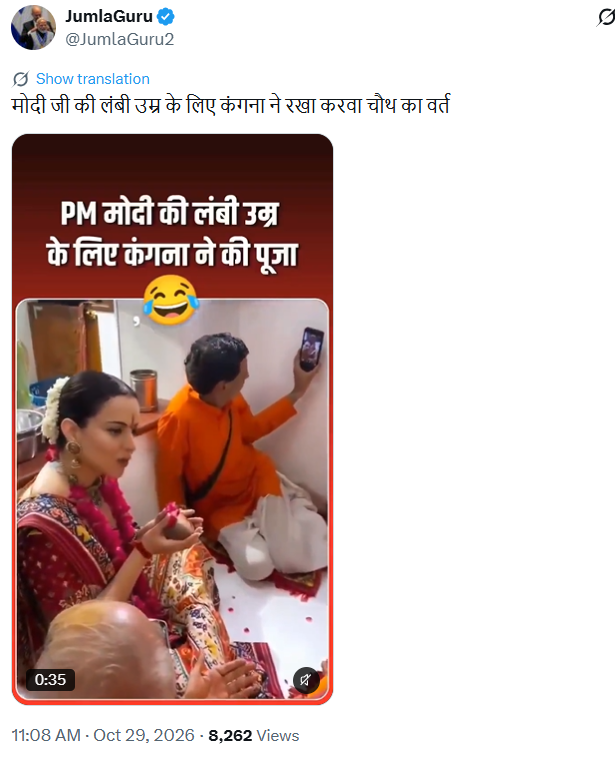
A user on social media platform X shared the viral video on October 29, 2026, with the caption: “Kangana observed the Karwa Chauth fast for Modi ji’s long life.” The post link, archive link and screenshot are provided below.
https://x.com/JumlaGuru2/status/2115679529742295307?a=msomkzvR3AP6rXIKj44&s=20
Fact Check
To verify the viral claim, we first searched Google using relevant keywords. However, we did not find any credible media reports supporting the claim.
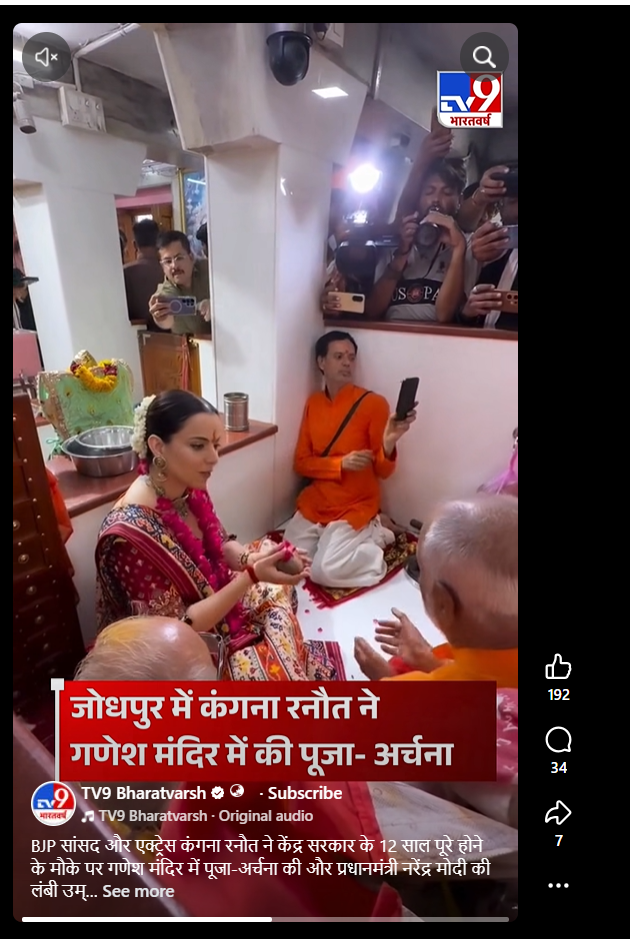
We then conducted a reverse image search using keyframes from the viral video. During this process, we found the same video on the Facebook page of TV9 Bharatvarsh, where it was published on June 12, 2026. According to the post’s caption, BJP MP and actress Kangana Ranaut performed a puja at a Ganesh temple to mark 12 years of the central government and prayed for Prime Minister Narendra Modi’s long life and good health. The post link and screenshot are provided below.
https://www.facebook.com/reel/1334827725455458
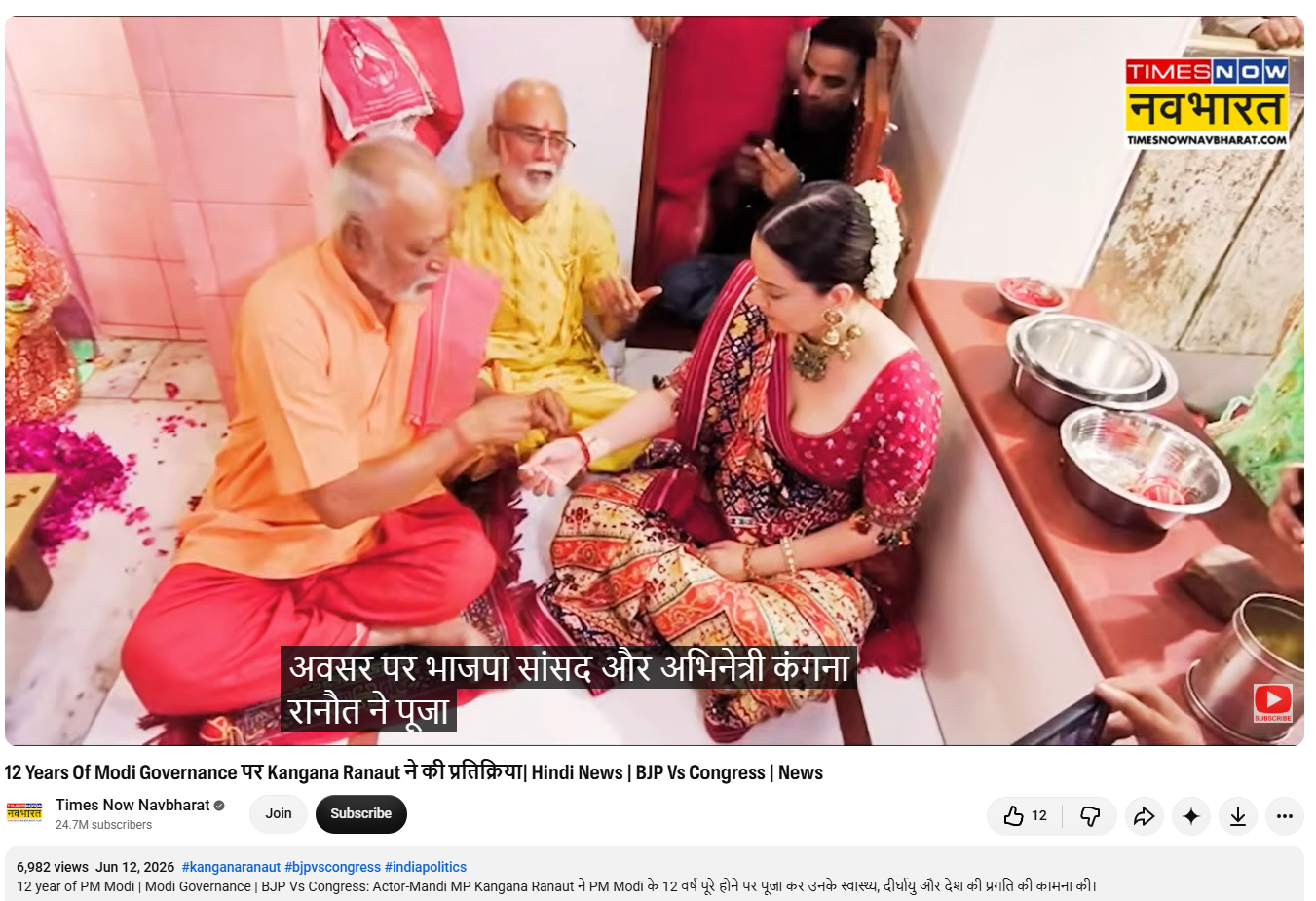
As the research progressed, we also found the video on the YouTube channel of Times Now Navbharat, where it was published on June 12, 2026, with a neutral caption. The post link and screenshot are provided below.
https://www.youtube.com/watch?v=V971aT2e98Y
Conculsion
Our research found that the video dates back to June 2026, when MP Kangana Ranaut performed a puja in Jodhpur to mark 12 years of the Modi government and prayed for Prime Minister Narendra Modi’s long life.
