
The Commercialization of Synthetic Fraud: Analyzing the $40M Deepfake Marketplace
Introduction
The commercialization of synthetic fraud has rapidly transformed from an abstract threat into a multi-billion-dollar shadow economy. As per the recent threat intelligence data from firms like identifAI, synthetic media and deepfakes now amounts to an estimated $40 billion in global financial fraud. The need for advanced coding skills are no longer required to bypass secure perimeters, as the Cybercriminals can now readily purchase real-time customised voice clones, face swapping software and other such identity morphing plugins from highly structured digital marketplaces.
The democratisation of advanced generative AI tools marks a fundamental pivot from traditional text-based phishing to real time synthetic fraud. Synthetic fraud operates on a heavily commercialized, “as a service” business model, by buying access to specialised tools developed by a smaller tier of highly skilled Engineers. According to the industry tracking, synthetic attacks are primarily split across three key mediums: audio-voice cloning (21.9%), Video Synthesis (42.7%), and identity morphing & fabrication (17.6%).
What does the data shows
The report finds that the United States is the largest target or source market (34.1%), followed by India (7.7%) and the UK (6.6%).Social media serves as the primary source for attackers to gather the personal audio and video data used in these schemes, with X accounting for 42.1% of reconnaissance activity and LinkedIn for 14.5% as executives’ public files are harvested.
While US generative AI-enabled fraud losses are projected by Deloitte to rise from $12.3 billion in 2023 to $40 billion by 2027, this trajectory is mirrored by Javelin’s 2025 estimate of $38 billion in total US identity fraud. Entrust’s 2026 finding that deepfakes account for one in five biometric fraud attempts, underscoring a consistent upward trend despite varying methodologies.
Emerging Trends
The landscape of digital fraud is shifting rapidly due to four emerging trends. Firstly, the industrialization of cybercrime allows attackers to use ready-made toolkits and virtual camera injection software to bypass biometric and identity checks. Second, these threats are targeting financial controls, moving past simple consumer hoaxes into remote onboarding and internal payment systems. Third, attackers are conducting reconnaissance at scale, using just seconds of public audio to clone executive voices. Finally, the rise of agentic AI means manipulated inputs can deceive automated software agents before a transaction even reaches the bank, shifting the primary security challenge from verifying identity to confirming data authenticity.
Risks and Implications
Bengaluru police data shows deepfake and “deep nude” cases rising from none in 2022 to 37 in 2025, with 32 recorded by 30 June 2026. Nationally, Indian Cybercrime Coordination Centre (I4C) data records 12.71 lakh cyber-fraud complaints and losses above Rs 10,178 crore in January–June 2026 (all fraud types, not deepfake-specific), driven by investment fraud, “digital arrest” scams and impersonation. An ORF survey found 47% of Indian adults had experienced or knew someone affected by an AI voice-cloning or deepfake scam, against a 25% global average. Recovery lags: of Rs 64,447 crore lost between 2021 and May 2026, about Rs 10,718 crore was frozen and only Rs 323 crore refunded.
Faces and voices have long served as informal proof of identity. Both identity systems and human instinct were built for a pre-generative era. identifAI argues that losses are being passed to consumers through higher banking fees and insurance premiums, and that the same attack works on hospitals and councils as readily as on banks.
As fakes proliferate, genuine evidence can be dismissed as fabricated. Deloitte’s 2025 survey, found nearly 70% of respondents worried about being deceived by synthetic content and nearly 60% struggling to tell it from human-made material.
Detection is necessary but not sufficient as detectors can lag generators, and vendors publishing market estimates have commercial interests. Any defence relying on a single classifier is brittle.
Policy Perspectives
India’s IT Rules amendment, notified on 10 February 2026 and effective from 20 February, brought “synthetically generated information” into the due-diligence framework: prominent labelling, provenance metadata, user declarations, and compressed takedown windows of as little as three hours for certain unlawful content and two hours for non-consensual intimate imagery.
As per EU’s AI Act, Article 50, applicable since 02 August 2026, requires deepfake disclosure, with fines up to EUR 15 million or 3% of worldwide turnover. In the US, identifAI points to the FTC Impersonation Rule and the TAKE IT DOWN Act, which points towards policy agenda in lieu of synthetic deception.
These measures matter, but a gap remains. Labelling regimes govern public content on compliant platforms, whereas fraud unfolds in private calls, messaging apps (mostly through Over-The-Top Platforms) and onboarding sessions where criminals will not label their output. Provenance rules reduce the supply of deceptive content; they do not authenticate a transaction. Financial-sector standards for onboarding verification, liability allocation and rapid fund recovery are the next policy frontier.
The Way Forward
For Organisations:
- Never let a single call or message authorise a transfer. Require callbacks to known numbers and dual approval for high-value or unusual payments.
- Layer identity defences: injection-attack detection, device and session signals, and deepfake detection embedded in workflows, not face matching alone.
- Limit executive media exposure and run realistic simulations in staff training.
For Individuals:
- Pause when urgency, secrecy and money appear together. Verify through a second channel, agree a family code word, and report quickly to 1930 or cybercrime.gov.in, as early reporting improves the chance of freezing funds.
For Policymakers and platforms:
- Harmonise provenance standards, set clear financial-sector verification obligations, speed up fund freezing and refunds, and invest in public digital literacy.
Conclusion
The $40 billion USD figure is an estimate, but the direction it describes is indisputable. Deepfakes have turned perception, once our most reliable tool, into an attack surface, and attackers are adapting faster than the controls built to stop them. While labelling and provenance rules help, they cannot authenticate a payment or an onboarding session on their own. Rebuilding digital trust requires moving from "trust what you see" to "trust what you can verify." This shift demands layered identity checks, out-of-band confirmation, and faster fund recovery, all backed by shared accountability across industry, regulators, and citizens.
References
- Bacudo, K. J. (2026, October 14). Deepfake fraud market hits USD $40 billion, report says. SecurityBrief Australia. https://securitybrief.com.au/story/deepfake-fraud-market-hits-usd-40-billion-report-says
- Entrust. (2025). 2026 identity fraud report. https://www.entrust.com/resources/reports/identity-fraud-report
- Investment frauds surge in Bengaluru. (2026, August 3). Deccan Herald. https://www.deccanherald.com/india/karnataka/bengaluru/investment-frauds-surge-in-bengaluru-4096890
- Javelin Strategy & Research. (2026, April 21). 2026 identity fraud study: The illusion of progress. https://javelinstrategy.com/node/35385
- Lalchand, S., Srinivas, V., Maggiore, B., & Henderson, J. (2024, May 29). Generative AI is expected to magnify the risk of deepfakes and other fraud in banking. Deloitte Insights. https://www.deloitte.com/us/en/insights/industry/financial-services/deepfake-banking-fraud-risk-on-the-rise.htm

Related Blogs

At Semicon India 2025 held recently, the Prime Minister declared, “when the chips are down, you can bet on India”. The event showcased the country’s first indigenous microprocessor, Vikram, developed by ISRO’s Semiconductor Lab, and announced that commercial chip production will begin by the end of 2025. India aims to become a global player in semiconductor production, and build self-reliance in a world where global supply chains are shifting rapidly.
Why Semiconductors Matter
Semiconductors power almost everything around us, from laptops and air conditioners to cars and even the tiniest gadget we hardly notice . They’ve rightly been called the “oil of the digital age” because our entire digital world depends on them. But the global supply chain for chips is heavily concentrated. Taiwan alone makes over 60% of the world’s semiconductors and nearly 90% of the most advanced ones. Rising tensions between China and Taiwan have only shown how fragile and risky this dependence can be for the rest of the world. For India, building its own semiconductor base is not just about technology, it is about economic security and reduced dependence on imports.
India’s Push: The Numbers and Projects
The government has committed nearly US$18 billion across 10 projects, making it one of the country’s largest industrial bets in decades. Under the Production Linked Incentive (PLI) scheme, ₹76,000 crore (about US$9.1 billion) was set aside, of which most has already been allocated.
Key developments include:
- Vikram processor – developed at ISRO’s Semiconductor Lab, fabricated on 180nm technology.
- CG Power facility in Sanand, Gujarat – launched in 2024, scaling chip assembly and testing.
- Micron’s investment – ₹22,500+ crore in Gujarat for packaging and testing.
- Tata Electronics–PSMC partnership – ₹91,000 crore tie-up with Taiwan’s Powerchip for fabs.
The domestic market, valued at US$38 billion in 2023, is expected to touch US$100–110 billion by 2030 if growth sustains.
The Technology Gap
While the Vikram chip, a 32 bit microprocessor, is a proud milestone, it highlights the technology gap India faces. The chip was fabricated using a 180nm CMOS process, a process that was cutting-edge back in the early 2000s. Today, companies like TSMC and Samsung are already producing 3nm chips for smartphones and AI servers, whereas those like Nvidia and Apple have developed chips 2ith 64-bit processing capabilities.
This means India's main focus, to become self-reliant in the mature end of the spectrum useful for space, defense, and automotives and electronics, is far from the global cutting edge. Bridging this gap will require both time and deep technical expertise.
Talent and Design Strengths
On the positive side, India already contributes around 20% of global semiconductor design talent. Two advanced design centers—one in Noida and another in Bengaluru—are working on 3nm designs. The government’s Design Linked Incentive scheme has cleared 20+ projects to nurture startups in chip design.
Over 60,000 engineers have been trained under various programs, but scaling this to the hundreds of thousands needed for fabs remains a challenge. Unlike software development, semiconductor fabrication demands highly specialised skills in process engineering, yield optimization, and supply chain logistics.
Lessons from Global Players
Countries like Taiwan, South Korea, and the US didn’t build their chip industries overnight. Taiwan’s TSMC spent decades and billions of dollars mastering yield rates and building trust with clients. The US recently passed the CHIPS and Science Act to revive domestic production, while the EU has its own Chips Act. Japan, too, has pledged billions, including ¥10 trillion in cooperation with India.
These examples show that success depends not just on funding , but also on harmony between government and private players, consistent execution, ecosystem building, and global partnerships.
The Challenges Ahead
India’s ambitions face several hurdles:
- Capital intensity – A single leading-edge fab costs US$10–20 billion, and requires constant upgrades.
- Supply chain complexity – Hundreds of chemicals, gases, and precision tools are needed, many of which India doesn’t yet produce domestically.
- Technology transfer – Advanced lithography machines (from ASML in the Netherlands, for example) are tightly controlled and not easily available.
- Execution risks – Moving from announcements to commercially viable fabs with competitive yields is where many countries have stumbled.
The Way Forward
India has big ambitions in the field of semi-conductor design and manufacturing, with the goal of becoming a major global exporter instead of importer. The country appears to be adopting a step-by-step approach, starting with assembly, testing, and mature-node fabs, while simultaneously investing in design, research, and talent. Every successful global power in this industry first mastered older nodes before advancing to cutting-edge levels.
At the same time, international collaborations with players like Micron, Tata-PSMC, and Japan will be critical for technology transfer and capacity building. If India can combine its engineering talent, rising domestic demand, and government backing with the PLI scheme, and drive global collaborations, the outlook can be promising.
Conclusion
India’s semiconductor story is just beginning, but the direction is clear. The Vikram processor and investment announcement at Semicon 2025 shows the intent of the government. The hard part now lies ahead: moving from prototypes to large-scale production and globally competitive fabs in an industry that demands substantial investment, flawless execution, and years of patience.
Yet the stakes couldn’t be higher. Semiconductors will shape the future of economies and national security . If India plays its cards right by nurturing talent, innovating and researching, and driving global partnerships, the dream of becoming a global semiconductor hub may well move from ambition to reality.
References
- https://www.ndtv.com/india-news/when-chips-are-down-bet-on-india-pm-narendra-modis-big-semiconductor-push-6539317
- https://www.indiatoday.in/science/story/what-is-vikram-32-bit-chip-presented-to-pm-modi-at-semicon-india-2025-2780582-2025-09-02#
- https://www.visionofhumanity.org/the-worlds-dependency-on-taiwans-semiconductor-industry-is-increasing/
- https://m.economictimes.com/tech/artificial-intelligence/tata-electronics-and-powerchip-semiconductor-manufacturing-corporation-to-build-indias-first-semiconductor-fab/articleshow/113694273.cms
- https://www.business-standard.com/economy/news/10-trillion-yen-in-10-years-japan-pledges-big-investment-in-india-125082901564_1.html
- https://www.oecd.org/content/dam/oecd/en/publications/reports/2023/06/vulnerabilities-in-the-semiconductor-supply-chain_f4de7491/6bed616f-en.pdf
- https://techwireasia.com/2025/09/semiconductor-india-commercial-production-2025/

Executive Summary
Amid rising tensions between the United States, Israel, and Iran, a video is circulating on social media claiming that Burj Khalifa in Dubai has been attacked. The clip is being widely shared with users alleging that a strike took place near the iconic skyscraper. However, research by CyberPeace found the claim to be misleading. Our research revealed that the viral video is not real and was generated using artificial intelligence.
Claim
On March 1, 2026, a Facebook user shared the viral clip claiming that an attack had taken place in Dubai. The post was shared with the caption: “Dubai has been attacked.” The link to the post and its archive is provided below along with a screenshot.

Fact Check
To verify the claim, we first searched Google using relevant keywords. During this process, we found a report published on March 1, 2026, by the Indian news outlet Dainik Bhaskar.

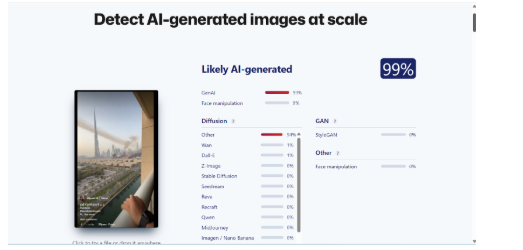
According to the report, tensions in the Middle East escalated amid the Israel–Iran conflict, impacting several countries in the region. A drone incident reportedly occurred near Burj Khalifa, prompting authorities to evacuate the building as a precautionary measure and temporarily switch off its lights. However, the visuals seen in the viral video do not match the details or imagery described in the report. Upon closely examining the viral clip, we noticed several technical inconsistencies and unusual visual elements, raising suspicions that the video might have been generated using artificial intelligence. To verify this, we analyzed the video using the AI detection tool Sightengine. The results indicated a 99% probability that the video was AI-generated.
Conclusion
Our research found that the viral video circulating on social media is not authentic. The footage was created using artificial intelligence and does not depict a real attack on Burj Khalifa.

Executive Summary
A video showing a monkey dramatically rescuing a child hanging from a balcony is being widely shared on social media. In the clip, a small child appears to be on the verge of falling when a monkey suddenly arrives, grabs the child, and saves them from falling. Many users praised the monkey’s bravery, while some even described it as a miracle. Research by CyberPeace Research Wing found that the viral video is not real and was created using AI technology before being shared with misleading claims.
Claim
An X user shared the video claiming that a monkey saved a child from falling off a balcony just in time, astonishing onlookers with its intelligence and quick action. The post described the monkey’s act as heroic and compassionate.

Fact Check
To verify the claim, we extracted keyframes from the viral video and conducted a reverse image search using Google Lens. During this process, we found the same video uploaded on April 16, 2026 by an Instagram account named Instagram user mojilo_vandro. The caption described the scene as a “miracle of God.”

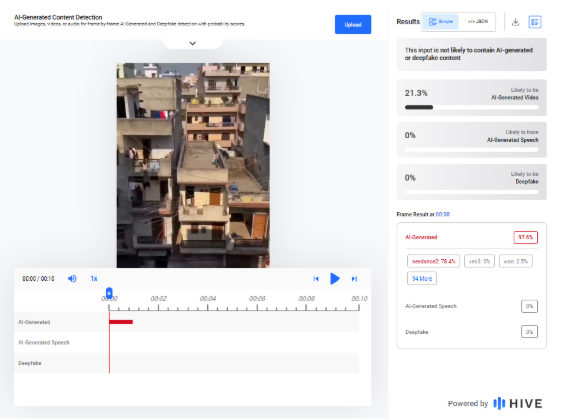
A closer review of the account revealed several similar monkey-themed videos. More importantly, the account bio clearly states that it creates AI-based fictional content. We also analyzed the clip using AI detection tool Hive Moderation, which assessed the video as having a 97.6% probability of being AI-generated
Conclusion
Our research confirms that the viral video of a monkey saving a child hanging from a balcony does not depict a real incident. It was digitally created using AI and shared online with misleading claims.
