
Mule Accounts and the Money Trail: Why India's Cybercrime Fight Runs Through the Bank Branch
In Delhi there is a bank branch where a lot of money was stolen from people over the country. This bank branch is where all the money disappeared. The people who did this did not wear masks. Break in at midnight. They just used a passbook a rubber stamp and a form that nobody checked carefully. This is the truth that the people who investigate cybercrime keep finding. The way that cybercriminals get away with the money is not by using a computer it is by using a bank account. The police in Delhi who investigate cybercrime have found that a lot of accounts were opened at bank branches. These accounts were opened using identity documents that were borrowed bought or stolen. Then these accounts were rented out to groups of criminals. One bank branch keeps coming up in complaints. This is not bad luck it is a sign of a bigger problem with how banks check who is opening an account.
These fake accounts, which are called " accounts" are controlled by criminal groups, not the people whose names are on the accounts. These accounts are a part of the cybercrime problem in India. The mistakes that bank branches make which allow these accounts to be opened raise a lot of questions. These questions are about how banks check who is opening an account how they prevent money laundering and how they work with groups to stop cybercrime. The bank accounts are the way that cybercriminals in India get away with the money they steal from people. The cybercrime investigators keep finding bank accounts like the ones at the bank branch, in Delhi, where the money was stolen.
The Anatomy of a Mule Account Network
The pattern is now familiar to investigators. A fraud complaint on the National Cyber Crime Reporting Portal traces a victim's stolen money to a beneficiary account. When police pull the account-opening file, the person named on the KYC documents often denies ever visiting the branch or signing the forms; signature verification frequently shows a mismatch. In one recent Delhi case, a cooperative bank's deputy manager was arrested after a single account he had helped open surfaced in 159 separate cyber fraud complaints from across the country, with transactions worth nearly Rs 68 crore routed through it before detection. Similar investigations have uncovered supply gangs that procure dozens of accounts at a time using POS machines, stacks of ATM cards, and cheque books belonging to different people and rent them out to fraudsters as ready-made conduits for stolen money.
What makes a single branch or a small cluster of accounts significant is what it reveals about entry-point failure. Investigators do not describe these as sophisticated hacking operations; they describe them as verification failures as are accounts opened without the mandatory in-person checks, video KYC, or document authentication that RBI rules require. When 96, or 700, or 8.5 lakh mule accounts are traced back through a handful of branches and intermediaries, the story is not really about the fraudsters at the far end of the chain. It is about the choke point where honest oversight should have stopped the account from ever existing.
Where the KYC Framework Is Breaking Down
The RBI's Know Your Customer Master Direction requires banks to establish customer identity, verify a genuine business relationship, and apply risk-based due diligence before allowing an account to operate. In practice, investigators have repeatedly found accounts opened through complicit or negligent bank staff, business correspondents, and third-party agents who bypass these checks entirely. Analysts note that mule accounts systematically exploit gaps in customer onboarding, KYC verification, transaction monitoring, and dormant-account surveillance, with criminals using forged or stolen identity documents and layering funds across multiple accounts to escape detection. Economically vulnerable individuals who are daily-wage workers, students, the unemployed are frequently paid a small commission to hand over their documents or existing accounts, often without understanding that they could face criminal liability for transactions they never authorised.
This is compounded by a financial-inclusion paradox that regulators themselves acknowledge: India has expanded banking access faster than it has expanded financial and digital literacy, leaving a population that is easy to recruit knowingly or unknowingly into mule networks. The result is a KYC regime that looks robust on paper but is only as strong as its weakest branch-level implementation, and weak implementation has proved trivially easy for organised networks to locate and exploit at scale.
The Regulatory and Institutional Response
RBI: From Static Compliance to Active Detection
The Reserve Bank of India has moved beyond periodic KYC audits toward technology-driven detection. It has directed banks to tighten onboarding controls, strengthen transaction monitoring, and report suspicious activity more proactively, and it has proposed additional safeguards, including limits on aggregate credits into accounts where a satisfactory business relationship has not yet been established. Its most significant intervention is MuleHunter.ai, an AI and machine-learning system built to flag suspected mule accounts from transaction-behaviour patterns rather than static KYC data alone; the platform is already operational across roughly two dozen banks and is being expanded. The RBI Innovation Hub has also begun working directly with the Indian Cyber Crime Coordination Centre (I4C) to share fraud-risk intelligence and coordinate detection in near real time.
FIU-IND and the PMLA Framework
The Prevention of Money Laundering Act, 2002 (PMLA) is the backbone of India's AML architecture. It mandates KYC verification, Customer Due Diligence, record maintenance, and timely reporting of suspicious transactions to the Financial Intelligence Unit–India (FIU-IND). Banks are required to file Suspicious Transaction Reports (STRs) and Cash Transaction Reports with FIU-IND, which in turn analyses financial intelligence and shares it with law enforcement and regulators. On paper, this creates a feedback loop between banks, the RBI, and enforcement agencies; in practice, the sheer volume of mule-linked transactions are hundreds of thousands of accounts flagged nationally has strained the capacity of this reporting chain to generate timely, actionable freezes before funds are withdrawn or converted to cryptocurrency.
The IT Act, CERT-In, and Cyber Enforcement
The Information Technology Act, 2000, together with provisions of the Bharatiya Nyaya Sanhita, provides the criminal-law basis for prosecuting mule account operators, aggregators, and the fraudsters who direct them. CERT-In's role sits slightly upstream of the banking layer: it issues advisories on phishing, fake payment gateways, and compromised digital infrastructure that fraud syndicates use to recruit mule account holders and move money. The Ministry of Home Affairs' I4C coordinates the National Cyber Crime Reporting Portal and the 1930 helpline, which allow victims to report fraud and trigger a limited window for freezing beneficiary accounts. I4C has also issued direct public alerts against illegal payment gateways built on mule accounts, warning citizens not to rent or sell their bank credentials to intermediaries.
The Coordination Gap
None of these institutions is short of legal authority. The gap is operational: banks, the RBI, FIU-IND, state police cyber cells, the CBI, and I4C each hold a piece of the picture, but no single agency has a real-time, end-to-end view of an account from opening to fraud to freeze. A mule account can be flagged by one bank's internal monitoring, reported through a completely different victim's complaint in another state, and investigated by a third jurisdiction's cyber police with each step introducing delay. The Indian Banks' Association has publicly pushed for the RBI to be given clearer power to directly freeze accounts flagged as mule accounts, rather than requiring each bank to act unilaterally or wait for a police request, precisely because this fragmentation lets fraudsters withdraw or launder funds within hours of a transaction.
Policy Recommendations
1. Mandatory video-KYC and biometric re-verification for all new accounts opened through business correspondents and third-party agents, with personal liability for verifying bank officials found complicit.
2. A statutory, RBI-backed mechanism allowing banks to freeze accounts flagged by MuleHunter.ai-type systems or FIU-IND intelligence within hours, rather than only after a formal police complaint.
3. A unified, interoperable case database linking the National Cyber Crime Reporting Portal, FIU-IND's STR system, and state cyber cells, so that an account flagged once is visible to every agency instantly.
4. Stronger due-diligence audits of banking correspondents and cooperative banks, which recur disproportionately in mule account cases relative to their share of total accounts.
5. Public financial-literacy campaigns targeted at the economically vulnerable groups most often recruited as unwitting mule account holders, paired with clear legal guidance distinguishing victims from willing participants.
Conclusion
The branch-level mule account cases surfacing across Delhi and other cities are not isolated policing stories; they are a live audit of India's AML and KYC architecture. The RBI, FIU-IND, CERT-In, and law enforcement agencies each have credible tools and legal mandates like MuleHunter.ai, PMLA reporting, IT Act prosecutions, and I4C's coordination portal chief among them but fraud syndicates continue to outpace the system by exploiting the seams between institutions rather than any single point of failure. Closing that gap requires less new law and more operational integration: faster account freezes, verified accountability at the point of account opening, and a shared, real-time picture of mule networks across every agency involved. Until banks, regulators, and investigators can act as one system rather than several disconnected ones, every dismantled racket will simply be replaced by the next.
References
- https://aninews.in/news/national/general-news/delhi-police-arrests-bank-deputy-manager-in-83776792-crore-mule-account-case-linked-to-159-cyber-fraud-complaints20260610130737/
- https://the420.in/delhi-bank-manager-mule-account-cyber-fraud-case/
- https://www.business-standard.com/finance/news/what-are-mule-accounts-cybercrime-banking-layer-india-fraud-rbi-126062400855_1.html
- https://www.business-standard.com/india-news/centre-freezes-450-000-mule-bank-accounts-used-in-cyber-fraud-schemes-124111200320_1.html
- https://www.medianama.com/2025/04/223-iba-rbi-cyber-fraud-measures-freeze-bank-accounts-cybercrime/
- https://www.deccanherald.com/amp/story/india%2Fcentre-warns-of-illegal-payment-gateways-and-mule-accounts-3252723
- https://www.deccanherald.com/india/over-85-lakh-mule-accounts-in-700-bank-branches-used-by-cyber-criminals-cbi-3604229
- https://website.rbi.org.in/en/web/rbi/-/notifications/master-direction-know-your-customer-kyc-direction-2016-updated-as-on-may-04-2023-lt-span-gt-11566
- https://www.indiacode.nic.in/bitstream/123456789/15402/1/moneylaunderingact2002.pdf
- https://www.indiacode.nic.in/bitstream/123456789/13116/1/it_act_2000_updated.pdf
- https://www.mha.gov.in/en/division_of_mha/cyber-and-information-security-cis-division/Details-about-Indian-Cybercrime-Coordination-Centre-I4C-Scheme

Related Blogs

Introduction:
A new Android malware called NGate is capable of stealing money from payment cards through relaying the data read by the Near Field Communication (“NFС”) chip to the attacker’s device. NFC is a device which allows devices such as smartphones to communicate over a short distance wirelessly. In particular, NGate allows forging the victims’ cards and, therefore, performing fraudulent purchases or withdrawing money from ATMs. .
About NGate Malware:
The whole purpose of NGate malware is to target victims’ payment cards by relaying the NFC data to the attacker’s device. The malware is designed to take advantage of phishing tactics and functionality of the NFC on android based devices.
Modus Operandi:
- Phishing Campaigns: The first step is spoofed emails or SMS used to lure the users into installing the Progressive Web Apps (“PWAs”) or the WebAPKs presented as genuine banking applications. These apps usually have a layout and logo that makes them look like an authentic app of a Targeted Bank which makes them believable.
- Installation of NGate: When the victim downloads the specific app, he or she is required to input personal details including account numbers and PIN numbers. Users are also advised to turn on or install NFC on their gadgets and place the payment cards to the back part of the phone to scan the cards.
- NFCGate Component: One of the main working features of the NGate is the NFCGate, an application created and designed by some students of Technical University of Darmstadt. This tool allows the malware to:
- Collect NFC traffic from payment cards in the vicinity.
- Transmit, or relay this data to the attacker’s device through a server.
- Repeat data that has been previously intercepted or otherwise copied.
It is important to note that some aspects of NFCGate mandate a rooted device; however, forwarding NFC traffic can occur with devices that are not rooted, and therefore can potentially ensnare more victims.
Technical Mechanism of Data Theft:
- Data Capture: The malware exploits the NFC communication feature on android devices and reads the information from the payment card, if the card is near the infected device. It is able to intercept and capture the sensive card details.
- Data Relay: The stolen information is transmitted through a server to the attacker’s device so that he/she is in a position to mimic the victim’s card.
- Unauthorized Transactions: Attackers get access to spend money on the merchants or withdraw money from the ATM that has NFC enabled. This capability marks a new level of Android malware in that the hackers are able to directly steal money without having to get hold of the card.
Social Engineering Tactics:
In most cases, attackers use social engineering techniques to obtain more information from the target before implementing the attack. In the second phase, attackers may pretend to be representatives of a bank that there is a problem with the account and offer to download a program called NGate, which in fact is a Trojan under the guise of an application for confirming the security of the account. This method makes it possible for the attackers to get ITPIN code from the sides of the victim, which enables them to withdraw money from the targeted person’s account without authorization.
Technical Analysis:
The analysis of malicious file hashes and phishing links are below:
Malicious File Hashes:
csob_smart_klic.apk:
- MD5: 7225ED2CBA9CB6C038D8
- Classification: Android/Spy.NGate.B
csob_smart_klic.apk:
- MD5: 66DE1E0A2E9A421DD16B
- Classification: Android/Spy.NGate.C
george_klic.apk:
- MD5: DA84BC78FF2117DDBFDC
- Classification: Android/Spy.NGate.C
george_klic-0304.apk:
- MD5: E7AE59CD44204461EDBD
- Classification: Android/Spy.NGate.C
rb_klic.apk:
- MD5: 103D78A180EB973B9FFC
- Classification: Android/Spy.NGate.A
rb_klic.apk:
- MD5: 11BE9715BE9B41B1C852
- Classification: Android/Spy.NGate.C.
Phishing URLs:
Phishing URL:
- https://client.nfcpay.workers[.]dev/?key=8e9a1c7b0d4e8f2c5d3f6b2
Additionally, several distinct phishing websites have been identified, including:
- rb.2f1c0b7d.tbc-app[.]life
- geo-4bfa49b2.tbc-app[.]life
- rb-62d3a.tbc-app[.]life
- csob-93ef49e7a.tbc-app[.]life
- george.tbc-app[.]life.
Analysis:

Broader Implications of NGate:
The ultramodern features of NGate mean that its manifestation is not limited to financial swindling. An attacker can also generate a copy of NFC access cards and get full access when hacking into restricted areas, for example, the corporate offices or restricted facility. Moreover, it is also safe to use the capacity to capture and analyze NFC traffic as threats to identity theft and other forms of cyber-criminality.
Precautionary measures to be taken:
To protect against NGate and similar threats, users should consider the following strategies:
- Disable NFC: As mentioned above, NFC should be not often used, it is safe to turn NFC on Android devices off. This perhaps can be done from the general control of the device in which the bursting modes are being set.
- Scrutinize App Permissions: Be careful concerning the permission that applies to the apps that are installed particularly the ones allowed to access the device. Hence, it is very important that applications should be downloaded only from genuine stores like Google Play Store only.
- Use Security Software: The malware threat can be prevented by installing relevant security applications that are available in the market.
- Stay Informed: As it has been highlighted, it is crucial for a person to know risks that are associated with the use of NFC while attempting to safeguard an individual’s identity.
Conclusion:
The presence of malware such as NGate is proof of the dynamism of threats in the context of mobile payments. Through the utilization of NFC function, NGate is a marked step up of Android malware implying that the attackers can directly manipulate the cash related data of the victims regardless of the physical aspect of the payment card. This underscores the need to be careful when downloading applications and to be keen on the permission one grants on the application. Turn NFC when not in use, use good security software and be aware of the latest scams are some of the measures that help to fight this high level of financial fraud. The attackers are now improving their methods. It is only right for the people and companies to take the right steps in avoiding the breach of privacy and identity theft.
Reference:
- https://www.welivesecurity.com/en/eset-research/ngate-android-malware-relays-nfc-traffic-to-steal-cash/
- https://therecord.media/android-malware-atm-stealing-czech-banks
- https://www.darkreading.com/mobile-security/nfc-traffic-stealer-targets-android-users-and-their-banking-info
- https://cybersecuritynews.com/new-ngate-android-malware/
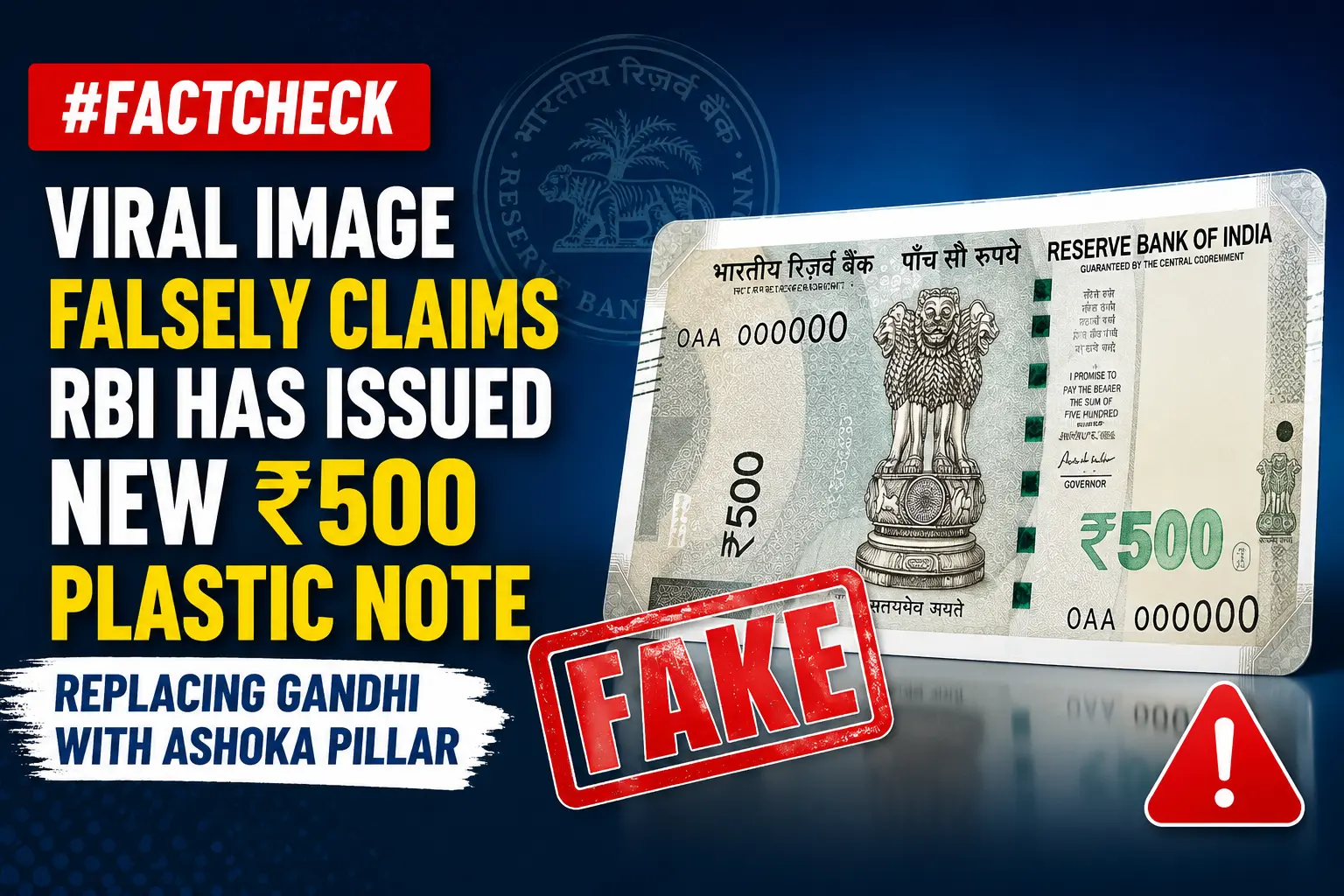
Executive Summary
An image of a purported new ₹500 plastic banknote is being widely shared on social media. Users claim that the Reserve Bank of India (RBI) has issued the new note and replaced Mahatma Gandhi’s portrait with the Ashoka Pillar.The CyberPeace Research Wing research found the claim to be misleading. The probe revealed that RBI has not issued any new ₹500 plastic banknote. Furthermore, no official announcement or decision has been made regarding the removal of Mahatma Gandhi’s portrait from Indian currency and its replacement with the Ashoka Pillar.
Claim
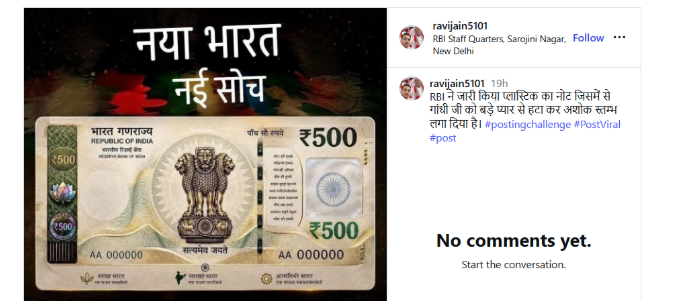
An Instagram user shared the viral image with the claim: “RBI has issued a ₹500 plastic note in which Mahatma Gandhi’s image has been removed and replaced with the Ashoka Pillar.” The claim has been widely circulated on social media, with many users sharing the image as genuine. The post link, archived version, and screenshot can be seen below.
Fact Check
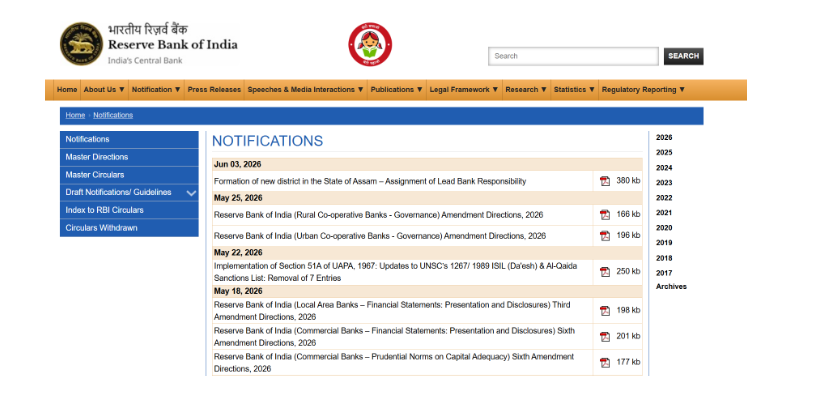
To verify the claim, we conducted a keyword search on Google. However, we found no credible media reports suggesting that RBI had issued a new ₹500 plastic note featuring the Ashoka Pillar in place of Mahatma Gandhi. We then searched the official RBI website for any notification or announcement related to the claim. Our search yielded no official communication supporting the viral claim.
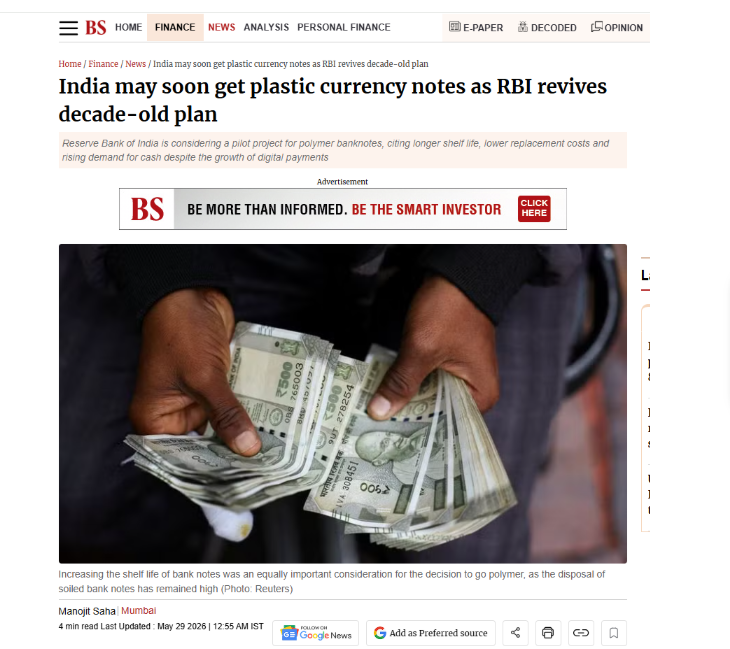
During the research, we also came across a report published by Business Standard. According to the report, the Reserve Bank of India is exploring the possibility of introducing polymer (plastic) currency notes in the future. The report states that RBI is studying and discussing the proposal in view of the growing global adoption of polymer notes and their greater durability. However, the report does not state that RBI has already issued a new ₹500 plastic note. Nor does it mention any decision to remove Mahatma Gandhi’s portrait from existing currency notes and replace it with the Ashoka Pillar.
- https://www.business-standard.com/finance/news/rbi-set-to-unveil-polymer-rupee-notes-amid-rising-currency-demand-126052801725_1.html
Conclusion
The research found that the viral claim is misleading. RBI has not issued any new ₹500 plastic banknote, and there has been no official announcement or decision to replace Mahatma Gandhi’s portrait on Indian currency with the Ashoka Pillar.
.webp)
Executive Summary
This report analyses a recently launched social engineering attack that took advantage of Microsoft Teams and AnyDesk to deliver DarkGate malware, a MaaS tool. This way, through Microsoft Teams and by tricking users into installing AnyDesk, attackers received unauthorized remote access to deploy DarkGate that offers such features as credential theft, keylogging, and fileless persistence. The attack was executed using obfuscated AutoIt scripts for the delivery of malware which shows how threat actors are changing their modus operandi. The case brings into focus the need to put into practice preventive security measures for instance endpoint protection, staff awareness, limited utilization of off-ice-connection tools, and compartmentalization to safely work with the new and increased risks that contemporary cyber threats present.
Introduction
Hackers find new technologies and application that are reputable for spreading campaigns. The latest use of Microsoft Teams and AnyDesk platforms for launching the DarkGate malware is a perfect example of how hackers continue to use social engineering and technical vulnerabilities to penetrate the defenses of organizations. This paper focuses on the details of the technical aspect of the attack, the consequences of the attack together with preventive measures to counter the threat.
Technical Findings
1. Attack Initiation: Exploiting Microsoft Teams
The attackers leveraged Microsoft Teams as a trusted communication platform to deceive victims, exploiting its legitimacy and widespread adoption. Key technical details include:
- Spoofed Caller Identity: The attackers used impersonation techniques to masquerade as representatives of trusted external suppliers.
- Session Hijacking Risks: Exploiting Microsoft Teams session vulnerabilities, attackers aimed to escalate their privileges and deploy malicious payloads.
- Bypassing Email Filters: The initial email bombardment was designed to overwhelm spam filters and ensure that malicious communication reached the victim’s inbox.
2. Remote Access Exploitation: AnyDesk
After convincing victims to install AnyDesk, the attackers exploited the software’s functionality to achieve unauthorized remote access. Technical observations include:
- Command and Control (C2) Integration: Once installed, AnyDesk was configured to establish persistent communication with the attacker’s C2 servers, enabling remote control.
- Privilege Escalation: Attackers exploited misconfigurations in AnyDesk to gain administrative privileges, allowing them to disable antivirus software and deploy payloads.
- Data Exfiltration Potential: With full remote access, attackers could silently exfiltrate data or install additional malware without detection.
3. Malware Deployment: DarkGate Delivery via AutoIt Script
The deployment of DarkGate malware utilized AutoIt scripting, a programming language commonly used for automating Windows-based tasks. Technical details include:
- Payload Obfuscation: The AutoIt script was heavily obfuscated to evade signature-based antivirus detection.
- Process Injection: The script employed process injection techniques to embed DarkGate into legitimate processes, such as explorer.exe or svchost.exe, to avoid detection.
- Dynamic Command Loading: The malware dynamically fetched additional commands from its C2 server, allowing real-time adaptation to the victim’s environment.
4. DarkGate Malware Capabilities
DarkGate, now available as a Malware-as-a-Service (MaaS) offering, provides attackers with advanced features. Technical insights include:
- Credential Dumping: DarkGate used the Mimikatz module to extract credentials from memory and secure storage locations.
- Keylogging Mechanism: Keystrokes were logged and transmitted in real-time to the attacker’s server, enabling credential theft and activity monitoring.
- Fileless Persistence: Utilizing Windows Management Instrumentation (WMI) and registry modifications, the malware ensured persistence without leaving traditional file traces.
- Network Surveillance: The malware monitored network activity to identify high-value targets for lateral movement within the compromised environment.
5. Attack Indicators
Trend Micro researchers identified several indicators of compromise (IoCs) associated with the DarkGate campaign:
- Suspicious Domains: example-remotesupport[.]com and similar domains used for C2 communication.
- Malicious File Hashes:some text
- AutoIt Script: 5a3f8d0bd6c91234a9cd8321a1b4892d
- DarkGate Payload: 6f72cde4b7f3e9c1ac81e56c3f9f1d7a
- Behavioral Anomalies:some text
- Unusual outbound traffic to non-standard ports.
- Unauthorized registry modifications under HKCU\Software\Microsoft\Windows\CurrentVersion\Run.
Broader Cyber Threat Landscape
In parallel with this campaign, other phishing and malware delivery tactics have been observed, including:
- Cloud Exploitation: Abuse of platforms like Cloudflare Pages to host phishing sites mimicking Microsoft 365 login pages.
- Quishing Campaigns: Phishing emails with QR codes that redirect users to fake login pages.
- File Attachment Exploits: Malicious HTML attachments embedding JavaScript to steal credentials.
- Mobile Malware: Distribution of malicious Android apps capable of financial data theft.
Implications of the DarkGate Campaign
This attack highlights the sophistication of threat actors in leveraging legitimate tools for malicious purposes. Key risks include:
- Advanced Threat Evasion: The use of obfuscation and process injection complicates detection by traditional antivirus solutions.
- Cross-Platform Risk: DarkGate’s modular design enables its functionality across diverse environments, posing risks to Windows, macOS, and Linux systems.
- Organizational Exposure: The compromise of a single endpoint can serve as a gateway for further network exploitation, endangering sensitive organizational data.
Recommendations for Mitigation
- Enable Advanced Threat Detection: Deploy endpoint detection and response (EDR) solutions to identify anomalous behavior like process injection and dynamic command loading.
- Restrict Remote Access Tools: Limit the use of tools like AnyDesk to approved use cases and enforce strict monitoring.
- Use Email Filtering and Monitoring: Implement AI-driven email filtering systems to detect and block email bombardment campaigns.
- Enhance Endpoint Security: Regularly update and patch operating systems and applications to mitigate vulnerabilities.
- Educate Employees: Conduct training sessions to help employees recognize and avoid phishing and social engineering tactics.
- Implement Network Segmentation: Limit the spread of malware within an organization by segmenting high-value assets.
Conclusion
Using Microsoft Teams and AnyDesk to spread DarkGate malware shows the continuous growth of the hackers’ level. The campaign highlights how organizations have to start implementing adequate levels of security preparedness to threats, including, Threat Identification, Training employees, and Rights to Access.
The DarkGate malware is a perfect example of how these attacks have developed into MaaS offerings, meaning that the barrier to launch highly complex attacks is only decreasing, which proves once again why a layered defense approach is crucial. Both awareness and flexibility are still the key issues in addressing the constantly evolving threat in cyberspace.
