
#FactCheck: Video of ‘Free Palestine’ Slogans at Birmingham City Council Falsely Shared as Recent Footage from Israeli Parliament
Executive Summary
A video showing several people chanting “Free, Free Palestine” enthusiastically while clapping is going viral on social media. It is being claimed that the video is a recent recording from the Israeli Parliament. CyberPeace found in its research that the viral video is not from Israel but from England. In the video, several councillors of Birmingham City Council can be seen chanting “Free, Free Palestine” after voting in favour of an anti-Israel motion.
Claim:
A Facebook user shared the video with the caption, “Now slogans in support of Palestine have started being raised in the Israeli Parliament as well.” Many people reacting to the video are criticising and mocking Israeli Prime Minister Benjamin Netanyahu. One user commented, “The wheel of time never stays in one place; it keeps turning.” Another wrote, “The fatherland has changed.”
https://www.facebook.com/reel/1136204839172609

Factcheck
A reverse image search of the keyframes from the viral video led us to the same video on the website of Birmingham Mail. According to the report, the people chanting “Free, Free Palestine” in the video are councillors from Birmingham. Most members of Birmingham City Council had voted in favour of a motion calling for disinvestment from companies linked to Israel, which was subsequently passed.
https://uk.news.yahoo.com/councillors-cheer-voting-proposal-seek-161917783.html

During the discussion on the motion, photographs of children killed in Gaza were also displayed. According to Express.co.uk, the motion was moved by independent councillors Nausheen Khalid and Jamal Khan.
https://www.express.co.uk/news/uk/2263420/fury-bin-strike-uk-city-gaza-israel-palestine

Conclusion
Our research established that the viral video is from Birmingham, England, where several councillors voted in favour of a motion opposing investment in companies linked to Israel.

Related Blogs

Executive Summary
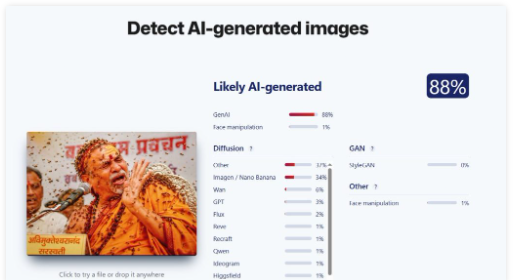
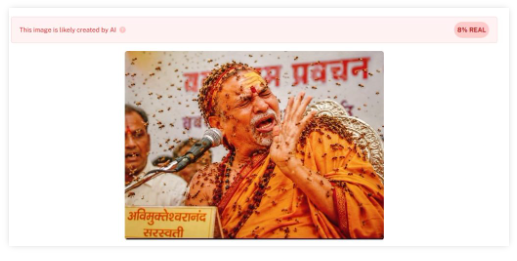
During the Gau Raksha Yatra of Shankaracharya Swami Avimukteshwaranand Saraswati, bees reportedly attacked a discourse event in Rohania area of Varanasi, Uttar Pradesh. Following the incident, a picture has gone viral on social media showing bees attacking Swami Avimukteshwaranand Saraswati. Several users are sharing the image as genuine while targeting the Shankaracharya online. CyberPeace Research Wing investigated the viral image and found it to be fake. Our research revealed that the picture was created using Artificial Intelligence (AI). While it is true that a bee attack occurred during Swami Avimukteshwaranand Saraswati’s discourse program, the viral image itself is fabricated.
Claim
A Facebook user named “Sanjay Chaudhary” shared the viral image on May 15, 2026, with the caption: “Prakritik kop ka bhajan bana Shukracharya Umashankar alias Avimukteshwaranand… This Kaalnemi was delivering false sermons in Rohania, Varanasi in the name of religion… The bees from a nearby hive did not like it and collectively attacked, creating chaos. Even insects and nature no longer like the opposition’s politics disguised as Sanatan Dharma. Calling Yogi Ji Aurangzeb, Akbar and butcher is not acceptable even to nature and insects.”
Post link and archive link are given below:
- https://www.facebook.com/sanjaychaudhary073/posts/pfbid02kgts8igKDwgctz3MamECMGoGfQR5aWPTdsDgLeux3pD9jwP7ADfgNpoPfHvMb9Zul
- https://perma.cc/E6SE-BAXZ

Fact-Check
To verify the viral claim, we used Google Open Search tools and found reports related to the incident on the YouTube channel of News18 UP Uttarakhand. A report published on May 13, 2026 stated that bees attacked the discourse event during Swami Avimukteshwaranand’s Gau Raksha Yatra in Rohania, Varanasi. The incident created panic at the venue, forcing the Swami to end his discourse midway. The channel also uploaded a YouTube Shorts video related to the incident.

As part of the research, we further analyzed the viral image using AI detection tools. First, we used the tool “Sight Engine,” which indicated an 88 percent probability that the image was AI-generated.
We then examined the image using another AI detection tool called “Undetectable,” which also suggested that the photo was likely created using AI.
Conclusion
Our research found that the viral image is AI-generated. The picture was created using artificial intelligence tools. While bees did attack during Swami Avimukteshwaranand Saraswati’s Gau Raksha Yatra on May 13, 2026, the viral image circulating on social media is fictional and not real.

A few of us were sitting together, talking shop - which, for moms, inevitably circles back to children, their health and education. Mothers of teenagers were concerned that their children seemed to spend an excessive amount of time online and had significantly reduced verbal communication at home.
Reena shared that she was struggling to understand her two boys, who had suddenly transformed from talkative, lively children into quiet, withdrawn teenagers.
Naaz nodded. “My daughter is glued to her device. I just can’t get her off it! What do I do, girls? Any suggestions?”
Mou sighed, “And what about the rising scams? I keep warning my kids about online threats, but I’m not sure I’m doing enough.”
Not just scams, those come later. What worries me more are the videos and photos of unsuspecting children being edited and misused on digital platforms,” added Reena.
The Digital Parenting Dilemma
For parents, it’s a constant challenge—allowing children internet access means exposing them to potential risks while restricting it invites criticism for being overly strict.
‘What do I do?’ is a question that troubles many parents, as they know how addictive phones and gaming devices can be. (Fun fact: Even parents sometimes struggle to resist endlessly scrolling through social media!)
‘What should I tell them, and when?’ This becomes a pressing concern when parents hear about cyberbullying, online grooming, or even cyberabduction.
‘How do I ensure they stay cybersafe?’ This remains an ongoing worry, as children grow and their online activities evolve.
Whether it’s a single-child, dual-income household, a two-child, single-income family, or any other combination, parents have their hands full managing work, chores, and home life. Sometimes, children have to be left alone—with grandparents, caregivers, or even by themselves for a few hours—making it difficult to monitor their digital lives. While smartphones help parents stay connected and track their child’s location, they can also expose children to risks if not used responsibly.
Breaking It Down
Start cybersafety discussions early and tailor them to your child’s age.
For simplicity, let’s categorize learning into five key age groups:
- 0 – 2 years
- 3 – 7 years
- 8 – 12 years
- 13 – 16 years
- 16 – 19 years
Let’s explore the key safety messages for each stage.
Reminder:
Children will always test boundaries and may resist rules. The key is to lead by example—practice cybersafety as a family.
0 – 2 Years: Newborns & Infants
Pediatricians recommend avoiding screen exposure for children under two years old. If you occasionally allow screen time (for example, while changing them), keep it to a minimum. Children are easily distracted—use this to your advantage.
What can you do?
- Avoid watching TV or using mobile devices in front of them.
- Keep activity books, empty boxes, pots, and ladles handy to engage them.
3 – 7 Years: Toddlers & Preschoolers
Cybersafety education should ideally begin when a child starts engaging with screens. At this stage, parents have complete control over what their child watches and for how long.
What can you do?
- Keep screen time limited and fully supervised.
- Introduce basic cybersecurity concepts, such as stranger danger and good picture vs. bad picture.
- Encourage offline activities—educational toys, books, and games.
- Restrict your own screen time when your child is awake to set a good example.
- Set up parental controls and create child-specific accounts on devices.Secure all devices with comprehensive security software.
8 – 12 Years: Primary & Preteens
Cyber-discipline should start now. Strengthen rules, set clear boundaries, and establish consequences for rule violations.
What can you do?
- Increase screen time gradually to accommodate studies, communication, and entertainment.
- Teach them about privacy and the dangers of oversharing personal information.
- Continue stranger-danger education, including safe/unsafe websites and apps.
- Emphasize reviewing T&Cs before downloading apps.Introduce concepts like scams, phishing, deepfakes, and virus attacks using real-life examples.
- Keep banking and credit card credentials private—children may unintentionally share sensitive information.
Cyber Safety Mantras:
- STOP. THINK. ACT.
- Do Not Trust Blindly Online.
13 – 16 Years: The Teenage Phase
Teenagers are likely to resist rules and demand independence, but if cybersecurity has been a part of their upbringing, they will tolerate parental oversight.
What can you do?
- Continue parental controls but allow greater access to previously restricted content.
- Encourage open conversations about digital safety and online threats.
- Respect their need for privacy but remain involved as a silent observer.
- Discuss cyberbullying, harassment, and online reputation management.
- Keep phones out of bedrooms at night and maintain device-free zones during family time.
- Address online relationships and risks like dating scams, sextortion, and trafficking.
16 – 19 Years: The Transition to Adulthood
By this stage, children have developed a sense of responsibility and maturity. It’s time to gradually loosen control while reinforcing good digital habits.
What can you do?
- Monitor their online presence without being intrusive.Maintain open discussions—teens still value parental advice.
- Stay updated on digital trends so you can offer relevant guidance.
- Encourage digital balance by planning device-free family outings.
Final Thoughts
As a parent, your role is not just to set rules but to empower your child to navigate the digital world safely. Lead by example, encourage responsible usage, and create an environment where your child feels comfortable discussing online challenges with you.
Wishing you a safe and successful digital parenting journey!

In what is being stated by experts to be one of the largest data breaches of all time, approximately 16 billion passwords were exposed online last week. According to various news reports, the leak contains credentials spanning a broad array of online services, including Facebook, Instagram, Gmail, etc., creating a serious alarm across the globe. Cybersecurity specialists have noted that this leak poses immense risks of account takeovers, identity theft, and enabling phishing scams. The leaked data is being described as a “collection-of-collections,” with multiple previously breached databases compiled into one easy-to-access repository for cybercriminals.
Infostealer Malware and Why It’s a Serious Threat
This incident brought to light a type of malware that experts refer to as the Infostealer. Just as the name suggests, this is a malware program made expressly to take personal information from compromised computers and devices, including cookies, session tokens, browser data, login credentials, and more. It targets high-value credentials, as opposed to ransomware, which encrypts files for ransom, or spyware that passively watches users. Once installed, they silently gather passwords, screenshots, and other information while hiding inside unassuming software, such as a game, utility, or browser plugin. Once stolen, these credentials are then combined by hackers to create databases, which are then offered for sale on dark web forums or even made public, as was the case in this breach. This is particularly risky since, if session tokens or other browser data are also taken, these credentials can be used to get around even two-factor authentication. As a result, the leak would also enable the rise of other crimes such as phishing.
Guidelines for protection
In response to this breach, India’s Computer Emergency Response Team (CERT-IN) issued an advisory, urging all internet users to take immediate action to protect their accounts. Although this is in response to the specific data leak, these are some key measures advised to be followed to maintain a general standard of cyber hygiene at all times.
- Reset your passwords: In case of incidents such as the above, users are advised to change the passwords of their accounts immediately. More so of the ones that have been compromised and need to be prioritised, such as email, online banking, and social media etc.
- Use strong, unique passwords and password manager features: Avoid password reuse across platforms. Using a password manager on a trusted platform can aid in storing and recalling them for different accounts.
- Monitor account activity: Check activity logs, especially for signs of unrecognised login attempts or password-reset notifications.
- Enable Multi-Factor Authentication (MFA): The user is advised to enable two-step verification (via an app like Google Authenticator or a hardware key), which will add an extra security layer.
- Phishing attacks: Cybercriminals will likely attempt to use leaked credentials to impersonate legitimate companies and send phishing emails. Read carefully before clicking on any links or attachments received.
- Scan devices for malware: Run updated antivirus or anti-malware scans to catch and remove infostealers or other malicious software lurking on your device.
Why This Data Breach is a Wake-Up Call
With 16 billion credentials exposed, this breach highlights the critical need for robust personal cybersecurity hygiene. It also reveals the persistent role of infostealer malware in feeding a global cybercrime economy, one where credentials are the most valuable assets. As Infosecurity Europe and other analysts highlight, infostealers are lightweight, often distributed via phishing or malicious downloads, and are highly effective at lifting data in the background without alerting the user. Even up-to-date antivirus software can struggle to catch new variants, making proactive security practices with respect to such malware all the more essential. In a time where data is everything, access to credentials can derive power and safety, regarding it must be kept in check.
Conclusion
This breach is a reminder that cybersecurity is a shared responsibility. Even with protective systems in place with respect to the industries and official authorities, every internet user must do their part in protecting themselves through cyber hygiene practices such as resetting passwords, using multi-factor authentication, staying vigilant against phishing scams, and ensuring devices are regularly scanned for malware. While breaches like this can seem overwhelming and might create a surge of panic, practical measures go a long way in mitigating exposure. Staying informed and proactive is the best defence one can adopt in a rapidly evolving threat landscape.
References
- https://economictimes.indiatimes.com/news/international/us/16-billion-passwords-exposed-in-unprecedented-cyber-leak-of-2025-experts-raise-global-alarm/articleshow/121961165.cms?from=mdr
- https://timesofindia.indiatimes.com/technology/tech-news/16-billion-passwords-leaked-on-internet-what-you-need-to-know-to-protect-your-facebook-instagram-gmail-and-other-accounts/articleshow/121967191.cms
- https://indianexpress.com/article/technology/tech-news-technology/16-billion-passwords-leaked-online-what-we-know-10077546/
- https://indianexpress.com/article/technology/tech-news-technology/16-billion-passwords-leaked-online-what-we-know-10077546/
- https://www.hindustantimes.com/business/certin-issues-advisory-after-data-breach-of-16-billion-credentials-asks-people-to-change-passwords-101750779940872.html
- https://www.cert-in.org.in/s2cMainServlet?pageid=PUBVLNOTES02&VLCODE=CIAD-2025-0024
- https://www.infosecurityeurope.com/en-gb/blog/threat-vectors/guide-infostealer-malware.html
