
#FactCheck: Old Video of Israeli Basketball Player Yam Madar Falsely Linked to Flydubai Flight Accident
Executive Summary
A video showing people dancing inside an aircraft with a speaker playing music is being shared on social media with the claim that they were celebrating after surviving an accident involving a flydubai flight travelling from Dubai to Tel Aviv. However, CyberPeace Research found that the video was actually shared by an Israeli sports media outlet in August 2025, and shows Israeli basketball player Yam Madar playing music through a speaker inside a flight.
Claim
A video is going viral on social media showing a person playing music through a speaker inside an aircraft, while other passengers can be seen dancing to the song being played.
https://x.com/NirmalJ8881922/status/2105542863278973186

Fact Check:
We began our research into the viral video using the InVID tool and extracted several keyframes from it. During this process, we found the same video on the Instagram account of Israeli sports media channel Sports 5, where it was uploaded on August 18, 2025. The video was accompanied by a caption in Hebrew, which translates into Hindi as: “Don’t take a sleeping pill: This is what it’s like to be on a flight with Yam Madar.”
https://www.instagram.com/reels/DNgQrgLsW11/

During our research, we also found an interview with another player from the Israeli basketball team, Khadeen Carrington, uploaded on Sports 5’s YouTube channel on August 26, 2025. During the interview, when Carrington was asked about his relationship with the other members of the team, he referred to the aforementioned video featuring Yam Madar.
https://www.youtube.com/watch?v=k_0AzSWlvJw

Conclusion
The evidence gathered during our research makes it clear that the video being linked to the flydubai flight accident is old. The person seen in the video is Yam Madar, a member of the Israeli basketball team.

Related Blogs

Executive Summary
Amid ongoing tensions in West Asia, a video has been circulating on social media claiming that Prime Minister Narendra Modi urged women not to visit beauty parlours as part of an appeal related to fuel conservation. Users are widely sharing the clip as genuine. However, a fact-check by CyberPeace Research Wing has found the claim to be false. The research revealed that the original video, which discussed saving petrol, diesel and cooking gas, has been digitally edited using AI tools and shared with a misleading narrative.
Claim
An Instagram user shared the viral video on May 15, 2026, claiming that the Prime Minister advised women against visiting beauty parlours.
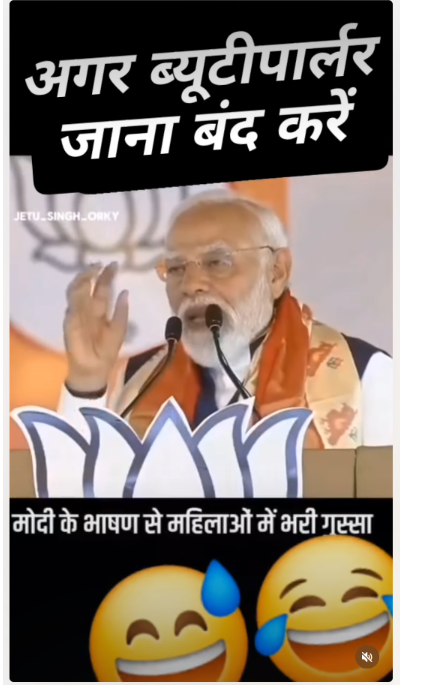
Fact Check
A keyword-based search on Google did not return any credible media reports supporting the viral claim. To verify the video, keyframes were extracted and run through reverse image search. The original footage was traced to the official YouTube channel of Prime Minister Narendra Modi, uploaded on May 10, 2026.
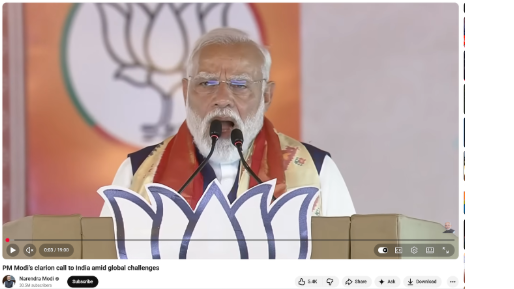
The video shows a rally held in Hyderabad, where the Prime Minister appealed to the public to save fuel by adopting work-from-home practices, promoting swadeshi goods, and refraining from purchasing gold for one year. However, nowhere in the full video is there any mention of advising women not to visit beauty parlours.
Further analysis also raised suspicion that the viral clip had been digitally altered using AI tools. The video was scanned using the HIVE Moderation AI detection tool, which indicated that it is approximately 88% likely to be AI-generated or manipulated.
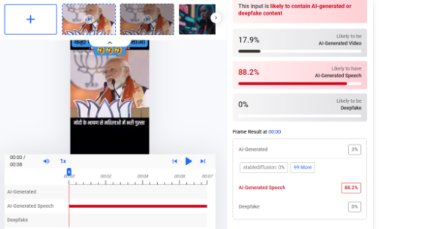
Conclusion
The viral video is misleading. The original speech by Prime Minister Narendra Modi about conserving petrol, diesel and cooking gas has been edited using AI tools and circulated with a false claim targeting women visiting beauty parlours.
.webp)
Introduction
For much of the past two decades, India's contribution to the global technology economy was defined by software services and consumer internet platforms, which is a model that built enormous wealth and made the country the world's third-largest startup ecosystem.
That story is changing. More than ever before, the best received pitches in Bengaluru, Hyderabad, and Chennai are for rocket propulsion, semiconductor design, and autonomous hardware, not apps. And this isn't just a style choice of what gets funded. It's the real concentration of money, people, and political support around "deep tech" ventures based on frontier science and engineering breakthroughs as opposed to incremental software work.
The Data Behind the Narrative
The scale of this shift is now visible in hard numbers. In fact, Indian deeptech companies cumulatively raised $11.4 billion in funding between 2015 and mid-2026, according to the Bharat Deep Tech Report 2026 published by the Indian Venture and Alternate Capital Association (IVCA). 2025 was a record year for Indian deeptech firms, which saw a total raise of $2.96 billion across 189 deals, despite a slowdown in funding in the Indian startup ecosystem overall. Analytically speaking, here is what that reveals: investors haven't just raised the tide with the roadmap; they have explicitly taken a far-flung sector-specific decision to reallocate the capital and instead pursue science-and-engineering-led startups, even when pulling back elsewhere.
That very same report further pointed out that over 85% of all the deeptech funding raised in India since 2015 was obtained in the last six years, suggesting that the sector has only very recently come of age and matured from doing mostly early proof-of-concept experiments to delivering products that have undergone verifiable commercialisation. Of all the capital, funding and deals raised, AI and generative AI, followed by electric vehicles and battery technology, were the highest in terms of both dollars and the number of deals, while semiconductors and space tech were identified as the fastest-growing industrial segments and areas of research, consistent with India's national aspirations around technological self-sufficiency. When it comes to the distribution of deals and funding across India, the report found that Bengaluru on its own accounts for nearly 50%, with the rest of the country grabbing less than half.
Space as the Sector's Proof Point
If any single industry illustrates the credibility of India's hardware pivot, it is private space. Skyroot Aerospace's trajectory offers a useful case study. In May 2026, the Hyderabad-based launch vehicle company raised approximately $60 million in a round co-led by Sherpalo Ventures and GIC, with participation from BlackRock-managed funds, Arkam Ventures, and the Shanghvi Family Office, pushing its valuation to $1.1 billion and making it India's first space-tech unicorn. The round is notable not just for its size but for its composition: sovereign wealth capital (GIC) and global asset managers (BlackRock) backing a hardware company whose Vikram-1 rocket is roughly 95% indigenously built and expected to draw significant demand from the global telecommunications sector, with around 90% of Skyroot's customers based outside India. That the company's valuation nearly doubled in about thirty months also suggests investors are pricing in execution risk more favourably than in earlier cycles, when Indian hardware ventures were often viewed as uninvestable relative to their software counterparts.
This is not the only data point. Alongside Skyroot, companies including Agnikul Cosmos, Dhruva Space, Pixxel and Digantara are working on propulsion, satellite platforms and orbital-debris-tracking technology. Even if all of the Indian space startups do not go on to become businesses on the scale of ISRO, the existence of so many private-sector firms working on these goods and services shows the ecosystem in India is maturing. India's private space startup ecosystem lines up with broader sector reporting that India's private space startup ecosystem is approaching 440 companies as the private-sector push gathers speed through 2026.
Policy Architecture and Patient Capital
A defining characteristic of deeptech like the long R&D cycles, capital-heavy prototyping, and complex regulation makes deeptech firms structurally different from software startups, and Indian policymakers seem to be acknowledging as much. In April 2026, the government announced the Startup India Fund of Funds 2.0, creating a corpus of 10,000 crores to acquire commitments to Alternative Investment Funds, with a focus on deeptech, technology-focused manufacturing and early-growth-stage companies. The intention here, as was articulated, was to increase the supply of institutional capital for companies that diverge from software-investing norms. This complements the operational R & D and Innovation (RDI) Scheme and the India Semiconductor Mission, creating a multilayer public-capital framework for deeptech commercialisation.
Yet the same IVCA survey data complicates any triumphalist reading. Despite these schemes, 40% of surveyed venture funds reported having never engaged with any government capital vehicle, pointing to a persistent gap between policy design and on-the-ground fund utilisation. More critically, the survey identified a structural weak point in the financing pipeline: fund participation drops sharply at the Series B/C stage, with fewer investors able to write larger cheques to growth-stage companies.
Perhaps the single biggest limiting factor for the long term of deeptech in India. Spotting and encouraging deeptech entrepreneurs has definitely begun, but long-term success hinges on an ecosystem that can finance deeptech innovators through the critical scale-up phase – larger-ticket funds that many deeptech firms need to grow from a proof of concept into full-scale commercial products globally. Traditionally, Indian hardware startups have been quickly sold off or listed in foreign markets.
The exit environment reflects this immaturity. IVCA data shows 62% of funds cited exit visibility as their primary challenge, with secondary transactions accounting for 56% of all exits in the period studied, which is a signal that public-market exits (IPOs) remain the exception rather than the rule for deep-tech companies, unlike in India's more established software and fintech sectors.
An Analytical Assessment
Overall, the body of data confirms a measured yet real read on structural change rather than hype about cycles. How funding has focused on AI, semiconductors and spacetech; how some credible unicorns were born using homegrown hardware (like Skyroot); how policy and a fund-of-funds ecosystem were purposefully built – these all led, in Rajat Tandon's words, "from promise to more investible commitments, with an increasingly institutionalised ecosystem play".
However, three analytical caveats temper the enthusiasm. First, India's deep tech capital base, while growing rapidly in percentage terms, remains small in absolute terms relative to the United States and China, and much of it is still concentrated in early rounds rather than growth-stage financing. Second, geographic concentration in Bengaluru risks under-leveraging engineering talent elsewhere in the country. Third, and most consequentially, cross-border regulatory friction, export controls, dual-use technology restrictions, and the need for internationally recognised IP protection remains a binding constraint for hardware ventures seeking to scale beyond the domestic market, a challenge that policy alone cannot resolve.
Conclusion
India's transition from software exporter to deep-tech engineer is therefore real, measurable, and policy-supported, but it is a transition still in its early-to-middle innings, dependent on whether growth-stage capital and international market access can keep pace with early-stage enthusiasm and government intent.
Sources
- YourStory — Indian deeptech investments reach $11.4B: Report
- Outlook Business — India's Deeptech Funding Crosses $11 Bn As Investors Turn To AI, Semiconductors
- Business Standard — Over 85% of India's deeptech funding raised in past six years: IVCA
- The Week — Skyroot Aerospace becomes India's first space tech unicorn
- Outlook Business — Skyroot Aerospace Reaches Unicorn Orbit as Vikram-1 Launch Countdown Begins
- SatelliteToday — Skyroot Secures $60M in Funding, Becoming India's First Space 'Unicorn'
- Convergence Now — India's Startup Funding Map: AI, Sustainability & Deeptech Leading the Next Wave
- Seafund — DeepTech Startups in India: Funding & Innovation 2026
- YourStory (original reference article) — From software to satellites: Why India's next venture opportunity lies in deeptech

Executive Summary
A graphic widely circulating on social media claims that Union Home Minister Amit Shah has warned, “A major crisis is coming; if possible, skip one meal a day.” The claim has been found to be false in a fact-check conducted by CyberPeace Research Wing. The research revealed that Amit Shah has not made any such statement.
Claim
A Facebook user shared the viral graphic on May 17, 2026, claiming that BJP leader and Home Minister Amit Shah issued a “warning” to the public, allegedly saying people should be prepared for a major crisis and consider skipping one meal a day. The post has been widely circulated on social media, drawing significant attention and discussion.
- https://www.facebook.com/photo.php?fbid=1509406197622070&set=pb.100056581115590.-2207520000&type=3
- https://archive.ph/Z9Tle

Factcheck
A keyword-based search on Google did not return any credible news reports supporting the claim. Further scrutiny of the official account of the Ministry of Home Affairs on X also found no mention or statement matching the viral claim.

A separate review of the official X account of Home Minister Amit Shah also did not show any such statement or post confirming the viral claim.

Conclusion
The viral claim is false. Union Home Minister Amit Shah has not made any such statement.
