
#FactCheck-16-Year-Old Bronx Fire Rescue Video Misrepresented as Lucknow Incident
Executive Summary
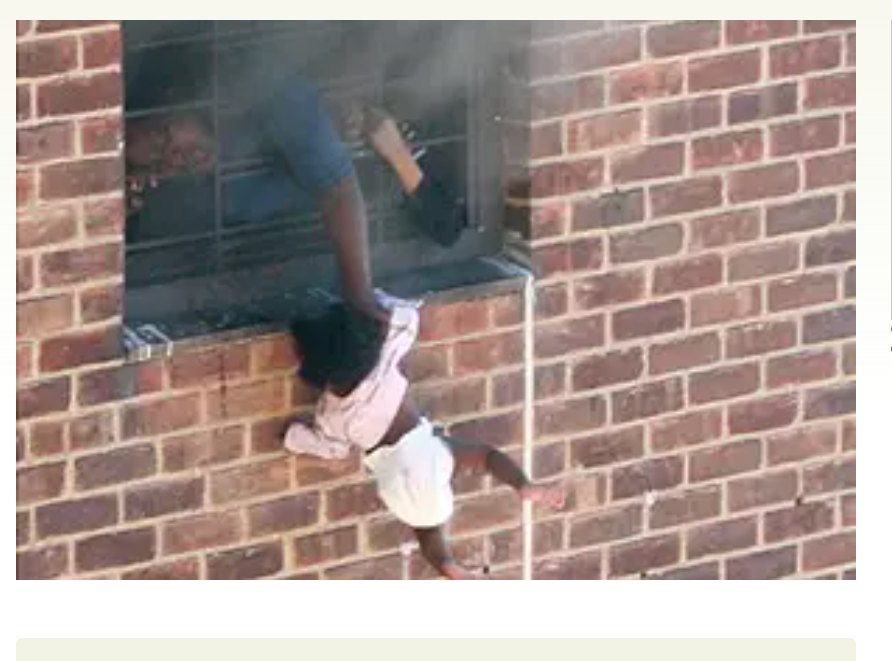
A video is being widely shared on social media after a fire incident in Aliganj, Lucknow. The approximately 15-second clip shows a building engulfed in flames, where a woman is seen hanging her small child outside a window while desperately seeking help. The video is being circulated as if it shows the recent Lucknow fire incident. CyberPeace Research Wing research found the claim to be misleading. The viral video is not related to the Lucknow fire incident. In fact, the clip is around 16 years old and originates from a completely different incident in the United States. It is being falsely shared on social media with a misleading context.
Claim:
A Facebook user shared the viral video on June 22, 2026, claiming: “A mother’s love is so powerful that even in front of death, she goes to any extent to save her child.” The post link, archived link, and screenshots are provided below.
https://www.facebook.com/reel/1168968548755052

Factcheck
To verify the claim, we conducted a reverse image search of the video keyframes using Google Lens. During the research, we found the same visuals published in a HuffPost report dated 2010. According to the report, the incident shows a fire in an apartment in the Bronx, New York, USA. https://www.huffpost.com/entry/photo-captures-baby-dangl_n_463780

Further research led us to another report published by Gothamist in 2010, which also confirmed that the footage is related to a fire incident in the Bronx apartment building in New York. https://gothamist.com/news/baby-held-out-window-in-bronx-fire-is-healthy-adorable
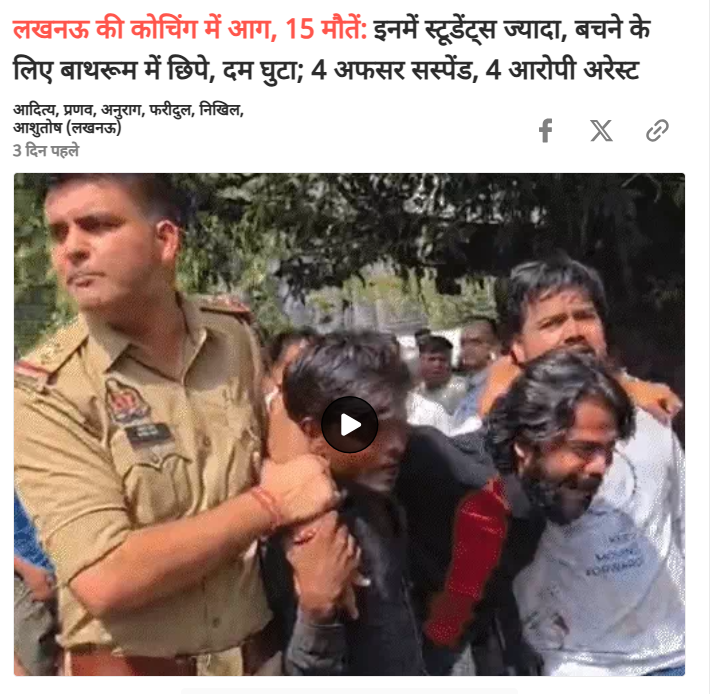
According to a report by Dainik Bhaskar, a fire incident at a coaching center in Aliganj, Lucknow resulted in the death of around 15 people. The government suspended four officials and police arrested four accused in connection with the incident. However, it was confirmed that the actual footage from the Lucknow coaching center fire is different from the viral video and has no relation to it. https://www.bhaskar.com/local/uttar-pradesh/lucknow/news/lucknow-coaching-center-fire-children-rescue-effort-138258629.html
Conclusion:
Our research confirms that the viral video is not related to the Lucknow fire incident. The footage is actually from a 16-year-old fire incident in the Bronx, New York, USA, and is being falsely shared with a misleading context on social media.

Related Blogs

Executive Summary
Amid reports that the U.S. military rescued a missing crew member of a fighter jet in Iran, a video is going viral on social media. The clip is being shared with the claim that it shows a U.S. F-15 pilot captured in Iran after his aircraft was shot down. In the video, the detained officer can be heard identifying himself as “Colonel David William Everly.”
However, research by the CyberPeace has found this claim to be misleading. The viral video is real but not recent. It is from the 1991 Gulf War, when U.S. Air Force Colonel David William Everly was captured in Iraq during Operation Desert Storm.
Claim
A social media user “palestinereports786” shared the video with the caption suggesting that a U.S. F-15 fighter jet was shot down over Iran and that one crew member may have been captured.
Fact Check
In the viral video, the officer is heard responding to questions, stating his name as Colonel David William Everly and identifying himself as a U.S. national and an F-15 pilot from the 4th Tactical Fighter Wing. Using these details, we conducted a news search and found several old reports confirming that this incident dates back to the 1991 Gulf War.
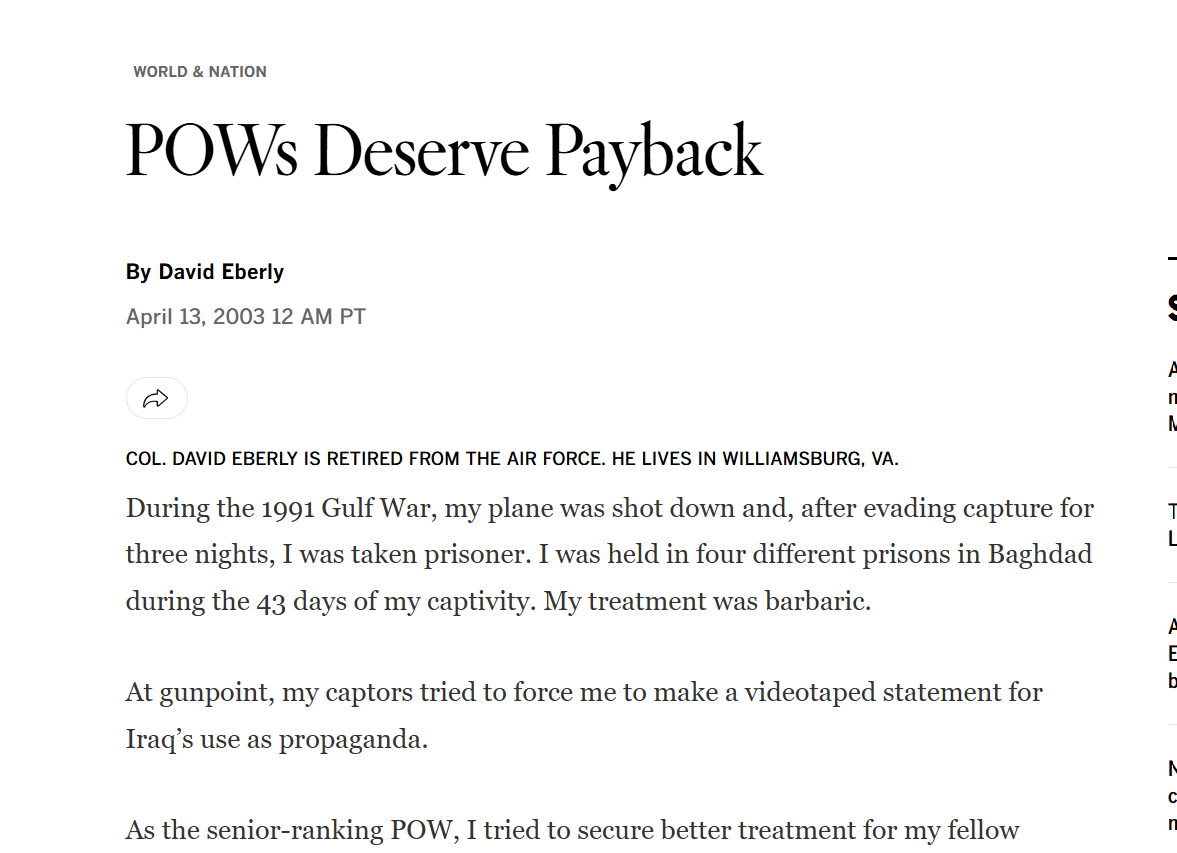
A report by the Los Angeles Times (April 13, 2003) recounts Everly’s experience, stating that his aircraft was shot down during the Gulf War. After evading capture for three nights, he was eventually taken prisoner and held for 43 days in multiple prisons in Baghdad, where he faced harsh treatment.
Additional references to the incident were also found on platforms such as pownetwork.org, nara.getarchive.net, and the National Air and Space Museum’s “Wall of Honor,” all documenting Everly’s captivity and eventual return to the United States. We also found an older interview of Everly, where he narrates the same incident.
According to data from acleddata.com, military tensions involving the United States, Israel, and Iran escalated after February 28, 2026, when operations against Iran reportedly began and are ongoing. However, reports indicate that the crew members of the recently downed F-15 aircraft were able to eject safely before the crash. Both crew members survived, and at least one has already been rescued by U.S. forces. There is no confirmed evidence that any pilot has been captured in Iran.

Conclusion
The viral video claiming to show a U.S. pilot captured in Iran is misleading. The footage is not related to any recent incident but originates from the 1991 Gulf War, when Colonel David William Everly was captured in Iraq. The old video has been shared with a false narrative to link it to the current geopolitical situation involving Iran. There is no verified evidence supporting claims that a U.S. pilot has been captured in Iran in the recent conflict.
Introduction
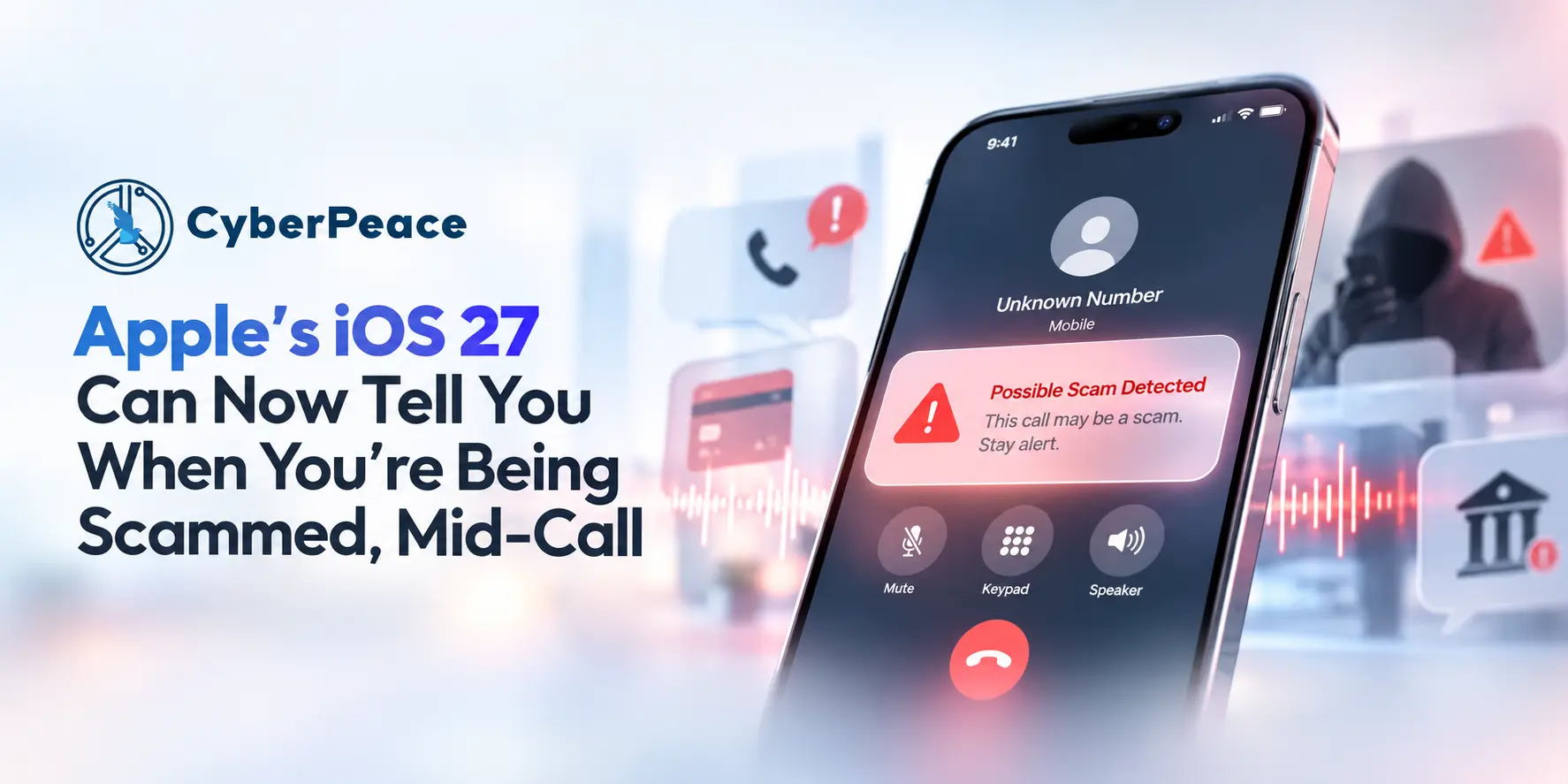
There is a particular kind of fraud that security engineers have struggled with for years, precisely because it defeats every technical safeguard by design. It is the social engineering scam, where a caller poses as your bank's department, your tax office, or a relative in trouble, and walks you, step by step, into making a payment or changing your own account details. Two-factor authentication does not stop this. Strong passwords do not stop it. The account holder is doing everything correctly, except they have been persuaded to do the wrong thing by someone skilled at sounding legitimate. With iOS 27 and iPadOS 27, released in September 2026, Apple has built a feature aimed specifically at that gap, called Impersonation Risk Detection.
What the feature actually does
The mechanism is narrower and more specific than it might first sound. Impersonation Risk Detection does not run continuously in the background scanning for scam calls the way a caller ID app might. Instead, it activates only when a supported app, not Apple's own apps necessarily, but any third party app that chooses to integrate it, requests a real time risk assessment at the exact moment a user attempts a sensitive action. Apple's own examples are specific: making a payment, changing a password, or modifying other critical account security information.
At that moment, the operating system runs an on-device analysis built on what Apple calls its Trust Insights framework. It draws on device use patterns, including the approximate number of recent phone calls and emails, Apple Account information such as app download and purchase history, and what Apple describes as interaction patterns, timing, context and basic sensor data. Crucially, Apple has been explicit that the system does not read the contents of Photos, Messages or Mail, and it does not examine the actual point of intrusion, meaning it cannot tell you whether the phone call you are currently on is itself fraudulent. What it is assessing, instead, is whether the pattern of behaviour surrounding this specific sensitive action looks statistically consistent with how a genuine user behaves, or with the pressured, rushed, coached pattern typical of someone being actively scammed.
The output is deliberately minimal. The requesting app receives only one of three labels, unknown, medium or high risk, never the underlying data that produced it. An "unknown" rating means no suspicious signs were detected, though Apple is careful to note this does not confirm the action is actually safe, only that nothing suspicious surfaced. Apple itself never sees the underlying device data used to generate the assessment either, though it does learn what type of action triggered the request in the first place. What the app then does with that risk label, whether to add a waiting period, prompt identity verification, or display an outright warning, is left entirely to the app's own design, not dictated by Apple.
Why the defaults and the fine print matter
Two details in how Apple shipped this feature are worth paying close attention to, because they reveal a lot about the threat model Apple was actually designing against. First, the feature is off by default. Users must manually navigate to Settings, then Privacy & Security, then Impersonation Risk Detection, and toggle on Share with App Developers, often requiring an Apple Account sign-in to activate. Second, and more tellingly, Apple built in a mandatory 24 hour delay before the toggle, once enabled, can actually be switched off. Apple's own guidance states plainly that if someone contacts you and insists you turn this feature off, treat that as a red flag. That is not a generic privacy disclaimer. It is Apple directly anticipating that scammers, once this feature becomes widely known, will start coaching victims to disable it mid-call, and designing a specific friction point to blunt exactly that manipulation.
Apps that have requested an assessment appear under a Recent Activity log, where users can review the specific actions that triggered each request and revoke access app by app, through a section Apple labels Reasons for Access. As of launch, Apple has not published a list of which apps actually support the feature, meaning its real world usefulness depends entirely on third party developers choosing to integrate it, something Apple cannot mandate.
How this compares to what Google has shipped earlier
Apple is not the first to market here, and the framing in early coverage of this feature, "it was just a matter of time," reflects that fairly accurately. Google began rolling out Scam Detection on Pixel phones in beta in late 2024, expanding it through 2025 using its on-device Gemini Nano model to analyse both phone calls and text messages in real time. The approaches differ in a meaningful way, though. Google's feature listens to an entire live conversation for scam-like conversational patterns, playing an audible beep at the start of a monitored call so both parties know AI analysis is active, and can interrupt mid-call with a warning. Apple's feature does not listen to anything resembling the call itself; it evaluates behavioural and account signals around a specific sensitive action a user is about to take, regardless of whether that action was prompted by a phone call, a text, or an email. Google's model is built around catching the scam as it happens in conversation; Apple's is built around catching the moment the user is about to act, irrespective of the channel that pressured them there. Both are opt-in or off by default, and both emphasise on-device processing and limited data sharing, reflecting a shared industry recognition that scam detection tools built on reading private conversations need unusually strong privacy guarantees to earn user trust.
Why this matters well beyond the US
Google has already signalled that it sees markets like India as a genuine proving ground for this category of tool, having launched Pixel-based scam detection there in November 2025 specifically citing the scale of digital fraud losses in the country, alongside partnerships with Indian financial apps including Google Pay, Paytm and Navi to warn users during risky screen-sharing sessions, a common vector in Indian banking fraud. That context matters for Apple's rollout too. Social engineering scams impersonating banks, government tax departments and law enforcement are a dominant and rapidly growing fraud category across much of Asia, and a feature that specifically targets the moment someone is being walked through a fraudulent payment, rather than relying on the victim recognising the scam themselves, addresses exactly the mechanism that most existing fraud prevention tools miss.
The honest limitation
Apple has been careful, in its own language, to frame this as a supplementary safeguard rather than a complete solution to telecom and online fraud, and that caution lines up with what the broader behavioural analytics industry has already learned the hard way. The feature depends entirely on third party app adoption that has not yet been detailed, it is switched off by default so most users will never encounter it without deliberately enabling it, and an "unknown" risk rating explicitly does not mean an action is safe, only that nothing suspicious happened to surface.
The deeper issue is one every company working on behavioural fraud detection has run into before Apple did: these systems are only as reliable as the baseline of "normal" behaviour they are measuring against, and that baseline is not stable across every type of user. Industry data on behavioural biometrics, the broader category of technology Apple's system belongs to, puts typical false positive rates for flagging new device, location, or timing combinations in the range of 15 to 25 percent before careful tuning, and practitioners in the field note that elderly users in particular tend to show higher variance in their interaction patterns, which makes them statistically harder for these models to read correctly, not easier, despite being exactly the population most targeted by impersonation scams in the first place. The risk is not hypothetical or confined to finance. In eldercare technology more broadly, a documented case from a California pilot programme saw a fall detection system switched off entirely after it generated so many false alarms that it triggered repeated, unwanted social service visits to an older adult's home, a clear illustration of what happens when a protective automated system cannot adequately account for the exact population it was built to protect.
Apple has not published performance data on how Impersonation Risk Detection behaves across these edge cases, new phones, irregular usage patterns, older users less familiar with typical app behaviour, and that silence is worth noting rather than assuming away. What Impersonation Risk Detection represents is not a solved problem, but a genuine, technically serious first attempt by a major platform to intervene at the exact moment social engineering scams succeed, the point of action, rather than relying on users to have correctly identified the deception several steps earlier. Whether it meaningfully reduces fraud losses at scale will depend less on the underlying design, which appears carefully thought through, and more on two things outside Apple's direct control: how many developers actually build it into the apps people use for banking and account security, and how well the system holds up for exactly the users who need it most.
References
- Help Net Security, "Apple's new iOS 27 feature looks for signs you're being scammed." https://www.helpnetsecurity.com/2026/09/24/apple-ios-27-impersonation-risk-detection/
- 9to5Mac, "iOS 27 adds scam-prevention feature to iPhone, here's how to enable it." https://9to5mac.com/2026/09/16/ios-27-adds-scam-prevention-feature-to-iphone-heres-how-to-enable-it/
- 9to5Mac, "Security Bite: iOS 27 now lets apps ask your iPhone if you're being scammed." https://9to5mac.com/2026/09/21/security-bite-ios-27-now-lets-apps-ask-your-iphone-if-youre-being-scammed/
- Engadget, "Apple's new iPhone and iPad security feature can protect you from scammers." https://www.engadget.com/2271157/apple-iphone-ipad-impersonator-risk-detection-new-security-feature/
- gHacks Tech News, "iOS 27 Adds Impersonation Risk Detection to Help Protect Against Social Engineering Scams." https://www.ghacks.net/2026/09/21/ios-27-adds-impersonation-risk-detection-to-help-protect-against-social-engineering-scams/
- BigGo Finance, "Apple Rolls Out On-Device Scam Detection in iOS 27 Ahead of High-Risk Transactions." https://finance.biggo.com/news/89a0ae92-1603-4ac9-aef9-b8b466e6ac40
- MacObserver, "iOS 27 Impersonation Risk Detection: How Apple's anti-scam setting works." https://www.macobserver.com/news/ios-27-impersonation-risk-detection-anti-scam-setting/
- Google Blog, "New AI-Powered Scam Detection Features to Help Protect You on Android." https://blog.google/security/new-ai-powered-scam-detection-features/
- Digital Trends, "Google Pixel 9 is getting a scam detection upgrade you'll want on your phone." https://www.digitaltrends.com/phones/google-pixel-scam-detection-gemini-nano-ai-calls-messages-safety/
- Gulf News, "Google ramps up AI scam protection in India." https://gulfnews.com/technology/media/google-ramps-up-ai-scam-protection-in-india-1.500355149

Introduction
Robotic or Robo dogs are created to resemble dogs in conduct and appearance, usually comprising canine features including barking and wagging tails. Some examples include Rhex (hexapod robot), Littledog and BigDog (created by Boston Dynamics robot). Robodogs, on the whole, can even respond to commands and look at a person with large LED-lit puppy eyes.
A four-legged robotic solution was recently concluded through its foremost successful radiation protection test inside the most extensive experimental area at the European Organization for Nuclear Research known as CERN. Each robot created at CERN is carefully crafted to fulfil exceptional challenges and complement each other. Unlike the previous wheeled, tracked or monorail robots, the robodogs will be capable of penetrating unexplored dimensions of the caverns, expanding the spectrum of surroundings that CERN robots can act as a guide. Also, Incorporating the robodog with the existing monorail robots in the Large Hadron Collider (LHC) tunnel will expand the range of places available for monitoring and supervision, improving the security and efficiency of the operation of CERN. Lenovo too has designed a six-legged robot called the "Daystar Bot GS" to be launched this year, which promises "comprehensive data collection."
Use of Robodogs in diverse domains
Due to the enhancement of Artificial Intelligence (AI), robodogs can be a boon for those with exceptional requirements. The advantage of AI is the dependability of its features, which can be programmed to answer certain commands detailed to the user.
In the context of health and well-being, they can be useful if they are programmed to take care of a person with distinct or special requirements (elderly person or visually impaired person). For this reason, they are considered more advantageous than the real dogs. Recently, New Stanford has designed robodogs that can perform several physical activities, including dancing and may also one day assist in putting pediatric patients in comfort during their hospital stays. Similarly, the robodog, "Pupper", is a revamped version of another robotic dog designed at Stanford called "Doggo", an open-source bot with 3D printed elements that one could create on a fairly small budget. They were also created to interact with humans. Furthermore, Robots as friends are a more comfortable hop for the Japanese. The oldest and most successful social robot in Japan is called "Paro", resembling an ordinary plush toy that can help in treating depression, stress, anxiety and also mood swings in a person. Following 1998, several Paro robots were exported overseas and put into service globally, reducing stress among children in ICUs, treating American veterans suffering from Post Traumatic Stress Disorder (PTSD), and assisting dementia patients.
Post-pandemic, the Japanese experiencing loneliness and isolation have been clinging to social robots for mind healing and comfort. Likewise, at a cafe in Japan, proud owners of the AI-driven robot dog "Aibo" have pawed its course into the minds and hearts of the people. Presently, robots are replacing the conventional class guinea pig or bunny at Moriyama Kindergarten in the central Japanese city of Nagoya. According to the teachers here, the bots apparently reduce stress and teach kids to be more humane.
In the security and defence domain, the unique skills of robodogs allow them to be used in hazardous and challenging circumstances. They can even navigate through rugged topography with reassurance to save stranded individuals from natural catastrophes. They could correspondingly help with search and rescue procedures, surveillance, and other circumstances that could be dangerous for humans. Researchers or experts are still fine-tuning the algorithm to develop them by devising the technology and employing affordable off-shelf robots that are already functional. Robodogs are further used for providing surveillance in hostage crises, defusing bombs, besides killing people to stop them from attacking other individuals. Similarly, a breakthrough in AI is being tested by the Australian military that reportedly allows soldiers to control robodogs solely with their minds. Cities like Florida and St. Petersburg also seem bound to keep police robodogs. The U.S. Department of Homeland Security is further seeking plans to deploy robot dogs at the borderlands. Also, the New York City Police Department (NYPD) intends to once again deploy four-legged 'Robodogs' to deal with high-risk circumstances like hostage negotiations. The NYPD has previously employed alike robodogs for high-octane duties in examining unsafe environments where human officers should not be exposed. The U.S. Marine Corps is additionally experimenting with a new breed of robotic canine that can be helpful in the battleground, enhance the safety and mobility of soldiers, and aid in other tasks. The Unitree Go1 robot dog (Nicknamed GOAT-Grounded Open-Air Transport) by the Marines is a four-legged machine that has a built-in AI system, which can be equipped to carry an infantry anti-armour rocket launcher on its back. The GOAT robot dog is designed to help the Marines move hefty loads, analyse topography, and deliver fire support in distant and dangerous places.
However, on the contrary, robodogs may pose ethical and moral predicaments regarding who is accountable for their actions and how to ensure their adherence to the laws of warfare. This may further increase security and privacy situations on how to safeguard the data of the robotic dogs and contain hacking or sabotage.
Conclusion
Teaching robots to traverse the world conventionally has been an extravagant challenge. Though the world has been seeing an increase in their manufacturing, it is simply a machine and can never replace the feeling of owning a real dog. Designers state that intelligent social robots will never replace humans, though robots provide the assurance of social harmony without social contact. Also, they may not be capable of managing complicated or unforeseen circumstances that need instinct or human decision-making. Nevertheless, owning robodogs in the coming decades is expected to become even more common and cost-effective as they evolve or advance with new algorithms being tested and implemented.
References:
- https://home.cern/news/news/engineering/introducing-cerns-robodog
- https://news.stanford.edu/2023/10/04/ai-approach-yields-athletically-intelligent-robotic-dog/
- https://nypost.com/2023/02/17/combat-ai-robodogs-follow-telepathic-commands-from-soldiers/
- https://www.popsci.com/technology/parkour-algorithm-robodog/
- https://ggba.swiss/en/cern-unveils-its-innovative-robodog-for-radiation-detection/
- https://www.themarshallproject.org/2022/12/10/san-francisco-killer-robots-policing-debate
- https://www.cbsnews.com/news/robo-dogs-therapy-bots-artificial-intelligence/
- https://news.stanford.edu/report/2023/08/01/robo-dogs-unleash-fun-joy-stanford-hospital/
- https://www.pcmag.com/news/lenovo-creates-six-legged-daystar-gs-robot
- https://www.foxnews.com/tech/new-breed-military-ai-robo-dogs-could-marines-secret-weapon
- https://www.wptv.com/news/national/new-york-police-will-use-four-legged-robodogs-again
- https://www.dailystar.co.uk/news/us-news/creepy-robodogs-controlled-soldiers-minds-29638615
- https://www.newarab.com/news/robodogs-part-israels-army-robots-gaza-war
- https://us.aibo.com/
