
#FactCheck:Old Philippines earthquake video falsely shared as 7.4-magnitude quake in Colombia
Executive Summary
A video showing children crouching as the ground shakes violently is being widely shared on social media with the claim that it shows the aftermath of a devastating 7.4-magnitude earthquake that struck Colombia on August 10, 2026. However, the CyberPeace Research Wing found that the video is not from Colombia. The footage was recorded in the Philippines two months earlier during a more powerful earthquake.
Claim
An X user shared the video on August 10, 2026, claiming that it showed a massive 7.4-magnitude earthquake in Colombia that killed hundreds of people and destroyed thousands of homes. “Massive 7.4 magnitude earthquake in Colombia! Hundreds dead, thousands of homes destroyed,” the post claimed.
https://x.com/anandsh04294243/status/2086911617938362779

Fact Check
To verify the claim, the Desk conducted a reverse image search of keyframes from the viral video. The search led to the same footage being shared on social media on June 8, where it was linked to a powerful earthquake in the southern Philippines. The posts identified the footage as being related to a 7.8-magnitude earthquake that struck the region, causing buildings to collapse, triggering landslides and prompting tsunami warnings.
https://x.com/WeatherMonitors/status/2063855713223635055
Further research found that the video was recorded at Tubalan Elementary School in Malita, Davao Occidental province, Philippines.
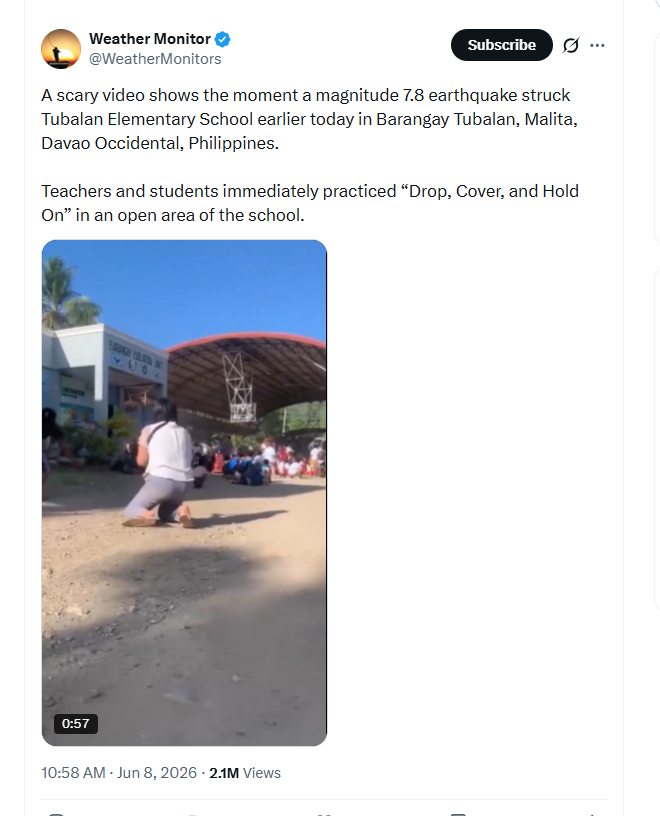
According to the edit history of the Facebook post, the user initially stated that the footage showed the first day of school at Tubalan Elementary School. The user later updated the caption, urging viewers not to blame the teachers. The updated post stated that the students were outside near the school’s basketball court when the earthquake struck and were subsequently evacuated to safety without any injuries. The school also issued a separate post on Facebook to address what it described as a misconception arising from the video circulating on social media. The school clarified that the outdoor gymnasium was not being used as an evacuation area after the earthquake. It said the students were already inside the gymnasium for the scheduled flag ceremony when the earthquake occurred.
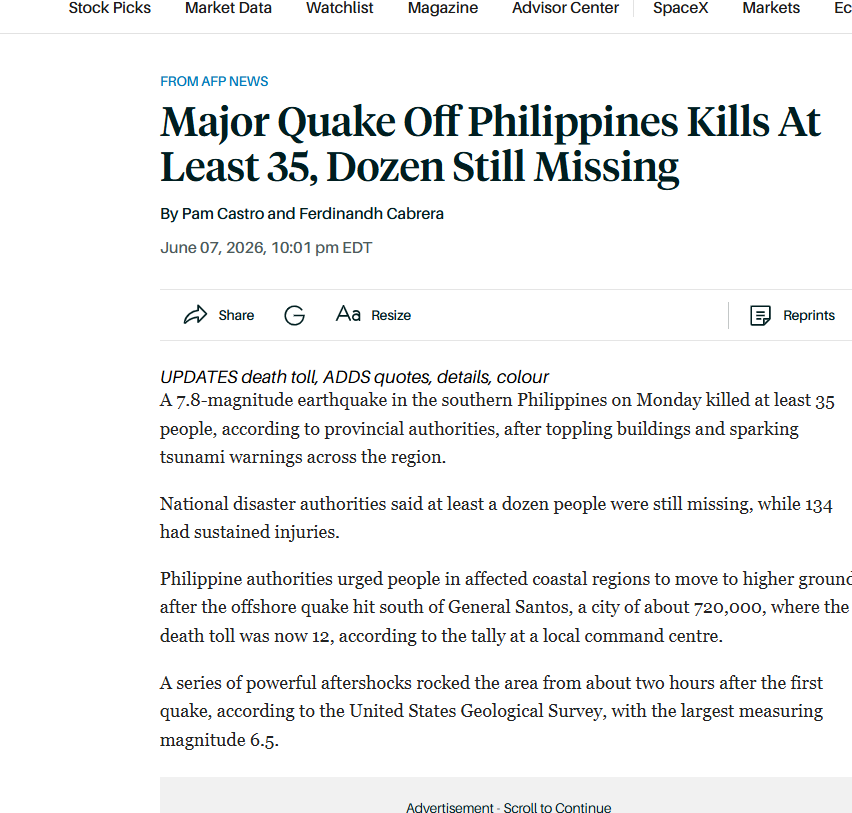
The Desk also searched for reports about the earthquake and found a detailed report published by Barron's, which confirmed the occurrence of a major earthquake off the southern Philippines. The report also mentioned casualties and tsunami warnings following the quake. https://www.barrons.com/news/major-quake-off-philippines-kills-one-triggers-tsunami-warnings-665c527c
Conclusion
The viral video does not show a 7.4-magnitude earthquake in Colombia. The footage was recorded at Tubalan Elementary School in the Philippines and was shared online in June 2026 in connection with a powerful earthquake that struck the southern Philippines. Therefore, the claim that the video shows the August 10, 2026 earthquake in Colombia is false.

Related Blogs

Executive Summary
A video is going viral on social media, showing a young boy carrying an even younger child on his back. Several users are sharing the video and its screenshots, claiming that it shows the aftermath of the floods in Nepal. A research by CyberPeace Research Wing found the viral claim to be false. Our research revealed that the video has been available online since August 11, 2026, and is being identified as footage from Vietnam. Meanwhile, Nepal was hit by a devastating flash flood on the morning of August 26, 2026. Therefore, the viral video has no connection with the recent floods in Nepal.
Claim
A news channel shared the viral image on Facebook with the caption: “A heartbreaking video from flood-hit Nepal has gone viral, showing two young siblings reportedly separated from their parents in the aftermath of the disaster. The children were seen trying to find their parents amid the devastation. Scratches and injuries were visible on their faces.The footage also shows the young boy trying to protect and look after his younger sister during the ordeal. The emotional visuals have sparked concern among social media users, highlighting the devastating human toll of the floods in Nepal.”
https://www.facebook.com/photo/?fbid=1711778750991761&set=a.637353345100979
https://perma.cc/GU6W-WQJM?type=standard

Fact Check
During a reverse image search of keyframes from the viral video, we found an uncropped version of the footage uploaded to YouTube on August 30. The title of the video reads, “Those who don’t have parents, #parents #orphanchildren #homelesschildren #poorkids #shortsfeed …” The text overlaid on the video reads, “The little boy carries his younger sibling under the scorching midday sun. Seeing the two siblings covered in dust breaks my heart.” The uncropped version also features a logo that reads “Thiên Duyên.”
https://www.youtube.com/shorts/z9XoY5GCxWs

In another video, a man can be heard speaking in Vietnamese and offering the children clothes and food.
https://www.instagram.com/p/DcxJHDjTLec/

An examination of the account’s ‘About this account’ section also showed that the account is based in Vietnam.

A keyword search using the account’s username led us to a news report by The Statesman, which had spoken to the owner of the page. The report identified the person behind the video as Thien Duyen. Duyen confirmed to The Statesman that he had filmed the video in Ha Giang, a rural and mountainous area of Vietnam. https://www.thestatesman.com/world/fact-check-viral-grave-of-the-fireflies-video-falsely-linked-to-nepal-floods-creator-says-it-was-shot-in-vietnam-exclusive-1503633031.html/amp
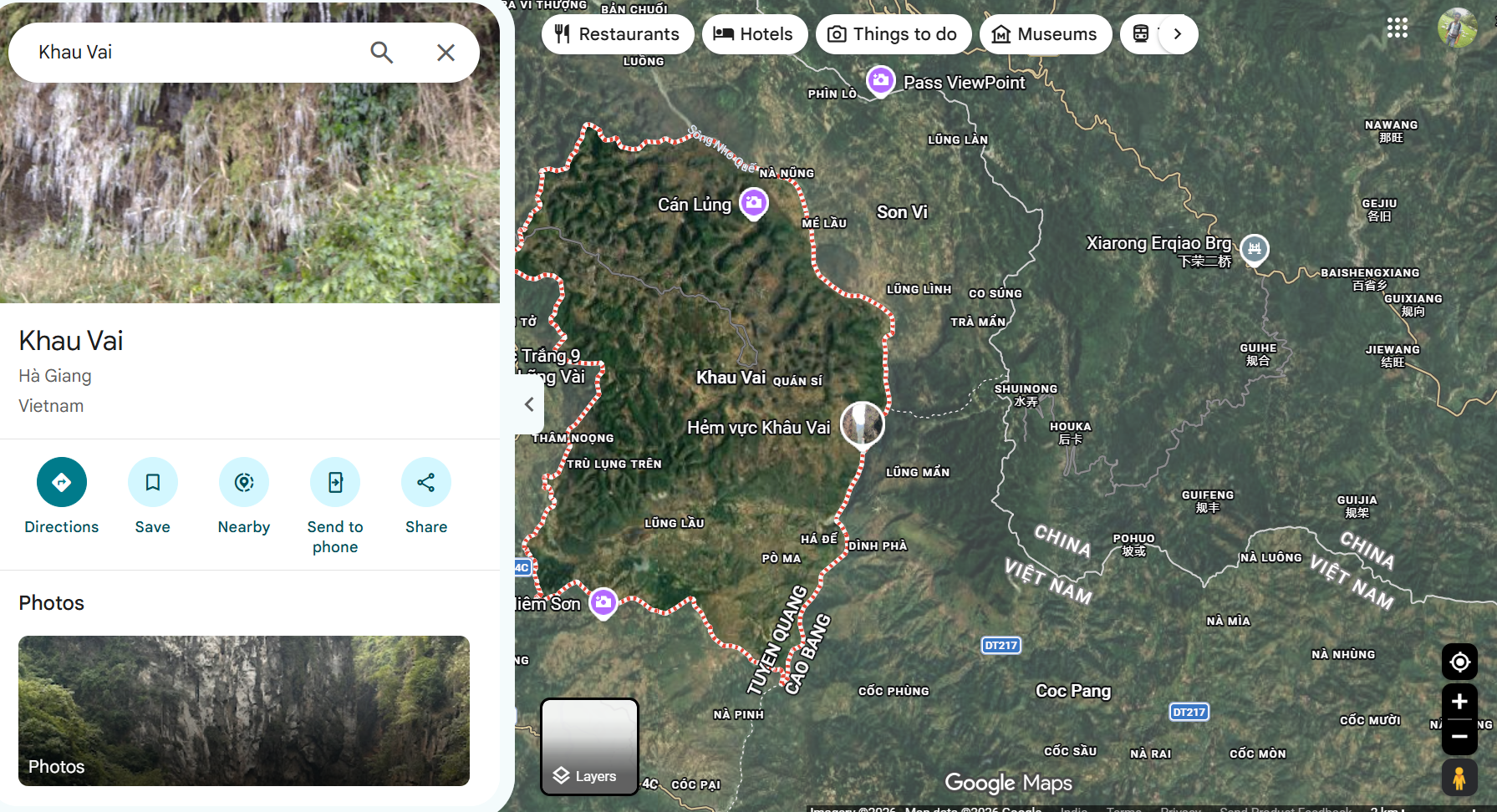
Using Google Maps and search, we found that Khau Vai is a remote mountain commune located in the Meo Vac district of Ha Giang Province, Vietnam.
Conclusion:
Our research found the viral claim to be false. The video has been available online since August 11, 2026, and has been identified as footage from Vietnam. Meanwhile, Nepal was hit by a devastating flash flood on August 26, 2026. This makes it clear that the viral video has no connection with the recent floods in Nepal.
%20(1).webp)
Before you take that next sip of your chai latte at Starbucks, you're about to see Artificial Intelligence (AI) in your tea. Yes you heard it right, but relax, you don't need to put the cup down, because it's not blended in like a new masala and nobody's adding AI as an ingredient. But AI will be deciding how much stock gets ordered, when the machine needs a service call, how the whole backend of your favourite coffee chain runs.
Here's what's actually going on. Starbucks has been quietly building its own AI to replace the systems Oracle, Microsoft, and IBM used to run for it, for the services such as inventory, equipment management, even the point-of-sale software every outlet depends on. In short: Starbucks decided it does not want to outsource its backend anymore. It wants to build the brain itself.
Sounds fascinating on the surface. A coffee company doing its own AI R&D, right? Except dig one layer deeper, and it stops being cool and starts being a conundrum. Here's the actual link: companies like Starbucks are Indian IT's bread and butter. This is literally the business model, global companies pay Indian IT firms like TCS, HCL, Infosys, Wipro to run exactly this kind of backend work: inventory systems, equipment management, point-of-sale software, IT infrastructure. That's what pays the salaries of roughly 6 million people employed by India's outsourcing industry.
However, recently, this workforce has been shrinking rather than growing. TCS, the largest player in the industry, reported just 0.4 percent revenue growth in the quarter after stripping out currency fluctuations, its slowest expansion in a year, while its workforce shrank by around 3 percent over the past year to about 594,000 employees. At smaller rival HCL Technologies, sales actually slipped 0.5 percent quarter on quarter. Company wide, TCS let go of over 23,000 employees in FY26 alone, citing its pivot toward an AI first services model and reduced bench requirements per client engagement, with a steep net decline of over 11,000 employees in the most recent quarter alone.
AI's impact on India's IT industry and workforce
India's IT sector employs close to 6 million people, and a large share of that workforce has built careers around exactly the kind of work now being absorbed by AI: inventory systems, equipment monitoring, point of sale software, and other repetitive backend operations. As more global clients explore building these capabilities in house, the demand for large teams doing routine maintenance work is likely to shrink. This does not mean mass job losses overnight, but it does suggest a shift in what kind of talent gets hired and retained. Entry level, process driven roles may see slower growth, while demand rises for professionals who can design, audit, and govern AI systems rather than simply maintain legacy software. For India's IT workforce, the challenge is less about competing with AI and more about repositioning around it, moving up the value chain before the shift forces the decision.
Beyond One Coffee Chain ~ The Real Shift in Global Outsourcing
Starbucks isn't an isolated case; it's a visible example of a much wider recalibration. For two decades, the operating assumption in enterprise software was that building complex, mission-critical systems in-house was too slow, too risky, and too expensive compared to buying from established vendors. AI-assisted coding is chipping away at that assumption. What used to require large, specialised engineering teams and years of development can now be prototyped and iterated on far faster enough that even a company whose core business is coffee, not code, can seriously consider building its own enterprise software stack.
However it is also worth noting that this transition isn't frictionless. Starbucks itself had to walk back an AI-powered inventory-counting tool earlier this year after it produced inaccurate counts, reverting stores to manual counting. Building in-house AI systems is not automatically smoother or more reliable than buying proven software; it just shifts the risk and the learning curve onto the company doing the building.
Disruption and Opportunity, Side by Side
None of this means Indian IT companies can afford to sit still. The Starbucks example offers a legitimate signal that repetitive, well defined, automatable work, especially when powered by in house built AI, genuinely poses some risk or not. But it cannot be seen only through the lens of the industry's obituary. It would be premature to call this a broader decline in terms of IT professionals, companies, or jobs.
The same earnings season also brought TCS's expanded AI mandate with ABB and HCL's $1.14 billion AI driven contract in Europe. Demand has not disappeared, it appears to be evolving from routine maintenance work toward AI native, higher value engagement.
Whether this becomes a meaningful structural shift or simply another cycle the industry eventually absorbs remains to be seen. What seems clear for now is that the path forward depends less on resisting the shift and more on how quickly the industry chooses to embrace it.
Conclusion
AI is a double-edged sword. While it challenges the old model of outsourcing via a maintenance and staff augmentation play, it also provides new, high-value services opportunities around AI integration, data infrastructure, and governance-areas where the scale, domain expertise, and global delivery experience that Indian IT has amassed over three decades is essential. Whether India's IT majors will move fast enough to upskill, re-skill, and reposition to ride this wave before the opportunity heads somewhere else, is the question to watch, rather than the survival of one vendor or contract.
Sources
- Bloomberg Opinion - Andy Mukherjee, "You Can't Spell Chai Latte Without AI, and That Will Hurt India.” bloomberg.com/opinion/articles/2026-07-14/you-can-t-spell-chai-latte-without-ai-that-will-hurt-india
- Yahoo Finance / Vlad Schepkov, "Starbucks Working on AI Tools to Replace Microsoft and IBM Software – Report," July 9, 2026. finance.yahoo.com/technology/ai/articles/starbucks-working-ai-tools-replace-105954159.html
- Livemint - Andy Mukherjee, "As Starbucks Mixes AI in Chai Latte, What Must IT Players Do?" Mint Curator.
livemint.com/opinion/online-views/andy-mukherjee-india-it-industry-starbucks-ai-tc-hcl-tech-artificial-intelligence-oracle-microsoft-ibm-11784118723454.html - Metaintro, "TCS and Infosys Face an AI Reckoning" https://www.metaintro.com/blog/tcs-infosys-ai-reckoning-millions-it-jobs-2026
- LayoffTrends, "IT Layoffs India 2026 — TCS, Infosys, Wipro, GCC Jobs" https://layofftrends.com/india.html
- NiftyTrader, "Hiring Slows at India's Top IT Firms — Net Headcount Falls in 9MFY26" https://www.niftytrader.in/markets/hiring-slows-at-indias-top-it-firms-net-headcount-falls-in-9mfy26-what-it-signals-for-the-sector/
- TCS official newsroom, "TCS and ABB Sign Multi-Million, Multi-Year Deal to Transform Global Network Operations with AI," tcs.com/who-we-are/newsroom/press-release/tcs-and-abb-sign-multi-million-multi-year-deal-to-transform-global-network-operations-with-ai

Executive Summary
A picture of late actor Sushant Singh Rajput is being shared on social media. In the picture, a woman can be seen holding him, while another person is standing beside him. The social media post claims that the picture is from the last days of Sushant Singh Rajput’s life.CyberPeace Research found the viral claim to be false. Our research found that the viral picture is not authentic, but was created using Artificial Intelligence (AI). The AI-generated image is being shared on social media with a misleading claim.
Claim:
On September 18, 2026, a Facebook user shared the viral picture with the caption, “How was Sushant Singh murdered? The photo is going viral.” The post link, archived link and screenshot are provided below.
https://www.facebook.com/reel/1591592259073828

Fact Check
To verify the authenticity of the viral image, we conducted a Google search using relevant keywords. However, we did not find any credible media report related to the viral image. In the next step of our research, we examined the viral image closely and noticed several inconsistencies that raised suspicion that it had been AI-generated. We then scanned the image using AI or Not. According to the results, the viral image was identified as AI-generated.
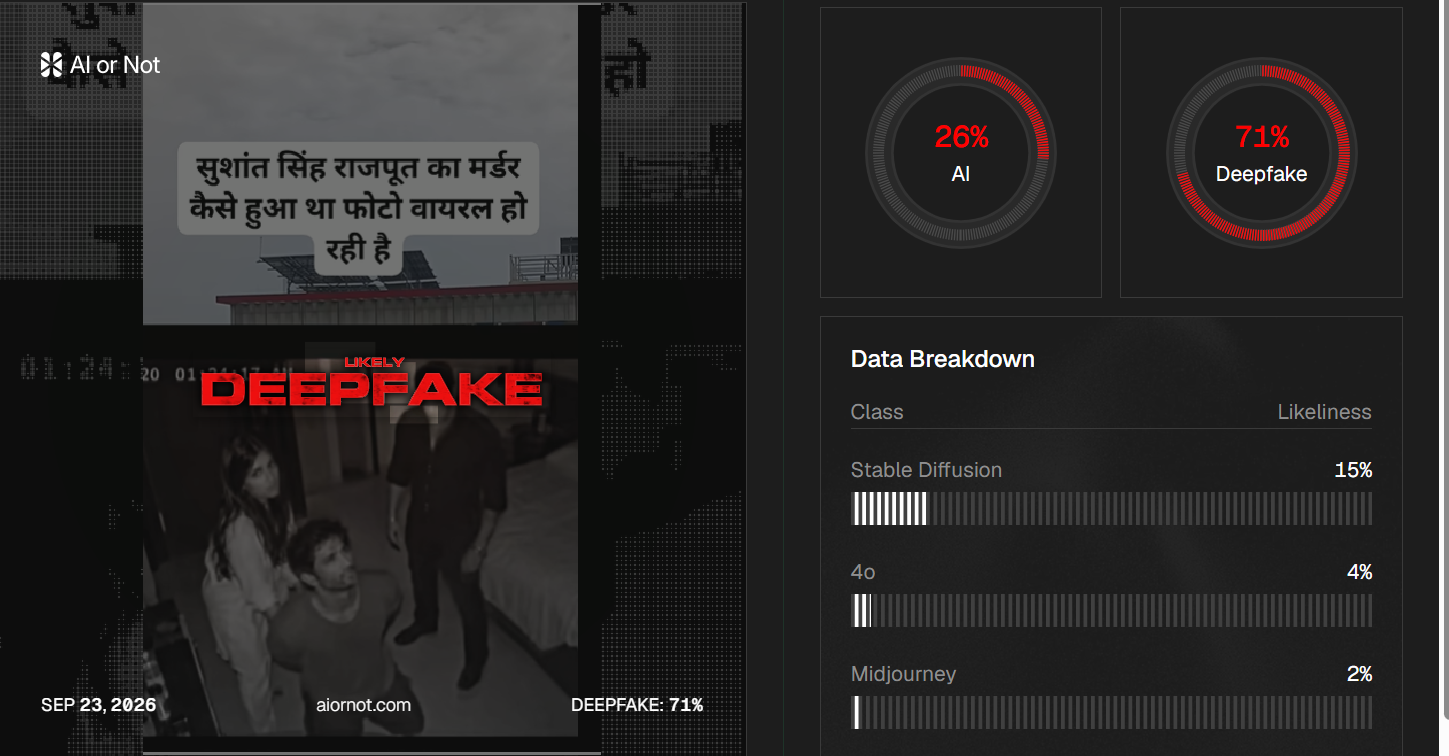
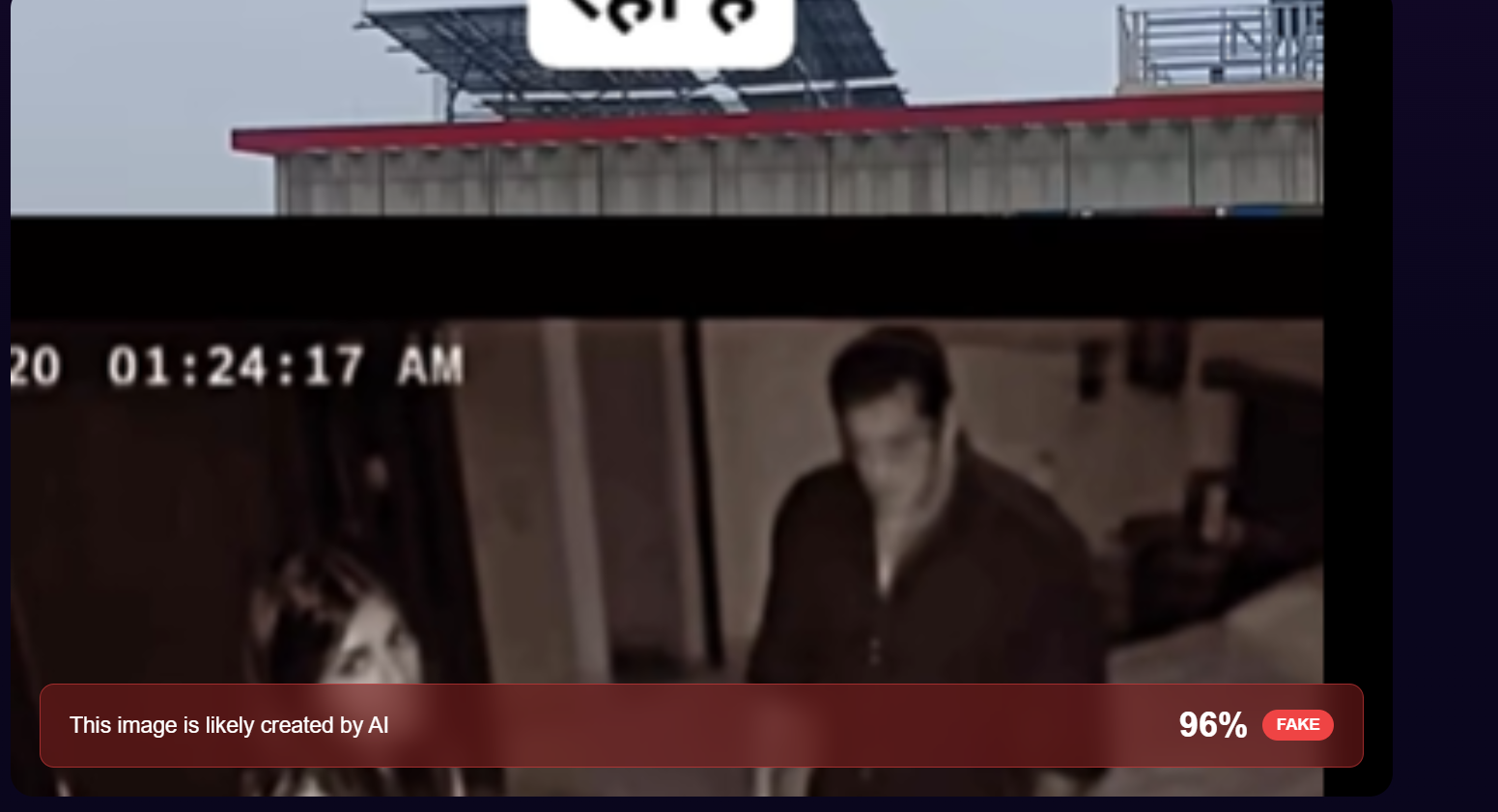
We also scanned the viral image using another AI detection tool, DeepAI. According to the results, the image was found to have a 96 percent likelihood of being AI-generated.
Conclusion
Our research found that the viral image is not authentic, but was created using Artificial Intelligence (AI). The AI-generated image is being shared on social media with a misleading claim.
