
#FactCheck : Old images of US sailors falsely linked to ongoing Iran tensions
Executive Summary
After Donald Trump said that US Navy ships would soon begin escorting tankers through the Strait of Hormuz, several old images resurfaced on social media with claims that they show American sailors recently captured by Iran amid the ongoing Middle East tensions. Research by CyberPeace found that the viral posts are misleading. The images being circulated are nearly a decade old and have no connection to the ongoing situation in the Middle East.
Claim:
Posts circulating on Facebook alleged that Iran had captured 10 US Navy personnel — nine men and one woman — and detained them at a military base on Farsi Island. The caption further claimed that the incident was reported by Iranian official Ali Larijani and denied by Donald Trump.
https://www.facebook.com/photo/?fbid=1381610870661566&set=pcb.1381611363994850

Fact Check
A reverse image search revealed that the viral images are not recent. They were published as early as January 13, 2016, by ABC News in a report titled “Iran Releases 10 Navy Sailors Held After Drifting Into Iranian Waters.”

Further checks showed that the same images were distributed by AFP, with credits to Sepah News, the media wing of Iran’s Revolutionary Guards.

Context
The images relate to a 2016 incident in which two US Navy patrol boats accidentally entered Iranian waters. The crew was detained and taken to Farsi Island. Iran later released the sailors after determining that the intrusion was unintentional and that there was no hostile intent.
Conclusion
The viral posts are misleading. The images being shared are nearly a decade old and unrelated to the ongoing situation in the Middle East.

Related Blogs
.webp)
Introduction
On the precipice of a new domain of existence, the metaverse emerges as a digital cosmos, an expanse where the horizon is not sky, but a limitless scope for innovation and imagination. It is a sophisticated fabric woven from the threads of social interaction, leisure, and an accelerated pace of technological progression. This new reality, a virtual landscape stretching beyond the mundane encumbrances of terrestrial life, heralds an evolutionary leap where the laws of physics yield to the boundless potential inherent in our creativity. Yet, the dawn of such a frontier does not escape the spectre of an age-old adversary—financial crime—the shadow that grows in tandem with newfound opportunity, seeping into the metaverse, where crypto-assets are no longer just an alternative but the currency du jour, dazzling beacons for both legitimate pioneers and shades of illicit intent.
The metaverse, by virtue of its design, is a canvas for the digital repaint of society—a three-dimensional realm where the lines between immersive experiences and entertainment blur, intertwining with surreal intimacy within this virtual microcosm. Donning headsets like armor against the banal, individuals become avatars; digital proxies that acquire the ability to move, speak, and perform an array of actions with an ease unattainable in the physical world. Within this alternative reality, users navigate digital topographies, with experiences ranging from shopping in pixelated arcades to collaborating in virtual offices; from witnessing concerts that defy sensory limitations to constructing abodes and palaces from mere codes and clicks—an act of creation no longer beholden to physicality but to the breadth of one's ingenuity.
The Crypto Assets
The lifeblood of this virtual economy pulsates through crypto-assets. These digital tokens represent value or rights held on distributed ledgers—a technology like blockchain, which serves as both a vault and a transparent tapestry, chronicling the pathways of each digital asset. To hop onto the carousel of this economy requires a digital wallet—a storeroom and a gateway for acquisition and trade of these virtual valuables. Cryptocurrencies, with NFTs—Non-fungible Tokens—have accelerated from obscure digital curios to precious artifacts. According to blockchain analytics firm Elliptic, an astonishing figure surpassing US$100 million in NFTs were usurped between July 2021 and July 2022. This rampant heist underlines their captivating allure for virtual certificates. Empowers do not just capture art, music, and gaming, but embody their very soul.
Yet, as the metaverse burgeons, so does the complexity and diversity of financial transgressions. From phishing to sophisticated fraud schemes, criminals craft insidious simulacrums of legitimate havens, aiming to drain the crypto-assets of the unwary. In the preceding year, a daunting figure rose to prominence—the vanishing of US$14 billion worth of crypto-assets, lost to the abyss of deception and duplicity. Hence, social engineering emerges from the shadows, a sort of digital chicanery that preys not upon weaknesses of the system, but upon the psychological vulnerabilities of its users—scammers adorned in the guise of authenticity, extracting trust and assets with Machiavellian precision.
The New Wave of Fincrimes
Extending their tentacles further, perpetrators of cybercrime exploit code vulnerabilities, engage in wash trading, obscuring the trails of money laundering, meander through sanctions evasion, and even dare to fund activities that send ripples of terror across the physical and virtual divide. The intricacies of smart contracts and the decentralized nature of these worlds, designed to be bastions of innovation, morph into paths paved for misuse and exploitation. The openness of blockchain transactions, the transparency that should act as a deterrent, becomes a paradox, a double-edged sword for the law enforcement agencies tasked with delineating the networks of faceless adversaries.
Addressing financial crime in the metaverse is Herculean labour, requiring an orchestra of efforts—harmonious, synchronised—from individual users to mammoth corporations, from astute policymakers to vigilant law enforcement bodies. Users must furnish themselves with critical awareness, fortifying their minds against the siren calls that beckon impetuous decisions, spurred by the anxiety of falling behind. Enterprises, the architects and custodians of this digital realm, are impelled to collaborate with security specialists, to probe their constructs for weak seams, and to reinforce their bulwarks against the sieges of cyber onslaughts. Policymakers venture onto the tightrope walk, balancing the impetus for innovation against the gravitas of robust safeguards—a conundrum played out on the global stage, as epitomised by the European Union's strides to forge cohesive frameworks to safeguard this new vessel of human endeavour.
The Austrian Example
Consider the case of Austria, where the tapestry of laws entwining crypto-assets spans a gamut of criminal offences, from data breaches to the complex webs of money laundering and the financing of dark enterprises. Users and corporations alike must become cartographers of local legislation, charting their ventures and vigilances within the volatile seas of the metaverse.
Upon the sands of this virtual frontier, we must not forget: that the metaverse is more than a hive of bits and bandwidth. It crystallises our collective dreams, echoes our unspoken fears, and reflects the range of our ambitions and failings. It stands as a citadel where the ever-evolving quest for progress should never stray from the compass of ethical pursuit. The cross-pollination of best practices, and the solidarity of international collaboration, are not simply tactics—they are imperatives engraved with the moral codes of stewardship, guiding us to preserve the unblemished spirit of the metaverse.
Conclusion
The clarion call of the metaverse invites us to venture into its boundless expanse, to savour its gifts of connection and innovation. Yet, on this odyssey through the pixelated constellations, we harness vigilance as our star chart, mindful of the mirage of morality that can obfuscate and lead astray. In our collective pursuit to curtail financial crime, we deploy our most formidable resource—our unity—conjuring a bastion for human ingenuity and integrity. In this, we ensure that the metaverse remains a beacon of awe, safeguarded against the shadows of transgression, and celebrated as a testament to our shared aspiration to venture beyond the realm of the possible, into the extraordinary.
References
- https://www.wolftheiss.com/insights/financial-crime-in-the-metaverse-is-real/
- https://gnet-research.org/2023/08/16/meta-terror-the-threats-and-challenges-of-the-metaverse/
- https://shuftipro.com/blog/the-rising-concern-of-financial-crimes-in-the-metaverse-aml-screening-as-a-solution/

Introduction
In the wake of the Spy Loan scandal, more than a dozen malicious loan apps were downloaded on Android phones from the Google Play Store, However, the number is significantly higher because they are also available on third-party marketplaces and questionable websites.
Unmasking the Scam
When a user borrows money, these predatory lending applications capture large quantities of information from their smartphone, which is then used to blackmail and force them into returning the total with hefty interest levels. While the loan amount is disbursed to users, these predatory loan apps request sensitive information by granting access to the camera, contacts, messages, logs, images, Wi-Fi network details, calendar information, and other personal information. These are then sent to loan shark servers.
The researchers have disclosed facts about the applications used by loan sharks to mislead consumers, as well as the numerous techniques used to circumvent some of the limitations imposed on the Play Store. Malware is often created with appealing user interfaces and promotes simple and rapid access to cash with high-interest payback conditions. The revelation of the Spy Loan scandal has triggered an immediate response from law enforcement agencies worldwide. There is an urgency to protect millions of users from becoming victims of malicious loan apps, it has become extremely important for law enforcement to unmask the culprits and dismantle the cyber-criminal network.
Aap’s banned: here is the list of the apps banned by Google Play Store :
- AA Kredit: इंस्टेंट लोन ऐप (com.aa.kredit.android)
- Amor Cash: Préstamos Sin Buró (com.amorcash.credito.prestamo)
- Oro Préstamo – Efectivo rápido (com.app.lo.go)
- Cashwow (com.cashwow.cow.eg)
- CrediBus Préstamos de crédito (com.dinero.profin.prestamo.credito.credit.credibus.loan.efectivo.cash)
- ยืมด้วยความมั่นใจ – ยืมด่วน (com.flashloan.wsft)
- PréstamosCrédito – GuayabaCash (com.guayaba.cash.okredito.mx.tala)
- Préstamos De Crédito-YumiCash (com.loan.cash.credit.tala.prestmo.fast.branch.mextamo)
- Go Crédito – de confianza (com.mlo.xango)
- Instantáneo Préstamo (com.mmp.optima)
- Cartera grande (com.mxolp.postloan)
- Rápido Crédito (com.okey.prestamo)
- Finupp Lending (com.shuiyiwenhua.gl)
- 4S Cash (com.swefjjghs.weejteop)
- TrueNaira – Online Loan (com.truenaira.cashloan.moneycredit)
- EasyCash (king.credit.ng)
- สินเชื่อปลอดภัย – สะดวก (com.sc.safe.credit)
Risks with several dimensions
SpyLoan's loan application violates Google's Financial Services policy by unilaterally shortening the repayment period for personal loans to a few days or any other arbitrary time frame. Additionally, the company threatens users with public embarrassment and exposure if they do not comply with such unreasonable demands.
Furthermore, the privacy rules presented by SpyLoan are misleading. While ostensibly reasonable justifications are provided for obtaining certain permissions, they are very intrusive practices. For instance, camera permission is ostensibly required for picture data uploads for Know Your Customer (KYC) purposes, and access to the user's calendar is ostensibly required to plan payment dates and reminders. However, both of these permissions are dangerous and can potentially infringe on users' privacy.
Prosecution Strategies and Legal Framework
The law enforcement agencies and legal authorities initiated prosecution strategies against the individuals who are involved in the Spy Loan Scandal, this multifaced approach involves international agreements and the exploration of innovative legal avenues. Agencies need to collaborate with International agencies to work on specific cyber-crime, leveraging the legal frameworks against digital fraud furthermore, the cross-border nature of the spy loan operation requires a strong legal framework to exchange information, extradition requests, and the pursuit of legal actions across multiple jurisdictions.
Legal Protections for Victims: Seeking Compensation and Restitution
As the legal battle unfolds in the aftermath of the Spy loan scam the focus shifts towards the victims, who suffer financial loss from such fraudulent apps. Beyond prosecuting culprits, the pursuit of justice should involve legal safeguards for victims. Existing consumer protection laws serve as a crucial shield for Spy Loan victims. These laws are designed to safeguard the rights of individuals against unfair practices.
Challenges in legal representation
As the legal hunt for justice in the Spy Loan scam progresses, it encounters challenges that demand careful navigation and strategic solutions. One of the primary obstacles in the legal pursuit of the Spy loan app lies in the jurisdictional complexities. Within the national borders, it’s quite challenging to define the jurisdiction that holds the authority, and a unified approach in prosecuting the offenders in various regions with the efforts of various government agencies.
Concealing the digital identities
One of the major challenges faced is the anonymity afforded by the digital realm poses a challenge in identifying and catching the perpetrators of the scam, the scammers conceal their identity and make it difficult for law enforcement agencies to attribute to actions against the individuals, this challenge can be overcome by joint effort by international agencies and using the advance digital forensics and use of edge cutting technology to unmask these scammers.
Technological challenges
The nature of cyber threats and crime patterns are changing day by day as technology advances this has become a challenge for legal authorities, the scammers explore vulnerabilities, making it essential, for law enforcement agencies to be a step ahead, which requires continuous training of cybercrime and cyber security.
Shaping the policies to prevent future fraud
As the scam unfolds, it has become really important to empower users by creating more and more awareness campaigns. The developers of the apps need to have a transparent approach to users.
Conclusion
It is really important to shape the policies to prevent future cyber frauds with a multifaced approach. Proposals for legislative amendments, international collaboration, accountability measures, technology protections, and public awareness programs all contribute to the creation of a legal framework that is proactive, flexible, and robust to cybercriminals' shifting techniques. The legal system is at the forefront of this effort, playing a critical role in developing regulations that will protect the digital landscape for years to come.
Safeguarding against spyware threats like SpyLoan requires vigilance and adherence to best practices. Users should exclusively download apps from official sources, meticulously verify the authenticity of offerings, scrutinize reviews, and carefully assess permissions before installation.
References

Executive Summary
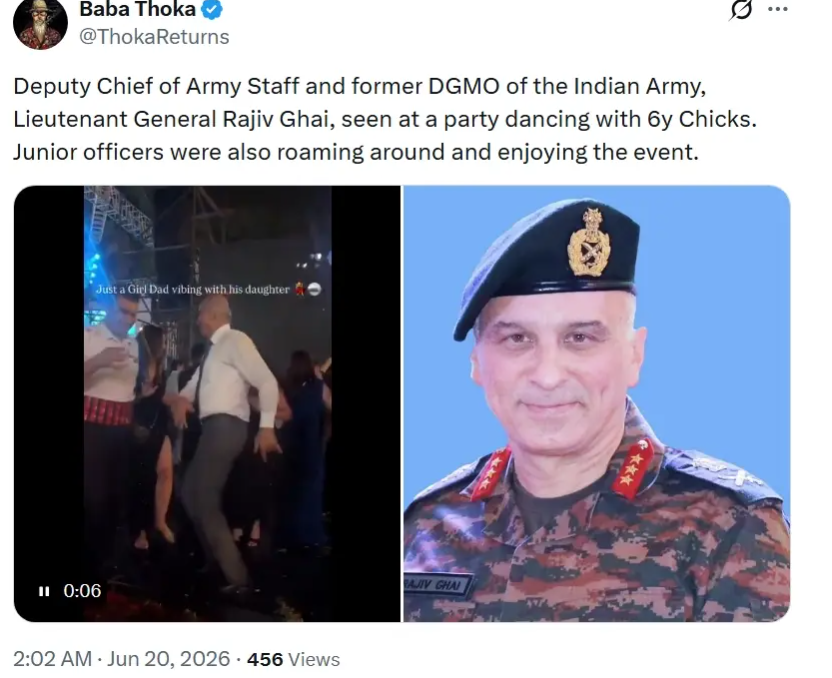
A video circulating on social media claims to show the Deputy Chief of Army Staff and former DGMO of the Indian Army, Lieutenant General Rajiv Ghai, dancing with a young woman at a party. Users sharing the clip further allege that other junior military officers were also present at the event. CyberPeace Research Wing research found the claim to be misleading. The viral video has no connection with the Indian Army, Lt Gen Rajiv Ghai, or any official military function. The person seen in the video is actually the father of content creator Akanksha Sehgal, who has featured him in multiple videos on her social media accounts.
Claim:
A Pakistani handle ‘Baba Thoka’ shared the video on X, alleging that Lt Gen Rajiv Ghai was seen dancing with young women at a party and that junior officers were also present.
- https://x.com/ThokaReturns/status/2068069535715147896?s=20
- https://archive.ph/H9EA0
Fact Check:
A reverse image search of keyframes from the viral video led to the same clip being found on Instagram handle ‘akku_sehgal_’, posted on December 14, 2025. The video caption read: “POV – when your dad and your music taste match.”

Further examination of the content creator Akanksha Sehgal’s Instagram profile showed multiple videos featuring the same father-daughter duo, confirming that the man in the viral clip frequently appears in her content.

Conclusion:
The viral video claiming to show Lieutenant General Rajiv Ghai dancing at a party is misleading. The individual seen in the video is not the senior Indian Army officer but the father of content creator Akanksha Sehgal.
