
#FactCheck-Claim of Man Being Burned Alive During Muharram Procession Found False, Deoria Incident Misrepresented
Executive Summary
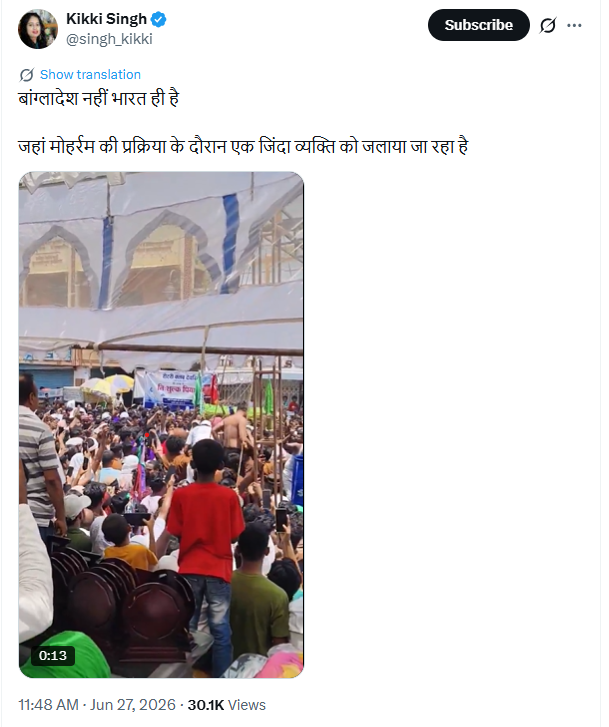
A video is being widely shared on social media linking it to a Muharram procession in India. The video shows a person engulfed in flames, with users claiming that an individual was deliberately set on fire during a Muharram procession in India. Several social media users are circulating the clip with communal claims. CyberPeace Research Wing research found that the viral claim is misleading. The video does not show any incident of a person being deliberately burned during a Muharram procession. In reality, it is from Deoria, Uttar Pradesh, where a performer sustained burn injuries while performing stunts during a Muharram procession.
Claim:
On X (formerly Twitter), a user posted the viral video on 3 June 2026, claiming: “Not Bangladesh, this is India where a person is being burned alive during a Muharram procession.” The post link, archive link, and screenshots are provided below. https://x.com/singh_kikki/status/2070753631167541586 , https://archive.ph/vP3bZ
Fact Check:
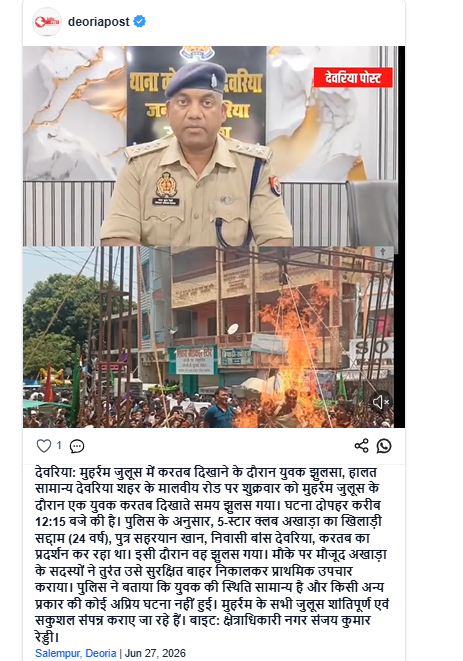
For verification, we extracted multiple keyframes from the video and conducted a reverse image search using Google Lens. During the search, we found the same video published on the Public app on 27 June 2026. According to the report, the incident took place on Malviya Road in Deoria city, Uttar Pradesh, during a Muharram procession, where a member of the 5-Star Club akhara, Saddam (24), a resident of Bans Deoria, suffered burn injuries while performing stunts involving fire. The report further stated that members of the akhara immediately rescued him and arranged first aid. Police confirmed that his condition is stable and that the incident was accidental. No other untoward incident was reported, and all Muharram processions were conducted peacefully. A statement by Circle Officer (City), Sanjay Kumar Reddy, was also included in the report. https://public.app/video/sp_zh7dywam0a2pb
In our subsequent research, we found a report published on Dainik Bhaskar's website with the same claim. A link and screenshot of the post are provided below. https://www.bhaskar.com/amp/local/uttar-pradesh/deoria/news/deoria-youth-burns-muharram-procession-stunt-138296624.html
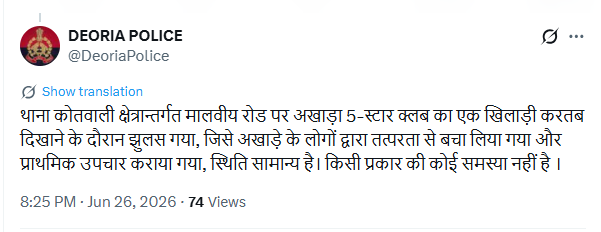
Finally, we also found an official post from the Deoria Police X handle confirming the incident. The police stated that a performer from the 5-Star Club akhara was injured while performing stunts on Malviya Road and was immediately given first aid. His condition is stable, and no other incident occurred. https://x.com/DeoriaPolice/status/2070521290864377982
Conclusion:
The research clearly found that the viral video does not show a person being deliberately burned during a Muharram procession. The footage is from Deoria, Uttar Pradesh, where a performer was accidentally injured during a fire stunt.

Related Blogs

Executive Summary:
QakBot, a particular kind of banking trojan virus, is capable of stealing personal data, banking passwords, and session data from a user's computer. Since its first discovery in 2009, Qakbot has had substantial modifications.
C2 Server commands infected devices and receives stolen data, which is essentially the brain behind Qakbot's operations.Qakbot employs PEDLL (Communication Files), a malicious program, to interact with the server in order to accomplish its main goals. Sensitive data, including passwords or personal information, is taken from the victims and sent to the C2 server. Referrer files start the main line of communication between Qakbot and the C2 server, such as phishing papers or malware droppers. WHOIS data includes registration details for this server, which helps to identify its ownership or place of origin.
This report specifically focuses on the C2 server infrastructure located in India, shedding light on its architecture, communication patterns, and threat landscape.
Introduction:
QakBot is also known as Pinkslipbot, QuakBot, and QBot, capable of stealing personal data, banking passwords, and session data from a user's computer. Malware is bad since it spreads very quickly to other networks, affecting them like a worm.,It employs contemporary methods like web injection to eavesdrop on customer online banking interactions. Qakbot is a member of a kind of malware that has robust persistence techniques, which are said to be the most advanced in order to gain access to compromised computers for extended periods of time.
Technical Analysis:
The following IP addresses have been confirmed as active C2 servers supporting Qbot malware activity:

Sample IP's
- 123.201.40[.]112
- 117.198.151[.]182
- 103.250.38[.]115
- 49.33.237[.]65
- 202.134.178[.]157
- 124.123.42[.]115
- 115.96.64[.]9
- 123.201.44[.]86
- 117.202.161[.]73
- 136.232.254[.]46
These servers have been operational in the past 14 days (report created in the month of Nov) and are being leveraged to perpetuate malicious activities globally.
URL/IP: 123.201.40[.]112

- inetnum: 123.201.32[.]0 - 123.201.47[.]255
- netname: YOUTELE
- descr: YOU Telecom India Pvt Ltd
- country: IN
- admin-c: HA348-AP
- tech-c: NI23-AP
- status: ASSIGNED NON-PORTABLE
- mnt-by: MAINT-IN-YOU
- last-modified: 2022-08-16T06:43:19Z
- mnt-irt: IRT-IN-YOU
- source: APNIC
- irt: IRT-IN-YOU
- address: YOU Broadband India Limited
- address: 2nd Floor, Millennium Arcade
- address: Opp. Samarth Park, Adajan-Hazira Road
- address: Surat-395009,Gujarat
- address: India
- e-mail: abuse@youbroadband.co.in
- abuse-mailbox: abuse@youbroadband.co.in
- admin-c: HA348-AP
- tech-c: NI23-AP
- auth: # Filtered
- mnt-by: MAINT-IN-YOU
- last-modified: 2022-08-08T10:30:51Z
- source: APNIC
- person: Harindra Akbari
- nic-hdl: HA348-AP
- e-mail: harindra.akbari@youbroadband.co.in
- address: YOU Broadband India Limited
- address: 2nd Floor, Millennium Arcade
- address: Opp. Samarth Park, Adajan-Hazira Road
- address: Surat-395009,Gujarat
- address: India
- phone: +91-261-7113400
- fax-no: +91-261-2789501
- country: IN
- mnt-by: MAINT-IN-YOU
- last-modified: 2022-08-10T11:01:47Z
- source: APNIC
- person: NOC IQARA
- nic-hdl: NI23-AP
- e-mail: network@youbroadband.co.in
- address: YOU Broadband India Limited
- address: 2nd Floor, Millennium Arcade
- address: Opp. Samarth Park, Adajan-Hazira Road
- address: Surat-395009,Gujarat
- address: India
- phone: +91-261-7113400
- fax-no: +91-261-2789501
- country: IN
- mnt-by: MAINT-IN-YOU
- last-modified: 2022-08-08T10:18:09Z
- source: APNIC
- route: 123.201.40.0/24
- descr: YOU Broadband & Cable India Ltd.
- origin: AS18207
- mnt-lower: MAINT-IN-YOU
- mnt-routes: MAINT-IN-YOU
- mnt-by: MAINT-IN-YOU
- last-modified: 2012-01-25T11:25:55Z
- source: APNIC


IP 123.201.40[.]112 uses the requested URL-path to make a GET request on the IP-address at port 80. "NOT RESPONDED" is the response status code for the request "C:\PROGRAM FILES GOOGLE CHROME APPLICATION CHROME.EXE" that was started by the process.
Programs that retrieve their server data using a GET request are considered legitimate. The Google Chrome browser, a fully functional application widely used for web browsing, was used to make the actual request. It asks to get access to the server with IP 123.201.40[.]112 in order to collect its data and other resources.
Malware uses GET requests to retrieve more commands or to send data back to the command and control servers. In this instance, it may be an attack server making the request to a known IP address with a known port number. Since the server has not replied to the request, the response status "NOT RESPONDED" may indicate that the activity was carried out with malicious intent.
This graph illustrates how the Qakbot virus operates and interacts with its C2 server, located in India and with the IP address 123.201.40[.]112.

Impact
Qbot is a kind of malware that is typically distributed through hacked websites, malicious email attachments, and phishing operations. It targets private user information, including corporate logins or banking passwords. The deployment of ransomware: Payloads from organizations such as ProLock and Egregor ransomware are delivered by Qbot, a predecessor. Network Vulnerability: Within corporate networks, compromised systems will act as gateways for more lateral movement.
Proposed Recommendations for Mitigation
- Quick Action: To stop any incoming or outgoing traffic, the discovered IP addresses will be added to intrusion detection/prevention systems and firewalls.
- Network monitoring: Examining network log information for any attempts to get in touch with these IPs
- Email security: Give permission for anti-phishing programs.
- Endpoint Protection: To identify and stop Qbot infestations, update antivirus definitions.,Install tools for endpoint detection and response.
- Patch management: To reduce vulnerabilities that Qbot exploits, update all operating systems and software on a regular basis.
- Incident Response: Immediately isolate compromised computers.
- Awareness: Dissemination of this information to block the IP addresses of active C2 servers supporting Qbot malware activity has to be carried out.
Conclusion:
The discovery of these C2 servers reveals the growing danger scenario that Indian networks must contend with. To protect its infrastructure from future abuse, organizations are urged to act quickly and put the aforementioned precautions into place.
Reference:
- Threat Intelligence - ANY.RUN
- https://www.virustotal.com/gui
- https://www.virustotal.com/gui/ip-address/123.201.40.112/relations

Introduction
India & Bangladesh have adopted proactive approaches, focusing on advancing cyber capacity building in the region. Bangladeshi and Indian cybersecurity experts have emphasised the importance of continuous technology training to protect the digital space from growing cyber-attacks and threats. They call for greater collaboration to share knowledge and expertise in cyber resilience, network vulnerability, and cyber risk assessment. The Cyber-Maitree 2023 event held in Dhaka aimed to enrich and build capacity to counter cyber-attacks and threats. The senior director of India's Computer Emergency Response Team acknowledged the growing dependence on cyberspace and the need for increased preparedness as critical infrastructures, energy systems, banks, and utilities are connected to the internet. Recently, Bangladesh Cyber Security Summit 2024, organised by Grameenphone, was held in Dhaka on March 5th, 2024. Such collaborative dialogues between the countries serve as a shining example of cooperation between the governments of Bangladesh and India, serving as a platform for knowledge sharing, capacity building, and international cooperation in cyber security.
Cyber Maitree held in 2023
In 2023, India and Bangladesh held 'Cyber Maitree 2023', an initiative hosted by the ICT Division of the Bangladeshi Government, to address cybersecurity challenges in a rapidly globalising world characterised by digitisation. The event, which translates to "Cyber Friendship," was an interface for cybersecurity experts and aspirants from both nations, creating an avenue for extensive training, practical exercises, and a dynamic exchange of information. We need to emphasise the importance of bolstering digital safety as both nations grapple with the rapid digitisation of the world.
India-Bangladesh joint efforts aim to fortify cyber resilience, pinpoint potential network vulnerabilities, bolster rigorous risk assessments, and illuminate the landscape of cyber threats. It encompasses various sectors, including cybersecurity, artificial intelligence, ICT, and IT-driven human resource expansion. The growing camaraderie between India and Bangladesh has been evident through strategic engagements, such as the India-Bangladesh Startup Bridge and the establishment of 12 High Tech Parks in Bangladesh.
Highlights of the India-Bangladesh MoUs for Cyber Security Cooperation
In 2017, India and Bangladesh signed a Memorandum of Understanding (MoU) focused on cyber security cooperation.
In 2022, Both nations crafted a Memorandum of Understanding (MoU), highlighting collaboration in spheres such as e-governance, e-public service delivery, research, and development. A separate agreement was also inked focusing on mutual information sharing pertaining to cyber-attacks and incidents. The first MoU aims to provide a framework for training Bangladesh Railway employees at Indian Railways' training institutes, including field visits. The Indian Railways will coordinate with officials from the Ministry of Railways, Government of Bangladesh to improve training facilities in Bangladesh. The second MoU focuses on collaboration in IT systems, for the Bangladesh Railway. The Ministry of Railway, Government of India, will offer IT solutions for passenger ticketing, freight operations, train inquiry systems, asset management digitisation, HR and finance infrastructure. The MoUs aim to strengthen the friendship bond between India and Bangladesh and promote friendly cooperation in the railway sector.
Way Ahead
Zunaid Ahmed Palak, State Minister for Posts, Telecom and ICT, Bangladesh, has announced that Bangladesh and India will collaborate to ensure the safety of the cyber world. The two countries are expected to sign a final agreement within the next three to six months. He stressed the importance of attracting investments in the postal, telecommunication, and IT sectors. He also highlighted the strong ties between Bangladesh and India. He also announced that 12 high-tech parks will be constructed in Bangladesh with an Indian Line of Credit, starting operation by 2025. He further referred to the Indian Cyber Emergency Response Team (CERT), and said "We are very much enthusiastic in fighting against the cyber attacks and crimes as the team is now working with us".
Bangladesh Cyber Security Summit 2024
The Bangladesh Cyber Security Summit 2024, organised by Grameenphone, was held in Dhaka on 5th March 2024, focusing on cybersecurity issues and opportunities, fostering collaboration between government, private organisations, industry experts, and sponsors investing in Bangladesh's digital future.
Conclusion
India and Bangladesh share a common vision for a secure digital future, focusing on cybersecurity collaboration to safeguard shared aspirations and empower nations to thrive in the digital age. We must emphasise the need to fortify digital defenses, leveraging expertise, innovation, and collaboration to secure interconnected futures. Collaborative relations in Information and Communication Technology and Cyber Security will strengthen digital defense and establish cyber resilience.
References:
- https://caribbeannewsglobal.com/bangladesh-and-india-call-for-more-cyber-security-training/?amp=1
- https://www.indianewsnetwork.com/en/20231005/bangladesh-and-india-strengthen-ties-through-cyber-maitree-2023
- https://www.bssnews.net/news-flash/150763
- https://digibanglatech.news/english/bangladesh-english/125439/
- https://www.mea.gov.in/Portal/LegalTreatiesDoc/BG17B3024.pdf
- https://digibanglatech.news/english/bangladesh-english/125439/
- https://www.tbsnews.net/tech/ict/bangladesh-india-work-together-cyber-security-palak-712182
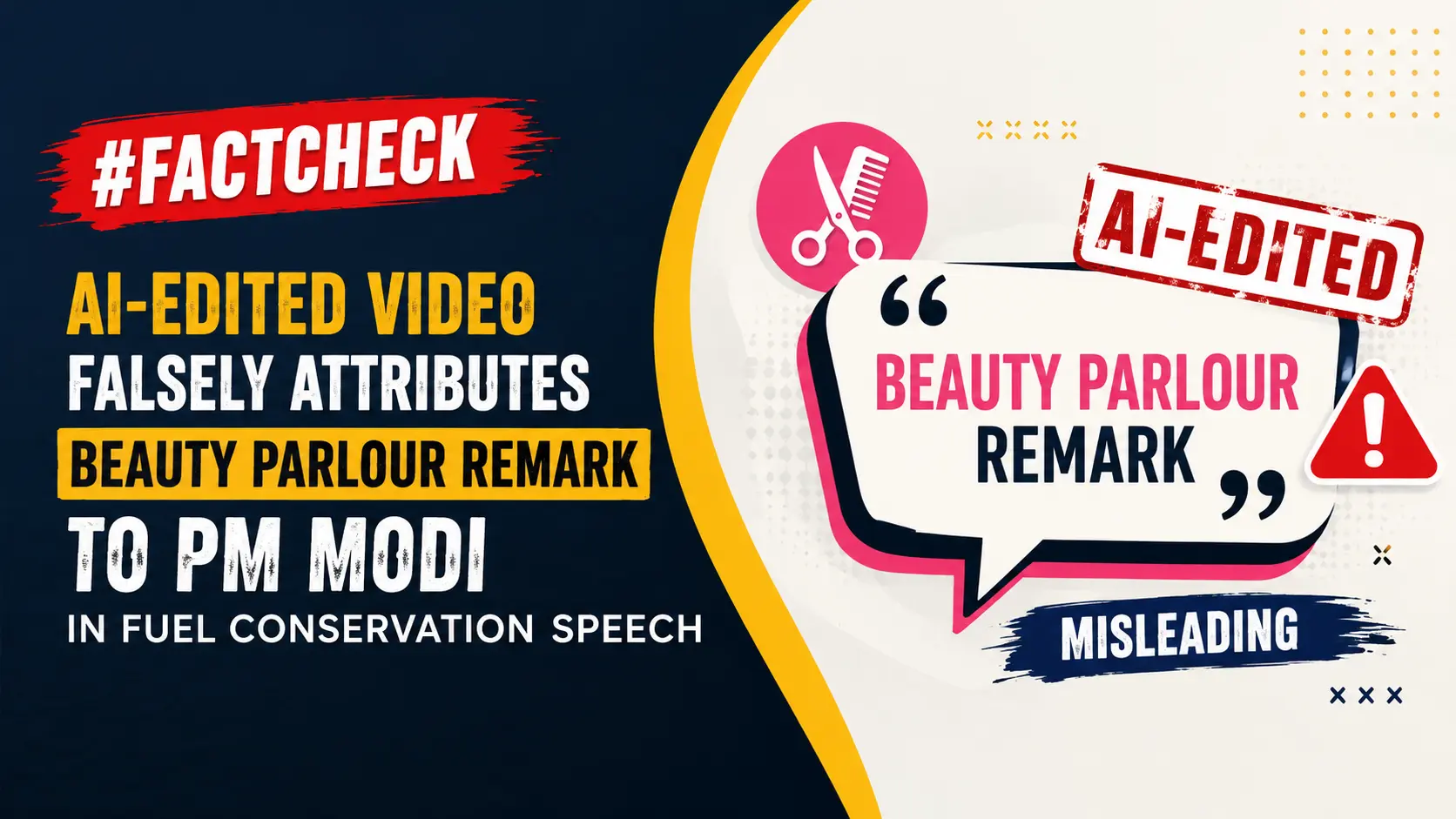
Executive Summary
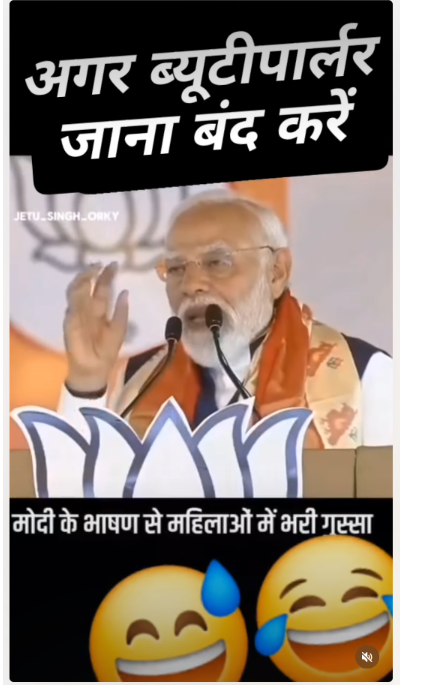
Amid ongoing tensions in West Asia, a video has been circulating on social media claiming that Prime Minister Narendra Modi urged women not to visit beauty parlours as part of an appeal related to fuel conservation. Users are widely sharing the clip as genuine. However, a fact-check by CyberPeace Research Wing has found the claim to be false. The research revealed that the original video, which discussed saving petrol, diesel and cooking gas, has been digitally edited using AI tools and shared with a misleading narrative.
Claim
An Instagram user shared the viral video on May 15, 2026, claiming that the Prime Minister advised women against visiting beauty parlours.
Fact Check
A keyword-based search on Google did not return any credible media reports supporting the viral claim. To verify the video, keyframes were extracted and run through reverse image search. The original footage was traced to the official YouTube channel of Prime Minister Narendra Modi, uploaded on May 10, 2026.
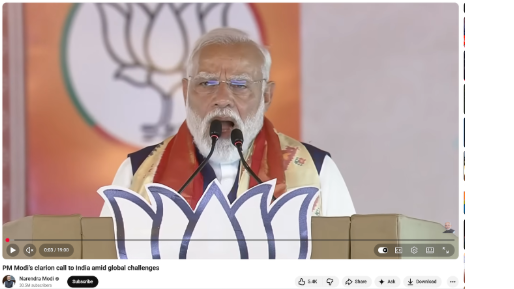
The video shows a rally held in Hyderabad, where the Prime Minister appealed to the public to save fuel by adopting work-from-home practices, promoting swadeshi goods, and refraining from purchasing gold for one year. However, nowhere in the full video is there any mention of advising women not to visit beauty parlours.
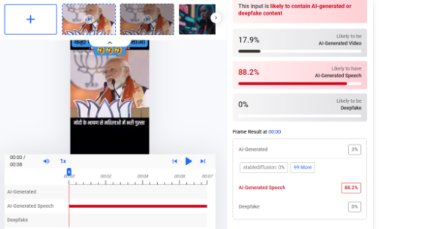
Further analysis also raised suspicion that the viral clip had been digitally altered using AI tools. The video was scanned using the HIVE Moderation AI detection tool, which indicated that it is approximately 88% likely to be AI-generated or manipulated.
Conclusion
The viral video is misleading. The original speech by Prime Minister Narendra Modi about conserving petrol, diesel and cooking gas has been edited using AI tools and circulated with a false claim targeting women visiting beauty parlours.
