
#FactCheck: AI-Generated Video Falsely Shared as Footage of Landslide in Nepal
Executive Summary
A video is being shared on social media showing a large amount of debris cascading down a mountain amid multi-storey buildings. The video is being shared with the claim that it shows a landslide incident in Nepal. CyberPeace Research found the viral claim to be false. Our research found that the viral video is AI-generated and is being shared with a misleading claim.
Claim:
A Facebook user shared the viral video on September 29, 2026, with the caption, “A horrifying scene of a mountain collapsing in Nepal.” The post link, archive link and screenshot are provided below.
https://x.com/ptravidwivedi/status/2104934750595219494

Fact Check
To verify the authenticity of the viral claim, we conducted a reverse image search using keyframes from the video. However, we did not find any credible media reports or other reliable sources related to the video during the search. Upon closely examining the viral video, we noticed several inconsistencies that raised suspicions that the video may be AI-generated.
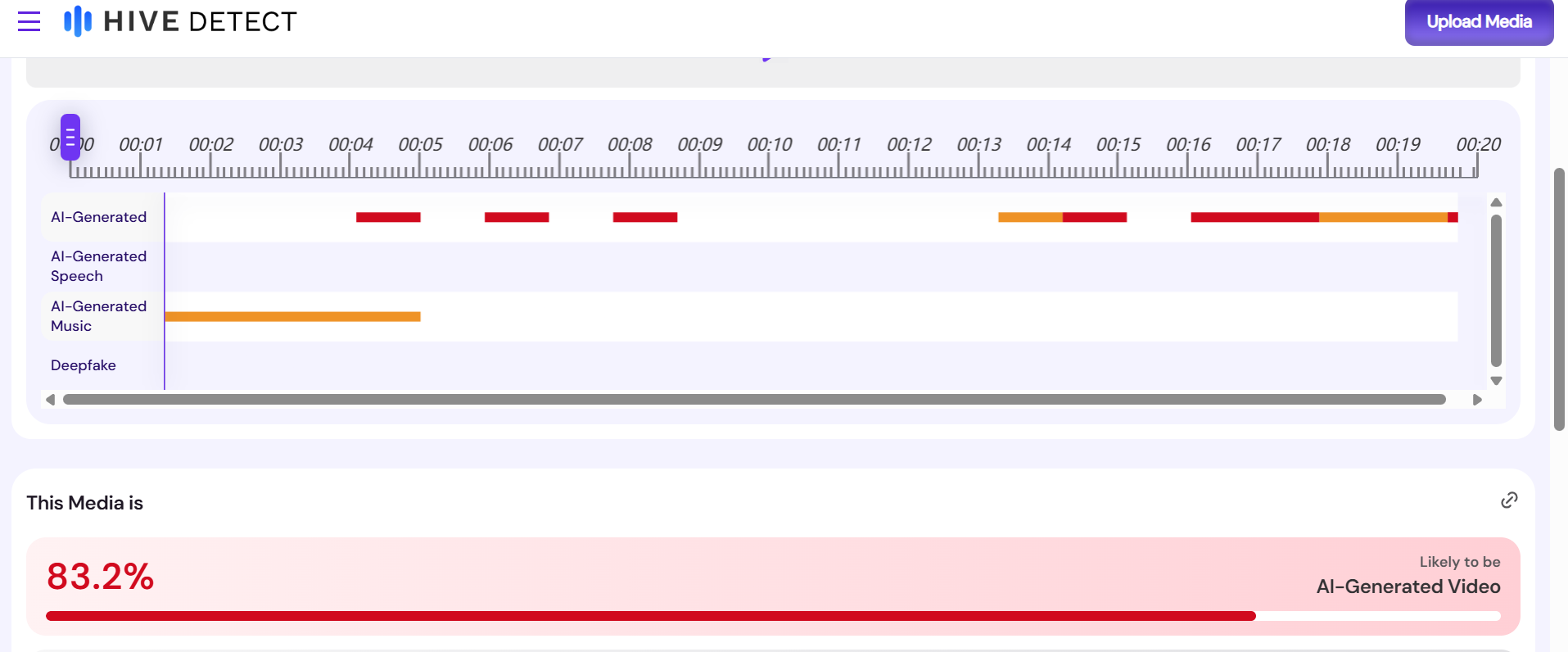
As part of the next step in our research, we scanned the video using the AI detection tool Hive Detect. According to the results, the viral video has an 83 per cent likelihood of being AI-generated.

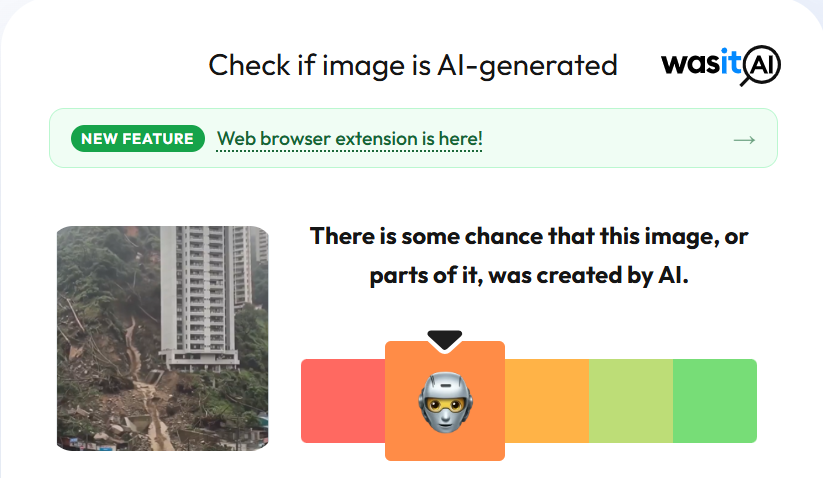
At the end of our research, we scanned the viral video using the AI detection tool WasIt AI. According to the results, the viral video was found to be AI-generated.

Conclusion
Our research found that the viral video is AI-generated and is being shared with a misleading claim.

Related Blogs

Executive Summary
Talks between the United States and Iran over a ceasefire reportedly held in Islamabad on Saturday ended without a resolution. Meanwhile, a video circulating on social media claims to show US troops returning home following a ceasefire in the Middle East conflict.
However, a research by the CyberPeace found the claim to be false. The viral video is not linked to any recent ceasefire. It actually dates back to March and shows the return of Iowa National Guard troops after months of deployment in the Middle East.
Claim
An X (formerly Twitter) user posted the video on April 7, 2026, claiming,“Another victory for Iran: American soldiers have started arriving home. After leaving the Middle East, American soldiers are saying, ‘Why did we fight for Israel? If Iran is talking about peace, we will also stand with them.’”

Fact Check
To verify the claim, we extracted keyframes from the viral video and conducted a reverse image search using Google Lens. This led us to posts by Newsradio 1040 WHO, which had shared the same footage on March 12 across Facebook and Instagram.


In its caption, the radio station stated that nearly 600 Iowa soldiers had returned home after a nine-month deployment in the Middle East as part of Operation Inherent Resolve. The segment, narrated by journalist Claire Burnett, explained that the soldiers belonged to the 2nd Brigade Combat Team, 34th Infantry Division, and had been deployed to Iraq and Syria. The footage was recorded at the 132nd Wing base of the Iowa Air National Guard in Des Moines.

For further confirmation, a March 12 report by KCCI 8 News also showed the same aircraft and troops, verifying the authenticity and timeline of the footage

Operation Inherent Resolve, launched in 2014, is a US-led campaign aimed at supporting local forces in the fight against the Islamic State (ISIS) and ensuring its lasting defeat.
https://www.kcci.com/article/iowans-welcome-national-guard-unit-home-from-deployment-in-middle-east/70729105

Conclusion
The viral claim is false and misleading. The video does not show US troops returning due to any recent ceasefire between the United States and Iran. Instead, it captures the routine homecoming of Iowa National Guard soldiers in March after completing a scheduled deployment in the Middle East.There is no evidence linking the footage to current geopolitical developments or any ceasefire agreement. The claim has been taken out of context and shared with a misleading narrative to create confusion around ongoing international events.

Introduction
Misinformation is, to its basic meaning, incorrect or misleading information, it may or may not include specific malicious intent and includes inaccurate, incomplete, misleading, or false information and selective or half-truths. The main challenges in dealing with misinformation are defining and distinguishing misinformation from legitimate content. This complexity arises due to the rapid evolution and propagation which information undergoes on the digital platforms. Additionally, balancing the fundamental right of freedom of speech and expression with content regulation by state actors poses a significant challenge. It requires careful consideration to avoid censorship while effectively combating harmful misinformation.
Acknowledging the severe consequences of misinformation and the critical need to combat misinformation, Bharatiya Nyaya Sanhita (BNS), 2023 has implemented key measures to address misinformation in India. These new provisions introduced under the new criminal laws in India penalise the deliberate creation, distribution, or publication of inaccurate information. Previously missing from the IPC, these sections offer an additional legal resource to counter the proliferation of falsehoods, complementing existing laws targeting the same issue.
Section 353 of the BNS on Statements Conducing to Public Mischief criminalises making, publishing, or circulating statements, false information, rumours, or reports, including through electronic means, with the intent or likelihood of causing various harmful outcomes.
This section thus brings misinformation into its ambit, since misinformation has been traditionally used to induce public fear or alarm that may lead to offences against the State or public tranquillity or inciting one class or community to commit offences against another. The section also penalizes the promotion of enmity, hatred, or ill will among different religious, racial, linguistic, or regional groups.
BNS also prescribes punishment of imprisonment for up to three years, a fine, or both for offences under section 353. Interestingly, a longer imprisonment of up to 5 years along with a fine has been prescribed to curb such offences in places of worship or during religious ceremonies. The only exception that may be availed under this section is granted to unsuspecting individuals who, believing the misinformation to be true, spread misinformation without any ill intent. However, this exception may not be as effective in curbing misinformation, since at the outset, the offence is hard to trace and has multiple pockets for individuals to seek protection without any mechanism to verify their intent.
The BNS also aims to regulate misinformation through Section 197(1)(d) on Imputations, assertions prejudicial to national integration. Under this provision, anyone who makes or publishes false or misleading information, whether it is in the form of spoken words, written, by signs, in visible representations, or through electronic communication, therefore, results in jeopardising the sovereignty, unity, integrity, or security of India is liable to face punishment in the form of imprisonment for up to three years, a fine, or both and if it occurs in a place of worship or during religious ceremonies, the quantum of punishment is increased to imprisonment for up to five years and may include a fine. Additionally, Section 212 (a) & (b) provides against furnishing false information. If a person who is legally obligated to provide information to a public servant, knowingly or reasonably believes that the information is false, and still furnishes it, they now face a punishment of six months imprisonment or a fine up to five thousand rupees or both. However, if the false information pertains to the commission or prevention of an offence, or the apprehension of an offender, the punishment increases to imprisonment for up to two years, a fine, or both.
Enforcement Mechanisms: CyberPeace Policy Wing Outlook
To ensure the effective enforcement of these provisions, coordination between the key stakeholders, i.e., the law enforcement agencies, digital platforms, and judicial oversight is essential. Law enforcement agencies must utilize technology such as data analytics and digital forensics for tracking and identifying the origins of false information. This technological capability is crucial for pinpointing the sources and preventing the further spread of misinformation. Simultaneously, digital platforms associated with misinformation content are required to implement robust monitoring and reporting mechanisms to detect and address the generated misleading content proactively. A supporting oversight by judicial bodies plays a critical role in ensuring that enforcement actions are conducted fairly and in line with legal standards. It helps maintain a balance between addressing misinformation and upholding fundamental rights such as freedom of speech. The success of the BNS in addressing these challenges will depend on the effective integration of these mechanisms and ongoing adaptation to the evolving digital landscape.
Resources:
- Bharatiya Nyaya Sanhita, 2023 https://www.mha.gov.in/sites/default/files/250883_english_01042024.pdf
- https://www.foxmandal.in/changes-brought-forth-by-the-bharatiya-nyaya-sanhita-2023/
- https://economictimes.indiatimes.com/news/india/spreading-fake-news-could-land-people-in-jail-for-three-years-under-new-bharatiya-nyaya-sanhita-bill/articleshow/102669105.cms?from=mdr
.webp)
Introduction
The digital ecosystem has undergone a profound transformation due to the rapid growth of artificial intelligence, especially through its generative applications. While this progress has introduced innovative technologies, it has also intensified the risks of deepfakes, misinformation, and identity theft. The Information Technology (Intermediary Guidelines and Digital Media Ethics Code) Amendment Rules, 2026, introduced by the Government of India, mark an important step toward stronger digital governance and greater oversight of online activities. These latest amendments establish new regulatory standards and represent India’s most comprehensive effort so far to address synthetically generated information, including AI created audio, video, and images that closely imitate reality.
Understanding the Core Shift: From Reactive to Proactive Regulation
The 2026 amendment establishes its main characteristic through its shift from a reactive compliance system to a proactive due diligence system. Intermediaries must now operate as active participants who take responsibility for detecting, marking and controlling dangerous material instead of functioning as neutral channels. The rules establish an official definition for stands for Synthetically Generated Information(SGI), which they protect through legal regulations, while they address issues such as impersonation scams, election manipulation and non-consensual deepfake content. The current transition represents a worldwide pattern that shows that governments are starting to make online platforms responsible for the material they display.
Key Provisions of the IT Amendment Rules, 2026
1. Mandatory Labelling of AI-Generated Content
Platforms must ensure that all AI-generated content is clearly labelled or watermarked to distinguish it from authentic media. Users must reveal their uploaded content's synthetic origin while platforms must confirm the information.
2. The 3-Hour Takedown Rule
The most contentious aspect of this regulation establishes new rules that require content removal to be processed within much shorter timeframes.:
- The government and courts grant three-hour time limits for removing unlawful content.
- The two-hour deadline applies to media that includes non-consensual intimate imagery.
The current time frame allows content removal within three hours, which represents a major decrease from the previous content removal time, which lasted between 24 and 36 hours, because online misinformation needs urgent attention.
3. Traceability and Metadata Requirements
The rules require AI-generated content to include both digital fingerprints and metadata, which enables traceability and accountability through their embedded digital fingerprints. The provision serves as an essential tool for law enforcement to investigate cases while it helps identify which parties generated harmful content.
4. Safe Harbour Conditionality
Intermediaries who do not meet the following three conditions risk losing their safe harbour protection through Section 79 of the IT Act:
- The first requirement demands that intermediaries must implement proper labelling.
- The second requirement demands that intermediaries must complete their takedown responsibilities within specific timeframes
- The third requirement demands that intermediaries must complete their due diligence tasks.
This development represents a major transition for digital platforms, which will face increased responsibility for their actions.
5. Strengthened Grievance Redressal
The amendment establishes two new requirements for platforms. The amendment requires platforms to create systems that operate at all times to monitor their compliance with regulations.
Significance: Why These Rules Matter
The 2026 amendments are significant for multiple reasons:
- The rules require labelling and rapid content removal, which helps to stop the viral dissemination of misleading information.
- The framework provides better identity protection, defamation defence and protection against non-consensual imagery.
- The new rules make intermediaries responsible for their own compliance failures.
- The regulation of AI-generated misinformation protects democratic processes during electoral periods and public discussions.
The rules demonstrate India's goal to establish international standards for AI governance and digital responsibility.
Challenges and Concerns
The amendments present key issues that exist despite their positive aspects:
- The process of removing content at high speed creates risks for legitimate expression because safeguards need to be established through careful planning.
- The technical and infrastructural requirements governing compliance create financial burdens for smaller platforms that operate as intermediaries.
The existing challenges demonstrate the necessity for a solution that protects both human rights and security needs.
Conclusion
The IT Amendment Rules, 2026, establish a critical turning point for India's progress toward digital governance. The framework aims to establish a more secure digital environment through its solution of AI-generated content and deepfake detection problems, which create transparency and accountability issues. The rules will achieve their goals through proper implementation, which requires creating quick enforcement methods that protect both legal processes and free speech rights. The ongoing development of AI technology requires regulatory systems to keep changing while including all citizens and upholding democratic principles.
References
- https://vajiramandravi.com/current-affairs/it-rules-amendment-2026
- https://indianexpress.com/article/legal-news/indias-new-3-hour-deepfake-removal-rule-experts-urge-strict-compliance-10528122
- https://timesofindia.indiatimes.com/technology/tech-news/governments-new-it-rules-make-ai-content-labelling-mandatory-give-google-youtube-instagram-and-other-platforms-3-hours-for-takedowns/articleshow/128157496.cms
- https://www.drishtiias.com/daily-updates/daily-news-analysis/information-technology-amendment-rules-2026
- https://visionias.in/current-affairs/news-today/2026-02-11/science-and-technology/government-notified-the-information-technology-intermediary-guidelines-and-digital-media-ethics-code-amendment-rules-2026
