
#FactCheck: AI-Generated Image Falsely Links Hardeep Puri to Jeffrey Epstein
Executive Summary
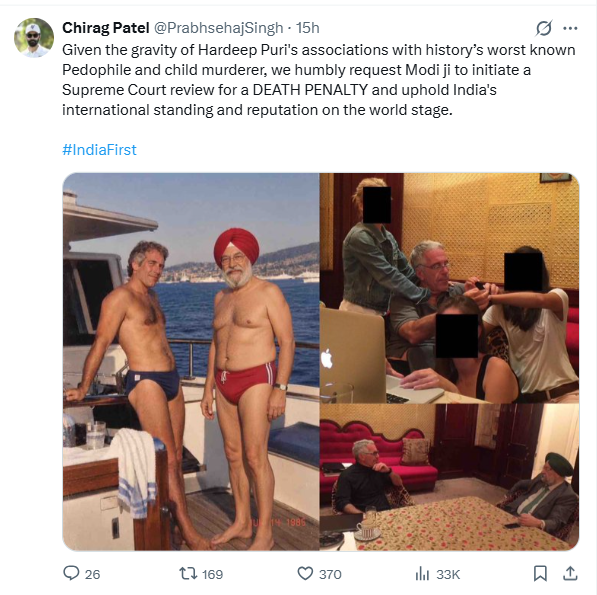
A photo is being shared on social media with the claim that it shows Union Minister Hardeep Puri alongside convicted sex offender Jeffrey Epstein. The post also claims that the image establishes an association between the two. CyberPeace Research found that the viral image is not authentic but AI-generated and is being shared with a misleading claim.
Claim
An X user shared the viral image with the following caption: “Given the gravity of Hardeep Puri's associations with history’s worst known pedophile and child murderer, we humbly request Modi ji to initiate a Supreme Court review for a DEATH PENALTY and uphold India's international standing and reputation on the world stage.”
https://x.com/PrabhsehajSingh/status/2113284787452657974?s=20
Fact Check
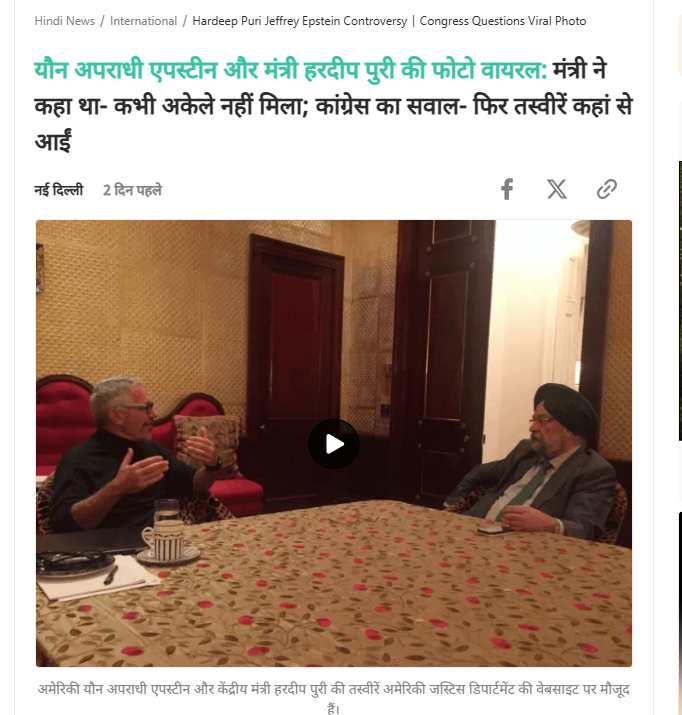
To verify the viral claim, we searched Google using relevant keywords. During the search, we found a report published by Dainik Bhaskar that featured photographs of convicted American sex offender Jeffrey Epstein and Union Minister Hardeep Puri. However, the photographs included in the report were completely different from the viral image.
As the next step in our research, we examined the viral image closely and suspected that it was AI-generated. We then scanned the image using the AI detection tool Hive Moderation. According to the results, the viral image is 99 per cent likely to be AI-generated.

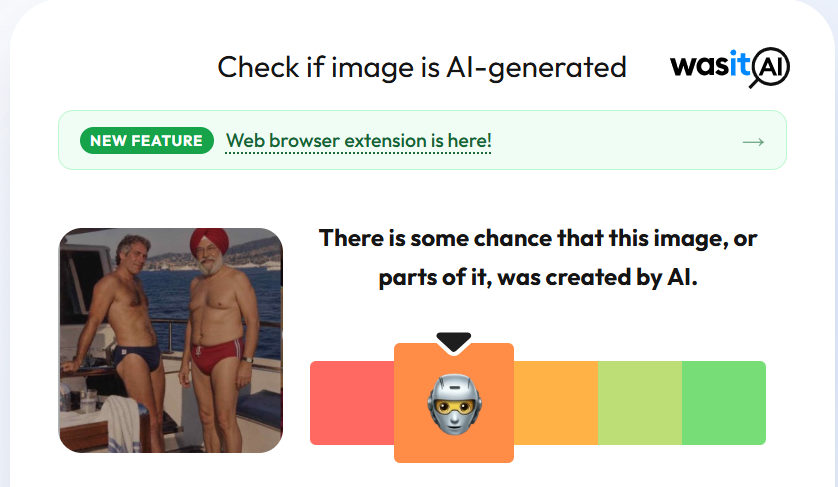
We also scanned the image using another AI detection tool, Wasit AI, which indicated that the viral image is AI-generated.
Conclusion
Our research found that the viral image is not authentic but AI-generated and is being shared with a misleading claim.

Related Blogs

Introduction
Rajeev Chandrasekhar, the Union minister of state for information technology (IT), said that the Global Partnership on Artificial Intelligence (GPAI) Summit, which brings together 29 member governments, including the European Union, announced on 13th December 2023 that the New Delhi Declaration had been adopted. The proclamation committed to developing AI applications for medical treatment and agribusiness jointly and taking the needs of the Global South into account when developing AI.
In addition, signing countries committed to leveraging the GPAI infrastructure to establish a worldwide structure for AI safety and trust, as well as to make AI advantages and approaches accessible to all. In order to complete the recommended structure in six months, India also submitted a proposal to host the GPAI Global Governance Summit.
“The New Delhi Declaration, which aims to place GPAI at the forefront of defining the future of AI in terms of both development and building cooperative AI across the partner states, has been unanimously endorsed by 29 GPAI member countries. Nations have come to an agreement to develop AI applications in healthcare, agriculture, and numerous other fields that affect all of our nations and citizens,” Chandrasekhar stated.
The statement highlights GPAI's critical role in tackling modern AI difficulties, such as generative AI, through submitted AI projects meant to maximize benefits and minimize related risks while solving community problems and worldwide difficulties.
GPAI
Global Partnership on Artificial Intelligence (GPAI) is an organisation of 29 countries from the Americas (North and South), Europe and Asia. It has important players such as the US, France, Japan and India, but it excludes China. The previous meeting took place in Japan. In 2024, India will preside over GPAI.
In order to promote and steer the responsible implementation of artificial intelligence based on human rights, multiculturalism, gender equality, innovation, economic growth, the surroundings, and social impact, this forum was established in 2020. Its goal is to bring together elected officials and experts in order to make tangible contributions to the 2030 Agenda and the UN Sustainable Development Goals (SDGs).
Given the quick and significant advancements in artificial intelligence over the previous year, the meeting in New Delhi attracted particular attention. They have sparked worries about its misuse as well as enthusiasm about its possible advantages.
The Summit
The G20 summit, which India hosted in September 2023, provided an atmosphere for the discussions at the GPAI summit. There, participants of this esteemed worldwide economic conference came to an agreement on how to safely use AI for "Good and for All."
In order to safeguard people's freedoms and security, member governments pledged to address AI-related issues "in a responsible, inclusive, and human-centric manner."
The key tactic devised is to distribute AI's advantages fairly while reducing its hazards. Promoting international collaboration and discourse on global management for AI is the first step toward accomplishing this goal.
A major milestone in that approach was the GPAI summit.
The conversation on AI was started by India's Prime Minister Narendra Modi, who is undoubtedly one of the most tech-aware and tech-conscious international authorities.
He noted that every system needs to be revolutionary, honest, and trustworthy in order to be sustained.
"There is no doubt that AI is transformative, but it is up to us to make it more and more transparent." He continued by saying that when associated social, ethical, and financial concerns are appropriately addressed, trust will increase.
After extensive discussions, the summit attendees decided on a strategy to establish global collaboration on a number of AI-related issues. The proclamation pledged to place GPAI at the leading edge of defining AI in terms of creativity and cooperation while expanding possibilities for AI in healthcare, agriculture, and other areas of interest, according to Union Minister Rajeev Chandrasekhar.
There was an open discussion of a number of issues, including disinformation, joblessness and bias, protection of sensitive information, and violations of human rights. The participants reaffirmed their dedication to fostering dependable, safe, and secure AI within their respective domains.
Concerns raised by AI
- The issue of legislation comes first. There are now three methods in use. In order to best promote inventiveness, the UK government takes a "less is more" approach to regulation. Conversely, the European Union (EU) is taking a strong stance, planning to propose a new Artificial Intelligence Act that might categorize AI 'in accordance with use-case situations based essentially on the degree of interference and vulnerability'.
- Second, analysts say that India has the potential to lead the world in discussions about AI. For example, India has an advantage when it comes to AI discussions because of its personnel, educational system, technological stack, and populace, according to Markham Erickson of Google's Centers for Excellence. However, he voiced the hope that Indian regulations will be “interoperable” with those of other countries in order to maximize the benefits for small and medium-sized enterprises in the nation.
- Third, there is a general fear about how AI will affect jobs, just as there was in the early years of the Internet's development. Most people appear to agree that while many jobs won't be impacted, certain jobs might be lost as artificial intelligence develops and gets smarter. According to Erickson, the solution to the new circumstances is to create "a more AI-skilled workforce."
- Finally, a major concern relates to deepfakes defined as 'digital media, video, audio and images, edited and manipulated, using Artificial Intelligence (AI).'
Need for AI Strategy in Commercial Businesses
Firstly, astute or mobile corporate executives such as Shailendra Singh, managing director of Peak XV Partners, feel that all organisations must now have 'an AI strategy'.
Second, it is now impossible to isolate the influence of digital technology and artificial intelligence from the study of international relations (IR), foreign policy, and diplomacy. Academics have been contemplating and penning works of "the geopolitics of AI."
Combat Strategies
"We will talk about how to combine OECD capabilities to maximize our capacity to develop the finest approaches to the application and management of AI for the benefit of our people. The French Minister of Digital Transition and Telecommunications", Jean-Noël Barrot, informed reporters.
Vice-Minister of International Affairs for Japan's Ministry of Internal Affairs and Communications Hiroshi Yoshida stated, "We particularly think GPAI should be more inclusive so that we encourage more developing countries to join." Mr Chandrasekhar stated, "Inclusion of lower and middle-income countries is absolutely core to the GPAI mission," and added that Senegal has become a member of the steering group.
India's role in integrating agribusiness into the AI agenda was covered in a paragraph. The proclamation states, "We embrace the use of AI innovation in supporting sustainable agriculture as a new thematic priority for GPAI."
Conclusion
The New Delhi Declaration, which was adopted at the GPAI Summit, highlights the cooperative determination of 29 member nations to use AI for the benefit of all people. GPAI, which will be led by India in 2024, intends to influence AI research with an emphasis on healthcare, agriculture, and resolving ethical issues. Prime Minister Narendra Modi stressed the need to use AI responsibly and build clarity and confidence. Legislative concerns, India's potential for leadership, employment effects, and the difficulty of deepfakes were noted. The conference emphasized the importance of having an AI strategy in enterprises and covered battle tactics, with a focus on GPAI's objective, which includes tolerance for developing nations. Taken as a whole, the summit presents GPAI as an essential tool for navigating the rapidly changing AI field.
References
- https://www.thehindu.com/news/national/ai-summit-adopts-new-delhi-declaration-on-inclusiveness-collaboration/article67635398.ece
- https://www.livemint.com/news/india/gpai-meet-adopts-new-delhi-ai-declaration-11702487342900.html
- https://startup.outlookindia.com/sector/policy/global-partnership-on-ai-member-nations-unanimously-adopt-new-delhi-declaration-news-10065
- https://gpai.ai/

Introduction
The Indian healthcare sector has been transforming remarkably. This is mainly due to the development of emerging technologies such as AI and IoT. The rapid adoption of technology in healthcare delivery such as AI and IoT integration along with telemedicine, digital health solutions, and Electronic Medical Records (EMR) have enhanced the efficacy of hospitals, driving growth. The integration of AI and IoT devices in healthcare can improve patient care, health record management, and telemedicine and reshape the medical landscape as we know it. However, their implementation must be safe, with robust security and ethical safeguards in place.
The Transformative Power of AI and IoT in Revolutionising Healthcare
IoT devices for healthcare such as smartwatches, wearable patches, and ingestive sensors are equipped with sensors. These devices take physiological parameters in real-time, including heart rate, blood pressure, glucose level, etc. This can be forwarded automatically from these wearables to healthcare providers and EHR systems. Real-time patient health data enable doctors to monitor progress and intervene when needed.
The sheer volume of data generated by IoT healthcare devices opens avenues for applying AI. AI and ML algorithms can analyse patient data for patterns that further provide diagnostic clues and predict adverse events before they occur. A combination of AI and IoT opens avenues for proactive and personalised medicine tailored to specific patient profiles. This amalgamation can be a bridge between healthcare accessibility and quality. And, especially in rural and underserved areas, it can help receive timely and effective medical consultations, significantly improving healthcare outcomes. Moreover, the integration of AI-powered chatbots and virtual health assistants is enhancing patient engagement by providing instant medical advice and appointment scheduling.
CyberPeace Takeaway, the Challenges and the Way Forward
Some of the main challenges associated with integrating AI and IoT in healthcare include cybersecurity due to data privacy concerns, lack of interoperability, and skill gaps in implementation. Addressing these requires enhanced measures or specific policies, such as:
- Promoting collaborations among governments, regulators, industry, and academia to foster a healthcare innovation ecosystem such as public-private partnerships and funding opportunities to drive collaborative advancements in the sector. Additionally, engaging in capacity-building programs to upskill professionals.
- Infrastructural development, including startup support for scalable AI and IoT solutions. Engaging in creating healthcare-specific cybersecurity enhancements to protect sensitive data. According to a 2024 report by Check Point Software Technologies, the Indian healthcare sector has experienced an average of 6,935 cyberattacks per week, compared to 1,821 attacks per organisation globally in 2024.
Conclusion
The Deloitte survey highlights that on average hospitals spend 8–10% of their IT budget on cybersecurity techniques, such as hiring professionals and acquiring tools to minimise cyber-attacks to the maximum extent. Additionally, this spending is likely to increase to 12-15 % in the next two years moving towards proactive measures for cybersecurity.
The policy frameworks and initiatives are also carried out by the government. One of the Indian government's ways of driving innovation in AI and IoT in healthcare is through initiatives under the National Digital Health Mission (NDHM), the National Health Policy and the Digital India Initiative.
Though the challenges presented by data privacy and cyber security persist, the strong policies, public-private collaborations, capacity-building initiatives and the evolving startup ecosystem carry AI and IoT’s potential forward from the thoughtful merging of innovative health technologies, delivery models, and analytics. If the integration complexities are creatively tackled, these could profoundly improve patient outcomes while bending the healthcare cost curve.
References
- https://www.ndtv.com/business-news/indian-healthcare-sector-faced-6-935-cyberattacks-per-week-in-last-6-months-report-5989240
- https://www.businesstoday.in/technology/news/story/meity-nasscom-coe-collaborates-with-start-ups-to-enhance-healthcare-with-ai-iot-458739-2024-12-27
- https://www2.deloitte.com/content/dam/Deloitte/in/Documents/risk/in-ra-deloitte-dsci-hospital-report-noexp.pdf
- https://medium.com/@shibilahammad/the-transformative-potential-of-iot-and-ai-in-healthcare-78a8c7b4eca1
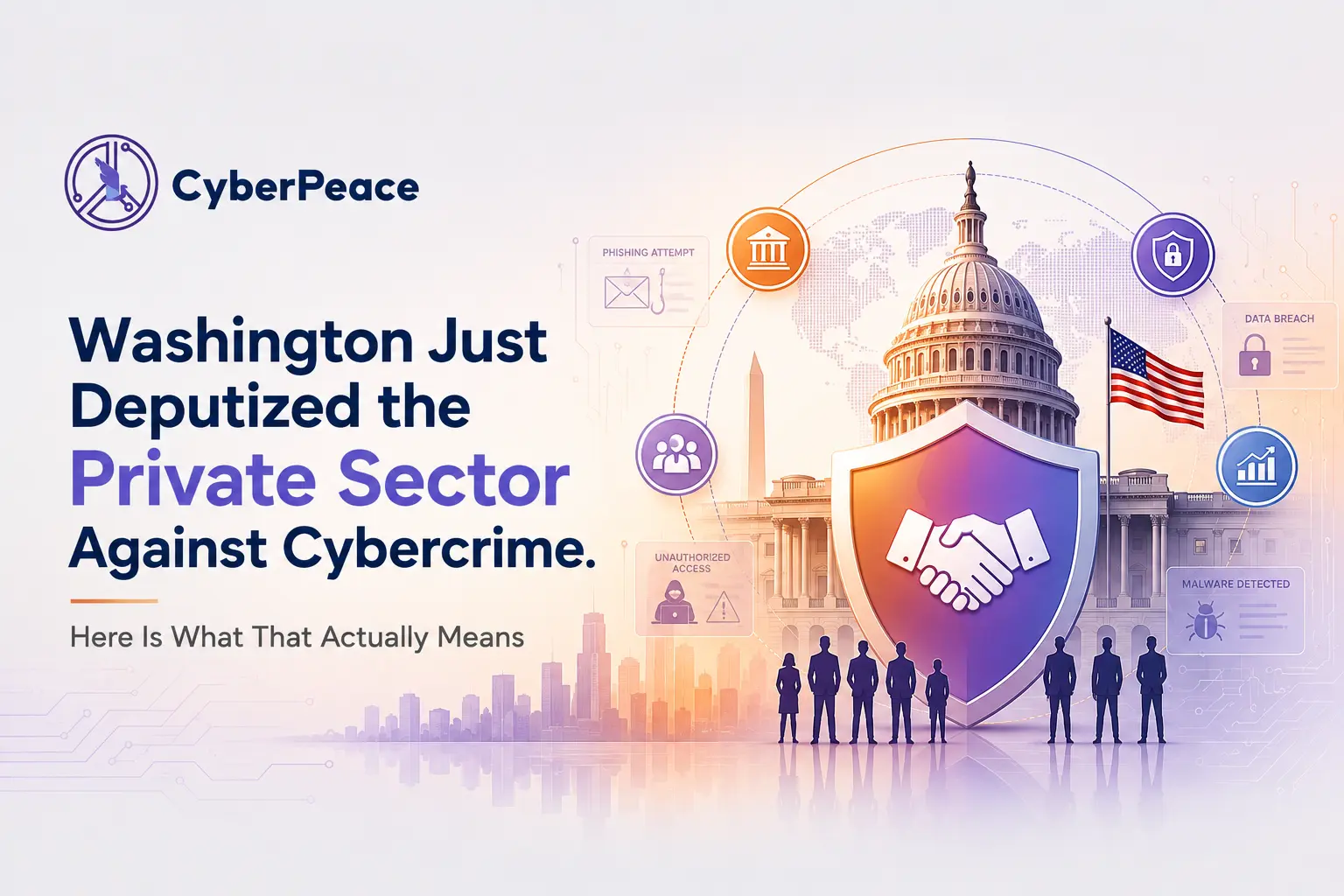
On 12 August 2026, President Donald Trump signed a National Security Presidential Memorandum titled Expanding Capabilities to Combat Transnational Cyber Enabled Crime. Stripped of its bureaucratic packaging, the document does something American law has resisted for three decades: it lets private companies, under close federal supervision, break into the systems of foreign criminal networks and, in some cases, disrupt or damage them.
That is a genuinely large policy shift, even if the memorandum itself is careful, almost defensive, about how it frames the shift. Understanding why requires separating what the text actually authorizes from the "hack back" headline that has attached itself to the story within days of signing.
The problem the memo says it is solving
The White House frames this as a response to scale, not ideology. Americans reported losing more than 20.8 billion dollars to cyber enabled crime in 2025, a sharp jump from the roughly 12.5 billion dollar figure cited when the administration's earlier March 2026 executive order on cybercrime, fraud, and predatory schemes was signed. Ransomware, phishing, financial fraud, sextortion, and impersonation scams sit at the center of that number, and the administration's own supporting material points to a grim detail buried in the numbers: one in seven young people who experienced sextortion as a minor reported harming themselves as a result.
Those crimes, the memorandum argues, are increasingly the work of organized, transnational groups operating from jurisdictions the FBI simply cannot reach. Domestic law enforcement, built for domestic crime, is structurally mismatched to a threat that lives across borders and inside encrypted infrastructure. The administration's answer is to formally recruit the resource it says is best positioned to close that gap: the American cybersecurity industry itself, which the memo describes as "the most innovative and technologically advanced in the world."
What the Program actually authorizes
The memorandum directs the National Coordination Center, a body first stood up under a 2025 executive order, to build a formal Program through which vetted Participating Companies can conduct two categories of activity against foreign Cyber Enabled Transnational Criminal Organizations, defined in the text as CE TCOs.
Cyber Surveillance Operations cover unauthorized access to a target's systems for the primary purpose of collecting information or intelligence, undertaken with the intent to remain undetected. Cyber Effects Operations go further: manipulating, disrupting, denying, degrading, or destroying information systems, the infrastructure those systems control, or the data resident on them.
Crucially, CE TCOs are defined narrowly. A foreign group only counts if it targets the US government, US persons, or US interests, and it must not be an institutional arm of a foreign state or wholly directed by one. The memo builds in a presumption of innocence at the state level too: a group is assumed not to be state controlled unless clear intelligence establishes otherwise. That distinction matters enormously, because it is the line meant to separate this Program from anything resembling private warfare against a nation state.
No operation happens unilaterally. Every proposed action must be approved in writing by two Program Executive Directors, one designated by the Attorney General and one by the Secretary of Homeland Security, coordinating with each other before signing off. Participating Companies must pass what the memo calls rigorous vetting, sign contractual agreements with DOJ or DHS, and in many cases post a bond or escrow of at least one million dollars, forfeited if they breach their agreement. Within 60 days of the memo's signing, the Program Executive Directors must publish detailed operating procedures covering everything from target adjudication to what happens if an operation accidentally hits a US person's system, in which case the company must stop, run minimization procedures, and immediately notify the Center.
There is also a hard ceiling built into the design. Operations expected to cause loss of life, serious injury, or conduct that would rise to the level of a use of force or armed attack under international law, termed Critical Outcomes in the text, cannot be approved by the Program Executive Directors at all. That ceiling is the memo's clearest attempt to keep this inside the bounds of law enforcement rather than sliding into something closer to conflict.
Multiple law firms tracking the rollout, including Wiley, have been explicit on one point worth repeating because so much coverage has blurred it: this is not a green light for companies to hack back on their own initiative. Every operation remains, on paper, an act of the federal government, merely executed through a contracted private hand.
Why experts are not popping champagne
Legal caution has not stopped a wave of professional anxiety. Cyber policy veterans interviewed by outlets like CyberScoop describe the memo as a genuine philosophical break in how Washington thinks about offense in cyberspace, and the debate that followed split fairly evenly between cautious optimism and open alarm.
The core worry, echoed across nearly every serious critique, is attribution. Cyber operations are hard to trace precisely because criminals exploit shared infrastructure, proxies, and compromised third party systems to hide, and that same fog does not lift just because a government contract sits behind the operator. A former senior CISA official, Michael Garcia, put the risk plainly: pressure to attribute quickly could push companies toward lower certainty judgments about who they are actually striking, with a realistic chance of hitting the wrong server, or worse, infrastructure tied to a foreign government rather than a criminal gang. A former Cyber Command official was blunter still, describing parts of the memo on social media as a structure that could reward companies for manufacturing billable threats rather than resolving them efficiently.
Paul Rosenzweig, a former DHS policy official, raised a separate and arguably more durable problem: jurisdiction. Whatever this memo authorizes under American law, the systems being accessed usually sit inside someone else's sovereign territory, governed by that country's own criminal statutes. Washington cannot legislate away a foreign hacking law simply by calling the American company that broke it a Participating Company.
None of this makes the memo indefensible. Supporters point out, correctly, that the private sector already does enormous amounts of active defense and threat disruption work informally, through botnet takedown litigation and coordinated infrastructure seizures, and that formalizing federal oversight over that activity is arguably safer than the current improvisation. The honest position, and probably the fair one, is that the memo trades one set of risks for another, and which set turns out worse will depend entirely on the operating procedures due inside sixty days, procedures the public has not yet seen.
CyberPeace Insights: what this means beyond America's borders
A significant share of the CE-TCO activity this memo is built to target, the ransomware crews, romance investment fraud operations, and sextortion rings running out of Southeast Asia, does not victimize Americans in isolation. The scam compounds clustered along the Myanmar, Cambodia, and Laos borders, repeatedly raided over the past two years, have held thousands of trafficked workers of dozens of nationalities, Indians consistently among the largest groups rescued, alongside Chinese, Filipino, and Malaysian nationals. India has run its own repatriation efforts out of Mae Sot in Thailand, bringing citizens home several hundred at a time, and has built its own institutional response to this threat through the Indian Cyber Crime Coordination Centre, which coordinates cybercrime enforcement across states and increasingly across borders.
That shared exposure gives India and the United States real common ground here. The criminal infrastructure this American Program is designed to disrupt is, in significant part, the same infrastructure that has trafficked and defrauded Indian citizens, which gives New Delhi genuine reason to watch this experiment closely and constructively. At the same time, the Program's underlying model, private companies conducting cross-border operations under one nation's legal authorization, is a genuinely new template in international cyber governance, and how it performs over its first year will likely shape how other major digital economies, India included, think about calibrating their own frameworks for public-private cooperation against transnational cybercrime. India and other nations should closely watch whether this becomes a template worth adapting or a cautionary tale worth avoiding.
It is pertinent to note that Justice and Homeland Security departments have 60 days to write detailed operating procedures covering everything from a target-vetting rubric to a classified operational workflow and 180 days to deliver the first status report to the White House.
References
- The White House. "Expanding Capabilities to Combat Transnational Cyber Enabled Crime." 12 August 2026. https://www.whitehouse.gov/presidential-actions/2026/08/expanding-capabilities-to-combat-transnational-cyber-enabled-crime/
- Wiley Rein LLP. "Navigating the New Presidential Memorandum on Transnational Cyber Enabled Crime." August 2026. https://www.wiley.law/alert-Navigating-the-New-Presidential-Memorandum-on-Transnational-Cyber-Enabled-Crime
- SecureWorld. "Trump Memo Lets Private Firms Hack Back at Cybercriminals." August 2026. https://www.secureworld.io/industry-news/trump-authorizes-private-firms-offensive-cyber-operations
- CyberScoop. "A bold new strategy or a dangerous precedent? Experts are divided on Trump's memo." August 2026. https://cyberscoop.com/private-sector-hacking-presidential-memo-cybersecurity/
- CyberScoop. "Trump turns to private sector in offensive hacking operations memo." August 2026. https://cyberscoop.com/trump-memo-private-sector-offensive-hacking/
- CNN Politics. "Cyber privateers: Trump issues order allowing US companies to hack overseas groups under certain conditions." August 2026. https://www.cnn.com/2026/08/13/politics/cyber-privateers-trump-order-overseas-groups-hacking
- NPR. "Trump administration wants to allow companies to hack foreign cybercriminals." August 2026. https://www.npr.org/2026/08/15/nx-s1-5930311/trump-companies-hack-foreign-cybercriminals
- The Next Web. "President Donald Trump signs memo letting US agencies hack transnational crime groups abroad." August 2026. https://thenextweb.com/news/trump-cyber-memo-transnational-crime
- Machine News. "Security firms hit back at Trump's call to hack back against international crime gangs." August 2026. https://www.machine.news/security-firms-hit-back-at-trumps-call-to-hack-back-against-international-crime-gangs/
- Lawfare. "Trump Admin Cyber Strategy Centers Private Sector in Offensive Cyber Operations." March 2026. https://www.lawfaremedia.org/article/trump-admin-cyber-strategy-centers-private-sector-in-offensive-cyber-operations
- Lawfare. "Partners or Provocateurs? Private Sector Involvement in Offensive Cyber Operations." July 2025. https://www.lawfaremedia.org/article/partners-or-provocateurs--private-sector-involvement-in-offensive-cyber-operations
- Global Indian Network. "Pig Butchering Scams in India: The Dark Intersection of Social Media, AI, and Emotional Manipulation." January 2026. https://globalindiannetwork.com/pig-butchering-scams-in-india/
- The Tribune. "India brings home scammed 549 nationals from Myanmar in 2 days." 2025. https://www.tribuneindia.com/news/india/india-brings-home-scammed-549-nationals-from-myanmar-in-2-days
- Malay Mail. "India to repatriate 500 nationals fleeing Myanmar's cyber scam hub, says Thai PM." October 2025. https://www.malaymail.com/amp/news/world/2025/10/29/india-to-repatriate-500-nationals-fleeing-myanmars-cyber-scam-hub-says-thai-pm/196399
- NBC News. "260 foreigners rescued from virtual slavery in Myanmar's online scam centers are being repatriated." 2025. https://www.nbcnews.com/news/world/260-foreigners-rescued-virtual-slavery-myanmars-online-scam-centers-ar-rcna192180
- CyberPeace Foundation. "About Us." https://cyberpeace.org/about-us
Contributors
- Maj. Vineet Kumar, Founder & Global President, CyberPeace
- Mr. Neeraj Soni, Senior Research Analyst, Policy & Advocacy, CyberPeace
List of Abbreviations
- CE‑TCO — Cyber Enabled Transnational Criminal Organization
- DOJ — Department of Justice
- DHS — Department of Homeland Security
- FBI — Federal Bureau of Investigation
- CISA — Cybersecurity and Infrastructure Security Agency
- I4C — Indian Cyber Crime Coordination Centre
- US — United States
- IT — Information Technology
