
#FactCheck: AI-generated audio falsely attributed to Shah Rukh Khan in video claiming he reprimanded Saudi Arabia over Baljinder Singh’s death sentence
Executive Summary
A video is being shared on social media with the claim that actor Shah Rukh Khan reprimanded Saudi Arabia over the death sentence awarded to Baljinder Singh.In the viral video, Shah Rukh Khan is purportedly heard saying, “Our simple and innocent brother Baljinder Singh, a resident of Sujanpur in Punjab’s Pathankot district, has been sentenced to death in Saudi Arabia after being falsely implicated in a drug case as part of a deep conspiracy. But stay strong, my brother.
Nothing will happen to you. I will definitely save you. Your brother is alive, and I swear that I will not let you die alone on that dreaded noose. Instead, I will put all my strength on the line and risk my life to pull you out of that hellish prison and bring you safely back to the soil of Punjab and the land of India.”
CyberPeace Research Wing’s research found the claim to be false. Our research found that the audio used in the viral video is AI-generated.
Claim:
A video is being shared on social media with the claim that actor Shah Rukh Khan reprimanded Saudi Arabia over the death sentence awarded to Baljinder Singh.
https://www.facebook.com/reel/1491107586179716
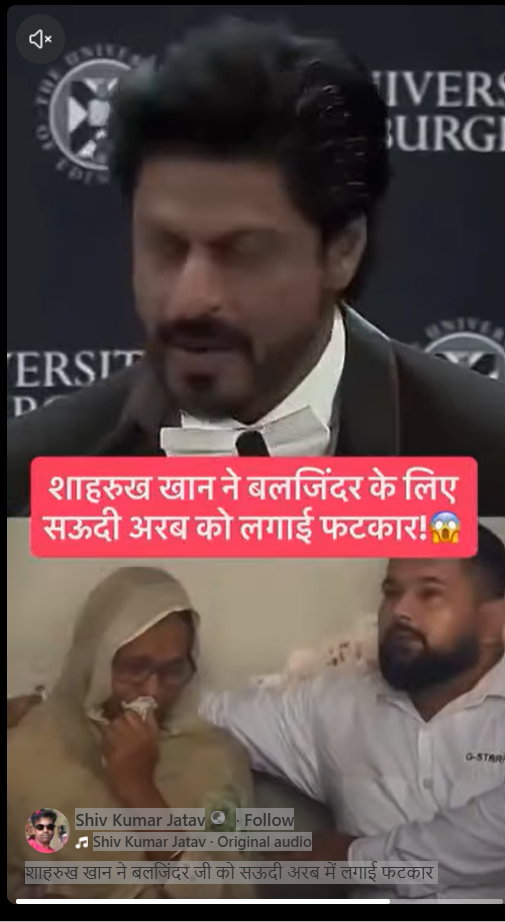
Fact Check
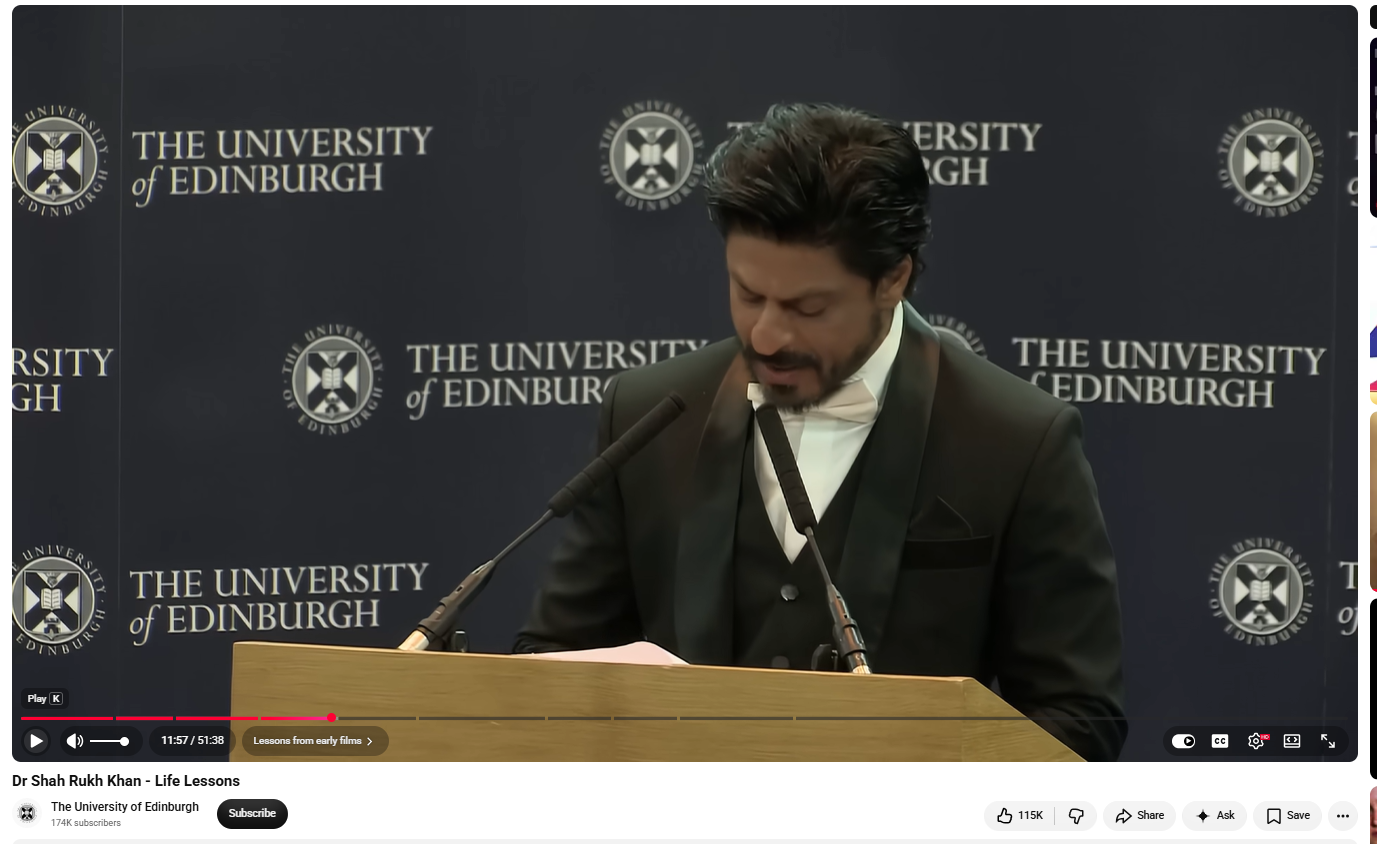
To verify the claim that Shah Rukh Khan reprimanded Saudi Arabia over the death sentence awarded to Baljinder Singh, we first conducted a Google search using relevant keywords. During the search, we did not find any information related to the viral claim in any credible media report.A reverse image search of the keyframes from the video led us to a video uploaded on The University of Edinburgh’s YouTube account on October 16, 2015, which contains the same segment seen in the viral clip. Notably, the background in the original video is identical to that seen in the viral clip.
In the original video, Shah Rukh Khan can be seen speaking about “life lessons”. During the event, he was conferred an honorary doctorate by the University of Edinburgh. In his address, he shared several unique lessons about life through some of his popular film characters. Shah Rukh Khan spoke about the importance of embracing one’s individuality, while combining humour with self-reflection. He also spoke about facing one’s fears and maintaining self-confidence amid challenges. Sharing anecdotes from his journey in films, Shah Rukh Khan explained how different characters had taught him to look at life from new perspectives.However, he makes no mention of Baljinder Singh anywhere in the video.
https://www.youtube.com/watch?v=VnnXAiTOLbo
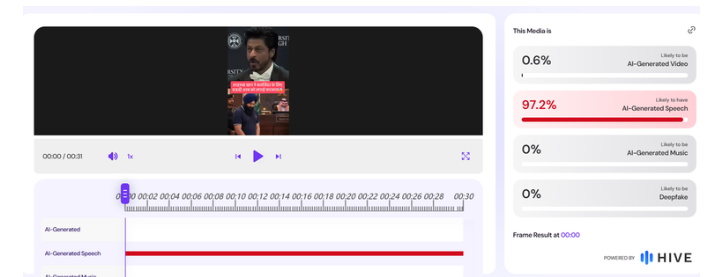
We then checked the viral video using Hive Detect, an AI detection tool. The tool’s analysis indicated that the voice of Shah Rukh Khan in the video was AI-generated, with a 97.2 per cent probability.
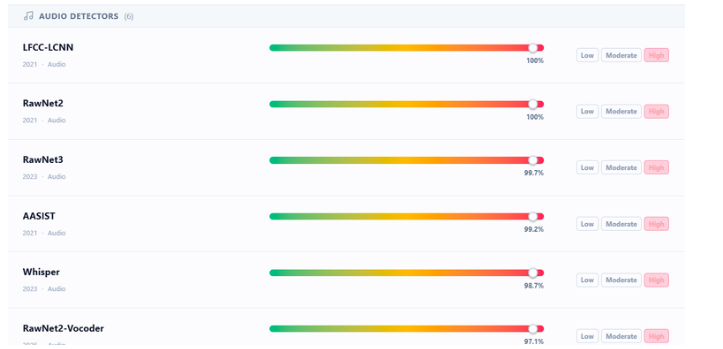
Additionally, six detectors on another AI detection tool, Deepfake-O-Meter, identified Shah Rukh Khan’s voice in the video as highly likely to be AI-generated.
Conclusion
The evidence gathered during our research makes it clear that the claim that Shah Rukh Khan reprimanded Saudi Arabia over the death sentence awarded to Baljinder Singh is false. The audio of Shah Rukh Khan in the viral video is AI-generated.

Related Blogs
Executive Summary
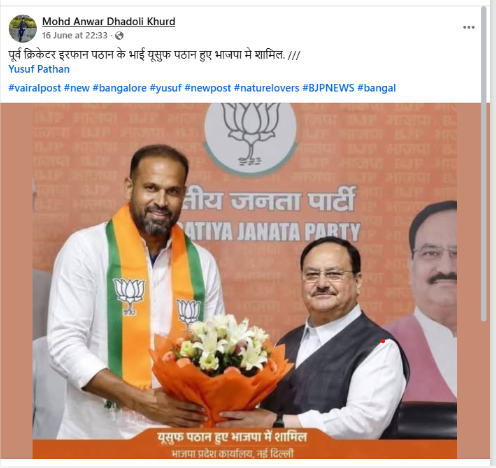
Amid political developments following the 2026 West Bengal Assembly elections, a photo is being widely circulated on social media claiming that former cricketer and Baharampur MP Yusuf Pathan has joined the Bharatiya Janata Party (BJP). The viral image shows Pathan wearing a BJP scarf and standing alongside Union Health Minister JP Nadda. CyberPeace Research Wing research found the claim to be false. The image in circulation is AI-generated and does not depict any real event.
Claim:
A Facebook user ‘Mohd Anwar Dhadoli Khurd’ shared the viral image on June 16, 2026, claiming that Yusuf Pathan has joined the BJP. The post has since been widely shared across platforms.
Post link: https://www.facebook.com/mohd.anwar.dhadoli.khurd/posts/pfbid02WAo4uXhhM1qEVTMbxTjKpTHkoeAbfEztwkX6tWLWpN8WBzNavgtJgKV8JoBGULSul
Archive link: https://perma.cc/4A3H-YTPL
Fact Check:
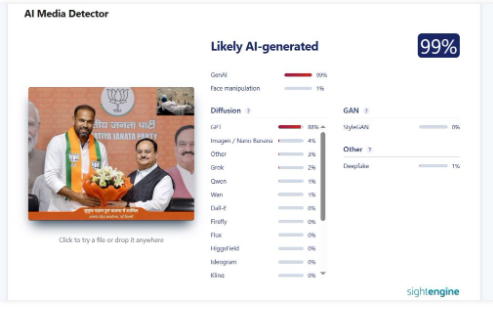
A reverse image search of the viral photo did not yield any credible news reports or authentic sources linking the image to any such political development. No related information was found on Yusuf Pathan’s official social media accounts either, raising suspicion about the authenticity of the image. The image was then analysed using AI detection tools. Sightengine reported a 99% probability of the image being AI-generated.
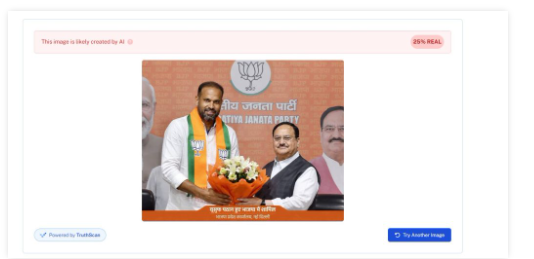
Additionally, analysis using “Undetectable.ai” also indicated a high likelihood of AI manipulation.
Conclusion:
The research confirms that the viral image claiming Yusuf Pathan’s entry into the BJP is AI-generated and does not reflect any real-world event.
Introduction
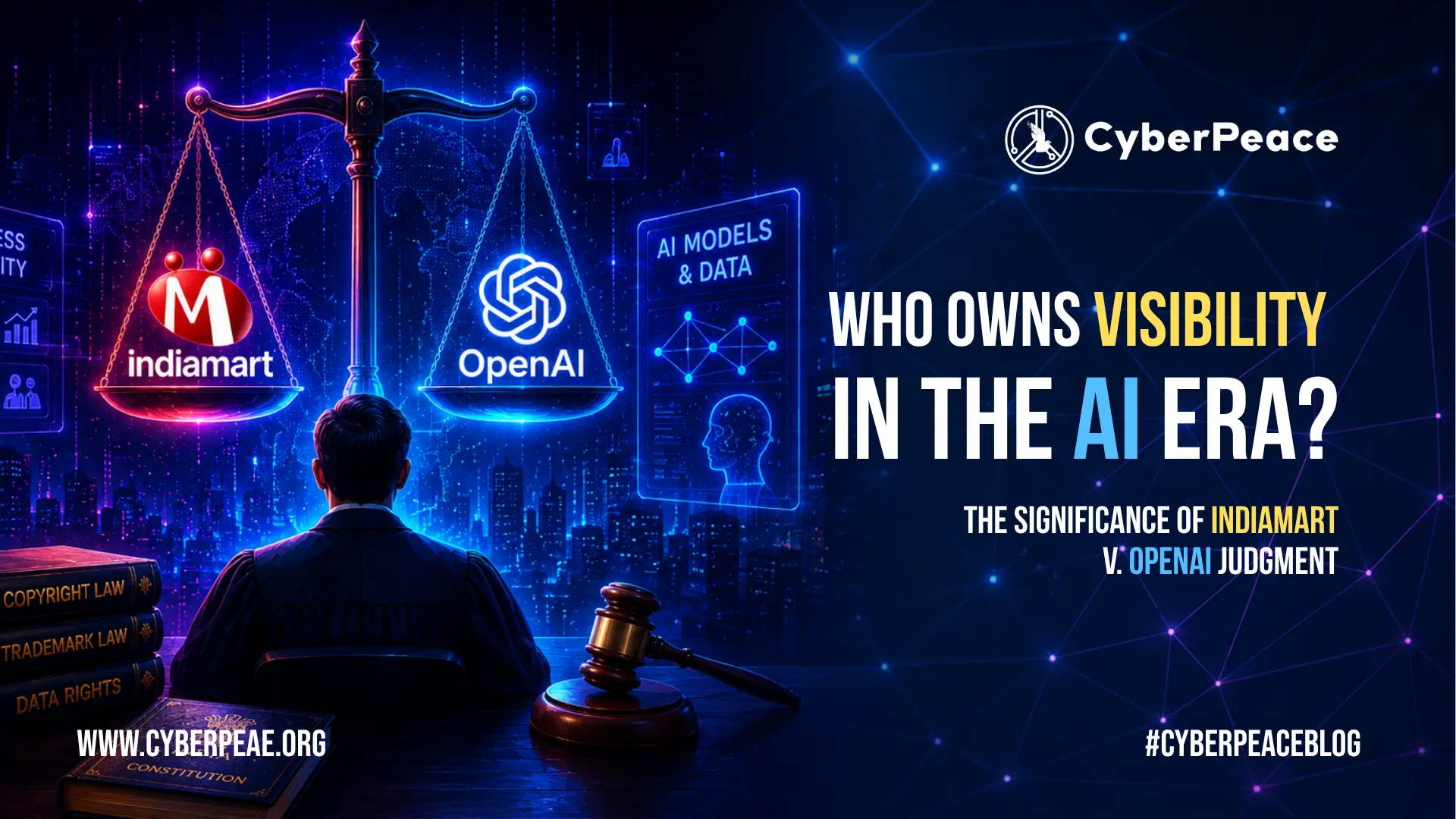
The rise of artificial intelligence has transformed how individuals search for information, buy and compare products online. Unlike the traditional search engines like Google that presents the user with a set of links and directs users to websites, AI-powered systems provide synthesised answers and recommendations which means we don't have to click through every link to find what we are looking for, we simply have to ask an LLM and it provides recommendations based on our needs expressed through prompt. This development has raised important legal and commercial questions, one such question was addressed in the judgement of Indiamart Inter Mesh Limited v. Open AI Inc. and Others (2026 SCC OnLine Cal 5738) decided by HMJ Ravi Krishan Kapur of Calcutta High court on 20 May 2026. If an AI platform becomes a primary source of information, can a business demand inclusion in its responses? Is it a legal injury if the LLM omits a business? More fundamentally, how do the existing laws classify technologies that not only process information, but also generate new content? These were the questions that came before Calcutta High Court. Although the dispute arose from Indiamart’s complaint regarding visibility on ChatGPT search, the judgement explored beyond the disagreement between two private entities.
The Dispute
IndiaMart is one of India’s largest electronic business-to-business marketplaces since 1996, serving millions of buyers and sellers across India. They also have registered trademarks and their entire business depends on visibility on the internet considering the digitalisation of the market. Open AI launched ChatGPT search in October 2024, which is a feature that supplements AI responses with links to relevant web sources. Indiamart alleged that ChatGPT was not displaying links to their online platform in the same way that it displayed links to other competing services or individual sellers. A major grievance raised by Indiamart was that ChatGPT allegedly bypassed IndiaMart market listings by directing users to sellers’ individual websites while continuing to provide platform level links for other competing platforms. Hence, they contended that this practice diverted users away from their platform and negatively affected their business interests. The company argued that such exclusion amounted to discriminatory treatment and resulted in economic harm, diluted its trademarks and amounted to disparagement. They alleged that it violated their rights under article 14, 19, 21 under the constitution and rights under IT Act and IT Rules also. When IndiaMart sought an explanation from OpenAI, the company stated that its decision was influenced by the inclusion of IndiaMart in the United States Trade Representative (USTR) Review of Notorious Markets for Counterfeiting and Piracy 2024, a U.S. government report that identifies online and physical marketplaces alleged to facilitate intellectual property infringements. IndiaMart challenged this justification, arguing that the USTR report has no statutory or binding force in India. It further alleged selective discrimination, pointing out that several other platforms featured on the same USTR list including DHGate, Pinduoduo, Shopee, and Taobao continued to remain accessible through ChatGPT-generated responses. Consequently, IndiaMart approached the Calcutta High Court seeking interim relief directing ChatGPT to display and provide access to IndiaMart links in its responses.
ARGUMENTS BEFORE THE COURT
IndiaMart's contentions: They argued that ChatGPT, because its search feature, performs the role of an "intermediary" within the meaning of Section 2(1)(w) of the IT Act and is therefore required to comply with the obligations imposed under the Information Technology (Intermediary Guidelines and Digital Media Ethics Code) Rules, 2021. Relying on Rule 3(1)(n), IndiaMart argued that an intermediary cannot engage in discriminatory treatment of platforms or selectively restrict access to information. IndiaMart further maintained that users have a right to access information relating to its platform and that the omission of IndiaMart links from ChatGPT's responses violated this interest. They alleged violation of Articles 14, 19, and 21 of the Constitution, along with the broader principle of a user's "right to know", to argue that OpenAI owed an obligation to display IndiaMart listings in response to relevant queries. In addition, IndiaMart alleged that the exclusion of its links caused commercial harm, diluted its trademarks, amounted to disparagement, and constituted an unfair trade practice that adversely affected its business and reputation.
OpenAI's contentions: OpenAI asserted that IndiaMart had no legally enforceable ‘Right to visibility’ on ChatGPT. They argued that neither contract, statute, nor constitutional law imposed any obligation on OpenAI to display, prioritise, or recommend IndiaMart links in response to user queries. In the absence of any recognised legal right, there could be no actionable injury and therefore no valid cause of action. OpenAI also challenged the classification of ChatGPT as an "intermediary" under the Information Technology Act, 2000. According to OpenAI, ChatGPT does not merely host, transmit, or facilitate access to third-party content but also generates responses through its large language model (LLM) and therefore functions more closely as an "originator" than an intermediary. Consequently, the obligations applicable to intermediaries under the Information Technology (Intermediary Guidelines and Digital Media Ethics Code) Rules, 2021, including those relied upon by IndiaMart, were inapplicable. With respect to the USTR Notorious Markets List, OpenAI submitted that its reliance on the report formed part of its internal risk-management and business policies. Such decisions, it argued, were matters of private commercial judgment and not ordinarily subject to judicial review. OpenAI further pointed out that IndiaMart had also previously blocked ChatGPT from accessing and crawling its website that weakened the company's demand for greater visibility within ChatGPT-generated responses.
Court’s decision: The court rejected Indiamart's claim that they were entitled to be displayed in ChatGPT searches. The court emphasised the autonomy of private businesses, the court held that the right to carry on trade and business is "inviolable" and that no law can compel one private entity to operate their platform for the benefit of another, which is based on foundational economic philosophy of laissez faire. Unless there is a contractual, statutory or constitutional obligation, a platform has no duty to the other platform to promote or advance their economic interest. Applying this principle, the court found no such duty or “vested legal right” that entitled IndiaMart’s visibility on ChatGPT. The court reasoned that even if users possess the ‘right to know’, Indiamart could not convert that interest into an enforceable claim under article 19(1)(g) or other legal provision. The court looked at the dispute as one arising from commercial disadvantage rather than violation of any legally protected right. Although the reduced visibility may have had economic consequences, economic harm does not by itself create a cause of action.
The court also took into consideration whether ChatGPT should be classified as an intermediary under Section 2(1)(w) of the Information Technology Act, 2000 or as an originator under Section 2(1)(za). This was an important distinction, because the intermediaries can claim safe harbour protection under section 79 of the IT act, but the originators cannot. The court expressed a preliminary view that ChatGPT is generative capabilities, place it closer to an originator than an intermediary because, unlike conventional search engines, which identify and rank existing information, Generative AI systems, analyse the data and produce new output based on algorithms, which is in response to the user’s prompt. The Court also referenced the NITI Aayog National Strategy for Artificial Intelligence (pages 7 to 12) to support its observations that ChatGPT does not merely store, host or transmit information, it can produce essays, research material, code, creative writing, and other forms of content that did not previously exist in that exact form, hence extending beyond the conventional understanding of an intermediary. The court also recognised that it is a vexed issue and remains unsettled because AI systems operate in response to users instructions and do not function independently, which is why the court refrained from providing a definitive classification and acknowledged that the question may ultimately require legislative clarification as well.
In addition to this, the Court took the view that the IndiaMart’s grievances did not amount to an Intellectual property dispute, as they found no trademark infringement or dilution because any reference to the "IndiaMart" mark was merely descriptive and did not constitute commercial use "in the course of trade" under Section 29(4) of the Trade Marks Act. IndiaMart also hadn’t demonstrated any false or misleading use of its trademark.
Similarly, the Court found that claims of disparagement, trade libel, and injurious falsehood were unsustainable because such claims require the publication of a false statement that harms reputation and since ChatGPT had not published any derogatory statement about IndiaMart, the mere omission of links could not amount to disparagement or libel. The Court relied on Tech Plus Media v. Jyoti Janda, that allegations of unfairness or copyright infringement must be supported by specific pleadings and evidence.
Beyond the immediate dispute, the judgment shed light on the growing difficulty of applying legal categories created for an earlier internet era to generative AI systems. The Information Technology Act was enacted at a time when internet regulation focused primarily on websites, service providers, and electronic communications and therefore existing classifications may not adequately address the hybrid nature of contemporary AI technologies. The Court acknowledged OpenAI's concern that granting IndiaMart's request could trigger floodgates of litigation on similar claims from businesses dissatisfied with AI-generated visibility, however, it clarified that such concerns cannot outweigh genuine legal claims or fundamental rights. The Court suggested that legislative intervention may eventually be necessary.
Conclusion
This judgement not only addressed the visibility issue in AI generated responses, but also whether visibility itself can become a legally protected interest in AI-driven searches? As more and more users rely on AI generated output for their preference rather than traditional search engine output, the power to decide what information is displayed and what is not will eventually become economically significant. The Calcutta High Court through this judgement declined to create any such right through judicial interventions and also highlighted that the existing legal framework is not adequately equipped to address the novel challenges posed by generative AI.
(This blog is based on the judgment in Indiamart Inter Mesh Limited v. Open AI Inc. and Others, 2026 SCC OnLine Cal 5738, decided on May 20, 2026 by the Calcutta High Court, and related reporting by LiveLaw and SCC Times.)
References
- https://www.livelaw.in/high-court/calcutta-high-court/no-right-to-visibility-exists-on-private-ai-platforms-calcutta-high-court-refuses-to-direct-chatgpt-to-display-indiamart-links-536891
- https://www.scconline.com/blog/post/2026/06/03/chatgpt-intermediary-originator-it-act-calcutta-high-court/
- https://indiankanoon.org/doc/198449710/

Introduction
In the dynamic intersection of pop culture and technology, an unexpected drama unfolded in the virtual world, where the iconic Taylor Swift account has been temporarily blocked on X . The incident sent a shockwave through the online community, sparking debates and speculation about the misuse of deepfake technology.
Taylor Swift's searches on social media platform X have been restored after a temporary blockage was lifted following outrage over her explicit AI images. The social media site, formerly known as Twitter, temporarily restricted searches for Taylor Swift as a temporary measure to address a flood of AI-generated deepfake images that went viral across X and other platforms.
X has mentioned it is actively removing the images and taking appropriate actions against the accounts responsible for spreading them. While Swift has not spoken publicly about the fake images, a report stated that her team is "considering legal action" against the site which published the AI-generated images.
The Social Media Frenzy
As news of temporary blockages spread like wildfire across social media platforms, users engaged in a frenzy of reactions. The fake picture was re-shared 24,000 times, with tens of thousands of users liking the post. This engagement supercharged the deepfake image of Taylor Swift, and by the time the moderators woke up, it was too late. Hundreds of accounts began reposting it, which started an online trend. Taylor Swift's AI video reached an even larger audience. The source of the photograph wasn't even known to begin with. The revelations are causing outrage. American lawmakers from across party lines have spoken. One of them said they were astounded, while another said they were shocked.
AI Deepfake Controversy
The deepfake controversy is not new. There are lot of cases such as Rashmika Mandana, Sachin Tendulkar, and now Taylor Swift have been the victims of such misuse of Deepfake technology. The world is facing a concern about the misuse of AI or deepfake technology. With no proactive measures in place, this threat will only worsen affecting privacy concerns for individuals. This incident has opened a debate among users and industry experts on the ethical use of AI in the digital age and its privacy concerns.
Why has the Incident raised privacy concerns?
The emergence of Taylor Swift's deepfake has raised privacy concerns for several reasons.
- Misuse of Personal Imagery: Deepfake uses AI and its algorithms to superimpose one person’s face onto another person’s body, the algorithms are processed again and again till the desired results are obtained. In the case of celebrities or higher-position people, it's very easy for crooks to get images and generate a deepfake. In the case of Taylor Swift, her images are misused. The misuse of Images can have serious consequences for an individual's reputation and privacy.
- False narrative and Manipulation: Deepfake opens the door for public reaction and spreads false narratives, causing harm to reputation, and affecting personal and professional life. Such false narratives through deepfakes may influence public opinion and damage reputation making it challenging for the person to control it.
- Invasion of Privacy: Creating a deepfake involves gathering a significant amount of information about their targets without their consent. The use of such personal information for the creation of AI-generated content without permission raises serious privacy concerns.
- Difficulty in differentiation: Advanced Deepfake technology makes it difficult for people to differentiate between genuine and manipulated content.
- Potential for Exploitation: Deepfake could be exploited for financial gain or malicious motives of the cyber crooks. These videos do harm the reputation, damage the brand name, and partnerships, and even hamper the integrity of the digital platform upon which the content is posted, they also raise questions about the platform’s policy or should we say against the zero-tolerance policy on posting the non-consensual nude images.
Is there any law that could safeguard Internet users?
Legislation concerning deepfakes differs by nation and often spans from demanding disclosure of deepfakes to forbidding harmful or destructive material. Speaking about various countries, the USA including its 10 states like California, Texas, and Illinois have passed criminal legislation prohibiting deepfake. Lawmakers are advocating for comparable federal statutes. A Democrat from New York has presented legislation requiring producers to digitally watermark deepfake content. The United States does not criminalise such deepfakes but does have state and federal laws addressing privacy, fraud, and harassment.
In 2019, China enacted legislation requiring the disclosure of deepfake usage in films and media. Sharing deepfake pornography became outlawed in the United Kingdom in 2023 as part of the Online Safety Act.
To avoid abuse, South Korea implemented legislation in 2020 criminalising the dissemination of deepfakes that endanger the public interest, carrying penalties of up to five years in jail or fines of up to 50 million won ($43,000).
In 2023, the Indian government issued an advisory to social media & internet companies to protect against deepfakes that violate India'sinformation technology laws. India is on its way to coming up with dedicated legislation to deal with this subject.
Looking at the present situation and considering the bigger picture, the world urgently needs strong legislation to combat the misuse of deepfake technology.
Lesson learned
The recent blockage of Taylor Swift's searches on Elon Musk's X has sparked debates on responsible technology use, privacy protection, and the symbiotic relationship between celebrities and the digital era. The incident highlights the importance of constant attention, ethical concerns, and the potential dangers of AI in the digital landscape. Despite challenges, the digital world offers opportunities for growth and learning.
Conclusion
Such deepfake incidents highlight privacy concerns and necessitate a combination of technological solutions, legal frameworks, and public awareness to safeguard privacy and dignity in the digital world as technology becomes more complex.
References:
- https://www.hindustantimes.com/world-news/us-news/taylor-swift-searches-restored-on-elon-musks-x-after-brief-blockage-over-ai-deepfakes-101706630104607.html
- https://readwrite.com/x-blocks-taylor-swift-searches-as-explicit-deepfakes-of-singer-go-viral/
