
#FactCheck- Viral Video Misleadingly Linked to Iran–US Tensions and Kuwait Military Base Claim
Executive Summary
Amid heightened tensions in West Asia, claims are circulating on social media alleging that Iran carried out missile and drone strikes on US military bases in Kuwait, particularly the Ali Al-Salem Air Base. The claim is being accompanied by a viral video showing massive explosions, fire, and thick plumes of smoke, which users say depicts the alleged Iranian attack. CyberPeace Research Wing research found that the viral video is from an explosion at a fireworks factory in Malta, a European country. It has no connection to the ongoing tensions in West Asia. However, Iran has claimed that it targeted US military bases in response to American strikes. Meanwhile, the United States has stated that it successfully intercepted and neutralized several Iranian missile and drone attacks.
Claim:
Instagram user ‘nitesh_nova’ posted a video on June 2, 2026 (archive link), stating: “Iran has carried out ballistic missile and drone attacks on US military bases in Kuwait, particularly the Ali Al-Salem Air Base. This action was taken in response to US airstrikes on Iranian positions, following which tensions in the Gulf region have significantly escalated.”
https://perma.cc/PQ7N-JYQS?type=standard
https://www.instagram.com/nitesh_nova/

Fact Check
A review of keyframes from the video using reverse image search tools led to reports identifying the footage as an industrial accident. The same visuals were found in news coverage published by France 24, which confirmed that the explosion occurred at a fireworks factory in Malta on June 1, 2026. The incident resulted in injuries to two individuals, although no workers were present inside the facility at the time of the blast.
https://www.youtube.com/watch?v=LTLGO-fu_QA
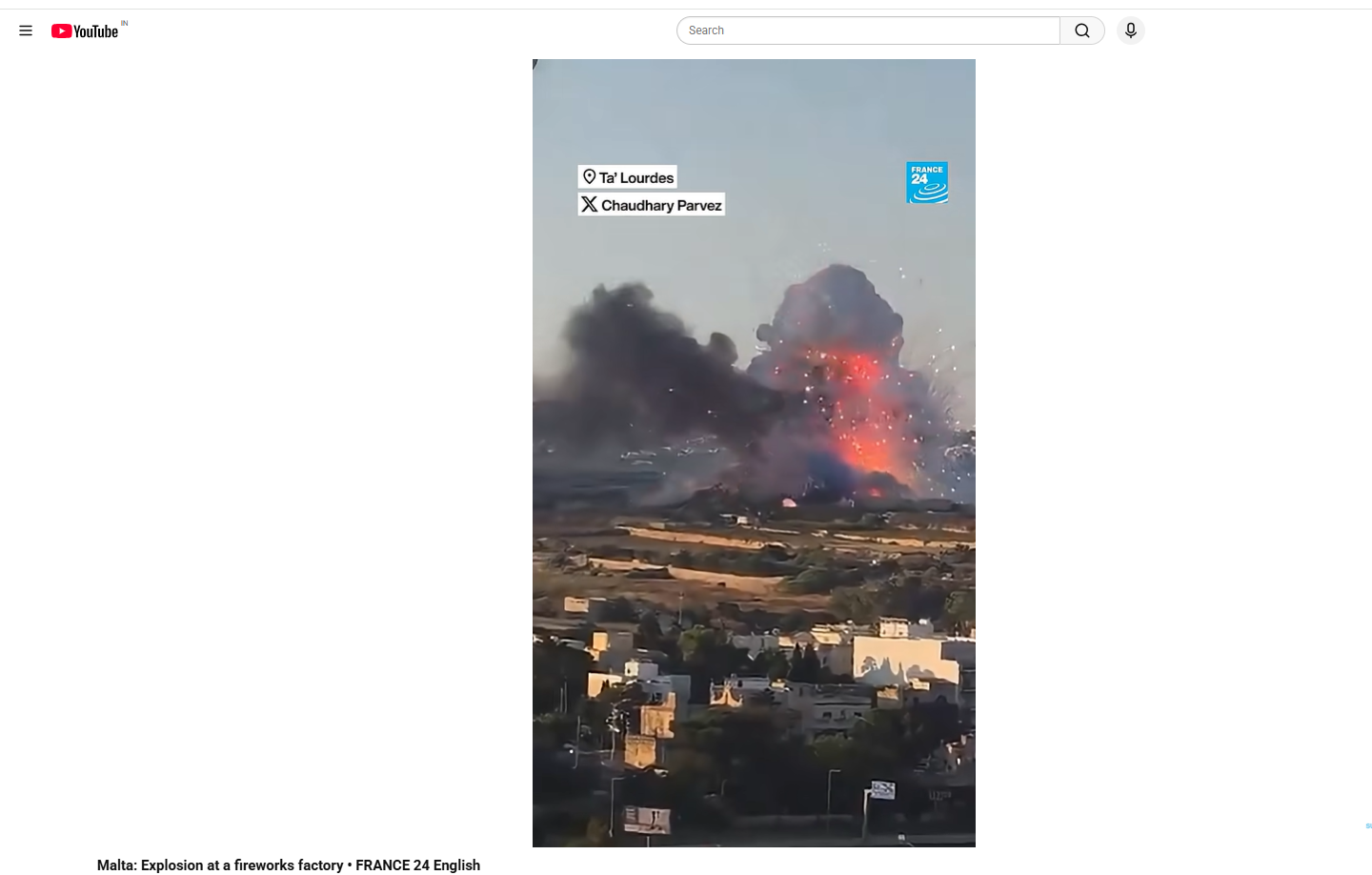
Further verification from 10 News Australia also supports the same context, showing the identical footage and reporting it as a fireworks factory explosion in Malta, posted on June 2, 2026.10 News Australia report
https://www.youtube.com/watch?v=8Lppvtdr50k

Conclusion:
The viral video being shared with claims of an Iranian missile strike on a US military base in Kuwait is misleading. The footage actually shows a fireworks factory explosion in Malta and has no connection to the ongoing geopolitical tensions in West Asia. Social media users are advised to verify such sensitive content before sharing, as misattributed visuals can significantly distort the understanding of real-world conflicts.

Related Blogs

Executive Summary:
A photo claiming that Mr. Rowan Atkinson, the famous actor who played the role of Mr. Bean, lying sick on bed is circulating on social media. However, this claim is false. The image is a digitally altered picture of Mr.Barry Balderstone from Bollington, England, who died in October 2019 from advanced Parkinson’s disease. Reverse image searches and media news reports confirm that the original photo is of Barry, not Rowan Atkinson. Furthermore, there are no reports of Atkinson being ill; he was recently seen attending the 2024 British Grand Prix. Thus, the viral claim is baseless and misleading.

Claims:
A viral photo of Rowan Atkinson aka Mr. Bean, lying on a bed in sick condition.


Fact Check:
When we received the posts, we first did some keyword search based on the claim made, but no such posts were found to support the claim made.Though, we found an interview video where it was seen Mr. Bean attending F1 Race on July 7, 2024.

Then we reverse searched the viral image and found a news report that looked similar to the viral photo of Mr. Bean, the T-Shirt seems to be similar in both the images.

The man in this photo is Barry Balderstone who was a civil engineer from Bollington, England, died in October 2019 due to advanced Parkinson’s disease. Barry received many illnesses according to the news report and his application for extensive healthcare reimbursement was rejected by the East Cheshire Clinical Commissioning Group.
Taking a cue from this, we then analyzed the image in an AI Image detection tool named, TrueMedia. The detection tool found the image to be AI manipulated. The original image is manipulated by replacing the face with Rowan Atkinson aka Mr. Bean.


Hence, it is clear that the viral claimed image of Rowan Atkinson bedridden is fake and misleading. Netizens should verify before sharing anything on the internet.
Conclusion:
Therefore, it can be summarized that the photo claiming Rowan Atkinson in a sick state is fake and has been manipulated with another man’s image. The original photo features Barry Balderstone, the man who was diagnosed with stage 4 Parkinson’s disease and subsequently died in 2019. In fact, Rowan Atkinson seemed perfectly healthy recently at the 2024 British Grand Prix. It is important for people to check on the authenticity before sharing so as to avoid the spreading of misinformation.
- Claim: A Viral photo of Rowan Atkinson aka Mr. Bean, lying on a bed in a sick condition.
- Claimed on: X, Facebook
- Fact Check: Fake & Misleading
.webp)
Executive Summary:
In late 2024 an Indian healthcare provider experienced a severe cybersecurity attack that demonstrated how powerful AI ransomware is. This blog discusses the background to the attack, how it took place and the effects it caused (both medical and financial), how organisations reacted, and the final result of it all, stressing on possible dangers in the healthcare industry with a lack of sufficiently adequate cybersecurity measures in place. The incident also interrupted the normal functioning of business and explained the possible economic and image losses from cyber threats. Other technical results of the study also provide more evidence and analysis of the advanced AI malware and best practices for defending against them.
1. Introduction
The integration of artificial intelligence (AI) in cybersecurity has revolutionised both defence mechanisms and the strategies employed by cybercriminals. AI-powered attacks, particularly ransomware, have become increasingly sophisticated, posing significant threats to various sectors, including healthcare. This report delves into a case study of an AI-powered ransomware attack on a prominent Indian healthcare provider in 2024, analysing the attack's execution, impact, and the subsequent response, along with key technical findings.
2. Background
In late 2024, a leading healthcare organisation in India which is involved in the research and development of AI techniques fell prey to a ransomware attack that was AI driven to get the most out of it. With many businesses today relying on data especially in the healthcare industry that requires real-time operations, health care has become the favourite of cyber criminals. AI aided attackers were able to cause far more detailed and damaging attack that severely affected the operation of the provider whilst jeopardising the safety of the patient information.
3. Attack Execution
The attack began with the launch of a phishing email designed to target a hospital administrator. They received an email with an infected attachment which when clicked in some cases injected the AI enabled ransomware into the hospitals network. AI incorporated ransomware was not as blasé as traditional ransomware, which sends copies to anyone, this studied the hospital’s IT network. First, it focused and targeted important systems which involved implementation of encryption such as the electronic health records and the billing departments.
The fact that the malware had an AI feature allowed it to learn and adjust its way of propagation in the network, and prioritise the encryption of most valuable data. This accuracy did not only increase the possibility of the potential ransom demand but also it allowed reducing the risks of the possibility of early discovery.
4. Impact
- The consequences of the attack were immediate and severe: The consequences of the attack were immediate and severe.
- Operational Disruption: The centralization of important systems made the hospital cease its functionality through the acts of encrypting the respective components. Operations such as surgeries, routine medical procedures and admitting of patients were slowed or in some cases referred to other hospitals.
- Data Security: Electronic patient records and associated billing data became off-limit because of the vulnerability of patient confidentiality. The danger of data loss was on the verge of becoming permanent, much to the concern of both the healthcare provider and its patients.
- Financial Loss: The attackers asked for 100 crore Indian rupees (approximately 12 USD million) for the decryption key. Despite the hospital not paying for it, there were certain losses that include the operational loss due to the server being down, loss incurred by the patients who were affected in one way or the other, loss incurred in responding to such an incident and the loss due to bad reputation.
5. Response
As soon as the hotel’s management was informed about the presence of ransomware, its IT department joined forces with cybersecurity professionals and local police. The team decided not to pay the ransom and instead recover the systems from backup. Despite the fact that this was an ethically and strategically correct decision, it was not without some challenges. Reconstruction was gradual, and certain elements of the patients’ records were permanently erased.
In order to avoid such attacks in the future, the healthcare provider put into force several organisational and technical actions such as network isolation and increase of cybersecurity measures. Even so, the attack revealed serious breaches in the provider’s IT systems security measures and protocols.
6. Outcome
The attack had far-reaching consequences:
- Financial Impact: A healthcare provider suffers a lot of crashes in its reckoning due to substantial service disruption as well as bolstering cybersecurity and compensating patients.
- Reputational Damage: The leakage of the data had a potential of causing a complete loss of confidence from patients and the public this affecting the reputation of the provider. This, of course, had an effect on patient care, and ultimately resulted in long-term effects on revenue as patients were retained.
- Industry Awareness: The breakthrough fed discussions across the country on how to improve cybersecurity provisions in the healthcare industry. It woke up the other care providers to review and improve their cyber defence status.
7. Technical Findings
The AI-powered ransomware attack on the healthcare provider revealed several technical vulnerabilities and provided insights into the sophisticated mechanisms employed by the attackers. These findings highlight the evolving threat landscape and the importance of advanced cybersecurity measures.
7.1 Phishing Vector and Initial Penetration
- Sophisticated Phishing Tactics: The phishing email was crafted with precision, utilising AI to mimic the communication style of trusted contacts within the organisation. The email bypassed standard email filters, indicating a high level of customization and adaptation, likely due to AI-driven analysis of previous successful phishing attempts.
- Exploitation of Human Error: The phishing email targeted an administrative user with access to critical systems, exploiting the lack of stringent access controls and user awareness. The successful penetration into the network highlighted the need for multi-factor authentication (MFA) and continuous training on identifying phishing attempts.
7.2 AI-Driven Malware Behavior
- Dynamic Network Mapping: Once inside the network, the AI-powered malware executed a sophisticated mapping of the hospital's IT infrastructure. Using machine learning algorithms, the malware identified the most critical systems—such as Electronic Health Records (EHR) and the billing system—prioritising them for encryption. This dynamic mapping capability allowed the malware to maximise damage while minimising its footprint, delaying detection.
- Adaptive Encryption Techniques: The malware employed adaptive encryption techniques, adjusting its encryption strategy based on the system's response. For instance, if it detected attempts to isolate the network or initiate backup protocols, it accelerated the encryption process or targeted backup systems directly, demonstrating an ability to anticipate and counteract defensive measures.
- Evasive Tactics: The ransomware utilised advanced evasion tactics, such as polymorphic code and anti-forensic features, to avoid detection by traditional antivirus software and security monitoring tools. The AI component allowed the malware to alter its code and behaviour in real time, making signature-based detection methods ineffective.
7.3 Vulnerability Exploitation
- Weaknesses in Network Segmentation: The hospital’s network was insufficiently segmented, allowing the ransomware to spread rapidly across various departments. The malware exploited this lack of segmentation to access critical systems that should have been isolated from each other, indicating the need for stronger network architecture and micro-segmentation.
- Inadequate Patch Management: The attackers exploited unpatched vulnerabilities in the hospital’s IT infrastructure, particularly within outdated software used for managing patient records and billing. The failure to apply timely patches allowed the ransomware to penetrate and escalate privileges within the network, underlining the importance of rigorous patch management policies.
7.4 Data Recovery and Backup Failures
- Inaccessible Backups: The malware specifically targeted backup servers, encrypting them alongside primary systems. This revealed weaknesses in the backup strategy, including the lack of offline or immutable backups that could have been used for recovery. The healthcare provider’s reliance on connected backups left them vulnerable to such targeted attacks.
- Slow Recovery Process: The restoration of systems from backups was hindered by the sheer volume of encrypted data and the complexity of the hospital’s IT environment. The investigation found that the backups were not regularly tested for integrity and completeness, resulting in partial data loss and extended downtime during recovery.
7.5 Incident Response and Containment
- Delayed Detection and Response: The initial response was delayed due to the sophisticated nature of the attack, with traditional security measures failing to identify the ransomware until significant damage had occurred. The AI-powered malware’s ability to adapt and camouflage its activities contributed to this delay, highlighting the need for AI-enhanced detection and response tools.
- Forensic Analysis Challenges: The anti-forensic capabilities of the malware, including log wiping and data obfuscation, complicated the post-incident forensic analysis. Investigators had to rely on advanced techniques, such as memory forensics and machine learning-based anomaly detection, to trace the malware’s activities and identify the attack vector.
8. Recommendations Based on Technical Findings
To prevent similar incidents, the following measures are recommended:
- AI-Powered Threat Detection: Implement AI-driven threat detection systems capable of identifying and responding to AI-powered attacks in real time. These systems should include behavioural analysis, anomaly detection, and machine learning models trained on diverse datasets.
- Enhanced Backup Strategies: Develop a more resilient backup strategy that includes offline, air-gapped, or immutable backups. Regularly test backup systems to ensure they can be restored quickly and effectively in the event of a ransomware attack.
- Strengthened Network Segmentation: Re-architect the network with robust segmentation and micro-segmentation to limit the spread of malware. Critical systems should be isolated, and access should be tightly controlled and monitored.
- Regular Vulnerability Assessments: Conduct frequent vulnerability assessments and patch management audits to ensure all systems are up to date. Implement automated patch management tools where possible to reduce the window of exposure to known vulnerabilities.
- Advanced Phishing Defences: Deploy AI-powered anti-phishing tools that can detect and block sophisticated phishing attempts. Train staff regularly on the latest phishing tactics, including how to recognize AI-generated phishing emails.
9. Conclusion
The AI empowered ransomware attack on the Indian healthcare provider in 2024 makes it clear that the threat of advanced cyber attacks has grown in the healthcare facilities. Sophisticated technical brief outlines the steps used by hackers hence underlining the importance of ongoing active and strong security. This event is a stark message to all about the importance of not only remaining alert and implementing strong investments in cybersecurity but also embarking on the formulation of measures on how best to counter such incidents with limited harm. AI is now being used by cybercriminals to increase the effectiveness of the attacks they make and it is now high time all healthcare organisations ensure that their crucial systems and data are well protected from such attacks.

Introduction:
The Ministry of Civil Aviation, GOI, established the initiative ‘DigiYatra’ to ensure hassle-free and health-risk-free journeys for travellers/passengers. The initiative uses a single token of face biometrics to digitally validate identity, travel, and health along with any other data needed to enable air travel.
Cybersecurity is a top priority for the DigiYatra platform administrators, with measures implemented to mitigate risks of data loss, theft, or leakage. With over 6.5 million users, DigiYatra is an important step forward for India, in the direction of secure digital travel with seamless integration of proactive cybersecurity protocols. This blog focuses on examining the development, challenges and implications that stand in the way of securing digital travel.
What is DigiYatra? A Quick Overview
DigiYatra is a flagship initiative by the Government of India to enable paperless travel, reducing identity checks for a seamless airport experience. This technology allows the entry of passengers to be automatically processed based on a facial recognition system at all the checkpoints at the airports, including main entry, security check areas, aircraft boarding, and more.
This technology makes the boarding process quick and seamless as each passenger needs less than three seconds to pass through every touchpoint. Passengers’ faces essentially serve as their documents (ID proof and if required, Vaccine Proof) and their boarding passes.
DigiYatra has also enhanced airport security as passenger data is validated by the Airlines Departure Control System. It allows only the designated passengers to enter the terminal. Additionally, the entire DigiYatra Process is non-intrusive and automatic. In improving long-standing security and operational airport protocols, the platform has also significantly improved efficiency and output for all airport professionals, from CISF personnel to airline staff members.
Policy Origins and Framework
Rooted in the Government of India's Digital India campaign and enabled by the National Civil Aviation Policy (NCAP) 2016, DigiYatra aims to modernise air travel by integrating Aadhaar-based passenger identification. While Aadhaar is currently the primary ID, efforts are underway to include other identification methods. The platform, supported by stakeholders like the Airports Authority of India (26%) and private airports (14.8% each), must navigate stringent cybersecurity demands. Compliance with the Digital Personal Data Protection Act, 2023, ensures the secure use of sensitive facial recognition data, while the Aircraft (Security) Rules, 2023, mandate robust interoperability and data protection mechanisms across stakeholders. DigiYatra also aspires to democratise digital travel, extending its reach to underserved airports and non-tech-savvy travellers. As India refines its cybersecurity and privacy frameworks, learning from global best practices is essential to safeguarding data and ensuring seamless, secure air travel operations.
International Practices
Global practices offer crucial lessons to strengthen DigiYatra's cybersecurity and streamline the seamless travel experience. Initiatives such as CLEAR in the USA and Seamless Traveller initiatives in Singapore offer actionable insights into further expanding the system to its full potential. CLEAR is operational in 58 airports and has more than 17 million users. Singapore has made Seamless Traveller active since the beginning of 2024 and aims to have a 95% shift to automated lanes by 2026.
Some additional measures that India can adopt from international initiatives are regular audits and updates to the cybersecurity policies. Further, India can aim for a cross-border policy for international travel. By implementing these recommendations, DigiYatra can not only improve data security and operational efficiency but also establish India as a leader in global aviation security standards, ensuring trust and reliability for millions of travellers
CyberPeace Recommendations
Some recommendations for further improving upon our efforts for seamless and secure digital travel are:
- Strengthen the legislation on biometric data usage and storage.
- Collaborate with global aviation bodies to develop standardised operations.
- Cybersecurity technologies, such as blockchain for immutable data records, should be adopted alongside encryption standards, data minimisation practices, and anonymisation techniques.
- A cybersecurity-first culture across aviation stakeholders.
Conclusion
DigiYatra represents a transformative step in modernising India’s aviation sector by combining seamless travel with robust cybersecurity. Leveraging facial recognition and secure data validation enhances efficiency while complying with the Digital Personal Data Protection Act, 2023, and Aircraft (Security) Rules, 2023.
DigiYatra must address challenges like secure biometric data storage, adopt advanced technologies like blockchain, and foster a cybersecurity-first culture to reach its full potential. Expanding to underserved regions and aligning with global best practices will further solidify its impact. With continuous innovation and vigilance, DigiYatra can position India as a global leader in secure, digital travel.
References
- https://government.economictimes.indiatimes.com/news/governance/digi-yatra-operates-on-principle-of-privacy-by-design-brings-convenience-security-ceo-digi-yatra-foundation/114926799
- https://www.livemint.com/news/india/explained-what-is-digiyatra-how-it-will-work-and-other-questions-answered-11660701094885.html
- https://www.civilaviation.gov.in/sites/default/files/2023-09/ASR%20Notification_published%20in%20Gazette.pdf

