
#FactCheck- Viral Video Falsely Claims Iranian Strike Destroyed Israeli Army Headquarters
Executive Summary
A video is going viral on social media showing a massive building engulfed in flames and collapsing into debris. It is being widely claimed that Iran launched a powerful attack that destroyed Israel’s army headquarters. However, research by CyberPeace reveals that this claim is misleading. The viral video is AI-generated and has no connection to any real-world event.
Claim
An X (formerly Twitter) user shared the viral video with the caption: “Iran has targeted Israel’s army headquarters. It seems Israel’s dream of becoming ‘Greater Israel’ will remain unfulfilled.”
Post link:
- https://x.com/KAMESHKUMAR96/status/2039009484069368083
Archived version:
- https://archive.ph/HKXkK
- https://x.com/KAMESHKUMAR96/status/2039009484069368083
- https://archive.ph/HKXkK
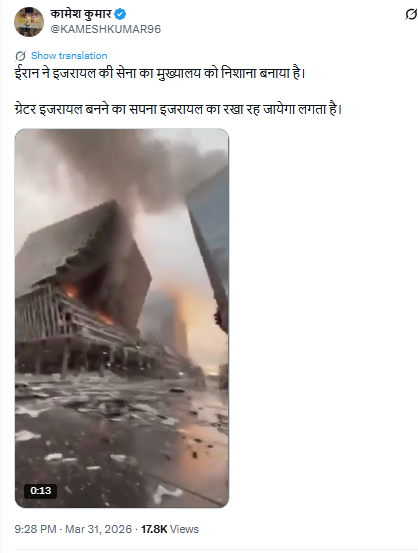
Similar videos have also been shared by other users on social media:
Fact Check
To verify the claim, we extracted keyframes from the viral video and conducted a reverse image search. During this process, we found several credible media reports confirming that Iran has carried out drone and missile attacks on Israel and the Gulf regions in recent times. However, none of these reports featured the viral video, indicating that it is not authentic footage.

- https://www.youtube.com/watch?v=fxDBX90bYng

A closer examination of the video revealed multiple visual inconsistencies commonly associated with AI-generated content. For instance, a building on the left side appears to bend and collapse in a rubber-like manner—something that is physically unrealistic for structures made of concrete and steel. Additionally, the smoke and flames appear unnatural and lack realistic dynamics.
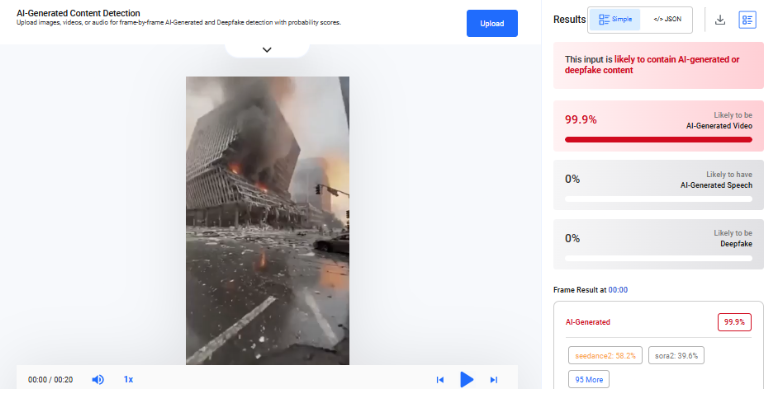
To further verify, we analyzed the video using the AI detection tool Hive Moderation, which classified it as 99.9% AI-generated.
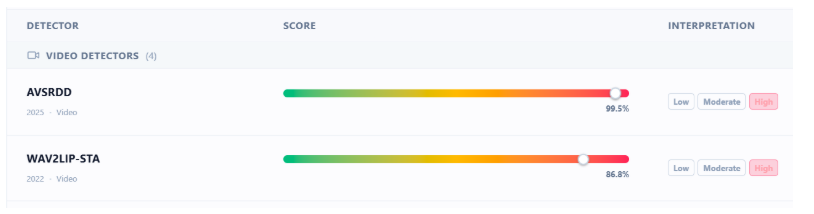
We also tested the video using the Deepfake-o-Meter platform.The AVSRDD (2025) model detected it as 99.5% AI-generated
Conclusion
Our research clearly establishes that the viral video claiming Iran destroyed Israel’s army headquarters is false and misleading. The footage does not appear in any credible news coverage of recent attacks, which strongly indicates that it is not real. Moreover, multiple AI detection tools consistently classify the video as artificially generated, with extremely high probability scores. Visual anomalies in the clip further support this finding.

Related Blogs

Executive Summary
A video is being widely shared on social media with the claim that it shows the recent Assam floods, where nurses are rescuing newborn babies after water entered a hospital. The caption accompanying the viral video claims that the babies are not drowning; instead, healthcare workers and rescue teams are carrying them to safety amid floodwaters inside a hospital. It further states that the video shows humanity and courage during a time of crisis. CyberPeace Research Wing’s research found the claim to be false. The research revealed that the viral video showing healthcare workers rescuing newborn babies is not real but was created using Artificial Intelligence (AI).
Claim:
An Instagram user named kamlakritika shared the video and claimed that it showed the Assam floods. The post stated that the babies were not drowning but were being rescued by healthcare workers and rescue teams from a flooded hospital. In the viral video, several nurses can be seen running through waterlogged areas while trying to protect incubators — containers used to keep newborn babies — from being submerged or swept away. According to the caption, a devastating flood had turned the entire area into a disaster zone. It claimed that incubators containing premature newborn babies were floating in floodwaters, while nurses were running behind them amid strong water currents to save the infants. The caption further claimed that several incubators were overturning and sinking with babies inside, putting hundreds of fragile lives at risk.
https://www.instagram.com/reel/DbXvJwgz72X/?utm_source=ig_web_copy_link&igsh=NTc4MTIwNjQ2YQ==

Factcheck
To verify the claim, CyberPeace Research Wing conducted a Google search using relevant keywords. During the search, the video was found shared by several other Instagram accounts. During the research, we found a report published by News18 on August 1, 2026. Although the report was related to the Assam floods, it mentioned a different incident. According to the report, a viral video showed floodwaters surrounding houses, with water spread across the area. In the video, a rescue team member can be seen carefully carrying a newborn baby in his arms through the flooded area and handing the child over to another rescue worker near a boat so that the baby could be taken to safety.

However, during our research, we could not find any information from credible news organisations or official sources confirming the viral video showing newborn babies being rescued in incubators. As part of further research, we closely examined the viral video and noticed several indications suggesting that it could be AI-generated. The video was then analysed using the AI detection tool FauxLens, which indicated that the video was approximately 75% AI-generated.

To further verify the authenticity of the video, we also analysed it using another AI detection tool, Human Meter. The tool showed an 85% probability of the video being generated with the help of AI.

Conclusion:
CyberPeace Research Wing’s research found that the viral video claiming to show nurses rescuing newborn babies during Assam floods is false. The video is not an actual incident but an AI-generated creation.

Executive Summary
A video is going viral on social media in which Defence Minister Rajnath Singh is seen allegedly saying, “During Operation Sindoor, we initially hid the losses of jets and soldiers so that Pakistan could not use them for propaganda. Later, a documentary was made to reveal the truth.” Research by the CyberPeace Research Wing found that the video is completely fake and was created using artificial intelligence (AI). Defence Minister Rajnath Singh never made any such statement. The video has primarily been circulated by Pakistani accounts.
Claim:
A video of Rajnath Singh has been shared by a Pakistani user on the social media platform X, with the caption: “Rajnath Singh while commenting on Operation Sindoor documentary makes a starting revelation, Initially we did not admit any jet or soldier losses to avoid giving any propaganda chances for Pakistan but then we made this documentary to tell the truth.” The post link and screenshot are provided below.
https://x.com/i/status/2091095915021193252
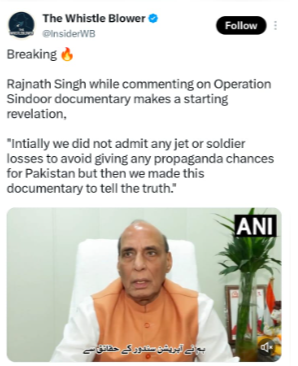
Fact Check:
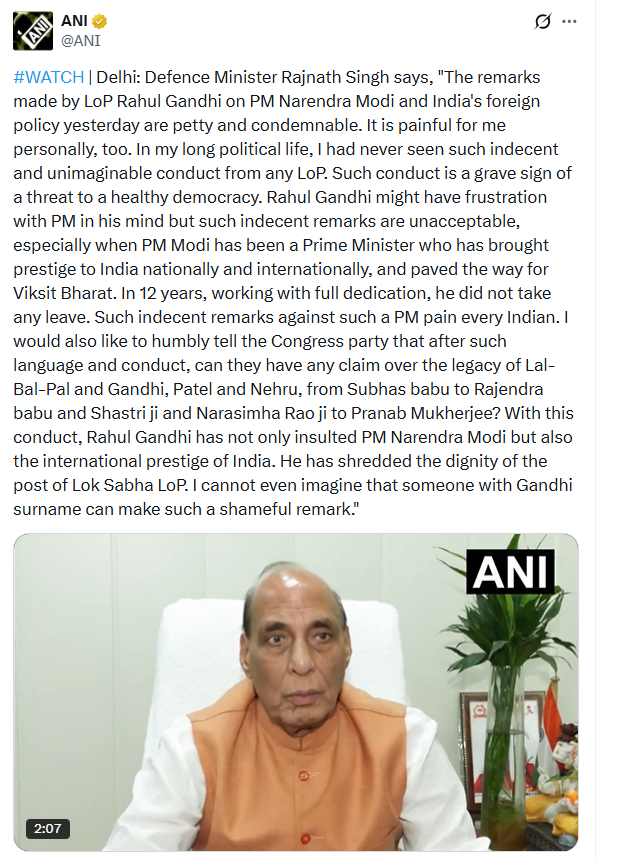
To investigate the viral claim, we first extracted keyframes from the video and conducted a reverse image search using Google Lens. During this process, we found the original video on ANI’s X account, in which Defense Minister Rajnath Singh can be seen saying: Defense Minister Rajnath Singh said, “The remarks made yesterday in the Lok Sabha by Leader of Opposition Rahul Gandhi regarding Prime Minister Narendra Modi and India’s foreign policy are extremely cheap and condemnable. Personally, this is painful for me as well. In my long political life, I have never seen such unbecoming and unthinkable behavior from any Leader of Opposition. Such conduct poses a serious threat to a healthy democracy. Rahul Gandhi may feel disappointment toward the Prime Minister, but such improper remarks are unacceptable—especially when PM Modi has elevated India’s national and international prestige and paved the way for a ‘Viksit Bharat’.
Working with complete dedication for 12 years, he has not taken a single day off. Such unbecoming remarks against such a Prime Minister pain every Indian I would also humbly like to ask the Congress Party: after such language and conduct, can it still claim the legacy of great stalwarts ranging from Lal-Bal-Pal and Gandhi, Patel, Nehru to Subhas Babu, Rajendra Babu, Shastri Ji, Narasimha Rao Ji, and Pranab Mukherjee? Through this behavior, Rahul Gandhi has not only insulted Prime Minister Narendra Modi but also damaged India’s international reputation. He has tarnished the dignity of the post of Leader of Opposition in the Lok Sabha. I cannot even imagine that anyone carrying the surname 'Gandhi' could make such a shameful remark.” Throughout the entire video, he never made the statement attributed to him in the viral claim. The post link and screenshot are provided below.
https://x.com/ANI/status/2088230045102002466
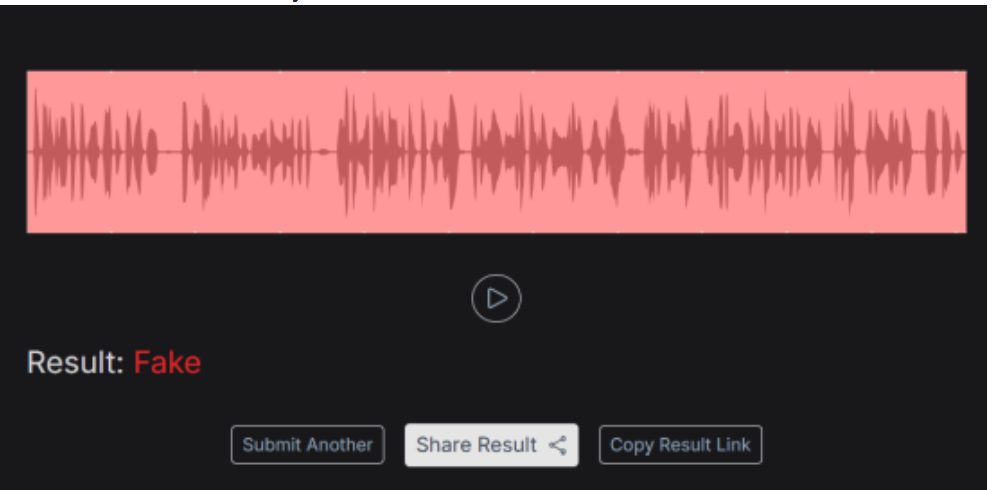
We scanned the audio on the AI detection tool Resemble AI, where the results confirmed that the voice is AI-generated.
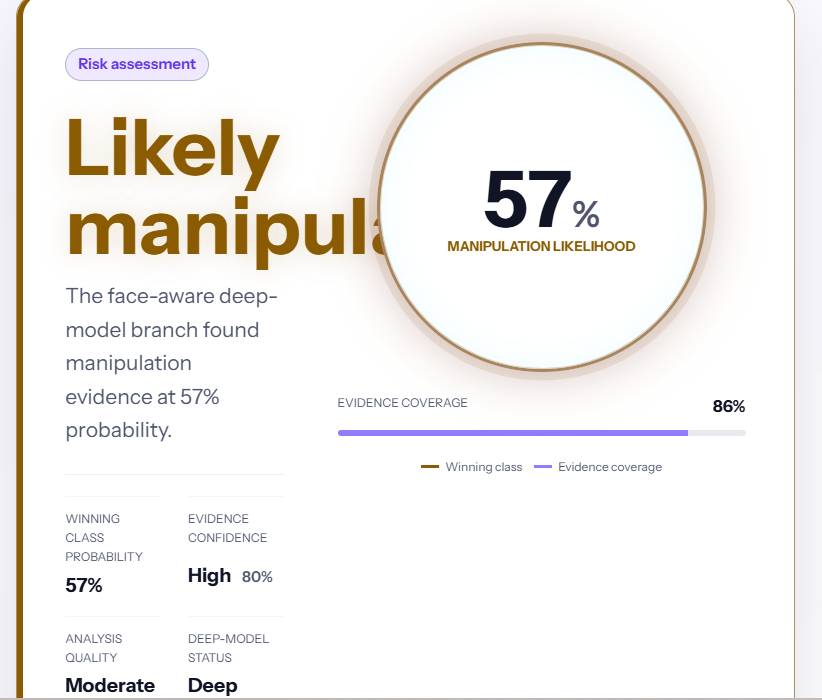
We also scanned the clip on another AI detection tool, Detect Video AI, where the results indicated that the viral video is 57 percent AI-generated.
Conclusion:
Our research revealed that the viral video is completely fake and was created using Artificial Intelligence (AI). The research confirmed that Defense Minister Rajnath Singh made no such statement. It was also revealed during the fact-check that this fake video is being primarily circulated on social media through Pakistani accounts.
Executive Summary
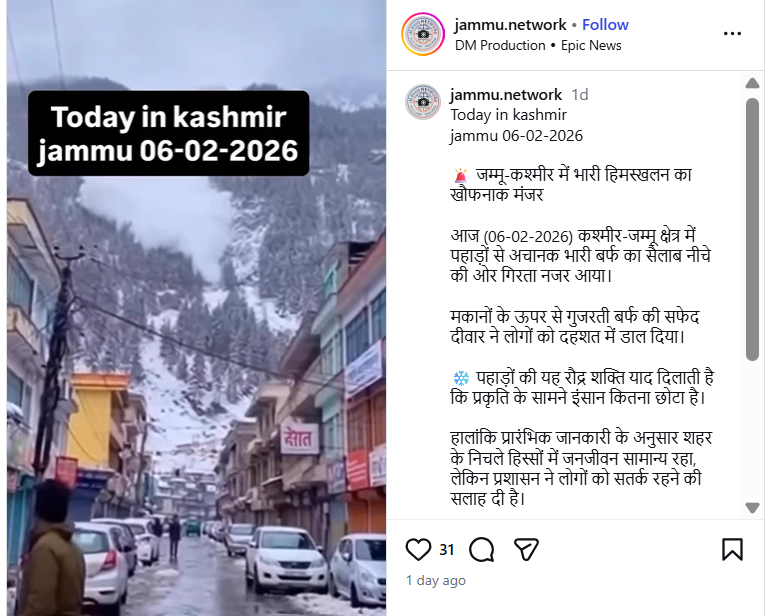
A video is being shared on social media claiming to show an avalanche in Kashmir. The caption of the post alleges that the incident occurred on February 6. Several users sharing the video are also urging people to avoid unnecessary travel to hilly regions. CyberPeace’s research found that the video being shared as footage of a Kashmir avalanche is not real. The research revealed that the viral video is AI-generated.
Claim
The video is circulating widely on social media platforms, particularly Instagram, with users claiming it shows an avalanche in Kashmir on February 6. The archived version of the post can be accessed here. Similar posts were also found online. (Links and archived links provided)
Fact Check:
To verify the claim, we searched relevant keywords on Google. During this process, we found a video posted on the official Instagram account of the BBC. The BBC post reported that an avalanche occurred near a resort in Sonamarg, Kashmir, on January 27. However, the BBC post does not contain the viral video that is being shared on social media, indicating that the circulating clip is unrelated to the real incident.

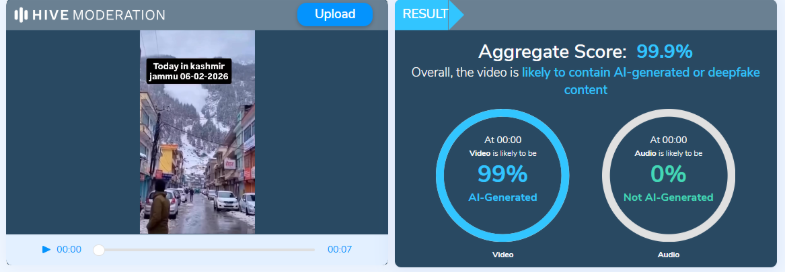
A close examination of the viral video revealed several inconsistencies. For instance, during the alleged avalanche, people present at the site are not seen panicking, running for cover, or moving toward safer locations. Additionally, the movement and flow of the falling snow appear unnatural. Such visual anomalies are commonly observed in videos generated using artificial intelligence. As part of the research , the video was analyzed using the AI detection tool Hive Moderation. The tool indicated a 99.9% probability that the video was AI-generated.
Conclusion
Based on the evidence gathered during our research , it is clear that the video being shared as footage of a Kashmir avalanche is not genuine. The clip is AI-generated and misleading. The viral claim is therefore false.
