
#FactCheck -Viral Image of ‘Saudi Son’ Meeting Hindu Mother Found to Be Misleading
Executive Summary
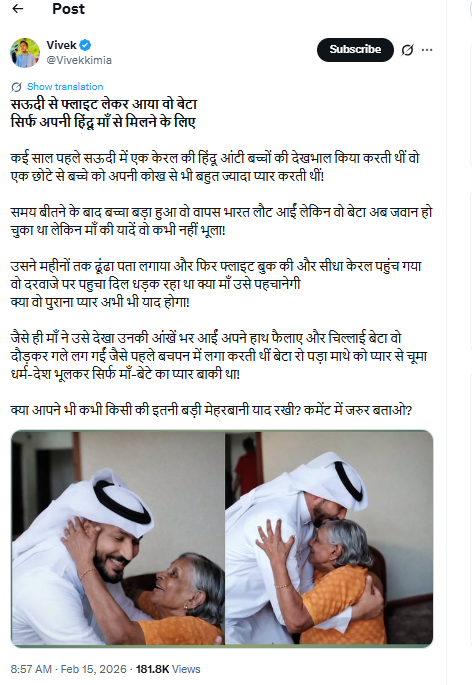
A photo is going viral on social media showing a young man dressed in traditional Arab attire warmly embracing an elderly woman. The post claims that the man flew in from Saudi Arabia to Kerala just to meet his “Hindu mother,” portraying the image as a heartwarming example of communal harmony. However, research by the CyberPeace found that the claim being shared with the image is misleading.
Claim
The viral post narrates an emotional story, alleging that years ago a Hindu woman from Kerala worked in Saudi Arabia caring for children and loved a young boy like her own son. After she returned to India, the boy—now grown up—reportedly searched for her for months, booked a flight, and finally reached Kerala to reunite with her. The post describes an emotional reunion filled with tears, affection, and a bond beyond religion and nationality.
Fact Check
A reverse image search of the viral picture led us to a video uploaded on August 18, 2023, on the YouTube channel of social media influencer Hashim Abbas. In the video, he is seen meeting and hugging the elderly woman while extending Onam greetings.
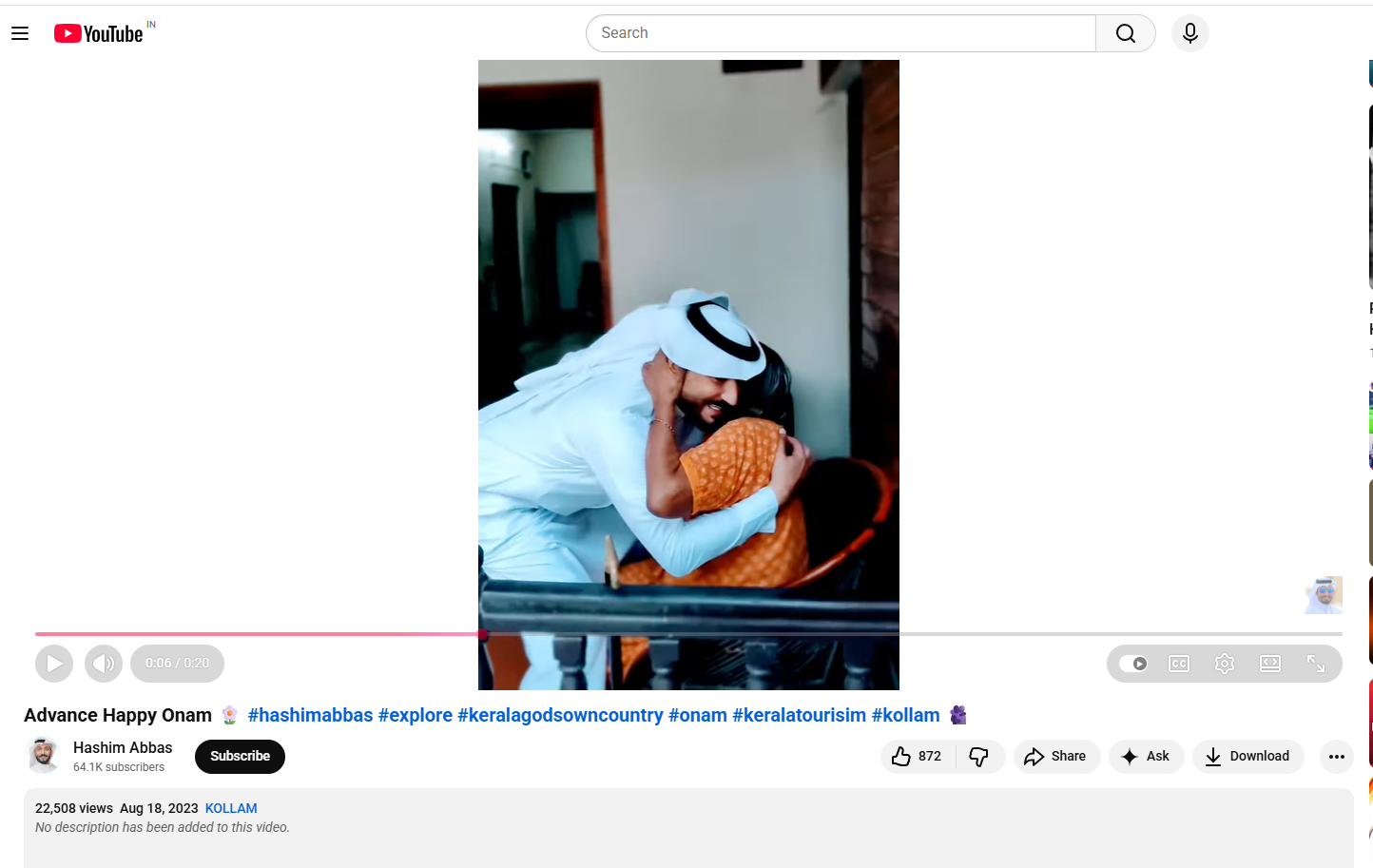
Further examination of Hashim Abbas’ social media accounts revealed several other videos from his Kerala visit. Our research also found that Abbas played a significant role in the Malayalam film Kondotty Pooram.

Additionally, we found a video posted on August 13, 2023, by actress and theatre artist Sandhya Rajendran, daughter of veteran Malayalam actress Vijayakumari. The video shows Vijayakumari teaching Onam songs to Hashim Abbas.

Conclusion
The evidence clearly establishes that the viral claim is misleading. The man seen in the image is Hashim Abbas, who was meeting senior Malayalam actress Vijayakumari to extend Onam greetings. The emotional story about a son flying from Saudi Arabia to reunite with his Hindu mother is fictional and not connected to the viral image.

Related Blogs
.webp)
Introduction
We were all stunned and taken aback when multiple photos of streets in the U.S. surfaced with heavily drugged individuals loosely sitting on the streets, victims of a systematically led drug operation that has recently become a target of the Trump-led “tariff” war, which he terms as a war on drug cartels. The drug is a synthetic opioid, fentanyl, which is highly powerful and addictive. The menace of this drug is found in a country that has Wall Street and the largest and most powerful economy globally. The serious implications of drug abuse are not about a certain economy; instead, it has huge costs to society in general. The estimated cost of substance misuse to society is more than $820 billion each year and is expected to continue rising.
On June 26, the International Day against Drug Abuse and Illicit Trafficking is observed globally. However, this war is waged daily for millions of people, not on streets or borders, but in bloodstreams, behind locked doors, and inside broken homes. Drug abuse is no longer a health crisis; it is a developmental crisis. The United Nations Office on Drugs and Crime has launched a campaign against this organised crime that says, “Break the Cycle’ attributing to the fact that de-addiction is hard for individuals.
The Evolving Drug Crisis: From Alleyways to Algorithms
The menace of Drug abuse and illicit trafficking has also taken strides in advancement, and what was once considered a street-side vice has made its way online in a faceless, encrypted, and algorithmically optimised sense. The online drug cartels operate in the shadows and often hide in plain sight, taking advantage of the privacy designed to benefit individuals. With the help of darknet markets, cryptocurrency, and anonymised logistics, the drug trade has transformed into a transnational, tech-enabled industry on a global scale. In an operation led by the U.S. Department of Justice’s Joint Criminal Opiod and Darknet Enforcement (JCODE) and related to Operation RapTor, an LA apartment was only to find an organised business centre that operated as a hub of one of the most prolific methamphetamine and cocaine distributors in the market. Aaron Pinder, Unit Chief of the FBI Hi-Tech Organised Crime Unit, said in his interview, “The darknet vendors that we investigate, they truly operate on a global scale.” On January 11, 2025, during the Regional Conference on “Drug Trafficking and National Security,” it was acknowledged how cryptocurrency, the dark web, online marketplaces, and drones have made drug trafficking a faceless crime. Reportedly, there has been a seven-fold increase in the drugs seized from 2004-14 to 2014-24.
India’s Response: Bridging Borders, Policing Bytes
India has been historically vulnerable due to its geostrategic placement between the Golden Crescent (Afghanistan-Iran-Pakistan) and Golden Triangle (Myanmar-Laos-Thailand), and confronts a fresh danger from “click-to-consume’ narcotics. Although India has always adopted a highly sensitised approach, it holds an optimistic future outlook for the youth. Last year, to commemorate the occasion of International Day against Drug Abuse and Illicit Trafficking, the Department of Social Justice & Empowerment organised a programme to engage individuals for the cause. The Indian authorities are often seen coming down heavily on the drug peddlers and cartels, and to aid the cause, the Home Minister Amit Shah inaugurated the new office complex of the NCB’s Bhopal zonal unit and extension of the MANAS-2 helpline to all 36 states and UTs. The primary objectives of this step are to evaluate the effectiveness of the Narcotics Coordination Mechanism (NCORD), assess the progress of states in fighting drug trafficking, and share real-time information from the National Narcotics Helpline ‘MANAS’ portal with the Anti-Narcotics Task Force (ANTF) of states and UTs.
The United Nation’s War on Narcotics: From Treaties to Technology
The United Nations Office on Drugs and Crime (UNODC) is leading the international response. It offers vital data, early warning systems, and technical support to the states fighting the drug problem. The UNODC incorporates cooperation in cross-border intelligence, overseeing the darknet activities, encouraging the treatment and harm reduction, and using anti-money laundering mechanisms to stop financial flows. India has always pledged its support to the UN led activities, and as per reports dated 26th March, 2025, India chaired the prestigious UN-backed Commission on Narcotic Drugs (CND) meeting held in vienna, wherein India highlighted the importance of opioids for medical purposes as well as the nation’s notable advancements in the field.
Resolution on June 26: From Commemoration to Commitment
Let June 26 be more than a date on the calendar- let it echo as a call to action, a day when awareness transforms into action, and resolve becomes resistance. On this day, CyberPeace resolves the following:
- To treat addicts as victims rather than criminals and to pitch for reforms to provide access to reasonably priced, stigma-free rehabilitation.
- To integrate anti-drug awareness into digital literacy initiatives and school curricula in order to teach frequently and early.
- To demand responsibility and accountability from online marketplaces and delivery services that unwittingly aid traffickers
- To tackle the demand side through employment, mental health services, and social protection, particularly for at-risk youth.
References
- https://www.gatewayfoundation.org/blog/cost-of-drug-addiction/#:~:text=The%20estimated%20cost%20for%20substance,Alcohol%3A%20%24249%20billion
- https://www.unodc.org/unodc/en/drugs/index-new.html
- https://www.fbi.gov/news/stories/global-operation-targets-darknet-drug-trafficking
- https://www.thehindu.com/news/national/dark-web-crypto-drones-emerge-as-challenges-in-fight-against-drug-trafficking-amit-shah/article69088383.ece
- https://www.pib.gov.in/PressReleaseIframePage.aspx?PRID=2028704
- https://www.newindianexpress.com/nation/2025/Mar/26/in-a-first-india-chairs-un-forum-on-narcotics-pledges-to-improve-access-to-pain-relief-and-palliative-care

Introduction
The insurance industry is a target for cybercriminals due to the sensitive nature of the information it holds. This makes it essential for insurance companies to have robust cybersecurity measures to protect their data and customers’ personal information.
Cyber fraud in India’s insurance industry is increasing. It is reported that the Indian insurance sector has witnessed a surge in cyber-attacks, with several instances of data breaches, identity thefts, and financial fraud being reported. These cybercrimes not only pose a significant threat to the financial stability of the insurance industry but also to the privacy and security of policyholders.
Cyber Frauds in the Insurance Industry
The insurance industry in India has been the target of increasing cyber fraud in recent years. With the growing digital transformation trend, insurance companies have become increasingly vulnerable to cyber-attacks. Cyber frauds in the insurance industry are initiated by hackers who use various techniques such as phishing, malware, ransomware, and social engineering to gain unauthorised access to policyholders’ personal data and sensitive information
Kinds of cyber frauds in the insurance industry
It is essential for insurers and policyholders alike to be aware of these kinds of cyber-attacks on insurance companies in today’s digital age. Staying educated about these threats can help prevent them from happening in the future.
Identity theft– One common type of cyber fraud that occurs in the insurance industry is identity theft. In this type of fraud, criminals steal personal information such as name, address, date of birth and social security numbers through phishing emails or fraudulent websites. They then use this information to open fraudulent policies or access existing ones.
Payment fraud- Another type of cyber fraud that is on the rise is payment fraud. In this type of fraud, hackers intercept electronic payments made by policyholders or agents using fake bank accounts or compromised payment gateways. The money is then siphoned into untraceable accounts, making it difficult for law enforcement agencies to identify and arrest the perpetrators.
Phishing attacks- Where the fraudsters posed as company officials and sent emails to policyholders requesting their account details. The unsuspecting customers fell for this scam and shared their sensitive information, which was then used to access their accounts and steal funds.
Hacking- Where hackers breach the company’s system to gain access to policyholder data. The hackers’ stoles personal records, including names, addresses, phone numbers, social security numbers, and financial information, which they later sell on the dark web.
Fake policies scam- Fraudsters create fake policies using stolen identities and collect premiums from innocent customers. The insurer then voided these policies due to fraudulent activity leaving those people without valid coverage when they needed it most. The victims suffer significant financial losses due to this scam.
Fake Insurance Websites- Discuss the creation of deceptive websites that imitate well-known insurance companies, where unsuspecting individuals provide their personal details, leading to identity theft or financial losses.

Prevention of Cyber Frauds in the Insurance Industry- Best practices to follow
Prevention is better than cure, which also holds true in the case of cyber fraud in the insurance industry. The industry must take proactive steps to prevent such frauds from occurring in the first place. One of the most effective ways to do so is by investing in cybersecurity measures that are specifically designed for the insurance sector.
Insurance companies must conduct regular employee training programs on cybersecurity best practices. This includes educating employees on how to identify and avoid phishing emails, create strong passwords, and recognise potential cyber threats. Companies should also establish a reporting mechanism for employees to report suspicious activity or incidents immediately.
Having proper access controls in place is also necessary. This means limiting access to sensitive data only to those employees who need it, implementing two-factor authentication, and regularly monitoring user activity logs. Regular audits can also provide an extra layer of protection against potential threats by identifying vulnerabilities that may have been overlooked during routine security checks.
Another essential step is encrypting all data transmitted between different systems and devices. Encryption scrambles data into unreadable codes that can only be deciphered using a decryption key, making it difficult for hackers to intercept or steal information in transit.
Legal Framework for Cyber Frauds in the Insurance Industry
The legal framework for cyber fraud in the insurance industry is critical to preventing such crimes. The Insurance Regulatory and Development Authority of India (IRDAI) has issued guidelines for insurers to establish a cybersecurity framework. The guidelines require insurers to conduct regular risk assessments, implement security measures, and ensure compliance with data privacy laws.
The Information Technology Act 2000, is another significant piece of legislation dealing with cyber fraud in India. The act defines offences such as unauthorised access to a computer system, hacking, and tampering with data. It also provides for stringent penalties and imprisonment for those found guilty of such offences.
The IRDAI’s guidelines provide insurers with a roadmap to establish robust cybersecurity measures to help prevent cyber fraud in the insurance industry. Stringent implementation of these guidelines will go a long way in safeguarding sensitive customer information from falling into the wrong hands.
Best Practices for Insurers and Policyholders
Insurers:
Implementing Strong Authentication: Encouraging the use of multi-factor authentication and secure login processes to safeguard customer accounts and prevent unauthorised access.
Regular Employee Training: Conduct cybersecurity awareness programs to educate employees about the latest threats and preventive measures.
Investing in Advanced Technologies: Utilizing robust cybersecurity tools and systems to promptly detect and mitigate potential cyber threats.
Policyholders:
Vigilance and Awareness: Policyholders must stay vigilant while sharing personal information online and verify the authenticity of insurance websites and communication channels.
Regular Updates and Patches: Advising individuals to keep their devices and software up to date to minimise vulnerabilities that cybercriminals can exploit.
Secure Online Practices: Encouraging the use of strong and unique passwords, avoiding sharing sensitive information on unsecured networks, and exercising caution when clicking on suspicious links or attachments.

Conclusion
As the Indian insurance industry embraces digitisation, the risk of cyber scams and data breaches becomes a significant concern. Insurers and policyholders must collaborate to ensure robust cybersecurity measures are in place to protect sensitive information and financial interests.
It is essential for insurance companies to invest in robust cybersecurity measures that can detect and prevent fraud attempts. Additionally, educating employees on the dangers of cyber fraud and implementing strict compliance measures can go a long way in mitigating risks. With these efforts, the insurance industry can continue to provide trustworthy and reliable services to its customers while protecting against cyber threats. As technology continues to evolve, it is imperative that the insurance industry adapts accordingly and remains vigilant against emerging threats.

Executive Summary:
On 20th May, 2024, Iranian President Ebrahim Raisi and several others died in a helicopter crash that occurred northwest of Iran. The images circulated on social media claiming to show the crash site, are found to be false. CyberPeace Research Team’s investigation revealed that these images show the wreckage of a training plane crash in Iran's Mazandaran province in 2019 or 2020. Reverse image searches and confirmations from Tehran-based Rokna Press and Ten News verified that the viral images originated from an incident involving a police force's two-seater training plane, not the recent helicopter crash.
Claims:
The images circulating on social media claim to show the site of Iranian President Ebrahim Raisi's helicopter crash.


Fact Check:
After receiving the posts, we reverse-searched each of the images and found a link to the 2020 Air Crash incident, except for the blue plane that can be seen in the viral image. We found a website where they uploaded the viral plane crash images on April 22, 2020.

According to the website, a police training plane crashed in the forests of Mazandaran, Swan Motel. We also found the images on another Iran News media outlet named, ‘Ten News’.
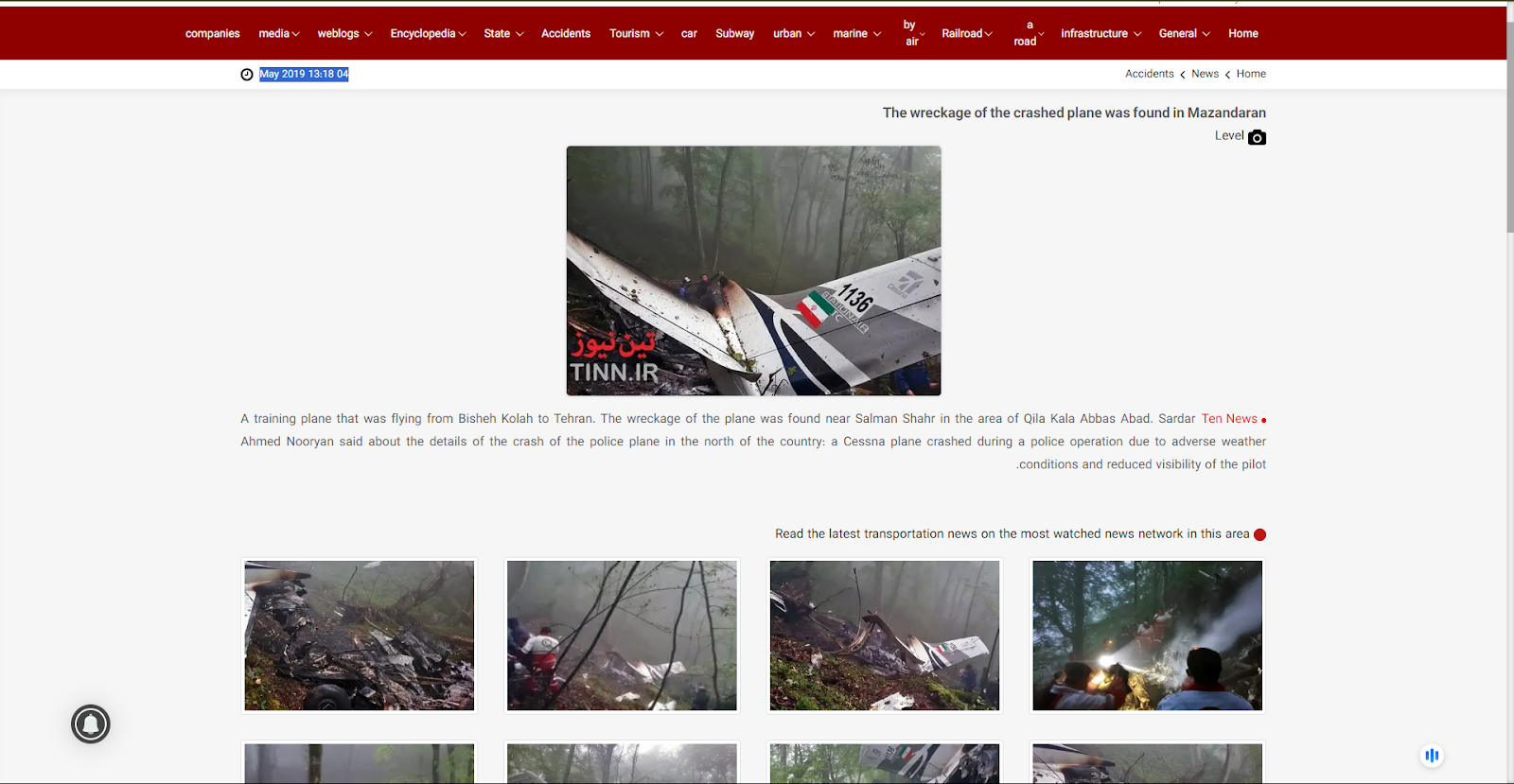
The Photos uploaded on to this website were posted in May 2019. The news reads, “A training plane that was flying from Bisheh Kolah to Tehran. The wreckage of the plane was found near Salman Shahr in the area of Qila Kala Abbas Abad.”
Hence, we concluded that the recent viral photos are not of Iranian President Ebrahim Raisi's Chopper Crash, It’s false and Misleading.
Conclusion:
The images being shared on social media as evidence of the helicopter crash involving Iranian President Ebrahim Raisi are incorrectly shown. They actually show the aftermath of a training plane crash that occurred in Mazandaran province in 2019 or 2020 which is uncertain. This has been confirmed through reverse image searches that traced the images back to their original publication by Rokna Press and Ten News. Consequently, the claim that these images are from the site of President Ebrahim Raisi's helicopter crash is false and Misleading.
- Claim: Viral images of Iranian President Raisi's fatal chopper crash.
- Claimed on: X (Formerly known as Twitter), YouTube, Instagram
- Fact Check: Fake & Misleading
